
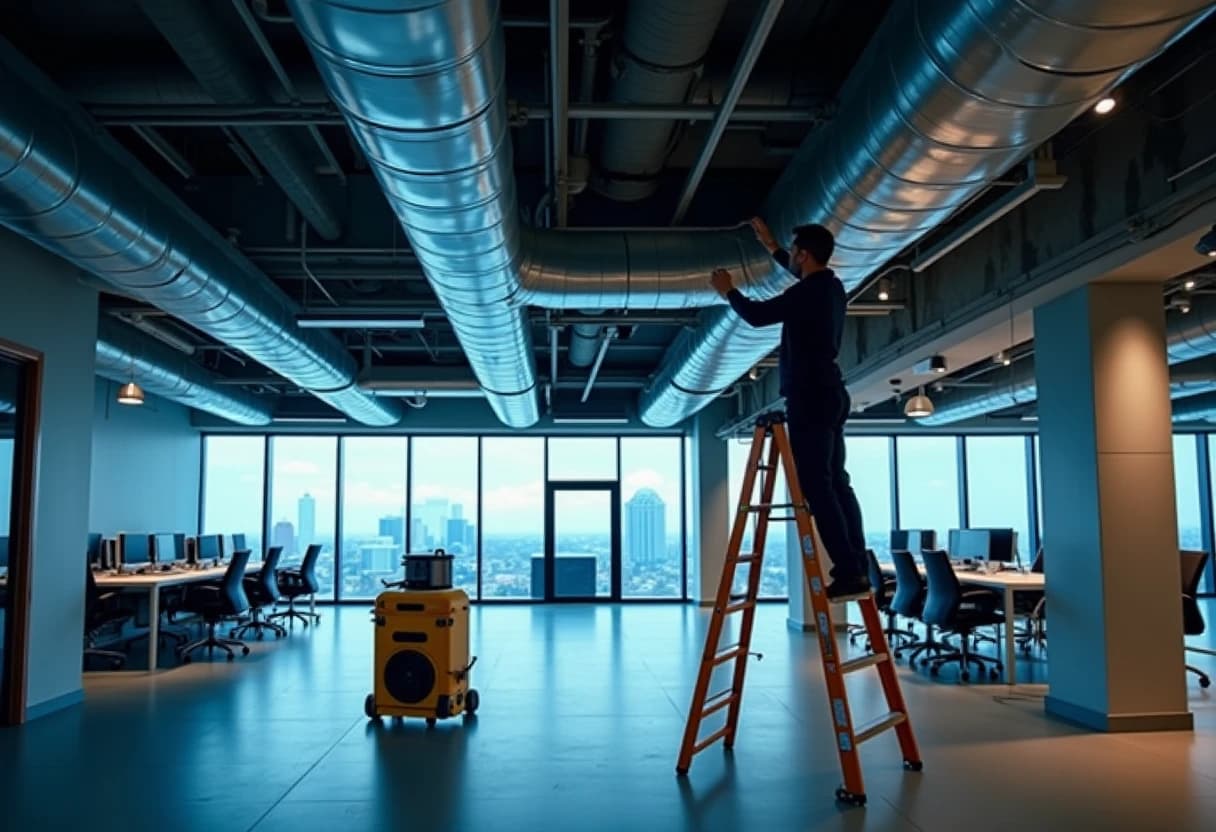
Facility managers in Back Bay call us when the low bid burned them once already — crews that wiped grilles, skipped the returns, blew dust across cubicles and left no paperwork. Commercial duct cleaning done correctly is a different product: the system is mapped zone by zone, sealed and placed under HEPA-filtered negative pressure, agitated mechanically along every trunk and branch, and verified with before-and-after imaging. We service offices, retail, restaurants, medical and dental practices, schools, daycares, houses of worship and fitness clubs across Greater Boston. Certificates of insurance, W-9s, background-checked technicians and after-hours access protocols are routine for us, and our reports are written so a board, an owner or an adjuster can see exactly what was cleaned and when.
Why Commercial Air Duct Cleaning Matters for Back Bay Homes
Weigh the cost of cleaning against the cost of not cleaning. A duct cleaning project for a typical commercial space runs a few thousand dollars once every three to five years. On the other side of the ledger: energy waste from fouled coils and choked airflow accruing monthly; premature rooftop unit failures measured in tens of thousands; productivity drag from poor air quality, which peer-reviewed workplace studies tie to slower cognitive performance and higher sick-day rates; tenant turnover costs when IAQ complaints go unresolved through a lease cycle; and the exposure of facing an air-quality claim with no documented maintenance history. Insurers and counsel increasingly treat HVAC hygiene records the way they treat sprinkler inspection records — the absence is the problem. Our commercial service is built to close that gap efficiently: assessment and flat quote from a site walk or mechanical drawings, after-hours execution that costs you zero operating hours, and a completion report with photographic evidence that drops straight into your maintenance file. Few line items in a facilities budget buy this much risk reduction per dollar.
Commercial spaces in Back Bay are exactly where duct contamination hides in plain sight. Back Bay is a nearly unbroken grid of Victorian brownstones built on filled land between the 1860s and 1890s, most long since divided into condos, alongside luxury towers near the Prudential and Copley Place. Original coal-and-radiator buildings have been retrofitted over and over - high-velocity mini-duct systems, ceiling-cassette air handlers, and full forced-air conversions threaded through plaster walls and marble-trimmed stairwells. Those retrofit runs are narrow, joint-heavy and notoriously dusty. Many of the area's storefronts, offices and mixed-use buildings run on HVAC systems that have served a parade of tenants, each fit-out leaving its construction dust in the trunk lines and ceiling plenums. The high-velocity small-duct systems common in Back Bay brownstones clog faster than conventional ductwork because the two-inch flexible tubing has so little tolerance for buildup. Add in landmark-district window restrictions that limit natural ventilation and dryer vents that exit through rear alley walls after long horizontal runs, and Back Bay units benefit from cleaning more often than almost anywhere we serve. Our commercial crews work Back Bay regularly and arrive equipped for its building stock — roof access gear for rooftop units, negative-air machines sized for long trunk runs, and containment that protects finished retail and office space. Certificates of insurance naming your property go out before the crew does, and overnight scheduling means your customers never see a hose.
Our Commercial Air Duct Cleaning Process in Back Bay
1Site Walk, System Mapping & Flat Quote
Commercial projects start with a site walk or a review of your mechanical drawings. We identify every air handler and rooftop unit, trace the zones they serve, count diffusers and returns, note access constraints — ceiling heights, tenant hours, roof access — and inspect representative duct sections with a camera. You receive a flat, written quote with a proposed schedule before anything is booked.
2Certificates of Insurance & Scheduling Around Your Operations
We plan commercial projects like contractors, not like a residential crew squeezing in a big job. That means pre-mobilization insurance certificates, coordination with your facilities or property management team, protection plans for finished spaces and merchandise, and crews scheduled for the windows when your building is emptiest — nights, weekends and holidays included at no scheduling premium for standard projects.
3Containment & Protection of Finished Spaces
Retail merchandise, exam rooms, server closets, commercial kitchens — commercial spaces contain things that must not get dusty, and our protection plan is written into every project scope. Sensitive areas are draped or excluded and sequenced appropriately, negative pressure ensures loosened debris travels into HEPA collection rather than the space, and each night's work area is inspected and restored before the crew leaves.
4Negative Pressure on Each Zone
Zone by zone, the duct network becomes a controlled vacuum circuit. Our negative-air machines pull thousands of cubic feet per minute through HEPA filtration, maintaining continuous negative pressure for the entire agitation phase. On multi-unit buildings we isolate and clean one system at a time, which keeps containment tight and lets partially occupied buildings continue operating around the work.
5Mechanical Agitation of Trunks, Branches & Terminal Units
Commercial duct construction varies — rigid rectangular mains, spiral rounds, duct board, flex runs to diffusers — and each takes the right tool: rotary brushes for metal, gentler whip systems for duct board and flex, hand tools inside boxes and plenums. We work from the terminal ends toward the collection points so debris always moves toward the vacuum, then clean the mains themselves last.
6Air Handler, Rooftop Unit & Coil Cleaning
The units themselves get hands-on attention: blower assemblies and housings cleaned, unit cabinets HEPA-vacuumed and wiped, condensate pans cleared and treated, fresh filters installed. Evaporator coil cleaning — the single highest-return item on most commercial systems — is available on every project, and on rooftop units we handle roof access, weather constraints and panel restoration as part of the scope.
7Verification, Restoration & Completion Report
The last step is a walkthrough with your facilities contact or property manager: systems running, airflow verified at representative diffusers, documentation reviewed page by page. Everything we observed inside your system goes in writing, including items outside our scope that deserve your HVAC contractor's attention. We then log your property for the maintenance interval you choose, so recurring cleanings arrive as calendar items, not emergencies.
Benefits of Professional Commercial Air Duct Cleaning in Back Bay
Lower Energy Costs Across Long Operating Hours
Commercial HVAC runs ten to fourteen hours a day, so every efficiency point lost to fouled coils, dirty blower wheels and debris-narrowed ducts compounds across thousands of operating hours a year. Cleaning restores design airflow and heat transfer, and buildings with long-neglected systems frequently see the project pay for itself at the utility meter within a couple of seasons.
Documentation for Insurance, Leases & Compliance
For medical, dental, childcare and food-service tenants, documented HVAC hygiene is part of operating credibly — inspectors notice dusty diffusers, and patients and parents notice them sooner. Our reports give these businesses a dated, photographic answer, and give their landlords a template for building-wide maintenance that keeps every tenancy covered.
Extended Rooftop Unit & Equipment Life
Deferred air-side maintenance shows up later as compressor failures, burned motors and heat-exchanger problems — repairs that dwarf the cost of cleaning. Facilities teams that fold duct and coil cleaning into their preventive maintenance calendar consistently see fewer emergency calls and longer equipment lifecycles, which is exactly the argument that wins budget approval.
Zero Disruption to Business Operations
Overnight, weekend and phased scheduling are the default for our commercial work, not a premium add-on. Retail spaces are cleaned between close and open; offices over weekends; multi-tenant buildings floor by floor with each area restored before occupants return. The only evidence of the project your customers ever see is cleaner air.
Fewer IAQ Complaints, Happier Tenants & Staff
Stale-air tickets, dust complaints and mystery odors trace back to the duct network more often than any other building system. Cleaning it removes the source rather than treating symptoms, which is why properties see complaint volume drop sharply after service — and why the photo report is such an effective tool in tenant communications and renewal conversations.
One Vendor for Whole Portfolios
We already carry the vendor infrastructure portfolio work requires — insurance certificates issued per property, W-9 and compliance paperwork on file, background-checked uniformed technicians, and reporting formatted for owner distribution. Several Suffolk County management companies route all their duct, dryer vent and exhaust cleaning through us for precisely this reason.
Signs Your Back Bay Home Needs Commercial Air Duct Cleaning
Water Intrusion, Mold Findings or Pest Evidence
Droppings, nesting material or insect debris in ceiling plenums and duct runs contaminate the airstream serving every occupant downstream. Pest remediation that stops at traps and exclusion leaves the duct-borne residue circulating. Include the ductwork in the cleanup scope and document it — it is the part occupants are actually breathing.
Odors That Return Every Operating Day
'Dirty sock' odors at system startup indicate microbial activity on coils or in ducts — most common after humid summers in systems with marginal condensate drainage. It deserves prompt attention: the same conditions producing odor can progress to visible growth, which escalates the fix from cleaning to remediation.
Rising Energy Bills or Weak Airflow in Certain Zones
Suites that never cool, conference rooms that never warm, and utility bills creeping up without rate changes all point to airflow loss — and dust is its quietest cause. Debris-narrowed branches, clogged VAV inlets and fouled coils steal delivered air zone by zone. Cleaning restores the balance the system was commissioned with.
No Service History Anyone Can Find
Building acquisitions inherit ductwork as-is: every previous tenant's dust, every fit-out's debris, every deferred year. A duct inspection belongs on the due-diligence checklist alongside the roof and the boilers — it is among the cheapest items on the list and regularly surfaces disconnections and damage that affect the negotiation.
Tenant or Employee Air Quality Complaints
Recurring complaints about stuffy air, odors, headaches or allergy symptoms that filter changes never resolve point upstream — into the duct network that filters never touch. When multiple occupants in zones served by the same unit report symptoms, the distribution system is the common denominator and the first place a camera should look.
Recent Fit-Out, Renovation or Construction
Tenant fit-outs fill duct systems with drywall, concrete and wood dust — the system inhales the job site through every open takeoff and unsealed return, and ceiling plenums collect the rest. Occupying the space without a post-construction duct cleaning means months of construction particulate delivered to desks, merchandise and lungs.
Commercial Air Duct Cleaning Cost in Back Bay, MA
Beware the two failure modes of commercial duct-cleaning pricing. The first is the residential coupon crew quoting a commercial building at house prices: they arrive with one portable vacuum, wipe the diffusers, skip the returns, boxes and units entirely, and leave no documentation — money spent for nothing but a false sense of maintenance. The second is the restoration-industry bid at two to three times market, justified by equipment lists rather than scope. The defensible middle for Eastern Massachusetts commercial work runs roughly $0.15–$0.50 per square foot or $500–$5,000 per typical project, executed by an insured crew with commercial negative-air equipment, and concluded with photographic before-and-after documentation. Get the scope in writing — every system, every zone, terminal units included, report included — and any bid becomes comparable. Ours arrives that way by default, usually within two business days of the site walk.
Want the full pricing picture? See our complete Boston-area cost guide or call (617) 390-7145 for an exact flat quote for your Back Bay home.
Local Knowledge: Back Bay, Suffolk County
Every town's ductwork tells the story of its housing. Back Bay is a nearly unbroken grid of Victorian brownstones built on filled land between the 1860s and 1890s, most long since divided into condos, alongside luxury towers near the Prudential and Copley Place. Original coal-and-radiator buildings have been retrofitted over and over - high-velocity mini-duct systems, ceiling-cassette air handlers, and full forced-air conversions threaded through plaster walls and marble-trimmed stairwells. Those retrofit runs are narrow, joint-heavy and notoriously dusty. The high-velocity small-duct systems common in Back Bay brownstones clog faster than conventional ductwork because the two-inch flexible tubing has so little tolerance for buildup. Add in landmark-district window restrictions that limit natural ventilation and dryer vents that exit through rear alley walls after long horizontal runs, and Back Bay units benefit from cleaning more often than almost anywhere we serve. We plan Back Bay jobs around those realities, from equipment selection to time on site, and it shows in the results. If you live near Prudential Center or anywhere across Back Bay's 02116 area, we have almost certainly cleaned a system like yours before — and we can tell you exactly what to expect before we arrive.
The Best Time of Year in Back Bay
Summer humidity is the biological threat to commercial systems. Cooling coils and condensate pans run wet for months, ceiling plenums in older buildings track outdoor humidity, and the organic dust film inside ducts absorbs moisture and becomes a growth medium — which is why musty-odor and 'dirty sock' complaints spike in August across Suffolk County. Buildings with marginal condensate drainage or oversized equipment that short-cycles are most vulnerable. A pre-summer cleaning removes the organic substrate growth needs; a post-summer inspection catches whatever a wet season started before winter runtime distributes it. Restaurants and gyms — high-moisture, high-odor operations — benefit from the tightest intervals of any building type we serve.
Why Choose Boston Air Duct Cleaners
Homeowners across Suffolk County choose Boston Air Duct Cleaners for three reasons. First, honesty: our inspection camera tells you whether your system actually needs cleaning — and sometimes the answer is no. Second, capability: truck-grade negative-air machines, rotary brush systems and HEPA filtration handle everything from antique gravity-furnace conversions to brand-new high-velocity systems. Third, accountability: flat quoted pricing, before-and-after photos, insured technicians, and a real local office you can call at (617) 390-7145. That combination is rarer in this industry than it should be.
Serving Back Bay and Surrounding Communities
We serve every community around Back Bay as well: Beacon Hill, South End, Boston, Brookline, Seaport District, Allston all fall inside our regular service routes. If you have a second property, a rental, or family nearby, ask about multi-home scheduling — grouped appointments on the same route are our most requested discount.