
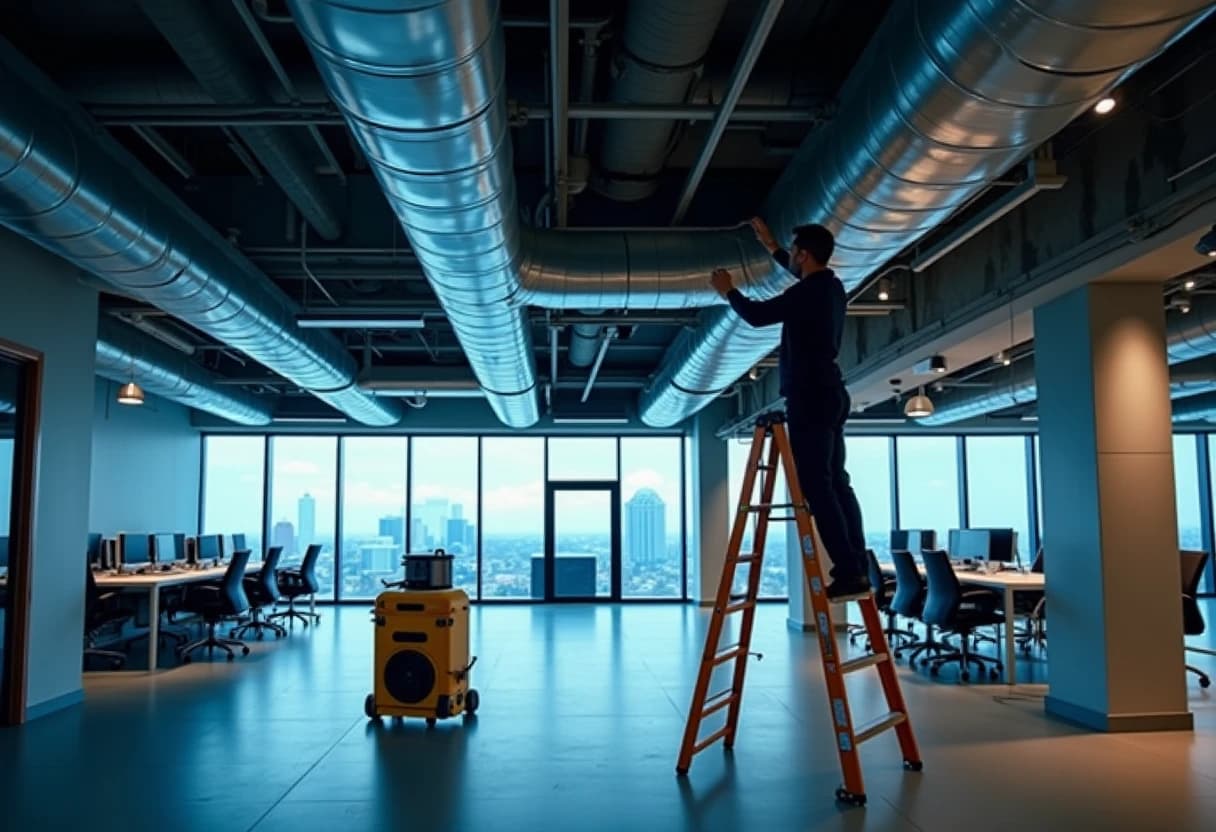
Commercial HVAC systems move enormous volumes of air through long trunk lines, VAV boxes, rooftop units and hundreds of diffusers — and every square foot of that ductwork collects dust, fibers, and whatever the building's occupants generate. Our commercial air duct cleaning crews serve Greater Boston offices, retail spaces, restaurants, medical suites, schools and fitness facilities with the same NADCA-standard source-removal method we use everywhere: the system goes under negative pressure with HEPA-filtered collection equipment, every run is mechanically agitated, and the work is documented in a written report your insurer, landlord or facilities director can file. We schedule nights and weekends so your business never loses an operating hour, and we carry the certificates of insurance commercial properties require before we ever set foot on site.
When employees complain about stuffy air, tenants file IAQ tickets, or customers notice dust streaming from ceiling diffusers, the ductwork is usually the culprit — and in commercial buildings it is measured in thousands of square feet of hidden sheet metal. Boston Air Duct Cleaners provides full source-removal duct cleaning for commercial properties in Greater Boston: supply and return trunks, branch runs, VAV and fan-powered boxes, rooftop unit interiors, and the diffusers and grilles your occupants actually see. Our crews are experienced with roof access, ceiling plenum returns, and the long horizontal trunk runs typical of office and retail construction. Every project includes pre- and post-cleaning photo documentation, after-hours or phased scheduling, and a certificate of insurance issued to your property before work begins.
Why Commercial Air Duct Cleaning Matters
Commercial ductwork works harder than residential ductwork and gets dirtier faster. A typical office system runs ten to twelve hours a day, moving air for dozens of occupants who each shed skin cells, clothing fibers and tracked-in street dust; retail and restaurant systems add door-traffic grit, paper dust and cooking aerosols on top. Ceiling plenum returns — standard in commercial construction — inhale everything above the ceiling tiles: fireproofing fibers, construction debris left from every past fit-out, and decades of settled dust. All of it recirculates through the space every operating hour. The consequences show up three ways. Occupants complain: headaches, irritated eyes, allergy flare-ups and the persistent 'stale office' smell that no janitorial contract fixes. Equipment suffers: fouled coils, blower wheels and filters drive up energy consumption and shorten the life of rooftop units that cost five figures to replace. And liability accumulates: documented IAQ maintenance is increasingly what insurers, tenants' counsel and health inspectors ask to see. A professional source-removal cleaning addresses all three at once, and the written report is often as valuable as the cleaning itself.
Certain commercial situations make duct cleaning non-negotiable. After tenant fit-outs and renovations, drywall and concrete dust saturates the duct network and ceiling plenum; occupying the space without cleaning means months of construction particulate raining onto desks and merchandise. After fire or smoke events — even minor ones — soot embeds in duct dust and re-releases odor indefinitely, and remediation scopes routinely require documented duct cleaning. After water intrusion, roof leaks or humidification failures, damp duct interiors become microbial growth sites within days, and the EPA's guidance is explicit that visibly contaminated ducts serving occupied spaces should be professionally cleaned. Ownership transitions matter too: buyers inherit the previous owner's deferred maintenance, and a pre-purchase duct inspection is one of the cheapest due-diligence items available. Finally, some tenants simply require it — medical uses, labs, food production and childcare leases often carry IAQ maintenance clauses. In each case, the combination of proper source-removal cleaning and a formal completion report satisfies the requirement and closes the file.
How Our Commercial Air Duct Cleaning Process Works
1Site Walk, System Mapping & Flat Quote
Commercial projects start with a site walk or a review of your mechanical drawings. We identify every air handler and rooftop unit, trace the zones they serve, count diffusers and returns, note access constraints — ceiling heights, tenant hours, roof access — and inspect representative duct sections with a camera. You receive a flat, written quote with a proposed schedule before anything is booked.
2Certificates of Insurance & Scheduling Around Your Operations
Before work begins, your property receives our certificate of insurance with the endorsements commercial buildings require, plus W-9 and vendor paperwork for property management onboarding. Then we build the schedule around you: overnight for retail and restaurants, weekends for offices, phased floor-by-floor for occupied multi-tenant buildings, school-vacation weeks for education clients. Your business hours are never the cost of clean ducts.
3Containment & Protection of Finished Spaces
Occupied commercial interiors demand real containment. We protect flooring along hose routes, cover or move furniture, desks and merchandise in work zones, and seal diffusers and grilles zone by zone so the system becomes a closed vacuum circuit. Ceiling tile removal and replacement is handled carefully and systematically — the space looks untouched when your staff arrives in the morning.
4Negative Pressure on Each Zone
We connect HEPA-filtered negative-air machines to the trunk lines of each zone through sealed access ports, placing the ductwork under continuous vacuum. Commercial systems demand serious equipment — long trunk runs and high static pressures swallow underpowered vacuums — so we size machines to the system, sometimes running multiple units on large floors. Debris loosened downstream travels one direction: into collection.
5Mechanical Agitation of Trunks, Branches & Terminal Units
With each zone under vacuum, technicians agitate every run: rotary brushes sized to duct dimensions scrub mains and branches, compressed-air whips chase debris from diffuser takeoffs back toward collection, and directional skipper nozzles sweep long horizontal trunks. VAV and fan-powered boxes are opened and hand-cleaned — they are debris traps that blown-air-only crews skip entirely.
6Air Handler, Rooftop Unit & Coil Cleaning
The units themselves get hands-on attention: blower assemblies and housings cleaned, unit cabinets HEPA-vacuumed and wiped, condensate pans cleared and treated, fresh filters installed. Evaporator coil cleaning — the single highest-return item on most commercial systems — is available on every project, and on rooftop units we handle roof access, weather constraints and panel restoration as part of the scope.
7Verification, Restoration & Completion Report
Projects close with proof. We re-image the duct sections photographed at the start, reinstall grilles and diffusers, replace ceiling tiles, restore thermostat settings and filters, and run each system to verify airflow. Your completion report includes before-and-after photos, a zone-by-zone scope checklist, observations on duct condition and recommended repairs, and the service date — formatted for owners, boards and insurance files.
Benefits You Can Expect
Fewer IAQ Complaints, Happier Tenants & Staff
Stale-air tickets, dust complaints and mystery odors trace back to the duct network more often than any other building system. Cleaning it removes the source rather than treating symptoms, which is why properties see complaint volume drop sharply after service — and why the photo report is such an effective tool in tenant communications and renewal conversations.
Lower Energy Costs Across Long Operating Hours
Commercial HVAC runs ten to fourteen hours a day, so every efficiency point lost to fouled coils, dirty blower wheels and debris-narrowed ducts compounds across thousands of operating hours a year. Cleaning restores design airflow and heat transfer, and buildings with long-neglected systems frequently see the project pay for itself at the utility meter within a couple of seasons.
Extended Rooftop Unit & Equipment Life
Replacing a commercial rooftop unit in Massachusetts runs well into five figures with crane time, curb adapters and controls. Dust is the primary aging accelerant — insulating coils, overheating motors, unbalancing blowers. Keeping the air path clean lets equipment run at design conditions, deferring the largest capital expenses on a building's mechanical schedule.
Documentation for Insurance, Leases & Compliance
Every project produces a completion report with photographic evidence, scope checklist and service date — the paper trail insurers, medical tenants, franchise inspectors and boards increasingly expect. When an air-quality question arises later, a documented maintenance history is the difference between a closed inquiry and an exposure. We format reports for exactly that use.
Zero Disruption to Business Operations
Overnight, weekend and phased scheduling are the default for our commercial work, not a premium add-on. Retail spaces are cleaned between close and open; offices over weekends; multi-tenant buildings floor by floor with each area restored before occupants return. The only evidence of the project your customers ever see is cleaner air.
A Visibly Cleaner, Fresher-Smelling Space
Dust-streaked diffusers and gray-ringed ceiling tiles quietly undermine every impression your space makes — customers, patients and job candidates all register them. Cleaning the system and its visible terminals removes both the staining source and the stains, and the persistent stale-building odor that clings to occupied commercial space typically leaves with the duct dust that harbored it.
One Vendor for Whole Portfolios
Property managers running multiple buildings get one point of contact, consistent pricing logic across properties, standardized reporting, and a maintenance calendar that schedules each site on its own interval. Adding a property to the program takes one site walk. It is the difference between managing a vendor and managing a program.
Warning Signs to Watch For
Tenant or Employee Air Quality Complaints
Recurring complaints about stuffy air, odors, headaches or allergy symptoms that filter changes never resolve point upstream — into the duct network that filters never touch. When multiple occupants in zones served by the same unit report symptoms, the distribution system is the common denominator and the first place a camera should look.
Dust Streaking on Diffusers, Grilles & Ceiling Tiles
Gray streaks fanning out from supply diffusers and dark rings on surrounding ceiling tiles are the system's contamination made visible: dust-laden supply air depositing its cargo at the exit. Wiping the diffusers treats the symptom for a week; the trunk and branch surfaces upstream hold the resupply until they are mechanically cleaned.
Rising Energy Bills or Weak Airflow in Certain Zones
Suites that never cool, conference rooms that never warm, and utility bills creeping up without rate changes all point to airflow loss — and dust is its quietest cause. Debris-narrowed branches, clogged VAV inlets and fouled coils steal delivered air zone by zone. Cleaning restores the balance the system was commissioned with.
Recent Fit-Out, Renovation or Construction
Tenant fit-outs fill duct systems with drywall, concrete and wood dust — the system inhales the job site through every open takeoff and unsealed return, and ceiling plenums collect the rest. Occupying the space without a post-construction duct cleaning means months of construction particulate delivered to desks, merchandise and lungs.
Odors That Return Every Operating Day
A building that smells stale at opening, musty after humid stretches, or faintly of last year's kitchen operations is broadcasting from its ductwork. Odor molecules bind to the organic dust film inside ducts and re-release with every operating hour. No cleaning contract or air freshener reaches the source; source removal takes it out of the building.
Water Intrusion, Mold Findings or Pest Evidence
Roof leaks, burst pipes and humidification failures routinely wet commercial ductwork, and damp duct dust becomes a microbial growth site within about 48 hours. Any water event near air-handling equipment warrants a duct inspection now — EPA guidance is explicit that visibly contaminated ducts serving occupied space should be professionally cleaned.
No Service History Anyone Can Find
If neither the maintenance file nor the longest-tenured employee can name when the ducts were last cleaned, they almost certainly never have been. Commercial systems accumulate contamination continuously across every tenancy; a camera inspection settles the question in an hour and costs little, and we quote cleaning only when the imaging justifies it.
Commercial Air Duct Cleaning Cost in the Boston Area
Commercial air duct cleaning in Greater Boston is typically priced per project, with most jobs landing between $500 and $5,000 and large or multi-unit properties above that. The most useful rule of thumb is $0.15 to $0.50 per square foot of conditioned space: a straightforward 3,000-square-foot office suite might run $600–$1,200, while a 15,000-square-foot building with several rooftop units, plenum returns and after-hours access requirements lands toward the higher rate. The honest price drivers are system count and complexity (each air handler or RTU is effectively its own project), duct construction and length, contamination level, ceiling heights and access, and scheduling constraints. We quote flat from a site walk or mechanical drawings, in writing, before anything is booked — and the quoted number is the invoice number.
Budget-minded facilities teams should weigh interval against invoice. A commercial system cleaned to NADCA standards stays serviceably clean for three to five years in typical use, so a $3,000 project annualizes to under a thousand dollars — less than most buildings lose annually to the energy penalty of fouled coils and choked airflow. Recurring-program clients do better still: properties on our maintenance calendar receive locked interval pricing, priority scheduling in the spring and fall rush, and inspection-first service where we camera-check the system and clean only when imaging justifies it. That inspect-first discipline matters; some intervals we recommend deferring a cleaning, and clients tell us that honesty is why entire portfolios end up on our schedule. Multi-property managers should ask about portfolio pricing — consolidated scheduling across sites reduces our mobilization costs, and we pass the difference through.
Seasonal Considerations in New England
Commercial buildings in Massachusetts live on a two-season HVAC cycle — heating from October into April, cooling through the humid summer — and both seasons punish dirty ductwork. Fall is the smartest window for commercial cleaning: systems get a clean start before near-continuous winter runtime, and the first heating cycles do not broadcast burnt-dust odor through the workplace. Late spring is the second-best slot, clearing winter accumulation before cooling season seals the building. For retail, the calendar adds its own logic — holiday-season floors should be cleaned by early November, not during it — and schools and daycares book vacation weeks months ahead. We hold overnight and weekend capacity year-round, but the fall commercial rush is real; property managers who schedule in September choose their dates rather than taking what remains.
Why Boston Air Duct Cleaners
As a West Newton-based company, we treat Greater Boston like the neighborhood it is — because for us, it is. Our reputation lives or dies on local referrals, so every job gets the full process: complete system cleaning under negative pressure, mechanical agitation of every run, blower compartment service, and a documented walkthrough before we leave. We are licensed and insured, our estimates are free and flat, and our schedule holds same-day slots for urgent calls. One visit and you will understand why neighbors keep our magnet on the fridge.