
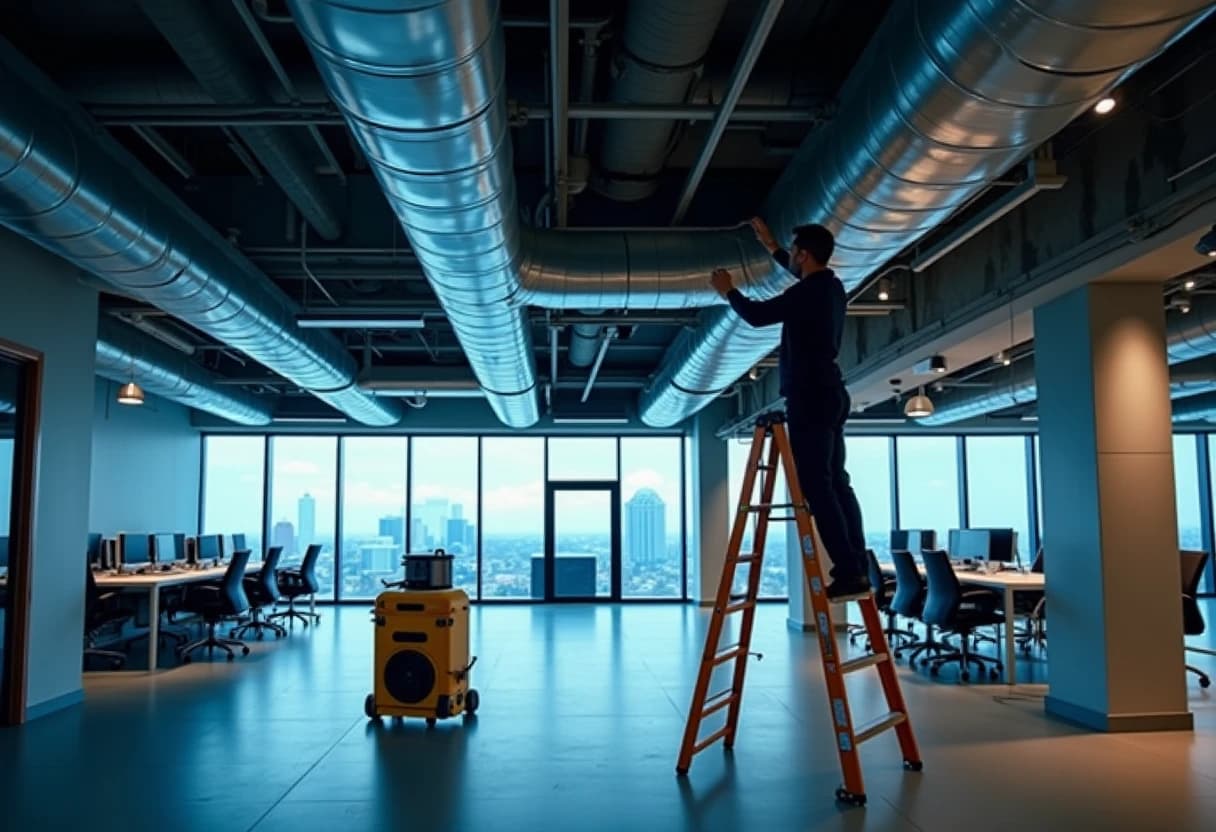
Facility managers in South Boston call us when the low bid burned them once already — crews that wiped grilles, skipped the returns, blew dust across cubicles and left no paperwork. Commercial duct cleaning done correctly is a different product: the system is mapped zone by zone, sealed and placed under HEPA-filtered negative pressure, agitated mechanically along every trunk and branch, and verified with before-and-after imaging. We service offices, retail, restaurants, medical and dental practices, schools, daycares, houses of worship and fitness clubs across Greater Boston. Certificates of insurance, W-9s, background-checked technicians and after-hours access protocols are routine for us, and our reports are written so a board, an owner or an adjuster can see exactly what was cleaned and when.
Why Commercial Air Duct Cleaning Matters for South Boston Homes
Commercial buildings in Greater Boston carry a particular burden: age. Much of the region's office, retail and mixed-use stock predates modern ventilation standards, and its duct systems have been extended, spliced and re-zoned through every tenancy since installation. Original trunk lines from the 1960s serve suites built out in the 1990s and re-divided in the 2010s; abandoned runs dead-end above ceilings collecting dust; flexible duct from a dozen different fit-outs sags between joists. These systems hold decades of accumulation that no filter has ever protected against, because most of it entered from the return side or during construction with the system exposed. Cleaning is also frequently the first time anyone has looked inside in years — our crews routinely discover disconnected branches dumping conditioned air into plenums, crushed flex starving whole suites, and pest evidence that explains long-standing odor complaints. The cleaning restores the system; the inspection that comes with it frequently saves the owner from paying to heat and cool the space above the ceiling tiles for another decade.
Ask any facilities manager responsible for property near East Broadway: tenant IAQ complaints are among the hardest tickets to close, because filter changes and thermostat checks never reach the real problem. South Boston's grid is filled with 19th-century brick rowhouses and wood-frame triple-deckers, a huge share of which have been gut-renovated into upscale condos over the past two decades, with new mid-rise buildings rising along West Broadway and the Dorchester Avenue corridor. Those gut rehabs almost always added central air and new ductwork, but tight rowhouse footprints force ducts through soffits and party-wall chases with plenty of bends. Roof decks and penthouse additions frequently put condensers and air handlers in salt-exposed locations. In buildings like these, the duct network itself carries decades of accumulation, and the complaints keep returning until it is cleaned. Southie juts into Boston Harbor, and homes near Castle Island and the beaches live with genuine coastal conditions - salt air that corrodes vent hoods and dampness that finds any duct run passing through an unconditioned space. The neighborhood's condo conversion boom also left a generation of systems installed fast during renovations, and we regularly pull construction debris from ducts in units sold as brand new. Our South Boston commercial projects follow NADCA source-removal standards — negative pressure, mechanical agitation, HEPA collection — and finish with photo documentation that lets you show tenants exactly what was done. We phase work by floor or suite so occupied buildings keep operating, and we hold COI, W-9 and access-protocol paperwork ready for property management onboarding.
Our Commercial Air Duct Cleaning Process in South Boston
1Site Walk, System Mapping & Flat Quote
Commercial projects start with a site walk or a review of your mechanical drawings. We identify every air handler and rooftop unit, trace the zones they serve, count diffusers and returns, note access constraints — ceiling heights, tenant hours, roof access — and inspect representative duct sections with a camera. You receive a flat, written quote with a proposed schedule before anything is booked.
2Certificates of Insurance & Scheduling Around Your Operations
Before work begins, your property receives our certificate of insurance with the endorsements commercial buildings require, plus W-9 and vendor paperwork for property management onboarding. Then we build the schedule around you: overnight for retail and restaurants, weekends for offices, phased floor-by-floor for occupied multi-tenant buildings, school-vacation weeks for education clients. Your business hours are never the cost of clean ducts.
3Containment & Protection of Finished Spaces
Retail merchandise, exam rooms, server closets, commercial kitchens — commercial spaces contain things that must not get dusty, and our protection plan is written into every project scope. Sensitive areas are draped or excluded and sequenced appropriately, negative pressure ensures loosened debris travels into HEPA collection rather than the space, and each night's work area is inspected and restored before the crew leaves.
4Negative Pressure on Each Zone
We connect HEPA-filtered negative-air machines to the trunk lines of each zone through sealed access ports, placing the ductwork under continuous vacuum. Commercial systems demand serious equipment — long trunk runs and high static pressures swallow underpowered vacuums — so we size machines to the system, sometimes running multiple units on large floors. Debris loosened downstream travels one direction: into collection.
5Mechanical Agitation of Trunks, Branches & Terminal Units
This is the labor the price reflects. Every supply branch from diffuser to trunk, every return path including plenum-connected grilles, and every accessible terminal unit gets individual mechanical agitation — not just a blast of air from one end. Stubborn accumulation gets repeat passes until inspection imaging shows clean metal. Access panels are installed where the system lacks them, per NADCA standards, and sealed properly afterward.
6Air Handler, Rooftop Unit & Coil Cleaning
A clean duct system fed by a dirty air handler recontaminates in months, so units are part of every complete scope. We open each RTU or interior handler and detail the components the airstream touches: blower wheel, housing interior, plenum sections and accessible panels. Coil condition is documented with photos; where fouling is significant we quote in-place coil cleaning honestly, using appropriate coil-safe methods.
7Verification, Restoration & Completion Report
The last step is a walkthrough with your facilities contact or property manager: systems running, airflow verified at representative diffusers, documentation reviewed page by page. Everything we observed inside your system goes in writing, including items outside our scope that deserve your HVAC contractor's attention. We then log your property for the maintenance interval you choose, so recurring cleanings arrive as calendar items, not emergencies.
Benefits of Professional Commercial Air Duct Cleaning in South Boston
Lower Energy Costs Across Long Operating Hours
Your mechanical systems were commissioned to move a specific volume of air. Years of accumulation quietly steal that capacity, and buildings compensate with longer runtimes and lower comfort. A full air-side cleaning — ducts, boxes, blowers and coils — is the cheapest capacity recovery available, restoring performance no thermostat adjustment can reach.
Documentation for Insurance, Leases & Compliance
Commercial leases, accreditation standards and insurance carriers are steadily adding IAQ maintenance language, and 'we changed the filters' does not satisfy it. A NADCA-standard cleaning with dated photo documentation does. Property managers file our reports the way they file fire-system inspections: proof of diligence, ready before anyone asks for it.
Zero Disruption to Business Operations
We coordinate with facilities teams, security desks and alarm companies as a matter of routine — after-hours access protocols, escort requirements and keyholder procedures are all handled in pre-project planning. Crews arrive on schedule, work the agreed window, and leave documentation of each shift, so managing the project costs you almost nothing in attention.
Extended Rooftop Unit & Equipment Life
Replacing a commercial rooftop unit in Massachusetts runs well into five figures with crane time, curb adapters and controls. Dust is the primary aging accelerant — insulating coils, overheating motors, unbalancing blowers. Keeping the air path clean lets equipment run at design conditions, deferring the largest capital expenses on a building's mechanical schedule.
One Vendor for Whole Portfolios
Recurring commercial clients get priority scheduling, locked maintenance-interval pricing and proactive reminders when each property comes due. For managers, that converts duct cleaning from a reactive scramble — usually triggered by a tenant complaint — into a quiet line item that renews itself, with documentation accumulating in each property's file automatically.
A Visibly Cleaner, Fresher-Smelling Space
Dust-streaked diffusers and gray-ringed ceiling tiles quietly undermine every impression your space makes — customers, patients and job candidates all register them. Cleaning the system and its visible terminals removes both the staining source and the stains, and the persistent stale-building odor that clings to occupied commercial space typically leaves with the duct dust that harbored it.
Signs Your South Boston Home Needs Commercial Air Duct Cleaning
Tenant or Employee Air Quality Complaints
IAQ tickets that keep reopening are expensive in management time and tenant goodwill. Before commissioning air-quality testing or consultant studies, look inside the ducts — in older commercial buildings, visible accumulation is the overwhelmingly common finding, and source-removal cleaning is the direct, documentable fix.
Odors That Return Every Operating Day
Gyms, restaurants and older offices each develop signature odors, and all three share the same mechanism: saturated duct dust re-emitting what the building's operations deposited. Post-cleaning, optionally finished with an EPA-registered deodorizing treatment, spaces smell neutral — which occupants register immediately even if they never identify why.
No Service History Anyone Can Find
Building acquisitions inherit ductwork as-is: every previous tenant's dust, every fit-out's debris, every deferred year. A duct inspection belongs on the due-diligence checklist alongside the roof and the boilers — it is among the cheapest items on the list and regularly surfaces disconnections and damage that affect the negotiation.
Water Intrusion, Mold Findings or Pest Evidence
Droppings, nesting material or insect debris in ceiling plenums and duct runs contaminate the airstream serving every occupant downstream. Pest remediation that stops at traps and exclusion leaves the duct-borne residue circulating. Include the ductwork in the cleanup scope and document it — it is the part occupants are actually breathing.
Rising Energy Bills or Weak Airflow in Certain Zones
Track runtime: systems compensating for fouled air paths cycle longer to reach setpoint, and long operating hours multiply the waste. If your building automation or utility data shows creeping consumption alongside comfort complaints, air-side fouling is the first hypothesis worth testing — and the cheapest one to fix.
Dust Streaking on Diffusers, Grilles & Ceiling Tiles
Janitorial crews wiping the same diffusers every month are documenting the problem, not fixing it. Persistent re-soiling of terminals means the duct interiors upstream are shedding continuously. After a proper source-removal cleaning, terminal surfaces stay clean for years instead of weeks — an easy before-and-after your maintenance log will show.
Commercial Air Duct Cleaning Cost in South Boston, MA
Three questions frame every commercial quote: How many air handling systems serve the space? What is the square footage and duct layout each one covers? And what condition is the system in? A single-RTU storefront sits near the $500–$900 floor. A two-story office building with four rooftop units, plenum returns and 12,000 square feet typically quotes $2,500–$4,500. Multi-tenant properties are usually priced per system so owners can phase work across budget years. What you should not pay for: per-vent teaser pricing that multiplies on site, 'mold remediation' sold from a flashlight photo without lab confirmation, or access and equipment surcharges invented after mobilization. Our commercial quotes include negative-air equipment, full trunk-and-branch cleaning, terminal unit cleaning, unit cabinet service, and the completion report — itemized so competing bids can be compared line by line.
Want the full pricing picture? See our complete Boston-area cost guide or call (617) 390-7145 for an exact flat quote for your South Boston home.
Local Knowledge: South Boston, Suffolk County
What makes South Boston different? South Boston's grid is filled with 19th-century brick rowhouses and wood-frame triple-deckers, a huge share of which have been gut-renovated into upscale condos over the past two decades, with new mid-rise buildings rising along West Broadway and the Dorchester Avenue corridor. Those gut rehabs almost always added central air and new ductwork, but tight rowhouse footprints force ducts through soffits and party-wall chases with plenty of bends. Roof decks and penthouse additions frequently put condensers and air handlers in salt-exposed locations. Southie juts into Boston Harbor, and homes near Castle Island and the beaches live with genuine coastal conditions - salt air that corrodes vent hoods and dampness that finds any duct run passing through an unconditioned space. The neighborhood's condo conversion boom also left a generation of systems installed fast during renovations, and we regularly pull construction debris from ducts in units sold as brand new. For duct and dryer vent systems, those local factors translate into specific, predictable problems — and predictable problems are the ones we solve fastest. Call (617) 390-7145, tell us your street and home style, and we will quote the job accurately the first time, usually in under five minutes.
The Best Time of Year in South Boston
Winter is when commercial IAQ complaints peak in Greater Boston, and the mechanism is simple: buildings close up tight, ventilation air is minimized against heating costs, and occupants spend the darkest months breathing recirculated air that passes through the duct system dozens of times a day. Whatever the ducts hold — dust, fibers, allergens, odor-saturated film — winter concentrates it. HR inboxes and property management ticket queues both show the January-February spike. A system cleaned before the closed-window months delivers its benefit exactly when occupants need it most, which is why our commercial calendar fills from the fall backward and why recurring clients anchor their intervals to early autumn.
Why Choose Boston Air Duct Cleaners
As a West Newton-based company, we treat South Boston like the neighborhood it is — because for us, it is. Our reputation lives or dies on local referrals, so every job gets the full process: complete system cleaning under negative pressure, mechanical agitation of every run, blower compartment service, and a documented walkthrough before we leave. We are licensed and insured, our estimates are free and flat, and our schedule holds same-day slots for urgent calls. One visit and you will understand why neighbors keep our magnet on the fridge.
Serving South Boston and Surrounding Communities
Beyond South Boston, our crews cover the surrounding communities daily — including Seaport District, Dorchester, South End, Boston, Back Bay, Quincy. Because routes cluster geographically, booking alongside a neighboring appointment often unlocks same-day service and combined-visit savings. Wherever you are in Suffolk County, the same flat-rate pricing, insured technicians and photo-documented process applies.