
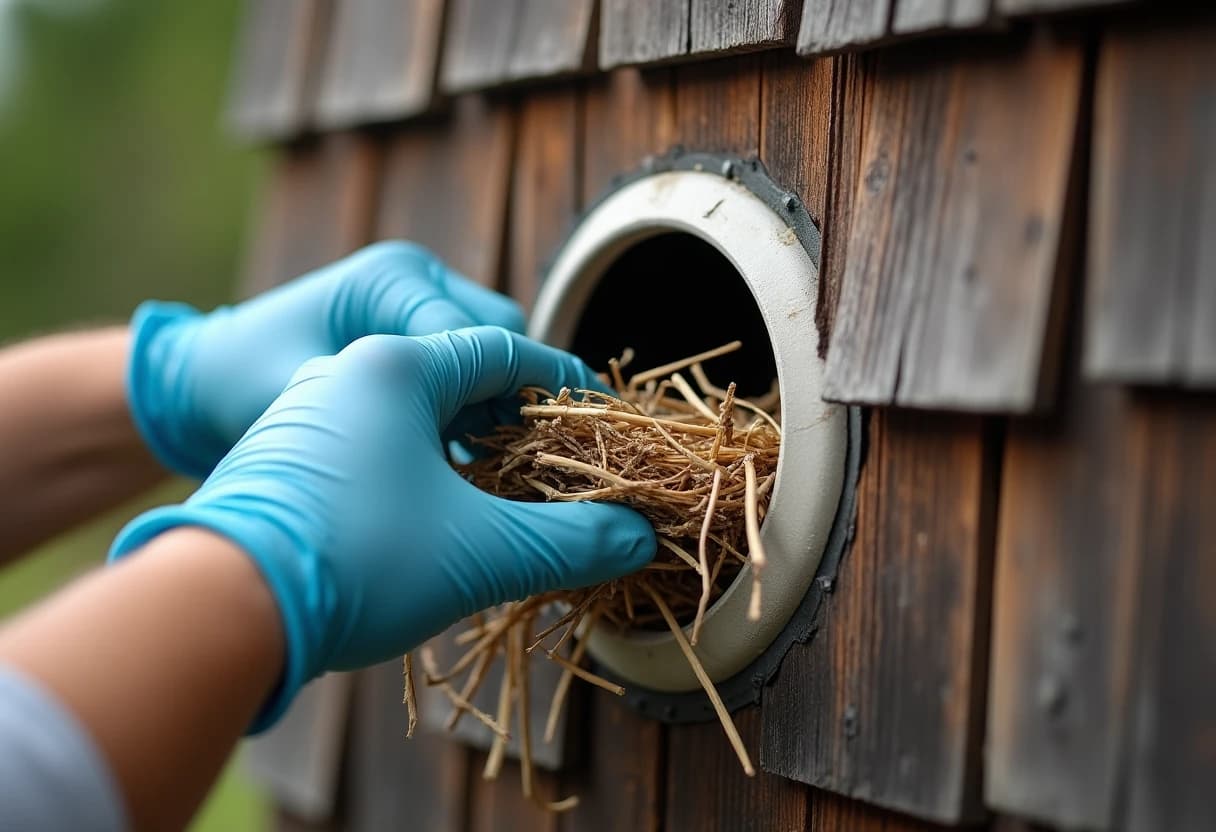
A dryer vent is prime real estate to a bird: a sheltered tube, warm air rising from below, an opening just the right size, and a flap that a determined starling pushes past in seconds. Every spring, Greater Boston homes discover the result — scratching sounds in the wall, a dryer that suddenly cannot dry, twigs poking from the exterior hood. Our removal service handles the whole problem, not just the nest: humane removal of birds and nesting material, a camera pass to confirm the duct is completely clear, sanitizing to address droppings and the mites nests leave behind, and a code-compliant pest guard so the vacancy never gets re-let. Most jobs finish in a single visit.
The nest you can see at the hood is rarely the whole nest. Starlings routinely pack nesting material two to eight feet down a dryer duct, and by the time twigs show at the termination, the run may be blocked nearly solid — with eggs or nestlings deeper in. That is why hood-level cleanouts fail: pull the visible material, and the dryer still cannot breathe, the smell gets worse, and the birds are often back within the week. Our service goes the full length: complete removal verified by camera, sanitizing of the contaminated run, hood repair or replacement where the birds forced the damper, and a code-compliant guard that ends the cycle permanently.
Why Bird Nest & Animal Removal from Dryer Vents Matters
A nest in a dryer vent is a fire-safety emergency wearing a wildlife costume. The mechanics are unforgiving: FEMA attributes roughly 2,900 home clothes dryer fires per year to U.S. households, with lint the leading ignition source — and a nest is a lint trap made of kindling, parked directly in a heated airstream. Dry grass, twigs and feathers pack the duct; lint from every subsequent load mats into the tangle; airflow collapses, so the dryer runs longer and hotter against the blockage; and the high-limit safety switch becomes the only thing standing between routine laundry and ignition. Meanwhile the moisture that cannot exit condenses in the run, and for gas dryers, combustion byproducts including carbon monoxide lose their exit path too. This is why a suspected nest justifies stopping dryer use immediately — not finishing the week's laundry first. Removal restores the exhaust path; the camera pass proves it; and the prevention hardware ensures the vent does not simply re-fill next spring, because a vent that hosted one nest has advertised itself to every bird in the neighborhood.
The damage animals do to vent hardware is the part that invites repeat visits. To get in, a bird or squirrel usually defeats something — a damper flap sprung open until the hinge bends, a plastic hood gnawed or cracked, a weathered seal pried loose. After a hood-level cleanout that ignores the damage, the vent stands open like a door with a broken lock, and wildlife returns on schedule: same season, sometimes same week. Our service treats hardware as part of the problem. We assess the termination on every job, repair dampers that can be restored, replace hoods that cannot — with quality metal hoods where pest pressure or coastal weather argues against plastic — and reseal the wall penetration against both weather and the gnawing pests that exploit gaps. Then comes the piece that actually ends the cycle: a purpose-built pest guard over the termination. The distinction matters, because the common DIY fix — window screen or hardware cloth over the opening — is prohibited by the mechanical code for dryer terminations. Mesh fine enough to stop birds is fine enough to trap lint, and a lint-matted screen recreates the fire hazard with none of the charm. Proper guards are engineered around that tradeoff: bars or cages sized to exclude wildlife while letting lint pass and the damper swing freely.
How Our Bird Nest & Animal Removal from Dryer Vents Process Works
1Assessment & Species Identification
We start by identifying what we are dealing with: sounds, droppings, nesting material at the hood, and camera or visual observation establish the species and whether the nest is active. Identification is not academic — it determines the removal method, the sanitizing scope, and the legal handling, since most native birds are federally protected while starlings and house sparrows are not.
2Contain the System & Remove the Nest Humanely
Containment comes first: the dryer is disconnected and the interior connection sealed, so nothing disturbed in the duct reaches the laundry room and no startled animal exits into the house. Then removal proceeds from the termination side — adult birds encouraged out unharmed, nesting material extracted with tools that grip rather than compact, since pushing a nest deeper is the classic DIY failure.
3Full-Length Camera Verification
When the visible material is out, the camera goes the full length of the duct — because a removal is only complete when the entire run is verified clear. We check for remaining debris, a second nest deeper in, moisture damage from the blocked period, and any duct separation the animal or the blockage caused. You see the footage; clear means proven clear.
4Sanitize the Contaminated Run
Nests leave a biological footprint: droppings, feather dander, and the mites and parasites that live in nesting material and go looking for new hosts once the nest is gone. We HEPA-vacuum the affected run, then apply an EPA-registered disinfectant through it — addressing pathogens associated with bird droppings and deterring mite migration toward the house.
5Repair or Replace the Damaged Hood
Animals rarely enter undamaged hardware. We assess the termination on every job: dampers sprung or bent by forced entry get repaired or replaced, cracked and gnawed hoods get swapped for quality units — metal where pest pressure or coastal weather argues against plastic — and the wall penetration gets resealed against weather and gnawing. The vent ends the visit in better condition than before the birds found it.
6Install a Code-Compliant Pest Guard
Prevention is the step that makes this a one-time problem. We install a purpose-built pest guard over the restored termination — a cage or bar design sized to exclude birds and rodents while letting lint pass freely and the damper swing fully. Critically, this is not a screen: mesh over a dryer termination traps lint, violates the mechanical code, and builds a fire hazard on your wall. Proper guards exclude wildlife without strangling airflow.
7Final Airflow Test & Documentation
The job closes with proof: dryer reconnected, run verified clear on camera, and exhaust airflow tested at the guarded termination to confirm the system breathes the way it should. You receive photo documentation of the blockage found, the cleared duct, the hardware work and the installed guard — a record for your files, your insurer, or your association.
Benefits You Can Expect
A Serious Fire Risk Eliminated
A nest is kindling parked in a heated exhaust stream — dry twigs and grass collecting lint in front of a machine that FEMA links to roughly 2,900 home fires a year even without wildlife assistance. Removal takes the fuel out of the equation and restores the airflow that keeps the dryer operating inside its safe design limits.
Humane, Lawful Wildlife Handling
Eviction, not extermination: adults leave unharmed, removals are staged to avoid needless suffering, and no poisons ever enter your duct — poison in a vent means a carcass you cannot reach and a smell you cannot escape. Humane handling is also simply the professional standard, and it costs nothing extra.
Complete Removal, Verified on Camera
Hood-level cleanouts fail because nests run deep — starlings pack material two to eight feet into a duct, far past the visible twigs. Our extraction works the full run and the camera proves it clear end to end, which is the difference between a removal and a postponement.
Health Hazards Cleaned Up Properly
What nests leave behind — droppings, feather dander, mites and parasites — is a genuine air-quality concern in a duct connected to your laundry. Our sanitizing step pairs HEPA extraction with an EPA-registered disinfectant through the affected run, addressing the biological footprint rather than just the twigs.
The Damage Repaired, Not Just Noted
Animals break hardware getting in — sprung dampers, cracked hoods, gnawed openings — and until the damage is fixed, the vent is a door with a broken lock. We repair or replace the termination in the same visit, with quality hoods carried on the truck, so the job closes with the wall actually sealed.
Prevention That Will Not Trap Lint
The pest guard is the step that makes this the last removal you pay for — and the engineering matters. Mesh screens over dryer terminations are prohibited by the mechanical code because they mat with lint into a fire hazard. Proper guards use bar and cage geometries that exclude birds while lint passes freely.
Documentation for Landlords, Boards & Insurers
Every removal produces a record: photos of the blockage found, the cleared and verified duct, hardware repairs and the installed guard. For landlords and condo owners, that packet is proof an identified fire exposure was professionally resolved — the document adjusters, boards and property managers actually ask for.
Warning Signs to Watch For
Chirping or Scratching Near the Dryer
Birdsong from a wall is not charming once you know what it means: an active nest in the duct, usually with the blockage already well established. Scratching, fluttering or scrabbling sounds near the laundry — especially in the morning — are the most direct evidence a vent can give, and they warrant stopping dryer use immediately.
Twigs or Straw at the Exterior Hood
Nesting material visible at the termination is the classic springtime sight — grass and twigs poking through the damper like a welcome mat. What you see is the overflow: starlings pack material feet deep into the run, so a visible tuft usually means a substantial blockage behind it.
The Dryer Suddenly Stopped Drying
A dryer that went from fine to useless in a week did not wear out — it got blocked, and in spring the blockage is a nest until proven otherwise. Gradual decline suggests lint; abrupt failure suggests an obstruction, and nesting season makes the diagnosis close to automatic.
Smells: Musty, Ammonia or Worse
A nest holds moisture against every load's exhaust, and the damp organic mass sours: musty, earthy laundry-room smells during dryer operation often mean an occupied or abandoned nest steeping in the run. The odor rides the leaks around the damper and connection into the house.
The Damper Flap Hangs Open or Is Damaged
A flap that no longer sits closed is both evidence and invitation: forced entry bends damper hinges, and the sprung flap then stands open for the next visitor. Walk your exterior and look at the hood — a gap you can see daylight through is a door wildlife has likely already used.
Insects or Mites Appearing Near the Laundry
Tiny crawling specks around the dryer, the laundry-room window or freshly dried clothes can be bird mites — nest parasites migrating through the duct in search of a new host after their birds fledged or died. It is an unsettling discovery with a clear meaning: there is or was a nest in the run.
It Happened Before
A vent that hosted a nest once is a marked address: starlings show strong fidelity to successful cavity sites and will recolonize an unguarded termination season after season. If your history includes even one removal without a proper guard installed afterward, assume spring will bring tenants.
Bird Nest & Animal Removal from Dryer Vents Cost in the Boston Area
Bird nest and animal removal from dryer vents runs $149 to $399 in Greater Boston, and where a job lands in that range comes down to four factors. Access is the biggest: a first-floor termination reachable from a stepladder sits at the low end, while hoods high on second- and third-story walls — common on the region's triple-deckers — require extension ladder work that adds cost. Blockage depth and extent matter next: a shallow, fresh nest extracts quickly, while material packed six feet into the run, or a duct hosting multiple seasons of accumulation, takes staged extraction and more camera time. Contamination level drives the sanitizing scope — a clean twig nest needs less treatment than a run carrying heavy droppings or rodent waste. And hardware condition sets the repair portion: a sound hood needing only damper restoration costs little, while a destroyed termination needs full replacement. Every quote is flat, itemized and confirmed before work begins, and it includes what some operators bill separately: the full-length camera verification and the debris disposal.
A typical job breaks down simply. Straightforward removals — accessible termination, single fresh nest, hood intact — cluster around $149 to $199 including camera verification and standard sanitizing. Mid-range jobs at $200 to $299 usually involve second-story ladder access, deeper material extraction, or a hood replacement folded in. The $300 to $399 tier covers the hard cases: third-story or steep-access terminations, ducts packed across multiple seasons, heavy contamination requiring extended sanitizing, or removal plus full termination rebuild. Pest-guard installation — the code-compliant cage or bar guard that prevents recurrence — adds a modest flat amount when purchased with a removal, and most customers take it, since it is the difference between solving this once and renting a ladder crew annually. Two things never appear on our invoices: emergency surcharges for calling during the spring rush, and per-foot camera fees. The camera pass is how we verify our own work; charging extra for it would be charging you to prove we finished.
Seasonal Considerations in New England
Spring is the season this service exists for. Starlings and house sparrows begin scouting cavities across Greater Boston in March, nest construction peaks through April and May, and a dryer termination — sheltered, pre-warmed, predator-proof — outcompetes almost any natural site. The calls follow the biology: our removal volume rises tenfold between the first warm week and Memorial Day. Timing within the season matters. A March intervention often catches material before eggs, making removal simple and fast; by May, active nests with young complicate the work and the ethics. The practical advice is simple: check your termination in early March, act on the first twig, and if your vent has a history, get the guard installed before the scouts arrive.
Why Boston Air Duct Cleaners
Choosing a duct cleaner is really a trust decision — you are letting a crew work inside the system that feeds air to your family. We make that decision easy: a local West Newton company with insured, uniformed technicians, transparent flat-rate quotes, NADCA-standard equipment and methods, and photographic proof of the finished work. No door-to-door sales, no bait-and-switch coupons, no invented 'mold emergencies.' Just honest mechanical cleaning done properly the first time, backed by a written guarantee.