
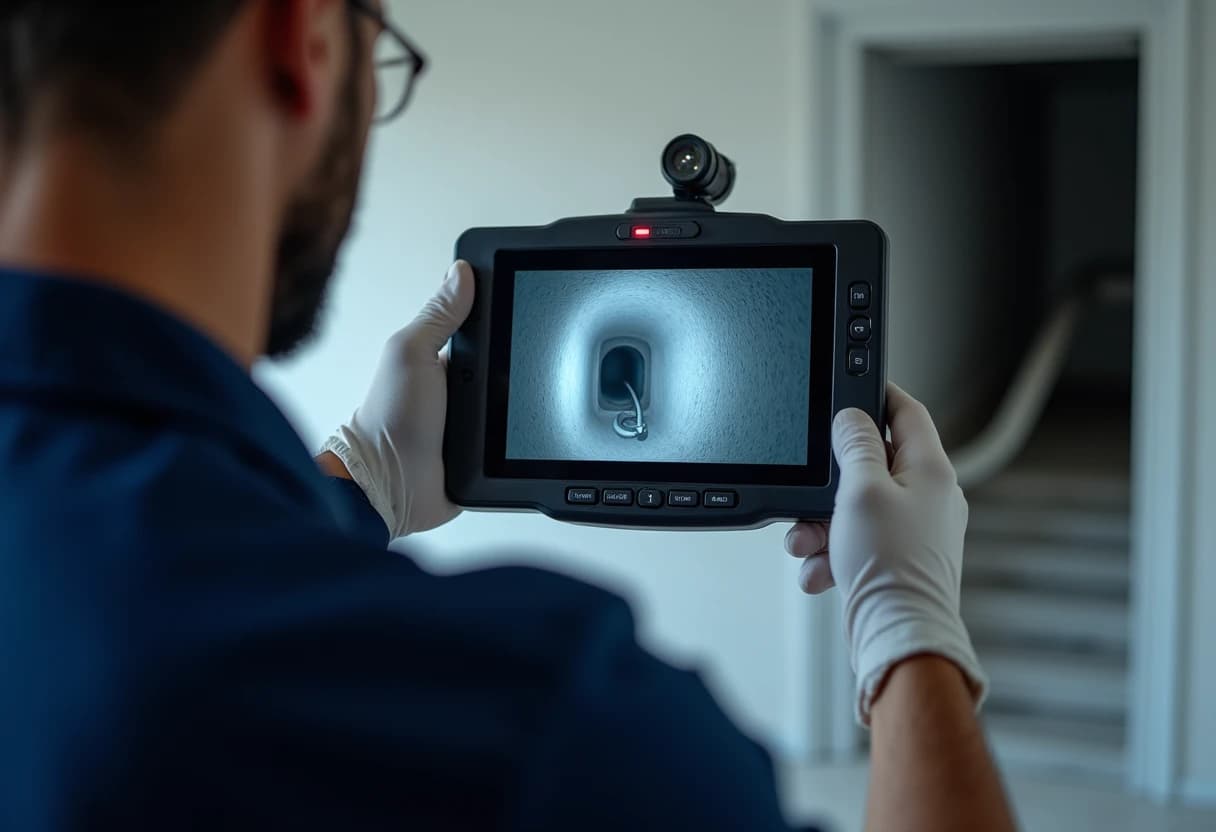
Before anyone sells you a duct cleaning, someone should show you your ducts. Our camera inspection service does exactly that: a technician runs a high-resolution borescope or robotic crawler camera through your supply and return runs, records what the interior surfaces actually look like, and gives you a straight go/no-go verdict — clean now, re-check in a couple of years, or leave it alone. Greater Boston homeowners use the service to settle the question honestly for $99 to $249 depending on system size, and if the imaging shows cleaning is warranted, the inspection fee is credited toward the job. If it shows your ducts are fine, we tell you so and leave. Either way, you decide from evidence instead of a sales pitch.
Duct problems are invisible by design — the system is sealed inside walls, ceilings and chases, which is why failures persist for years. A camera inspection makes the invisible visible. Our Greater Boston technicians use flexible borescopes for branch runs and wheeled robotic cameras for long trunk lines, inspecting the actual surfaces your air touches every day. The findings sort into three buckets: contamination (dust load, microbial staining, pest debris) that cleaning fixes; defects (disconnections, leaks, crushed or failed duct) that cleaning cannot fix but repair can; and healthy systems that need neither. We tell you which bucket you are in, show you the footage, and price only what the evidence supports. No camera, no recommendation — that is the rule.
Why Air Duct Camera Inspection Matters
The honest answer to 'do my ducts need cleaning?' is: nobody knows until someone looks. The EPA's own guidance says duct cleaning is warranted in specific conditions — visible mold, vermin infestation, or ducts clogged with excessive debris actually releasing into the home — and the only way to establish any of those is visual inspection of the duct interior. Yet the industry's default is backwards: quote the cleaning first, glance inside never. An inspection-first approach protects you in both directions. If your ducts are genuinely loaded — common in Greater Boston's older housing stock — the camera documents it and you buy the cleaning knowing it is justified, with the inspection fee credited toward the work. If your ducts are serviceably clean — common in newer construction and recently cleaned systems — you spend $99 to $249 to avoid spending $350 to $700, and you get a documented baseline plus a re-check date. Either outcome beats guessing, and both outcomes beat trusting a flashlight glance from someone whose truck is already parked outside with cleaning equipment in it.
Finally, inspection-first is your defense against this industry's worst habits. The FTC and Better Business Bureau have warned for years about duct-cleaning bait pricing: the $99 whole-house coupon that becomes a $600 invoice through on-site 'discoveries' — usually a flashlight photo of alleged mold, sometimes not even from your house. The scam works because the homeowner cannot see into their own ducts and must accept or reject a claim blind, under time pressure, with the crew standing in the kitchen. Recorded camera inspection dismantles the entire mechanism. Our findings come as footage of your actual ductwork, reviewable at your pace, second-opinion-able by anyone; mold-like staining is documented, not dramatized, and we will tell you plainly when a suspect patch is ordinary dust; and because the inspection is a priced service rather than a free sales visit, the economics do not require us to find anything. Roughly half of our inspections conclude with 'you do not need a cleaning yet' — a sentence that costs us short-term revenue and earns us the referrals that built this company.
How Our Air Duct Camera Inspection Process Works
1System Walkthrough & Access Planning
The inspection starts with a walkthrough: we locate the air handler, map supplies and returns room by room, check filter condition and fit, and note your specific concerns — the cold bedroom, the musty smell, the dust that keeps returning. That intake shapes the camera plan, because a good inspection targets your questions, not just a standard route.
2Borescope Inspection of Branch Runs
Flexible high-resolution borescope cameras go in through the register openings, snaking the length of each selected branch run. We inspect representative supplies in each zone and every accessible return — returns are the dirtier, more neglected side of most systems — recording video as we go. Registers are removed carefully and remounted exactly as found.
3Robotic Camera Inspection of Trunk Lines
Main trunks are where accumulation concentrates and where hand-held scopes cannot reach, so long horizontal mains get the wheeled robotic crawler: a self-propelled camera platform that travels the trunk interior, capturing stable, well-lit video of the full run. This is the footage that settles the go/no-go question, because trunk condition drives the cleaning verdict.
4Air Handler, Connections & Defect Check
Contamination is only half the inspection; defects are the other half. We examine the visible duct system for the failures cameras and eyes catch: disconnected or separated joints, crushed flex duct, failed tape and mastic, panned returns leaking basement air, ducts sweating or stained by past moisture, and insulation problems on runs through unconditioned space.
5Moisture, Microbial & Pest Assessment
Where footage shows staining, growth-like patches, corrosion or droppings, we slow down and document thoroughly: close imagery, locations, extent, and the moisture pathway that likely caused it. We are careful with language — visual inspection can identify conditions consistent with microbial growth, and we say when lab confirmation would be worth it rather than diagnosing from a screen.
6The Verdict: Go, No-Go, or Watch
Every inspection ends in one of three verdicts, delivered plainly. Go: contamination or conditions justify cleaning now, and we quote it flat with the inspection fee credited. No-go: the system is serviceably clean; keep the footage as your baseline and re-inspect in two to three years. Watch: borderline accumulation or a minor issue worth monitoring — with a specific re-check date, not a shrug.
7Recorded Imagery & Written Report
You keep the evidence: recorded video and still imagery from the inspection, tagged by location, plus a written summary covering accumulation levels by duct section, defects found with locations, moisture or pest findings, filter and air-handler observations, and the verdict with its reasoning. Reports are formatted to be forwarded — to spouses, agents, attorneys, landlords or other contractors.
Benefits You Can Expect
An Honest Answer Before You Spend on Cleaning
The inspection exists to answer one question with evidence: does this system actually need cleaning? When the footage says yes, you buy the cleaning knowing it is justified and the inspection fee credits toward it. When the footage says no, $99 to $249 just saved you $350 to $700 — and bought a documented baseline besides.
Finds Defects That Cleaning Would Never Fix
A meaningful share of 'dirty duct' symptoms are actually broken-duct symptoms: disconnected joints dumping conditioned air into cavities, crushed flex strangling a room, leaky panned returns inhaling basement air. The camera finds these in seconds, and the fix is usually a modest repair — not the equipment replacement or endless cleanings that misdiagnosis buys.
Verification of Any Company's Cleaning Work
A cleaning invoice says 'complete'; the trunk line forty feet in says what actually happened. Post-cleaning verification runs the camera through the same duct categories any vendor billed for, giving you footage to set beside their paperwork. It is the industry's missing quality-control step, available for our work and anyone else's.
Leverage and Clarity in Home Purchases
A pre-purchase duct inspection regularly pays for itself many times over at the negotiating table: documented contamination, defects or pest evidence become credits or seller repairs, backed by imagery no one can wave away. And when the system verifies clean, you close with one less unknown — worth the fee by itself.
Early Warning on Moisture, Mold & Pests
Moisture problems announce themselves inside ductwork before they surface anywhere else — staining, corrosion and matted dust mark the pathway while the growth is still incipient. Catching it at the inspection stage means addressing a humidity source or a small cleaning; catching it at the smell stage often means remediation.
A Documented Baseline for Your Home's Air
Dated interior imagery of your duct system is a reference that keeps paying: future air-quality questions get answered by comparison instead of speculation, future cleanings get judged against a known starting point, and future buyers get shown evidence of a well-maintained system rather than told about one.
The Fee Credits Toward the Fix
When the footage shows cleaning or repair is warranted and you book the work with us, the inspection fee is credited in full — the diagnosis effectively becomes free, and you paid only for the honesty of the process. When nothing is warranted, the fee bought a verified clean bill of health and a baseline file.
Warning Signs to Watch For
You're Being Quoted a Cleaning Without Anyone Looking
If a company has priced your duct cleaning without imaging your ducts, the quote is a guess and the urgency is a tactic. The professional order of operations is inspect, show, then quote. A $99 to $249 camera inspection either validates their quote with evidence or saves you the whole amount — both outcomes are worth it.
A Room That Never Heats or Cools Properly
The chronically cold bedroom or stubbornly hot office is a duct-defect symptom more often than an equipment problem: crushed flex, a separated joint, a damper stuck closed, or a run disconnected entirely inside a wall or attic. The camera finds the cause in minutes — usually a modest repair, not a system upgrade.
Musty or Unexplained Odors From the Vents
A musty smell when the system runs has several very different causes — moisture-bonded dust, active microbial growth, pest evidence, or a return drawing from a damp crawlspace — and each demands a different response. The camera distinguishes them on sight, replacing worst-case anxiety with a specific finding and a specific fix.
You're Buying (or Selling) a Home
The sellers' ducts hold their whole tenure — pets, smoke, renovations, water events, mice — and standard home inspections never look inside. A pre-purchase camera inspection inside your inspection window converts that blind spot into imagery, and imagery into negotiating position or peace of mind. Few due-diligence dollars work harder.
Dust, Allergies or Filter Mysteries Despite Clean Habits
When dust returns days after cleaning house, or allergies track the heating season despite good filters, the question is whether the duct system is the source — and that is a question about interior surfaces nobody has seen. The inspection answers it directly: heavy shedding accumulation says yes; clean runs say look elsewhere. Both answers are progress.
After Renovations, Water Events or Pest Activity
Any of the big three — construction, water, pests — makes an inspection immediately worthwhile. Renovation dust infiltrates open registers by the pound; water wets duct dust into a growth medium within about 48 hours; pests leave allergenic evidence along runs traps never reach. The camera establishes what happened and what response the evidence justifies.
It's Been Years Since Anyone Looked — or Ever
NADCA's guidance is a look every couple of years, cleaning only as conditions warrant. If your system has no inspection history at all, the first camera pass sets the baseline that makes every future decision easier — and in Greater Boston's older stock, it fairly often finds something worth knowing about, dirt or defect alike.
Air Duct Camera Inspection Cost in the Boston Area
Air duct camera inspection in Greater Boston runs $99 to $249, with the price driven by system size and scope rather than by anything discovered. A single-system condo or compact single-family sits at the $99 to $149 end: one air handler, a modest register count, borescope runs through representative branches and accessible trunk sections. Larger homes move toward $179 to $249 as zones, air handlers and duct footage multiply — each additional system is effectively a second inspection — and robotic crawler work on long trunk lines adds setup time that the higher tier reflects. Every inspection at every tier includes the same deliverables: recorded video and stills tagged by location, a written condition summary, a plain go/no-go verdict, and a flat quote for any work the footage justifies. And the fee credits in full toward cleaning or repair booked with us, which means a justified cleaning ends up costing exactly what it would have cost had you skipped the inspection — you just bought it knowing instead of guessing.
Compare the inspection's price against the decisions it informs and the economics are lopsided. A whole-home cleaning runs $350 to $700 in this market; the inspection is roughly a fifth of that, and about half the time it concludes the cleaning is not yet warranted — an immediate several-hundred-dollar save. On the defect side the leverage is larger: a disconnected supply found on camera costs a modest repair, while the same defect undiagnosed costs years of energy loss and comfort complaints, and frequently a misdirected equipment quote in the four figures. Pre-purchase clients see the sharpest returns of all: documented contamination or defects surfacing during an inspection window regularly convert to seller credits worth ten to fifty times the fee. We price the service to be an easy yes precisely because the inspect-first habit, once established, makes every subsequent duct dollar a household spends better-aimed — including the ones they spend with us.
Seasonal Considerations in New England
The smartest inspection dates on a Massachusetts calendar sit just before the two heavy-use seasons. A September or October camera pass tells you whether the system is fit for the five-month heating stretch when windows stay shut and the household breathes recirculated air almost exclusively — and if cleaning is warranted, there is still time to complete it before the furnace runs continuously. A late-spring inspection does the same ahead of cooling season, with a bonus: it catches the winter's accumulation and any moisture consequences of ice-dam season before summer humidity can turn damp dust into a biology project. Inspections book faster than cleanings — most homes take under an hour — so even peak-season slots stay available when full cleanings are waitlisted, which makes the camera the right first call whenever the calendar is tight.
Why Boston Air Duct Cleaners
As a West Newton-based company, we treat Greater Boston like the neighborhood it is — because for us, it is. Our reputation lives or dies on local referrals, so every job gets the full process: complete system cleaning under negative pressure, mechanical agitation of every run, blower compartment service, and a documented walkthrough before we leave. We are licensed and insured, our estimates are free and flat, and our schedule holds same-day slots for urgent calls. One visit and you will understand why neighbors keep our magnet on the fridge.