Air duct sanitizing is the finishing treatment that mechanical cleaning alone cannot provide: an EPA-registered antimicrobial, fogged through the freshly cleaned duct system under airflow so it reaches every surface the air touches. Where cleaning removes the dust, sanitizing neutralizes what lives in the residue — odor-causing bacteria, mold spores and the microbial film that gives ducts that stale, musty character. For Greater Boston homeowners fighting pet odors, previous-owner smells, smoke history or the damp-basement note that rides the airflow every summer, it is the difference between ducts that are clean and ducts that smell clean. We apply it honestly: only after source-removal cleaning, only with HVAC-labeled products, and only when your situation actually warrants it.
When Greater Boston homeowners call about duct odors, the stories rhyme: a musty smell every time the AC starts, a dog smell guests notice before they see the dog, cigarette ghosts from an owner two sales ago, or a basement note that follows the airflow upstairs. All of them live in the same place — the microbial and organic residue lining the duct system — and all of them respond to the same two-step fix: source-removal cleaning followed by EPA-registered antimicrobial fogging. We quote the pairing as a flat price, complete it in a single visit, and back it with a straightforward promise: if the odor problem is in your ducts, this ends it. If it is not, our inspection will tell you where to look instead.
Why Air Duct Sanitizing & Deodorizing Matters
Cleaning and sanitizing solve two different problems, and stubborn duct odors need both solved. Mechanical cleaning removes the bulk contamination — the dust, dander and debris load. But odors are chemical and biological: they persist in the thin film of oils, microbial residue and volatile compounds bonded to duct surfaces, in seams and joints, and in the porous textures brushes cannot polish. That is why homeowners who buy a standard cleaning to fix a smell are sometimes disappointed — the ducts are genuinely clean, and the odor faintly persists. An EPA-registered antimicrobial fogged through the cleaned system finishes the job: it kills the odor-producing bacteria metabolizing that residue, neutralizes the residue itself, and inhibits the regrowth that would otherwise rebuild the smell over the following months. The sequence matters enormously — chemistry over dirt fails, chemistry over clean metal works — which is why we position sanitizing as the second half of a two-part service rather than a standalone spray, and why our results last years rather than the weeks a discount fog delivers.
Pet households face duct odor mechanics that surface cleaning cannot beat. Dander is an aerosol: it rides the return airflow into the duct network, settles into the interior film, and accumulates for as long as the pet lives there — often across multiple pets and many years. The film becomes an odor reservoir with the system's full distribution reach, which is why the smell is strongest when the heat kicks on and why guests detect it instantly while residents have gone nose-blind. The same mechanism archives cigarette and cannabis smoke, cooking oils, and the general biological signature every household writes into its air system over time. When the home changes hands, the new owners inherit the archive. Source-removal cleaning strips the reservoir; EPA-registered fogging neutralizes the residue and the bacteria feeding on it; and the system stops broadcasting. For sellers, this pairing is one of the highest-leverage pre-listing investments available — showings live and die on the first thirty seconds of smell — and for buyers it is the cleanest possible start in a home with an unknown history.
How Our Air Duct Sanitizing & Deodorizing Process Works
1Odor Assessment & Honest Qualification
First we determine whether sanitizing will actually fix your problem. The technician traces the odor's behavior — does it arrive with airflow, vary by season, concentrate at certain registers — inspects the duct interiors and air handler, and checks for moisture. If the source is your ducts, we quote the treatment flat. If it is not, we say so and point you at the real source.
2Source-Removal Cleaning First
Sanitizer applied over dirt is wasted — no chemistry penetrates a mat of dust and biofilm. So the system is cleaned first to NADCA-standard bare surfaces: registers sealed, ductwork under HEPA-filtered negative pressure, every run mechanically agitated with brushes and air whips. If your ducts were professionally cleaned very recently, we verify by camera and credit the step accordingly.
3Product Selection & Preparation
We match the chemistry to the problem: an EPA-registered antimicrobial labeled for HVAC use as the base treatment, with odor-counteractant chemistry added for smoke, pet or severe musty situations. You see the product names and safety data sheets before application — never a vague 'proprietary treatment' — and we review re-entry timing, typically just a few hours, with you up front.
4Whole-System Antimicrobial Fogging
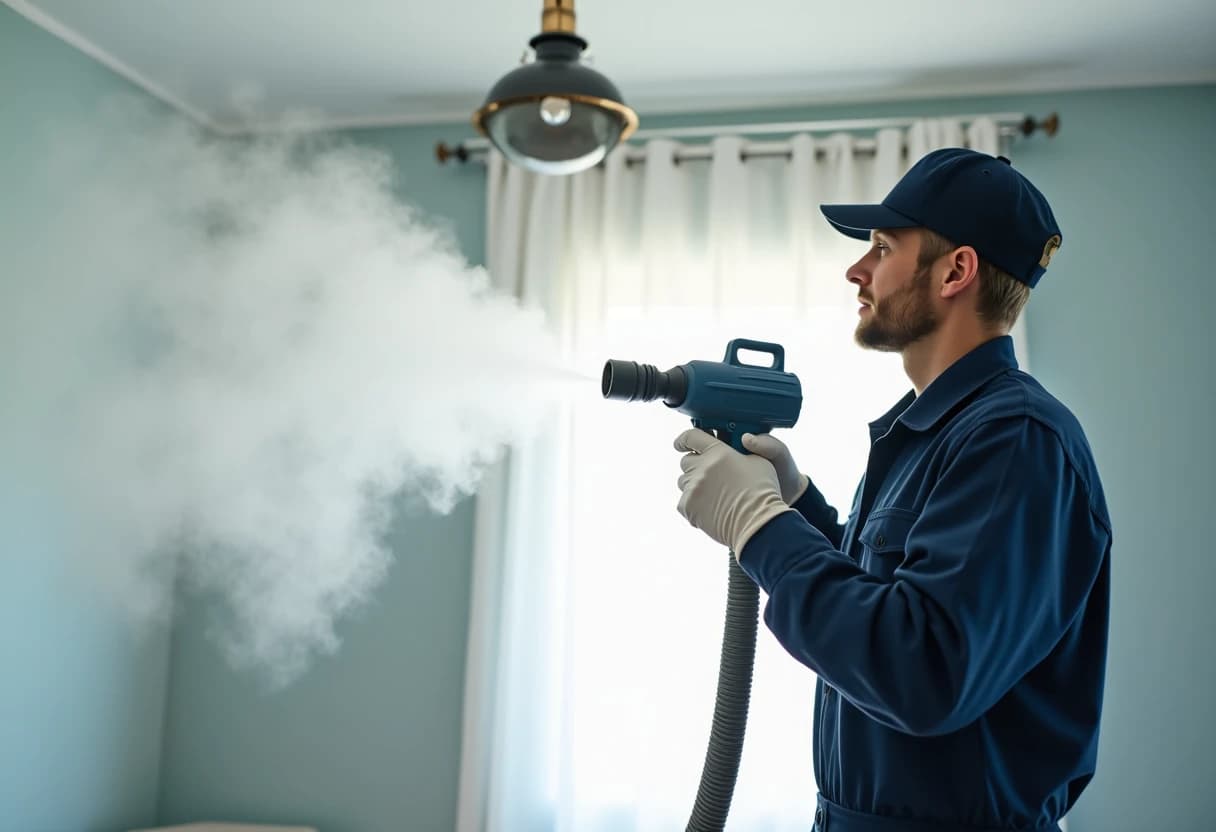
The treatment is atomized into a fine fog and introduced through the duct network while controlled airflow carries it the length of every supply and return. The fog deposits on all interior surfaces — including the seams, joints and corrugations mechanical cleaning cannot polish — killing odor-causing bacteria and neutralizing microbial residue on contact. Full-system coverage takes under an hour in most homes.
5Coil, Drain Pan & Blower Treatment
The dampest components carry the strongest biology, so the air handler wet section gets direct treatment: evaporator coil surfaces, the drain pan and its trap, and the blower wheel and housing. Musty odors disproportionately originate here — a slimy pan or biofilmed coil can perfume an entire house — and treating the ducts while skipping the equipment leaves the source in place.
6Deodorizing Pass for Stubborn Odors
Smoke and heavy pet situations get a second, targeted pass with odor-counteractant chemistry — products that bind and neutralize odor molecules rather than perfume over them. Tobacco residue in particular clings aggressively to metal and re-releases for years; the counteractant pass addresses it specifically. This step is included when the assessment calls for it and skipped, with the price reflecting that, when it does not.
7System Airing, Verification & Walkthrough
After label contact time elapses, we run the system to air the treatment through, reinstall registers, and walk the home with you register by register. You should smell neutral air — not fragrance, not chemicals, nothing. You receive the product documentation, re-entry guidance already satisfied by the airing process in most cases, and our callback commitment if any trace of the original odor resurfaces.
Benefits You Can Expect
Odors Neutralized at the Source, Not Masked
Every consumer odor product adds scent on top of the problem; sanitizing subtracts the problem. With the odor-holding film removed and the residue chemically neutralized, the ducts stop producing smell altogether. The house does not smell like a candle aisle afterward — it smells like nothing, which is what fresh actually is, and what no masking product can counterfeit.
A True Reset for Newly Purchased Homes
The previous owners' pets, kitchen, tobacco and habits are archived in your duct film, replaying on every cycle. Cleaning plus sanitizing erases the archive — mechanically stripping the residue, then neutralizing the biology — so the house starts smelling like yours from day one. It is the single most-requested reason for this service, and the reviews it generates say 'finally smells like our home.'
Pet Odor Elimination That Actually Holds
Dander is airborne, the return ducts inhale it continuously, and years of accumulation turn the duct film into a dander reservoir with whole-house reach — which is why the pet smell survives every carpet shampoo. Removing the reservoir and neutralizing the residue takes the system out of the equation, and most households report the smell simply gone, permanently, after one treatment.
Smoke Ghosts Finally Evicted
Tobacco residue is the most persistent household odor there is — tar and nicotine films bond to duct metal and off-gas for years, outliving paint, carpet and every previous owner. Our layered treatment pairs antimicrobial fogging with odor-counteractant chemistry that neutralizes the smoke compounds specifically, which is why it succeeds where repainting and time both failed.
Musty Summer Smell Broken for Good
That damp blast at AC start-up is bacteria metabolizing humid duct film — a cycle that returns every muggy stretch and worsens annually. Sanitizing removes the film and leaves treated surfaces the biology cannot recolonize, so the next humid week produces silence from the registers. For many Massachusetts households this is the first summer without the smell in a decade.
Microbial Load Reduced System-Wide
Beyond odor, the treatment is a sanitizing pass over the one surface network your household's air touches continuously. EPA-registered antimicrobials kill odor bacteria and mold spores resident in the duct film and inhibit their regrowth — meaningful for households with allergy sufferers, young children, elderly members or anyone for whom airborne biology is more than an abstraction.
Small Add-On Cost, Outsized Payoff
Bundled with duct cleaning, sanitizing adds roughly $75 to $200 to the visit — the system is already sealed, accessed and under negative pressure, so you pay for chemistry and application time, not a second mobilization. Against the hundreds homeowners spend annually on masking products that fix nothing, the one-time source treatment is the plainly economical choice.
Warning Signs to Watch For
Odors Return No Matter How Much You Clean
If deep-cleaning the house buys only a day or two before the smell creeps back, the source is upstream of everything you cleaned — in the air system, re-scenting the rooms on every cycle. That resupply pattern is the signature of duct-borne odor, and it means the fix is in the ducts, not in another weekend of scrubbing.
Guests Notice a Smell You No Longer Can
Nose-blindness is real and universal: constant exposure deletes a smell from your perception while every visitor gets it full strength at the door. If a candid friend, a relative or a real estate agent has mentioned a pet, smoke or musty note you cannot detect, believe them — and suspect the ducts, because whole-house odors are almost always airflow-distributed.
Musty Blast When the Heat or AC Starts
A damp, sour or dirty-sock note in the first minutes of a cycle, fading as the system runs, points to microbial activity on the coil, in the drain pan or along the duct film. It is most common in cooling season and after humid stretches. The pattern is diagnostic — and it is exactly what cleaning plus antimicrobial treatment eliminates.
You Just Bought the Home
An unknown air system is a reasonable default for sanitizing: you cannot see the duct film's history, and whatever the previous owners' household deposited — pets, smoke, cooking, dampness — is now on replay in your air. Between closing and move-in is the ideal window: empty rooms, open access, and a fresh biological baseline before your family breathes the system daily.
Pets Present or Past
Current pets write dander into the duct film continuously; previous owners' pets left their chapters behind. Either way the system holds an animal-scent reservoir that surface cleaning never touches. If the house smells of pets anywhere, it smells of pets from the registers — and treating the registers' source is the only fix with reach into every room.
Smoke History in the Home
If any era of the home's life included indoor smoking, the duct network carries the tar-and-nicotine film to prove it — and that film off-gasses for years, strongest on warm humid days when the residue softens. Paint and carpet replacement miss it entirely. Counteractant duct treatment is the step that finally clears a smoker's house.
After Pests, Mold or Water in the System
Rodent or insect activity in ductwork leaves droppings, nesting debris and bacterial contamination that mechanical cleaning removes but does not neutralize — the sanitizing pass is what addresses the biological load. Any pest history that touched the air system should end with an EPA-registered treatment, and the odor benefit arrives as a bonus.
Air Duct Sanitizing & Deodorizing Cost in the Boston Area
Air duct sanitizing in Greater Boston runs $250 to $500 as a standalone service, and $75 to $200 when bundled with duct cleaning — the bundle discount reflects that the system is already sealed, accessed and under negative pressure, so the marginal cost is chemistry and application time rather than a second full mobilization. Within those ranges, price tracks system size (number of runs and zones determines product volume and fogging time), the odor profile (straightforward musty or pet situations need the antimicrobial pass alone, while smoke and severe cases add counteractant treatment), and how much wet-section work the coil, drain pan and blower need. One structural note on honest pricing: because effective sanitizing requires clean surfaces, a standalone quote for a system with dirty ducts must include cleaning — which is why legitimate standalone pricing converges toward the bundle anyway. A company happy to fog your uncleaned ducts for $149 is selling you a scented failure; the EPA's guidance that biocides follow mechanical cleaning is not a formality, it is why the treatment works at all.
Three questions set your price. First, is the system clean? Freshly cleaned ducts qualify for standalone treatment pricing; ducts carrying normal accumulation need the cleaning-plus-sanitizing bundle, because fogging over dust fails chemically. Second, what is the odor? Musty, pet and general staleness respond to the EPA-registered antimicrobial pass; tobacco, fire smoke and heavy cooking residue need the additional counteractant chemistry, which adds modestly to the price. Third, how big is the system? A compact ranch with ten runs sits at the range's bottom; a three-zone colonial with twenty-five runs sits at the top, purely on product volume and application time. Across Greater Boston, typical outcomes: $325 to $550 bundled for average homes, $500 to $700 bundled for large ones, standalone treatments from $250. Every quote includes the wet-section work — coil, pan, blower — because skipping the system's dampest components to hit a teaser price defeats the treatment, and we would rather explain the honest number than discount our way to a callback.
Seasonal Considerations in New England
Duct odors in Massachusetts follow the calendar, and so should treatment timing. Late summer is peak mustiness: July and August humidity has been condensing in the system for weeks, the microbial film is at maximum activity, and the smell at AC start-up is at its yearly worst — sanitizing now delivers the most dramatic before-and-after. Early fall is the strategic window: treating the system before the heating season means the closed-window months ahead circulate neutral air instead of concentrating whatever summer grew. The heating season itself is when odor complaints peak — not because ducts get dirtier in winter, but because sealed houses concentrate what the system holds, and the household finally notices what open windows had been diluting since May.
Why Boston Air Duct Cleaners
Homeowners across Greater Boston choose Boston Air Duct Cleaners for three reasons. First, honesty: our inspection camera tells you whether your system actually needs cleaning — and sometimes the answer is no. Second, capability: truck-grade negative-air machines, rotary brush systems and HEPA filtration handle everything from antique gravity-furnace conversions to brand-new high-velocity systems. Third, accountability: flat quoted pricing, before-and-after photos, insured technicians, and a real local office you can call at (617) 390-7145. That combination is rarer in this industry than it should be.