When Abington homeowners call about duct odors, the stories rhyme: a musty smell every time the AC starts, a dog smell guests notice before they see the dog, cigarette ghosts from an owner two sales ago, or a basement note that follows the airflow upstairs. All of them live in the same place — the microbial and organic residue lining the duct system — and all of them respond to the same two-step fix: source-removal cleaning followed by EPA-registered antimicrobial fogging. We quote the pairing as a flat price, complete it in a single visit, and back it with a straightforward promise: if the odor problem is in your ducts, this ends it. If it is not, our inspection will tell you where to look instead.
Why Air Duct Sanitizing & Deodorizing Matters for Abington Homes
The value calculation for sanitizing is straightforward when you price the alternatives homeowners actually try first. A year of premium candles, plug-ins and sprays costs several hundred dollars and masks the problem. Ozone generators are marketed aggressively for odor work, but the EPA warns that ozone at safe concentrations does not effectively remove indoor odor sources and at effective concentrations is a lung irritant — and ozone does nothing about the residue that regenerates the smell. Replacing carpets and repainting rooms runs thousands and fails when the odor source is upstream in the air system, re-scenting the new surfaces within months. Against those options, a $250 to $500 professional treatment that neutralizes the actual source — applied once, lasting years — is the economical path, not the indulgent one. Bundled with duct cleaning it is cheaper still, since the system is already sealed, accessed and under negative pressure. That bundle is our most-requested package in odor situations, and the one with the highest review-to-job ratio of anything we sell.
Anyone who has spent a humid August near Island Grove Park knows the Abington basement smell — and in homes with forced-air systems, that smell rarely stays in the basement. Abington's housing runs from modest late-1800s Victorians and farmhouses near the old town center to waves of postwar capes, ranches and split-levels built as the South Shore suburbanized, with newer subdivisions and townhouse developments filling in along Route 18. Many of the mid-century homes started life with oil furnaces and have since been converted to gas forced-air, so ductwork ages and configurations vary widely street to street. Return leaks and duct runs through damp below-grade spaces pull musty air into the system, where it saturates the interior film and re-broadcasts upstairs all season. Abington sits on the wet, wooded edge of the Hockomock drainage, and the town's many slab and shallow-basement ranches are prone to damp crawlspaces that feed moisture straight into supply trunks. We regularly find rusted boots and musty return runs in homes near Island Grove Pond, where humidity hangs on well into fall. Our cleaning-plus-sanitizing pairing removes the saturated film and neutralizes the biology behind the odor, which is why Abington mustiness calls are among our most satisfying jobs: the fix is genuinely complete.
Our Air Duct Sanitizing & Deodorizing Process in Abington
1Odor Assessment & Honest Qualification
Not every odor is a duct odor, and not every duct needs sanitizing — the EPA does not recommend routine biocide use, and neither do we. Your visit starts with diagnosis: camera inspection of the duct film, a look at the coil and drain pan, moisture readings where mustiness is the complaint. You get a straight answer about whether treatment is warranted before anyone sells you anything.
2Source-Removal Cleaning First
Step one is removing the reservoir. The odor-saturated film lining your ducts is physically extracted under negative pressure — rotary brushes and pneumatic whips strip it from every supply, return and trunk while the HEPA vacuum captures it. Most of the odor leaves the house in this step; the fogging that follows neutralizes what remains and prevents the smell from rebuilding.
3Product Selection & Preparation
Preparation is checklist work that determines results: product selected for your specific odor profile, dilution mixed to label specification, fogging equipment matched to your system's size so droplet distribution covers the full duct network. We also plan the airflow path — which registers stay open, how the blower assists — so the treatment reaches the far end of every run, not just the trunks.
4Whole-System Antimicrobial Fogging
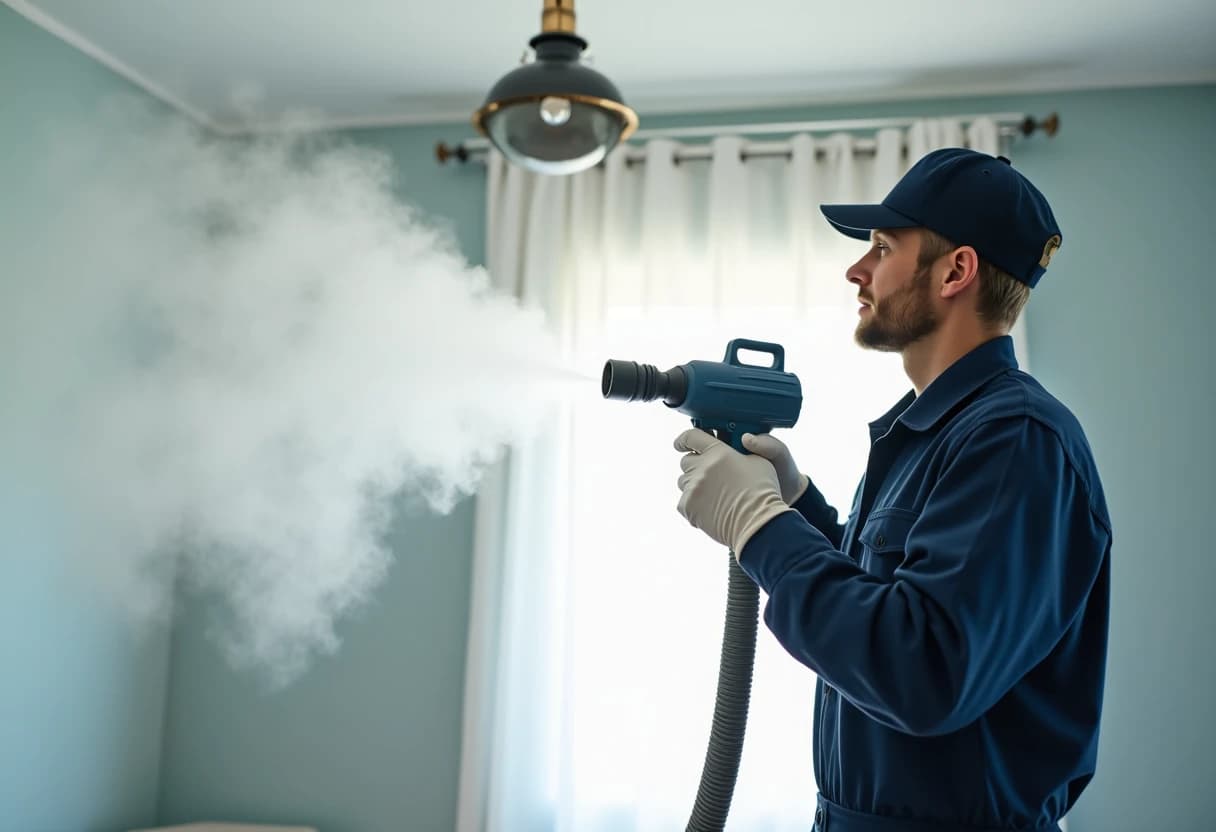
The treatment is atomized into a fine fog and introduced through the duct network while controlled airflow carries it the length of every supply and return. The fog deposits on all interior surfaces — including the seams, joints and corrugations mechanical cleaning cannot polish — killing odor-causing bacteria and neutralizing microbial residue on contact. Full-system coverage takes under an hour in most homes.
5Coil, Drain Pan & Blower Treatment
Every fogging visit includes hands-on treatment of the components the fog alone cannot adequately address: coil fins treated with appropriate cleaner, drain pan scrubbed and sanitized, condensate line flushed, blower compartment wiped and treated. If we find heavy coil fouling or standing water that signals a bigger problem, we document it with photos and quote the fix separately — informed consent, never ambush.
6Deodorizing Pass for Stubborn Odors
Severe cases get layered treatment: antimicrobial fogging for the biology, counteractant application for chemical residue, and where warranted, guidance on the adjacent surfaces — returns pull air across ceilings and walls, and a smoke-saturated house can re-seed clean ducts. We are candid about that boundary: ducts are our domain, and we will tell you when a whole-home odor needs remediation beyond them.
7System Airing, Verification & Walkthrough
After label contact time elapses, we run the system to air the treatment through, reinstall registers, and walk the home with you register by register. You should smell neutral air — not fragrance, not chemicals, nothing. You receive the product documentation, re-entry guidance already satisfied by the airing process in most cases, and our callback commitment if any trace of the original odor resurfaces.
Benefits of Professional Air Duct Sanitizing & Deodorizing in Abington
Pet Odor Elimination That Actually Holds
Multi-pet and long-tenure pet households benefit most: the accumulation scales with animal-years, and no surface cleaning touches the duct-borne share. Post-treatment, the improvement compounds — ongoing dander still sheds, but it lands in a neutral system rather than layering onto decades of saturated film, and routine filter changes keep the new baseline for years.
Microbial Load Reduced System-Wide
After specific contamination events — pest activity in the ducts, confirmed mold, water intrusion — this benefit becomes the headline: droppings, spores and bloom residue carry genuine pathogen and allergen loads, and mechanical cleaning alone does not neutralize them. The EPA-registered treatment does, which is why sanitizing moves from optional to advised the moment contamination history enters the picture.
Smoke Ghosts Finally Evicted
Tobacco residue is the most persistent household odor there is — tar and nicotine films bond to duct metal and off-gas for years, outliving paint, carpet and every previous owner. Our layered treatment pairs antimicrobial fogging with odor-counteractant chemistry that neutralizes the smoke compounds specifically, which is why it succeeds where repainting and time both failed.
A True Reset for Newly Purchased Homes
For buyers of older Massachusetts homes especially, the duct system may hold half a century of prior households. A documented cleaning and EPA-registered treatment resets it to a known-clean baseline — valuable for allergy-prone families, essential where the sellers had pets or smoked, and reassuring in any home whose maintenance history is a shrug. Start fresh literally.
Odors Neutralized at the Source, Not Masked
The failure of masking is chemical: fragrance molecules and odor molecules coexist, so the nose gets both — that sickly candle-over-dog note every guest recognizes. Neutralization is different chemistry entirely: the odor compounds are broken down or bound, and the bacteria regenerating them are killed. Once the source stops producing, nothing needs covering, and the difference is unmistakable at the front door.
Small Add-On Cost, Outsized Payoff
Standalone treatments run $250 to $500; bundled with cleaning, the marginal cost drops by half or more. That pricing asymmetry is why we encourage odor-motivated customers to book the pairing — one visit, one setup, both halves of the fix. The alternative sequence, cleaning now and a separate sanitizing visit after the smell persists, costs more and delays the result.
Signs Your Abington Home Needs Air Duct Sanitizing & Deodorizing
Odors Return No Matter How Much You Clean
The tell is the rhythm: rooms smell fine with the system off, and the odor rebuilds when it runs. Surfaces cannot cause that pattern; airflow can. Homeowners often spend months eliminating suspects — carpets, drains, trash areas, basements — before checking the one system that touches every room. The register test takes ten seconds: smell the air it delivers.
After Pests, Mold or Water in the System
Water events prime duct systems for microbial bloom: damp film, warm darkness, abundant food. If your basement flooded, a pipe let go, or humidity ran uncontrolled for a season, sanitizing after cleanup suppresses the bloom before it establishes — cheaper and easier than the mold removal that established growth eventually demands.
Pets Present or Past
Current pets write dander into the duct film continuously; previous owners' pets left their chapters behind. Either way the system holds an animal-scent reservoir that surface cleaning never touches. If the house smells of pets anywhere, it smells of pets from the registers — and treating the registers' source is the only fix with reach into every room.
Guests Notice a Smell You No Longer Can
The cruelest version arrives during a home sale: buyers and agents smell in thirty seconds what you have not smelled in years, and it costs you at the negotiating table either way. Pre-listing duct sanitizing addresses the odor you cannot perceive at its distribution point — which is why experienced listing agents put it on the prep checklist.
Smoke History in the Home
If any era of the home's life included indoor smoking, the duct network carries the tar-and-nicotine film to prove it — and that film off-gasses for years, strongest on warm humid days when the residue softens. Paint and carpet replacement miss it entirely. Counteractant duct treatment is the step that finally clears a smoker's house.
Musty Blast When the Heat or AC Starts
Cycle-start odor means the smell is being generated inside the system and flushed out with the first air movement. Intermittent mustiness responds fully to sanitizing; a strong, constant or worsening version can indicate active mold colonization, which our inspection distinguishes — a difference that matters, since mold removal involves containment protocols and different pricing.
Air Duct Sanitizing & Deodorizing Cost in Abington, MA
Compare the cost against what duct-borne odors actually extract from households. Masking products — candles, plug-ins, sprays — run $200 to $500 annually for a committed household and resolve nothing. Consumer ozone generators cost $100 to $400, carry EPA warnings, and leave the odor source intact. Carpet replacement motivated by a smell that turns out to be duct-borne runs $2,000 to $6,000 and fails on arrival, since the system re-scents new fibers within months. Repainting for smoke odor without treating the ducts: $3,000 to $8,000, same outcome. Against that landscape, $250 to $500 for professional source treatment — or $75 to $200 added to a cleaning you may need anyway — is not the premium option; it is the only option priced against the actual problem. For sellers the math sharpens further: listing agents consistently report that odor-flagged homes show worse and negotiate weaker, with concessions that dwarf the treatment cost by an order of magnitude. Fresh-smelling is the cheapest staging money can buy.
Want the full pricing picture? See our complete Boston-area cost guide or call (617) 390-7145 for an exact flat quote for your Abington home.
Local Knowledge: Abington, Plymouth County
What makes Abington different? Abington's housing runs from modest late-1800s Victorians and farmhouses near the old town center to waves of postwar capes, ranches and split-levels built as the South Shore suburbanized, with newer subdivisions and townhouse developments filling in along Route 18. Many of the mid-century homes started life with oil furnaces and have since been converted to gas forced-air, so ductwork ages and configurations vary widely street to street. Abington sits on the wet, wooded edge of the Hockomock drainage, and the town's many slab and shallow-basement ranches are prone to damp crawlspaces that feed moisture straight into supply trunks. We regularly find rusted boots and musty return runs in homes near Island Grove Pond, where humidity hangs on well into fall. For duct and dryer vent systems, those local factors translate into specific, predictable problems — and predictable problems are the ones we solve fastest. Call (617) 390-7145, tell us your street and home style, and we will quote the job accurately the first time, usually in under five minutes.
The Best Time of Year in Abington
Duct odors in Massachusetts follow the calendar, and so should treatment timing. Late summer is peak mustiness: July and August humidity has been condensing in the system for weeks, the microbial film is at maximum activity, and the smell at AC start-up is at its yearly worst — sanitizing now delivers the most dramatic before-and-after. Early fall is the strategic window: treating the system before the heating season means the closed-window months ahead circulate neutral air instead of concentrating whatever summer grew. The heating season itself is when odor complaints peak — not because ducts get dirtier in winter, but because sealed houses concentrate what the system holds, and the household finally notices what open windows had been diluting since May.
Why Choose Boston Air Duct Cleaners
We built this company around the jobs other duct cleaners do badly: the 130-year-old Victorian with panned-joist returns, the Abington condo with a 60-foot dryer run to the roof, the post-renovation house full of drywall dust. Our crews see Greater Boston's hardest systems every week, and the experience shows in the details — floor protection on the way in, sealed registers during the work, HEPA-vacuumed work areas on the way out, and imagery that proves the ducts are actually clean. Call (617) 390-7145 and judge the difference from the first conversation.
Serving Abington and Surrounding Communities
Beyond Abington, our crews cover the surrounding communities daily — including Rockland, Whitman, Brockton, Holbrook, Weymouth, Hanson. Because routes cluster geographically, booking alongside a neighboring appointment often unlocks same-day service and combined-visit savings. Wherever you are in Plymouth County, the same flat-rate pricing, insured technicians and photo-documented process applies.