
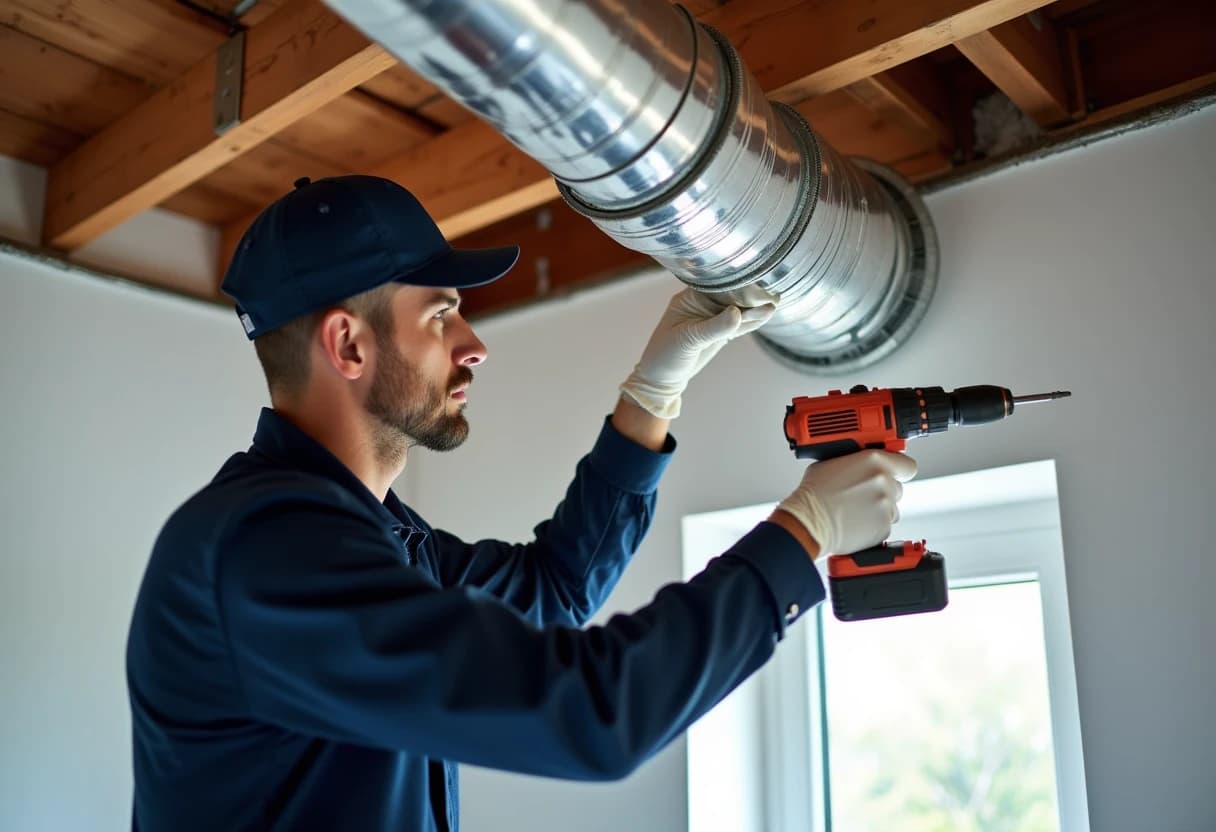
The building code is specific about dryer venting for a reason written in fire statistics: the IRC's dryer exhaust rules (Section M1502) call for smooth-interior rigid metal duct, a 4-inch diameter, a maximum equivalent length of 35 feet with deductions for every elbow, no fasteners protruding into the airstream, and a termination with a backdraft damper and no screen. Most Greater Boston homes fail several of those tests, because their vents were improvised generations ago. Our installation service brings your Abington laundry up to that standard — a new route where the old one is hopeless, rigid metal end to end, and documentation that satisfies inspectors, insurers and condo boards.
Why Dryer Vent Installation & Rerouting Matters for Abington Homes
New England's housing stock makes professional installation more consequential here than almost anywhere. Triple-deckers and brownstone conversions put laundry deep in floor plans, far from legal termination points, demanding careful route planning against the length budget. Balloon-framed Victorians hide cavities that swallow flex duct into inaccessible, uncleanable runs. Stone and brick foundations require masonry penetrations done with the right tools and flashing. Retrofitted basement laundries sit below grade, where the only paths out are up through the rim joist or across to a window bay — and where cold foundation walls make uninsulated duct a condensation machine. Condo associations layer approval processes and insurance requirements on top. We work these constraints every week: our installers carry the drills, core bits, flashing and fittings the old construction demands, we insulate runs crossing unheated space as a standard practice, and we provide the certificates and documentation associations require. The result is a vent that fits the building it serves — not a catalog diagram forced into a house that predates the catalog by a century.
Condo and multi-family installation around Island Grove Park is its own discipline, and Abington associations know the stakes: one bad vent in a shared structure is everyone's fire risk. Abington's housing runs from modest late-1800s Victorians and farmhouses near the old town center to waves of postwar capes, ranches and split-levels built as the South Shore suburbanized, with newer subdivisions and townhouse developments filling in along Route 18. Many of the mid-century homes started life with oil furnaces and have since been converted to gas forced-air, so ductwork ages and configurations vary widely street to street. We manage the full process — written scopes for board approval, certificates of insurance, penetrations planned with the building envelope and neighboring units in mind, and per-unit documentation on completion. Abington sits on the wet, wooded edge of the Hockomock drainage, and the town's many slab and shallow-basement ranches are prone to damp crawlspaces that feed moisture straight into supply trunks. We regularly find rusted boots and musty return runs in homes near Island Grove Pond, where humidity hangs on well into fall. For triple-deckers and small associations we can rough in venting for multiple units in one mobilization, which cuts per-unit cost substantially and gives the building one consistent, compliant system.
Our Dryer Vent Installation & Rerouting Process in Abington
1Site Assessment & Route Planning
The technician maps what exists and what is possible: where the dryer sits (or will sit), which walls are exterior, what the framing and foundation allow, and where obstacles — plumbing, wiring, ductwork, finished ceilings — constrain the path. Shortest is best: fewer feet and fewer elbows mean faster drying and slower lint accumulation for the life of the system.
2Demolition of Non-Compliant Venting
Replacement jobs start with removing what failed: vinyl and foil flex pulled from cavities and joist bays, abandoned duct capped or extracted, screened hoods and window inserts taken out, and improvised terminations into attics or crawlspaces closed off. We vacuum the lint these systems have shed along their routes — hidden accumulation that should not stay in the structure.
3Cut & Flash the Exterior Penetration
Penetrations are where amateur installs leak — water into sheathing, air into cavities. Ours are built like window details: sized to the hood, flashed to shed water over the cladding, sealed with quality exterior sealant, and finished so the termination looks intentional on the facade. On masonry we drill and anchor; we never improvise attachment.
4Install Rigid Metal Duct on the Planned Route
The run goes in as 4-inch smooth-interior rigid metal duct — the material the IRC specifies — cut to fit, joined male-to-female in the direction of airflow, and assembled without a single screw protruding into the airstream: joints are clamped or externally fastened and sealed with UL-listed foil tape. Elbows are used sparingly and counted against the length budget.
5Mount the Termination Hood & Damper
Termination choice is matched to the route: low-profile wall hoods for clapboard and shingle, masonry-mounted hoods for brick, rim-joist hoods for basement exits, and dedicated dryer roof caps — never plumbing-style caps — for vertical runs. Each is chosen for damper quality, because the damper is the moving part that determines how the termination survives New England weather.
6Connect the Appliance & Seal the System
Gas dryers are handled with the care the fuel demands: the flexible gas connector unstrained, the machine leveled and positioned, and the connection checked before operation. Electric units get cords routed clear of the duct. The appliance end is where good systems get ruined by casual reconnection, so we finish it to the same standard as the concealed run.
7Test, Verify & Document the Installation
Commissioning is non-negotiable: we run a full dryer cycle and verify strong, steady exhaust at the termination with the damper standing fully open — the visible proof the system delivers its design airflow. Where useful we measure and record the airflow, giving your annual cleanings a baseline number to verify against for years.
Benefits of Professional Dryer Vent Installation & Rerouting in Abington
Decades of Service From a One-Day Job
The one-day timeline is real for most installations: assessment and route confirmation, demolition of old venting, penetration, duct assembly, termination, connection and commissioning typically fit a single visit. Complex reroutes through finished space may take a second day. Either way, laundry is back in service the same evening.
Dramatically Faster Drying
Every elbow removed and every foot shortened is resistance the dryer no longer fights on every load, forever. The performance gain is not subtle on bad systems — 30 to 50 percent cycle-time reductions are common when we replace overlong flex runs — and unlike an appliance upgrade, it benefits every dryer the laundry will ever have.
Fire-Safe by Design, Not by Vigilance
The safety margin compounds with maintenance: rigid duct is fully brushable, so every annual cleaning actually reaches every surface — something no cleaning can honestly claim on a corrugated flex run threaded through cavities. You are not just starting cleaner; you are cleanable, permanently.
Code Compliance That Closes Every Question
Compliance has practical teeth in transactions: dryer venting is among the most commonly flagged items in Massachusetts home inspections, and an improvised system becomes a negotiation item or a closing repair. A documented compliant installation converts that liability into a selling point — visible evidence of a well-maintained house.
A Laundry Located Where You Actually Want It
For renovations, early vent planning is leverage: consulted while walls are open, we can route a short, straight, fully concealed run that would be expensive or impossible after drywall. A ten-minute conversation at framing stage regularly saves homeowners hundreds of dollars and a compromised route.
Moisture Managed, Structure Protected
Every load pushes about a gallon of water vapor through the vent, and an engineered system delivers all of it outdoors: continuous slope drains any condensate to the termination, insulation keeps exhaust above its dew point across cold spaces, and sealed joints leave nothing to drip. Your framing, insulation and finishes stay dry, load after load, year after year.
Signs Your Abington Home Needs Dryer Vent Installation & Rerouting
Chronic Condensation the Route Guarantees
Watch the laundry itself: loads that come out damp-smelling, a duct that drips after cycles, rust tracks under joints. Chronic internal moisture is rotting the system from the inside while it feeds blockages. The permanent fix is a route engineered for New England winters, not another season of drip trays and patches.
A New Laundry Location Needs Its First Vent
Moving laundry upstairs, finishing a basement, building an in-law suite or converting a condo all create the same requirement: a new exhaust route, designed before the walls close if at all possible. Vent routing decided at the framing stage is shorter, cheaper and cleaner than the same route retrofitted through finished surfaces months later.
The Run Is Overlong or Elbow-Heavy
Basement laundries venting to a far wall are the classic offenders — installed where the first hole was easiest, not where the route was shortest. Our assessment often finds a rim-joist or near-wall exit that cuts the run by half or more. Ask for the measurement; the equivalent-length math takes ten minutes and settles the question.
The Dryer Vents Indoors — Anywhere
Indoor venting is often invisible until you look: the duct disappears upward and no exterior hood exists anywhere on the house. If you cannot find your termination outside, find out where the exhaust actually goes — attic discoveries after years of indoor venting routinely involve soaked insulation, staining and mold remediation on top of the vent work.
Your Vent Is Flexible Plastic or Foil Duct
Flex duct concealed in walls and cavities is the worst case: it cannot be effectively brushed, so no cleaning ever truly clears it, and it accumulates lint until it blocks. If a cleaning service has ever told you your run 'can't really be cleaned,' this is what they meant — and rigid replacement is the answer.
Inspection, Insurance or Association Requirements
Condo associations across Greater Boston have tightened dryer vent requirements after regional fire losses, and some now mandate compliant installation on unit turnover or renovation. If your building has issued requirements, we handle the full sequence: scope for board approval, insured installation, and per-unit documentation for the association's records.
Dryer Vent Installation & Rerouting Cost in Abington, MA
Multi-family and condo installation pricing carries a few specifics worth knowing up front. Roof terminations — common for interior condo laundries — sit toward the top of the range for the flashing and access work, typically $650 to $900 for the full installation. Association requirements add process rather than much cost: we provide written scopes for board approval and certificates of insurance at no charge, and our documentation is built to satisfy trustee and management-company review. The meaningful savings lever is coordination: when a triple-decker owner or association books multiple units in one mobilization, shared setup, staging and travel drop per-unit pricing by 20 to 30 percent, and the building ends up with one consistent, compliant system instead of three eras of improvisation. For laundry-relocation projects inside renovations, timing is the lever: venting roughed in while walls are open routinely costs $200 to $400 less than the identical route built after finishes, which is why we encourage a planning call at the framing stage — free advice that saves real money.
Want the full pricing picture? See our complete Boston-area cost guide or call (617) 390-7145 for an exact flat quote for your Abington home.
Local Knowledge: Abington, Plymouth County
Serving Abington means knowing Abington. Abington's housing runs from modest late-1800s Victorians and farmhouses near the old town center to waves of postwar capes, ranches and split-levels built as the South Shore suburbanized, with newer subdivisions and townhouse developments filling in along Route 18. Many of the mid-century homes started life with oil furnaces and have since been converted to gas forced-air, so ductwork ages and configurations vary widely street to street. Abington sits on the wet, wooded edge of the Hockomock drainage, and the town's many slab and shallow-basement ranches are prone to damp crawlspaces that feed moisture straight into supply trunks. We regularly find rusted boots and musty return runs in homes near Island Grove Pond, where humidity hangs on well into fall. Those conditions shape how we work here: which brush heads come off the truck, how we protect finishes in older interiors, and what we expect to find when the camera goes into a 02351 duct system. Our crews are in and around Abington nearly every week — often for neighbors of past customers — so scheduling is fast and our arrival windows hold.
The Best Time of Year in Abington
Humid summers argue for good vent design from the opposite direction. When dew points sit in the seventies, dryer exhaust barely cools before reaching saturation, and any route flaw — a belly, a leak, an oversized dead-air section — collects water through the muggy months while basement laundries add ambient humidity of their own. Summer is also when improvised indoor venting does its worst damage, loading attics and crawlspaces with moisture exactly when the structure cannot dry. And at the termination, summer is nesting season: hoods without proper dampers and guards acquire tenants between March and June. A properly designed system shrugs all of it off — sealed, sloped, insulated, guarded — which is why summer's symptoms are so often what finally send homeowners to the phone.
Why Choose Boston Air Duct Cleaners
We built this company around the jobs other duct cleaners do badly: the 130-year-old Victorian with panned-joist returns, the Abington condo with a 60-foot dryer run to the roof, the post-renovation house full of drywall dust. Our crews see Greater Boston's hardest systems every week, and the experience shows in the details — floor protection on the way in, sealed registers during the work, HEPA-vacuumed work areas on the way out, and imagery that proves the ducts are actually clean. Call (617) 390-7145 and judge the difference from the first conversation.
Serving Abington and Surrounding Communities
We serve every community around Abington as well: Rockland, Whitman, Brockton, Holbrook, Weymouth, Hanson all fall inside our regular service routes. If you have a second property, a rental, or family nearby, ask about multi-home scheduling — grouped appointments on the same route are our most requested discount.