
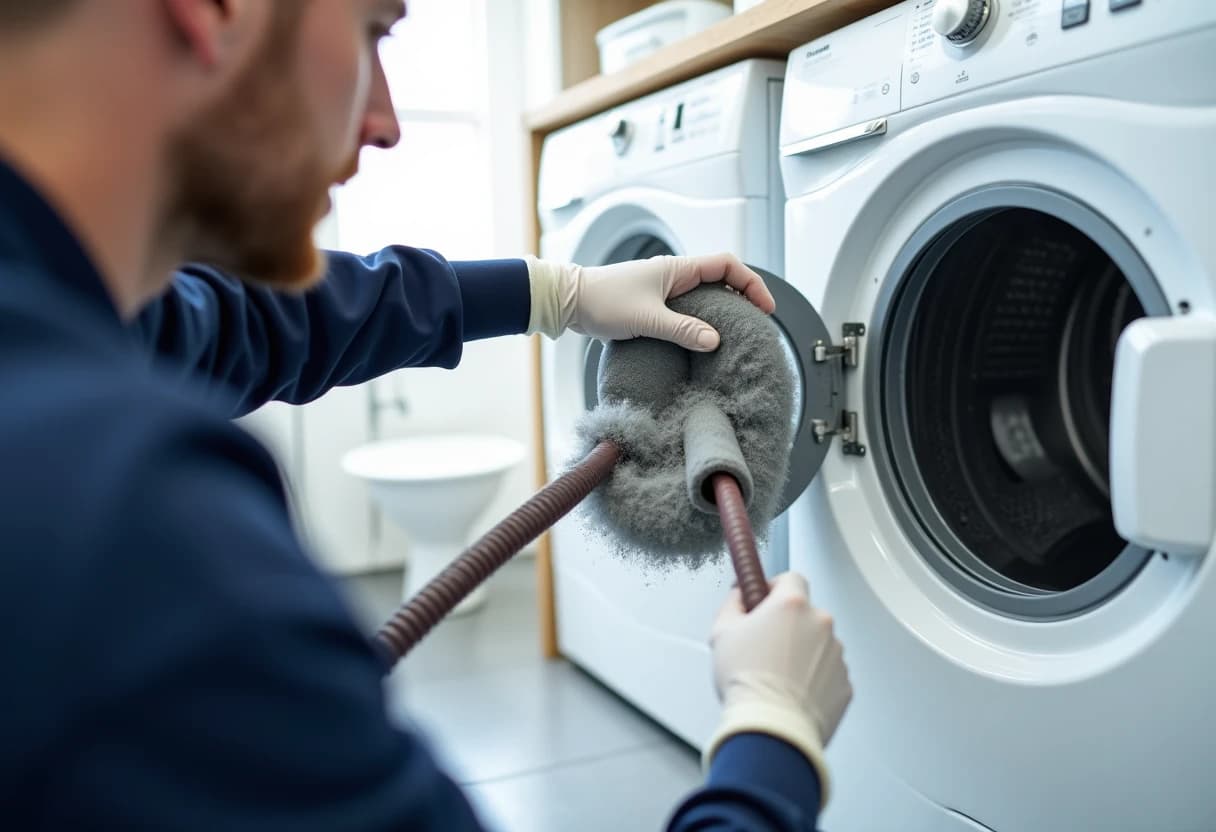
If your dryer takes two cycles to dry a load that used to take one, the problem is almost never the dryer — it is the vent. A lint-restricted exhaust line traps hot, moist air in the drum, stretching drying times, wasting electricity or gas, and overheating the very lint that lines the duct. Our certified technicians clean Abington dryer vents end to end with flexible rotary brush systems and HEPA-filtered vacuums, restoring full airflow in about an hour. The result is a dryer that works like new, utility bills that drop, and a fire hazard removed from the middle of your home.
Why Dryer Vent Cleaning Matters for Abington Homes
The fire statistics on clothes dryers deserve to be taken literally. FEMA's national estimates attribute roughly 2,900 residential fires per year to clothes dryers, causing an estimated five deaths, one hundred injuries and $35 million in property loss — and the leading factor, cited in about a third of these fires, is failure to clean. The mechanism is simple: lint escapes past the screen on every cycle, accumulates in the duct, restricts airflow, and drives exhaust temperatures upward until the lint itself — which ignites easily and burns fast — meets a hot enough surface or a stray spark from the dryer's heating element. A professional cleaning breaks every link in that chain at once. It removes the fuel, restores the airflow that keeps operating temperatures in the safe range, and gives a trained technician a look at the transition duct, joints and termination where problems concentrate. For $149 to $299, it is the cheapest fire prevention a homeowner can buy, and it pays part of itself back in energy savings immediately.
Ask around Abington Town Hall and you will find neighbors who learned about dryer vent fires the hard way — a scorched load, a melted transition hose, a fire department visit. Abington sits on the wet, wooded edge of the Hockomock drainage, and the town's many slab and shallow-basement ranches are prone to damp crawlspaces that feed moisture straight into supply trunks. We regularly find rusted boots and musty return runs in homes near Island Grove Pond, where humidity hangs on well into fall. Abington's housing runs from modest late-1800s Victorians and farmhouses near the old town center to waves of postwar capes, ranches and split-levels built as the South Shore suburbanized, with newer subdivisions and townhouse developments filling in along Route 18. Many of the mid-century homes started life with oil furnaces and have since been converted to gas forced-air, so ductwork ages and configurations vary widely street to street. Those local conditions are why we treat Abington dryer vent cleaning as a safety service, not a courtesy add-on: full-length rotary brush cleaning, HEPA capture, termination and damper service, transition duct inspection, and an airflow check at the end that proves the line is clear. Residents of Rockland and Whitman book the same service, which is why our trucks are in this part of Plymouth County nearly every week.
Our Dryer Vent Cleaning Process in Abington
1Inspect the Dryer, Transition Duct & Vent Path
We start behind the dryer: pulling the machine, examining the transition duct for crushing, kinks or foil accordion material, and tracing the vent's full path from connection to exterior termination. Mapping the run tells us its length, elbow count and materials — and lets us confirm your flat price before any cleaning begins.
2Protect the Laundry Area & Disconnect the Dryer
We treat laundry rooms — often tight, finished spaces — with the same care as any living area: drop cloths down, dryer walked out on protective sliders, and the work zone contained. Disconnecting at the appliance gives us a clean entry point into the duct and a chance to inspect the connection hardware that so often leaks lint into the wall cavity.
3Rotary Brush the Full Length of the Duct
Mechanical agitation is what separates professional cleaning from blow-through methods. The rotary brush physically breaks up compacted lint that air pressure alone would only compress further. We select brush heads sized to your duct — standard 4-inch for code-compliant lines, alternates for older oversized or reduced runs — so the bristles actually contact the duct wall the whole way.
4Capture Everything With HEPA Vacuum Extraction
Loosened lint has to go somewhere, and we make sure that somewhere is our vacuum. HEPA filtration captures the fine fiber dust that ordinary shop vacs exhaust straight back into the air — important in tight laundry areas and essential for allergy-sensitive households. Most cleanings fill a startling bag; we are happy to show you the haul.
5Clean From the Exterior Termination Inward
We then work the line from the outside in — wall hood, soffit outlet or roof cap. Exterior terminations trap their own debris: lint mats behind the damper, bird and rodent nests, and screening clogged solid. Roof terminations get full ladder or roof access; we carry the gear, and steep or high work is included in the quoted price.
6Service the Transition Duct & Reconnect
Before reconnecting, we vacuum the dryer's own lint trap housing and accessible internal ducting, where years of screen bypass collects near the heating element. Then the transition duct is cleaned or replaced, clamped properly — never screwed, since screw tips inside the airstream snag lint — and the dryer is positioned to leave the duct an easy, unkinked path.
7Verify Airflow & Walk You Through the Results
We run the dryer and inspect the termination together — you should see the damper flap standing open under confident airflow, something many homeowners have literally never observed on their own vent. Your technician reviews photos, flags any code or condition issues for future attention, and records your service date for an annual reminder.
Benefits of Professional Dryer Vent Cleaning in Abington
Documentation for Insurance, Condos & Peace of Mind
The quiet benefit is simply knowing. A dryer vent is invisible infrastructure that most homeowners have never once seen inside — and after our visit, you have photos, airflow numbers and a professional's assessment on file. That certainty, renewed once a year, is worth the modest price by itself.
Faster Drying Times
A blocked vent traps humid air in the drum, so the dryer tumbles wet clothes in wet air. Clearing the line lets each cycle actually exhaust the gallon of water a typical load releases. Drying times commonly drop 30 to 50 percent after cleaning a significantly restricted vent — time you get back every laundry day.
Dramatically Reduced Fire Risk
Roughly 2,900 home dryer fires occur each year in the US, and the leading factor is simply failure to clean. An annual professional cleaning takes that statistic off your list of worries for about the cost of a dinner out. Few home services offer a clearer safety return on such a modest price.
Less Moisture, Mildew & Musty Odor
Each load exhausts about a gallon of water as vapor. When the vent is blocked, that moisture backs into the laundry room and the duct itself — condensing on walls, peeling paint, and feeding mildew. A clear vent sends the humidity outside, drying out the laundry area and eliminating the damp, musty smell that clings to blocked systems.
Lower Energy Bills
Every minute of unnecessary drying time is metered energy. A restricted vent that doubles cycle times roughly doubles the dryer's share of your utility bill — often $10 to $20 a month for an average household. Annual cleaning typically pays for a large fraction of itself in the first year of restored efficiency.
Longer Dryer Lifespan & Fewer Repairs
The high-limit safety switch in your dryer is not meant to cycle constantly; when a blocked vent makes it do so, the switch and the heating element both wear prematurely. A $149 to $299 annual cleaning routinely prevents $200 to $400 repair visits, and postpones the eventual $800 to $1,200 replacement by years.
Signs Your Abington Home Needs Dryer Vent Cleaning
Laundry Room Gets Hot and Humid
Watch for secondary evidence: peeling paint near the dryer, mildew spots on the ceiling above it, a musty smell that lingers after laundry day, rust on shelf brackets. All are condensation footprints from exhaust escaping into the room through a restricted or leaking duct rather than exiting the house.
The Exterior Vent Flap Barely Opens
Step outside during a drying cycle and look at the termination hood. The damper should stand fully open with a strong, warm airstream you can feel from a foot away. A flap that flutters weakly, opens halfway or stays shut is showing you the blockage directly — the cheapest diagnostic in home maintenance.
It Has Been More Than a Year
The NFPA, FEMA and every major dryer manufacturer converge on the same guidance: professional vent cleaning at least annually, more often for heavy use. If you cannot remember your last cleaning — or know there has never been one — the schedule alone says you are due, whatever the symptoms.
Dryer or Clothes Are Hot to the Touch
A dryer cabinet too hot to rest a hand on, or clothes that come out scorching, means exhaust heat is not leaving the machine. That heat is being absorbed by the dryer's components — and by the lint in the duct. This is the pre-ignition condition fire investigators describe; treat it as urgent, not cosmetic.
Clothes Take More Than One Cycle to Dry
Modern sensor-dry machines mask the problem by simply running longer, so watch total time rather than dampness. A sensor cycle that used to finish in 45 minutes and now runs 75 is reporting a restricted vent the only way it can. Believe it before the thermal fuse makes the point more expensively.
Lint Building Up Behind or Inside the Dryer
Visible lint at any joint, seam or connection is a flag worth acting on. It usually indicates positive pressure in the duct from a downstream blockage forcing air out through gaps — or a partially disconnected duct dumping exhaust into the wall cavity, which our inspection will catch.
Dryer Vent Cleaning Cost in Abington, MA
It helps to weigh the price against the alternatives. A $149 to $299 annual cleaning stands against: $10 to $20 a month in energy waste from a restricted vent; $150 to $400 appliance repair visits for blown thermal fuses and burned elements that blocked vents cause; $800 to $1,200 for the dryer replacement that chronic overheating hastens; and the uncapped cost of a lint fire, which averages five figures in property damage even when contained quickly. Insurance data and FEMA's fire statistics make dryer vent cleaning one of the highest-return maintenance dollars in the home. We keep the pricing flat and published because the service only works as prevention if people actually book it annually — surprise invoices are how homeowners talk themselves into skipping years, and skipped years are how blockages happen.
Want the full pricing picture? See our complete Boston-area cost guide or call (617) 390-7145 for an exact flat quote for your Abington home.
Local Knowledge: Abington, Plymouth County
What makes Abington different? Abington's housing runs from modest late-1800s Victorians and farmhouses near the old town center to waves of postwar capes, ranches and split-levels built as the South Shore suburbanized, with newer subdivisions and townhouse developments filling in along Route 18. Many of the mid-century homes started life with oil furnaces and have since been converted to gas forced-air, so ductwork ages and configurations vary widely street to street. Abington sits on the wet, wooded edge of the Hockomock drainage, and the town's many slab and shallow-basement ranches are prone to damp crawlspaces that feed moisture straight into supply trunks. We regularly find rusted boots and musty return runs in homes near Island Grove Pond, where humidity hangs on well into fall. For duct and dryer vent systems, those local factors translate into specific, predictable problems — and predictable problems are the ones we solve fastest. Call (617) 390-7145, tell us your street and home style, and we will quote the job accurately the first time, usually in under five minutes.
The Best Time of Year in Abington
Fall is the strategic season for dryer vent cleaning in Massachusetts, and not only because winter laundry is coming. Fall is when heating systems seal the house — windows shut, mechanical ventilation doing all the work — which raises the stakes on any appliance that exhausts into, rather than out of, the building envelope. A restricted or leaking dryer vent in a closed-up house pushes moisture and, for gas dryers, combustion byproducts into air that will not be refreshed until April. An October cleaning means the vent enters the closed-window months verified clear, the damper moves freely before the first freeze, and holiday-season laundry marathons run on full airflow.
Why Choose Boston Air Duct Cleaners
Boston Air Duct Cleaners is a local, owner-operated company based at 1121 Washington St in West Newton — not a national franchise dispatching subcontractors. Every crew is our own: background-checked, factory-trained on commercial negative-pressure equipment, and fully insured. We quote flat prices before work begins, document every job with before-and-after photos, and follow NADCA-standard source-removal methods on every system we touch. That is why so much of our work comes from repeat customers, property managers and word-of-mouth referrals across Plymouth County.
Serving Abington and Surrounding Communities
Abington sits in the heart of our service area, and neighboring Rockland, Whitman, Brockton, Holbrook, Weymouth, Hanson appointments share the same routes. That density is why our response times in this part of Plymouth County are among our fastest — and why you will see our trucks in the area week after week.