
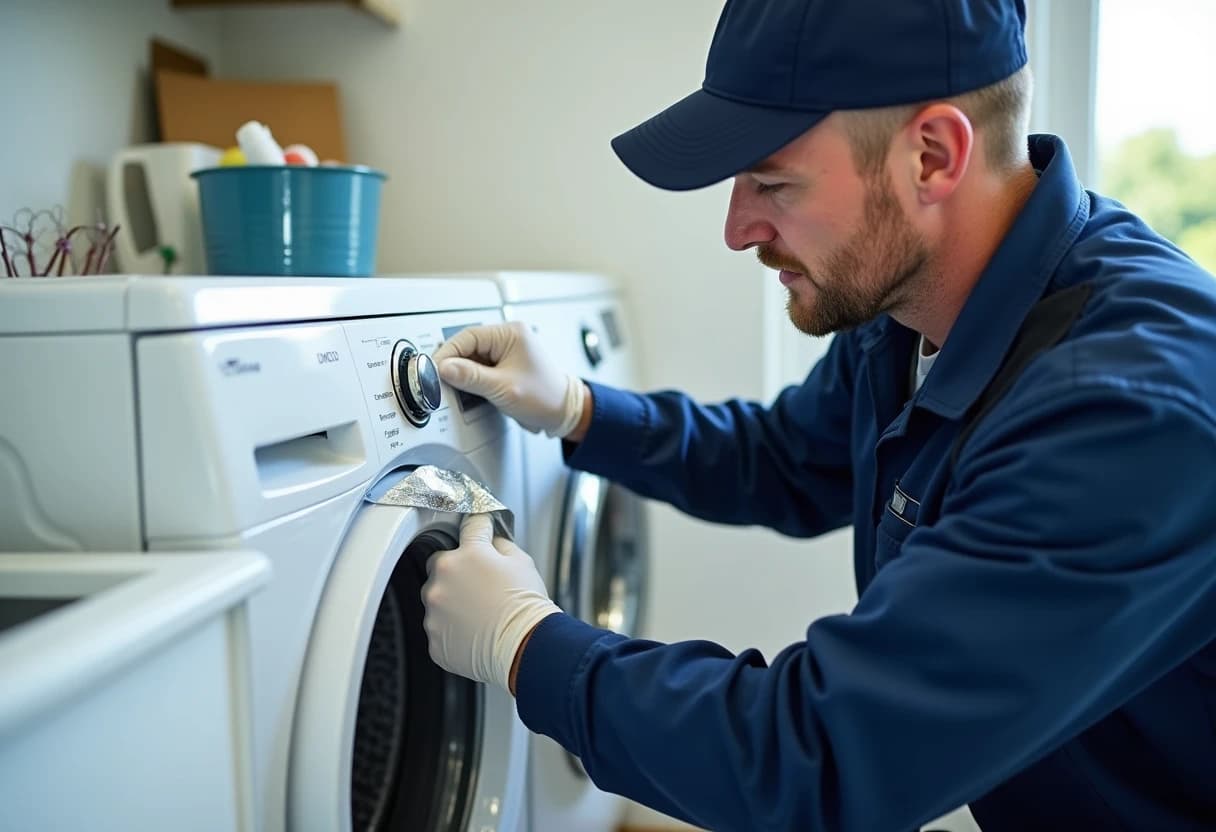
Condensation is the quiet destroyer of dryer vents in New England. Warm, moisture-saturated exhaust travels through ducts that pass cold basements, crawlspaces and exterior wall cavities; wherever the duct runs cold, that vapor condenses, soaking lint into blockage-forming mats, rusting metal duct from the inside, dripping from joints, and staining ceilings below. Our Abington repair service addresses condensation at its causes: sealing leaking joints, correcting sags where water pools, insulating duct sections that pass through unheated space, restoring proper slope, and replacing corroded runs. The fix is specific to your vent's routing — which is why every repair starts with a full-path inspection, not a guess.
Why Dryer Vent Repair Matters for Abington Homes
There is also a timing argument: dryer vent damage compounds, and early repair is dramatically cheaper than late repair. A loose joint today is a separated joint next year — and a wall cavity full of lint and moisture the year after, when the fix has grown from a $150 reconnection into drywall opening, cavity cleaning, and possibly mold remediation. A crushed transition hose today is a strained heating element and blown thermal fuse next winter, adding an appliance repair bill to the vent repair that was needed anyway. A failing damper today is a nest blockage by spring. This is why we treat inspection as the heart of the service: our technicians walk the entire exhaust path, test airflow at both ends, and give you a photographed, prioritized picture of what is failing and what it costs to fix now versus later. Most Abington repairs land between $150 and $450 and finish in a single visit — a modest price for closing off the expensive futures.
Dryer vent damage in Abington is largely a story about the buildings. Abington's housing runs from modest late-1800s Victorians and farmhouses near the old town center to waves of postwar capes, ranches and split-levels built as the South Shore suburbanized, with newer subdivisions and townhouse developments filling in along Route 18. Many of the mid-century homes started life with oil furnaces and have since been converted to gas forced-air, so ductwork ages and configurations vary widely street to street. Laundry hookups in homes like these were added long after construction, so vents thread through old framing, hug cold foundation walls and rely on joints assembled in cramped, concealed spaces — precisely the conditions that produce separations, crush points and condensation. Abington sits on the wet, wooded edge of the Hockomock drainage, and the town's many slab and shallow-basement ranches are prone to damp crawlspaces that feed moisture straight into supply trunks. We regularly find rusted boots and musty return runs in homes near Island Grove Pond, where humidity hangs on well into fall. Our repair crews work in Abington weekly and arrive equipped for its housing stock: rigid metal duct and fittings in the sizes older runs need, insulation for cold-space sections, and the patience concealed ductwork demands.
Our Dryer Vent Repair Process in Abington
1Diagnose the Full Exhaust Path
Your technician maps the vent's routing, materials and condition: transition hose state, joint integrity, crush points, sag, corrosion, termination function. Where the run is concealed, airflow measurements and inspection tools tell us what the walls hide. You get a photographed diagnosis and a flat repair quote before any work begins.
2Protect the Area & Open Access
Before repair work, we protect floors and finishes along the work path, move the dryer out carefully on sliders, and set up at the failure points. Where a concealed joint requires access, we discuss options first — many repairs can be made from existing openings, and when cutting is unavoidable we keep openings minimal and tell you exactly what restoration will involve.
3Reconnect & Properly Fasten Separated Joints
Where lint and moisture have escaped into a cavity through a long-standing disconnection, we vacuum accessible accumulation with HEPA equipment and document conditions with photos. Removing that hidden fuel load matters as much as the reconnection itself — and the photos give you a record for insurance or future renovation planning.
4Replace Crushed, Corroded or Non-Compliant Sections
Duct that is crushed, kinked, rusted through or made of prohibited material gets replaced, not patched. We install 4-inch smooth-interior rigid metal duct — the material the IRC's dryer exhaust rules specify — cut to fit, joined without airstream-piercing fasteners, and supported so it cannot sag into water-pooling bellies.
5Cure Condensation: Slope, Seal & Insulate
Where a run's routing makes condensation inevitable — long passages through cold space, low points that cannot be drained — we say so plainly and price the better fix: shortening or rerouting the run, which we quote as a separate option. Honest diagnosis beats a repair that treats symptoms the routing will simply recreate.
6Repair or Replace the Exterior Hood & Damper
Where pests have entered through a failed damper, we remove nesting material from the duct, clean the affected section, and install a termination with pest protection that does not restrict airflow. If the old hood was painted shut — common on older multi-family buildings — we free or replace it and note the repaint risk for the future.
7Replace the Transition Duct & Reset the Dryer
This step catches the last common failure point: many 'vent problems' are actually transition hoses flattened to a slot behind the machine. The compliant connector, correctly fitted and protected by proper dryer placement, ensures the airflow we restored in the wall actually reaches the duct from the appliance.
8Verify Airflow & Document the Repair
Finally we log the service and recommend a cleaning schedule for the repaired system — typically annual. A repaired vent with smooth rigid duct and a proper termination accumulates lint far more slowly than the failed system it replaced, and the documentation we leave shows exactly what is now behind your walls.
Benefits of Professional Dryer Vent Repair in Abington
Moisture Out of Your Walls and Ceilings
Every load of laundry exhausts about a gallon of water. A repaired, sealed vent delivers all of it outdoors; a leaking one delivers it into insulation, framing and drywall. Stopping that daily soaking is the benefit homeowners feel longest — no more spreading stains, peeling paint, mildew odors or the mold remediation bills that chronic wall moisture eventually writes.
Decades of Reliable Service From One Repair
Done with rigid metal, mechanical fastening and a quality termination, a dryer vent repair is not a patch — it is infrastructure. Properly installed rigid duct routinely outlasts the dryers connected to it, needing only annual cleaning. The failure-prone materials and joints that caused your problem simply are not there anymore.
Lower Energy and Repair Bills
A failed exterior damper is a hole in your heated envelope all winter — a 4-inch duct delivering January directly to your laundry room. Replacing it with a tight-closing hood pays for itself in heating savings and comfort, entirely apart from what it does for the dryer.
Restored Drying Performance
A crushed or separated duct throttles airflow just like a lint clog, and no amount of cleaning fixes it. Repair restores the full 4-inch path, and drying performance returns immediately — one-cycle loads, accurate sensor-dry behavior, and a machine that stops straining against backpressure it was never designed to fight.
Pest Entry Points Closed
Pest damage rarely stays at the hood: rodents that enter a duct chew insulation and nest against warm sections deep in the run. Closing the entry point promptly is far cheaper than the extended cleaning and repair an established rodent presence demands — one more reason failing dampers deserve fast attention.
A Serious Fire Hazard, Eliminated
A breached or restricted dryer vent combines the two ingredients of the roughly 2,900 annual US dryer fires: accumulating lint and rising exhaust temperatures. Repair removes both — the escape points that seed wall cavities with fuel, and the crush points and blockages that overheat the system. It is fire prevention with a wrench, and it lasts for decades.
Signs Your Abington Home Needs Dryer Vent Repair
Lint Appearing Where It Shouldn't
Lint drifting from a basement ceiling, gathering on joists, puffing from a wall register or collecting behind the dryer means exhaust is escaping the duct before the termination. Lint marks the leak like dye in water — follow it and you find the separated joint or breach. This is a repair call, not a cleaning call, and it should not wait.
Musty or Mildew Smell in the Laundry Area
EPA guidance on mold is unambiguous: control the moisture and you control the growth. In laundry areas the dryer vent is a prime suspect moisture source, and a $150 to $450 repair is dramatically cheaper than the remediation an ignored leak can eventually require.
Visibly Damaged, Kinked or Sagging Duct
Accordion-style foil or vinyl duct anywhere in the run is damage by definition — materials that codes and manufacturers rejected because they crush, snag lint and (in vinyl's case) melt. If you can see corrugations along your vent path, the repair recommendation writes itself: replace with smooth rigid metal.
Exterior Damper Broken, Stuck or Missing
Evidence of animals — chirping in the duct, nesting material at the hood, droppings near the vent line — means the termination has already failed as a barrier. We remove the nest, clean the affected duct, and install a hood with real pest protection. Spring is nesting season; the repair is best made before it.
Water Stains, Drips or Peeling Paint Near the Vent Path
A ceiling stain below a second-floor laundry, paint bubbling behind the dryer, or drips from a basement duct joint all point to exhaust moisture escaping or condensing in the run. Each load adds another gallon of vapor to the problem. Repair — sealing, sloping, insulating or replacing the affected section — stops the source; cosmetic fixes without it just repaint the symptom.
Slow Drying That Cleaning Didn't Fix
If a vent cleaning did not restore drying performance, the airflow restriction is structural: a crushed section, a collapsed inner liner, a separated joint dumping exhaust short of the hood, or a damper that cannot open. The next step is diagnosis, not another cleaning — we trace the path, find the mechanical fault, and quote its repair flat.
Dryer Vent Repair Cost in Abington, MA
Compare the repair cost against what the failure costs to keep. A leaking vent delivers roughly a gallon of water per load into your building assemblies — and chronic wall moisture matures into mold remediation and drywall work that starts around $1,500 and climbs steeply. A crushed or blocked duct overworks the dryer into $150 to $400 appliance repairs (thermal fuses, elements, switches) that recur until the vent is fixed, while adding $10 to $20 a month in energy waste. A failed damper leaks heated air all winter and invites nest blockages every spring. And every one of these failures raises fire risk in a system that already accounts for about 2,900 US home fires a year. Against that ledger, $150 to $450 for a permanent, code-compliant repair is one of the clearest-value maintenance purchases in the home. Most customers who see the diagnostic photos do not need convincing; the duct makes the argument itself.
Want the full pricing picture? See our complete Boston-area cost guide or call (617) 390-7145 for an exact flat quote for your Abington home.
Local Knowledge: Abington, Plymouth County
What makes Abington different? Abington's housing runs from modest late-1800s Victorians and farmhouses near the old town center to waves of postwar capes, ranches and split-levels built as the South Shore suburbanized, with newer subdivisions and townhouse developments filling in along Route 18. Many of the mid-century homes started life with oil furnaces and have since been converted to gas forced-air, so ductwork ages and configurations vary widely street to street. Abington sits on the wet, wooded edge of the Hockomock drainage, and the town's many slab and shallow-basement ranches are prone to damp crawlspaces that feed moisture straight into supply trunks. We regularly find rusted boots and musty return runs in homes near Island Grove Pond, where humidity hangs on well into fall. For duct and dryer vent systems, those local factors translate into specific, predictable problems — and predictable problems are the ones we solve fastest. Call (617) 390-7145, tell us your street and home style, and we will quote the job accurately the first time, usually in under five minutes.
The Best Time of Year in Abington
Winter exposes dryer vent damage that hides all year. Joints that leak slightly in summer drip visibly when exhaust moisture condenses hard against freezing duct; marginal dampers ice shut; snow buries grade-level hoods; and the season's heavy laundry loads push maximum moisture through every weak point. Massachusetts repair calls spike from December through February for exactly these reasons — and because a blocked or leaking vent in a sealed-up winter house sends its moisture and, for gas dryers, combustion byproducts into air that will not be refreshed until spring. If your vent showed symptoms last winter, repairing it in fall is the calm, scheduled alternative to an emergency call during a January cold snap with a full laundry basket waiting.
Why Choose Boston Air Duct Cleaners
Boston Air Duct Cleaners is a local, owner-operated company based at 1121 Washington St in West Newton — not a national franchise dispatching subcontractors. Every crew is our own: background-checked, factory-trained on commercial negative-pressure equipment, and fully insured. We quote flat prices before work begins, document every job with before-and-after photos, and follow NADCA-standard source-removal methods on every system we touch. That is why so much of our work comes from repeat customers, property managers and word-of-mouth referrals across Plymouth County.
Serving Abington and Surrounding Communities
We serve every community around Abington as well: Rockland, Whitman, Brockton, Holbrook, Weymouth, Hanson all fall inside our regular service routes. If you have a second property, a rental, or family nearby, ask about multi-home scheduling — grouped appointments on the same route are our most requested discount.