
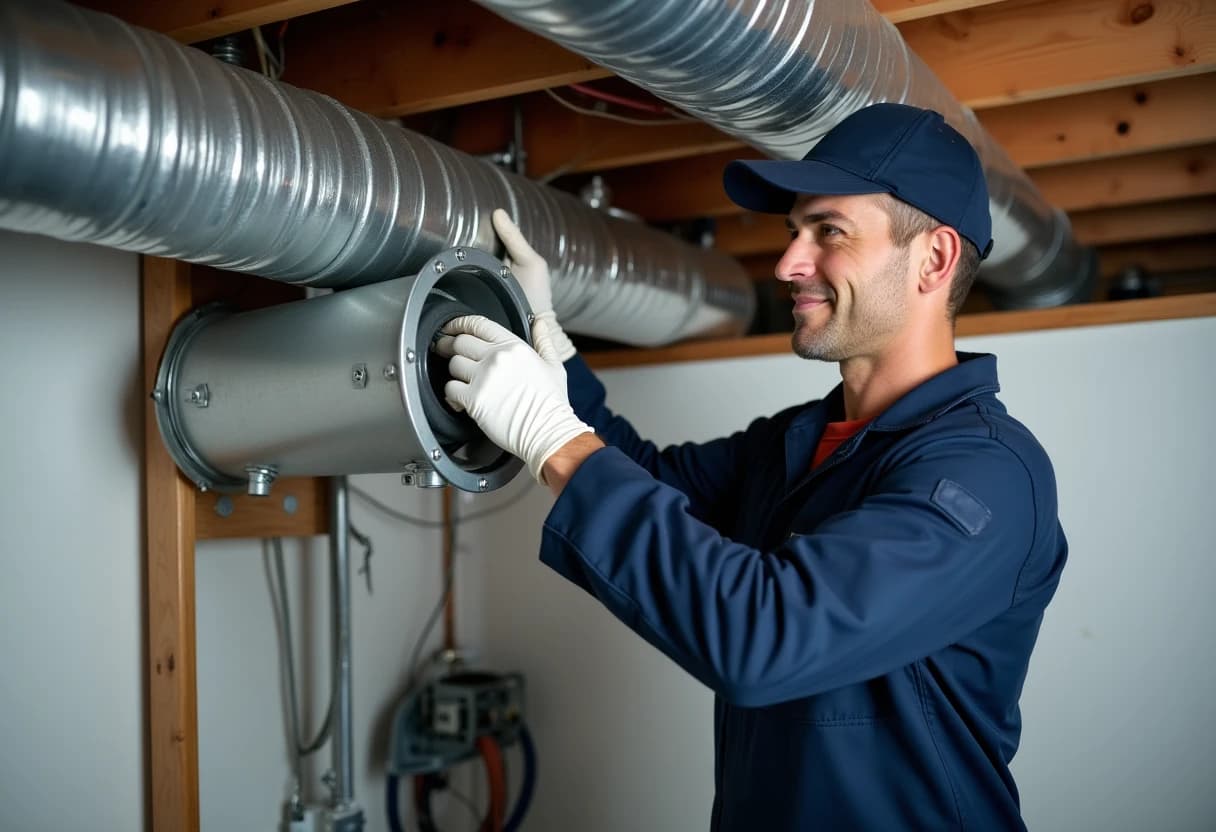
A clothes dryer is engineered to push exhaust through roughly 35 equivalent feet of smooth metal duct — the limit written into the residential code (IRC M1502), with every elbow deducting several feet from that budget. Many Greater Boston homes, especially condos and townhouses with interior laundry rooms, have vent runs far longer than that. The result: weak exhaust, multi-cycle drying, and lint settling along the entire run. A properly sized, pressure-activated inline booster fan solves the physics problem. Our technicians measure your run, clean it end to end, install the right fan in the right location, and verify airflow at the termination — so your dryer finally performs the way its manufacturer intended.
Lint is the leading ignition source in the roughly 2,900 home clothes dryer fires U.S. fire agencies report each year, and long duct runs are lint's favorite habitat: exhaust slows as it travels, and slow air drops its lint load like sediment in a lazy river. Homes with interior laundry closets — a signature of Greater Boston condo conversions and townhouse layouts — often have runs double the code maximum. An inline booster fan restores the exhaust velocity that keeps lint airborne until it exits the building. We handle the whole project: airflow diagnosis, full duct cleaning, correctly sized fan installation, electrical connection and a before-and-after airflow measurement you can see.
Why Dryer Vent Booster Fan Installation Matters
The residential mechanical code caps dryer duct length at 35 equivalent feet for a reason: beyond that, a standard dryer cannot maintain the exhaust velocity needed to carry lint out of the building. Equivalent feet are not tape-measure feet — each 90-degree elbow typically deducts five feet from the allowance and each 45-degree elbow about two and a half, so a run with four elbows may be over the limit at just 15 physical feet. Countless Greater Boston homes exceed this limit, particularly condos carved out of larger buildings, townhouses with central laundry closets, and basement installations venting to a far wall. The symptoms are predictable: loads that need multiple cycles, a dryer that shuts down on thermal overload, a hot and humid laundry area, and lint accumulating along the entire duct — the exact fuel condition behind most of the nation's roughly 2,900 annual dryer fires. A pressure-activated inline booster fan, correctly sized and correctly placed, restores compliant airflow through the existing run. It senses when the dryer starts, adds the missing static pressure, and shuts off when the cycle ends — no switches to remember, no wiring to the dryer itself.
Fire safety is the strongest argument for fixing a long, underperforming dryer vent. FEMA and NFPA data attribute about 2,900 home clothes dryer fires per year in the United States to dryers and their vents, with failure to clean — meaning lint accumulation — the leading contributing factor. Long runs accumulate lint faster than short ones and are far harder to clean thoroughly, so the hazard compounds year over year. There is also a hidden carbon monoxide dimension for gas dryers: a backed-up vent can push combustion byproducts into the living space instead of outdoors. A correctly installed booster fan addresses the underlying airflow deficiency rather than the symptoms. But correctness matters enormously here. The fan must be listed for dryer duty and lint-laden air, mounted the manufacturer-specified minimum distance from the dryer so wet lint does not foul the impeller, wired to a proper circuit, and activated by a pressure sensor so it cannot be forgotten. It must serve smooth rigid metal duct — never the foil accordion hose that codes treat as a transition-only material because its ridges trap lint and its plastic cousins have fueled fires. We install to that standard on every job.
How Our Dryer Vent Booster Fan Installation Process Works
1Airflow Diagnosis & Equivalent-Length Measurement
We start with numbers, not assumptions. Your technician measures exhaust airflow at the exterior termination, traces the full duct route, and calculates true equivalent length — physical footage plus the standard deductions for every 90- and 45-degree elbow. This tells us definitively whether the run exceeds the 35-foot code allowance and by how much, which drives every decision that follows.
2Reroute-vs-Boost Evaluation
Boosting is not always the right answer, so we check the alternative on every job. If a straighter path to an exterior wall could bring the run under 35 equivalent feet — removing an elbow or two, or exiting a closer wall — a reroute may cost similar money and require zero future fan maintenance. We price both options and let the building's geometry decide.
3Full-Length Duct Cleaning
Installing a fan on a dirty duct just compacts the clog, so every installation begins with a complete professional cleaning. Rotary brushes and high-pressure air move the entire lint load out of the run while a vacuum captures it. The fan we install afterward boosts a clean, full-diameter duct — the only configuration where a booster delivers its rated performance.
4Duct Corrections & Code Cleanup
Long runs accumulate code violations along with lint. Before the fan goes in, we replace foil accordion transition duct — a documented fire hazard — with listed semi-rigid connector, remove screws that penetrate the airstream and snag lint, re-secure separated joints with foil tape, and clear screened terminations. A booster fan cannot compensate for these defects, so they get fixed first.
5Booster Fan Sizing & Placement
Fan selection comes straight from the measurements: your run's equivalent length and diameter determine the model and capacity required. Placement follows manufacturer specification — typically a minimum of 15 feet downstream from the dryer so moisture-laden lint does not foul the impeller — in a location that permits future service access. We never bury a booster fan somewhere it can never be cleaned.
6Electrical Connection & Pressure-Switch Activation
The fan wires to a standard circuit and activates automatically: a pressure sensor detects the airflow surge when your dryer starts and switches the fan on, then off again after the cycle ends. Nothing connects to the dryer itself, nothing requires you to remember a switch, and the fan never runs dry against a stopped dryer.
7Airflow Verification & Maintenance Walkthrough
The job ends with proof: an airflow measurement at the exterior termination compared against the pre-installation reading, a test load's worth of runtime to confirm activation and shutoff, and a full walkthrough. You see the exhaust velocity your system now delivers, and you receive the readings in writing for your records, your inspector or your condo board.
Benefits You Can Expect
One Cycle Per Load Again
The most immediate change is the one you feel on laundry day: loads that needed two or three cycles dry in one. Restored exhaust velocity carries moisture out of the drum efficiently, so the dryer's sensors stop extending cycles and clothes come out dry the first time — often 30 to 50 percent faster than before.
Serious Reduction in Fire Risk
Lint accumulation is the leading factor in the roughly 2,900 home dryer fires U.S. agencies report annually, and long, slow-flowing ducts accumulate lint fastest. Restoring exhaust velocity keeps lint suspended until it exits the building instead of settling along the run — a structural reduction in the fuel load that makes these fires possible.
Lower Energy Bills
Every redundant cycle is billed twice: once in electricity or gas for the dryer, and again in the conditioned air it consumes. Cutting a household's drying time by a third saves real money month after month — for a family running eight loads a week, the fan frequently pays for itself within a couple of years.
Longer Dryer Lifespan
Restricted exhaust is the silent killer of dryers: heating elements cycle against trapped heat, thermal fuses blow, moisture sensors misread, and motors log double the runtime per load. Restoring airflow removes the strain that causes most premature dryer failures — often deferring an appliance replacement by years.
A Cooler, Drier Laundry Area
When exhaust cannot leave the building fast enough, it leaks — heat and humidity radiate from the duct and escape at the transition, turning laundry closets muggy and fogging nearby windows. Strong through-flow ends it: the moisture goes outside, and the laundry area stays as dry as the rest of the home.
Code-Aware, Documented Installation
Our installations address the whole system, not just the fan: listed equipment, manufacturer-specified placement, corrected transitions, and written airflow readings before and after. That documentation matters at sale time, satisfies home inspectors who flagged the original run, and gives condo boards the paper trail their insurance reviews ask for.
Set-and-Forget Automatic Operation
Pressure-activated controls make the fan invisible in daily life: it senses the dryer starting, runs during the cycle, and shuts down after. There is no switch to remember, no timer to set, and no way to accidentally dry a load unassisted. The system simply works, every load, for years.
Warning Signs to Watch For
Loads Need Two or Three Cycles
The classic symptom: a normal load emerges damp, and drying a set of towels becomes an evening-long project. If the vent has been cleaned and the dryer's own filter is clear, multi-cycle drying almost always traces to a run too long for the dryer's blower — the exact deficit a booster fan corrects.
The Laundry Room Is an Interior Room
If your washer and dryer live in a closet, hallway or central room with no exterior wall, the vent run behind them is long by construction — usually with multiple elbows through ceilings and chases. These layouts, common in condos and townhouses, are the textbook case for booster fans.
Weak or No Airflow at the Exterior Hood
Run the dryer and hold your hand at the outside termination: you should feel a strong, warm, steady stream and see the flapper held fully open. A weak breeze or a fluttering flapper means most of the dryer's exhaust pressure is being consumed inside the run — the signature of excessive length or blockage.
Dryer Overheats or Trips Its Thermal Fuse
A dryer that shuts down mid-cycle, feels dangerously hot on top, or has burned through a thermal fuse is protecting itself from trapped heat — heat the vent should be removing. Repeated thermal events are a strong signal the exhaust path cannot keep up, and they precede more expensive failures.
Humidity, Lint or Musty Smells Near the Laundry
Fogged windows near the laundry closet, damp air during cycles, or a musty odor in adjacent rooms mean exhaust is leaking into the home instead of exiting. Long runs with joint leaks under pressure push moist, lint-laden air into wall and ceiling cavities — a mold setup as well as a comfort problem.
An Existing Booster Fan That Is Old or Roaring
If your home already has a booster fan that rattles, roars or no longer helps, it likely has a lint-fouled impeller, a failed pressure sensor, or is an obsolete model with the motor in the airstream. We service and replace existing boosters constantly — often the duct behind them has never once been cleaned.
A Home Inspection or Insurer Flagged the Vent
Overlong dryer runs, foil accordion duct and missing boosters show up regularly on Massachusetts home inspection reports, and buyers increasingly negotiate over them. A documented professional installation — with airflow readings and code corrections — resolves the finding cleanly, whether you are the buyer inheriting the issue or the seller getting ahead of it.
Dryer Vent Booster Fan Installation Cost in the Boston Area
Professional dryer vent booster fan installation in Greater Boston typically runs $350 to $800 complete. The main variables: the fan itself ($150–$400 depending on capacity and model class), electrical work (a nearby outlet keeps costs low; a new circuit or long wire run adds $100–$250), access (an open basement ceiling is quick; a fan location above finished drywall requires an access panel), and the condition of the existing duct. Every quote includes the full-length cleaning that must precede installation — a booster on a dirty duct is a hazard, and we will not install one without cleaning first. Corrections like replacing foil transition duct or resealing separated joints are itemized transparently when needed, usually $50–$150. What you should not pay for: a fan sized by guesswork, an installation with no airflow verification, or a unit buried where it can never be serviced. Our quotes are flat, confirmed before work starts, and include the before-and-after airflow readings in writing.
Budget in three tiers. Straightforward installations — accessible duct, power nearby, standard 4-inch run — land at $350 to $500 including the pre-installation cleaning. Mid-range jobs at $500 to $650 typically involve creating an access panel, a longer electrical run, or duct corrections along the way: replacing accordion transitions, resealing joints, removing airstream screws. Complex projects at $650 to $800+ include roof-terminated condo runs, new dedicated circuits, or replacement of a failed existing booster with disposal and rewiring. Compare that against the alternatives people actually try first: a new dryer ($800–$1,500) that inherits the same choked duct, or repeated appliance repairs at $150–$300 per thermal-fuse visit. Rerouting the duct — when the building allows it — runs $400 to $1,200 depending on wall construction and finish repair, and we quote it side by side with boosting whenever it is viable, because sometimes it is genuinely the better spend.
Seasonal Considerations in New England
Winter is when long dryer vents fail hardest in Massachusetts. Exhaust traveling 50 feet through unheated basements, garages and chases cools below its dew point before reaching the termination, and the moisture condenses inside the duct — turning lint into a damp paste that accumulates far faster than in summer. Cold-weather symptoms follow: longer drying times from December onward, frost or ice at the exterior hood, and in severe cases a termination flapper frozen shut. A booster fan changes the physics by moving exhaust through the cold sections quickly, before it can shed its heat and moisture. Fall installation — ahead of both the heavy-laundry holiday season and the deep cold — is the smart calendar play, and our autumn schedule fills accordingly.
Why Boston Air Duct Cleaners
As a West Newton-based company, we treat Greater Boston like the neighborhood it is — because for us, it is. Our reputation lives or dies on local referrals, so every job gets the full process: complete system cleaning under negative pressure, mechanical agitation of every run, blower compartment service, and a documented walkthrough before we leave. We are licensed and insured, our estimates are free and flat, and our schedule holds same-day slots for urgent calls. One visit and you will understand why neighbors keep our magnet on the fridge.