
When Maynard homeowners call about duct odors, the stories rhyme: a musty smell every time the AC starts, a dog smell guests notice before they see the dog, cigarette ghosts from an owner two sales ago, or a basement note that follows the airflow upstairs. All of them live in the same place — the microbial and organic residue lining the duct system — and all of them respond to the same two-step fix: source-removal cleaning followed by EPA-registered antimicrobial fogging. We quote the pairing as a flat price, complete it in a single visit, and back it with a straightforward promise: if the odor problem is in your ducts, this ends it. If it is not, our inspection will tell you where to look instead.
Why Air Duct Sanitizing & Deodorizing Matters for Maynard Homes
Certain situations turn sanitizing from optional to strongly advised. After confirmed microbial growth or a mold finding, treatment of the cleaned surfaces inhibits recolonization while the moisture fix takes hold. After rodent or pest activity in the ductwork, sanitizing addresses the bacterial and viral load droppings leave behind — a genuine health matter, not merely an aesthetic one. After fire or heavy smoke exposure, deodorizing treatment neutralizes the acrid residue that otherwise off-gasses for years. After a water event, it suppresses the microbial bloom that damp ducts incubate. And at move-in, it resets a system whose history you cannot verify. In each case the logic is the same: cleaning removes what is visible, sanitizing addresses what is biological. Conversely — and we say this plainly because the industry often will not — a routinely maintained system with no odor, no moisture history and no contamination event does not need sanitizing, and the EPA does not recommend routine biocide use in ducts. We inspect first and recommend accordingly. Roughly a third of the time, our recommendation is to skip it.
Anyone who has spent a humid August near Assabet River knows the Maynard basement smell — and in homes with forced-air systems, that smell rarely stays in the basement. Maynard is a compact mill town of modest workers' housing - 19th-century cottages, two-families and four-squares on small downtown lots - ringed by mid-century capes and ranches in areas like Presidential Village. Many of the older homes converted from steam or gravity heat to forced air decades ago, leaving oversized trunk lines and patched-together branch runs in low basements. Return leaks and duct runs through damp below-grade spaces pull musty air into the system, where it saturates the interior film and re-broadcasts upstairs all season. The giant Assabet woolen mill that became Digital Equipment's headquarters and now Mill & Main defines Maynard, and its offices and lofts depend on large shared air-handling systems with long trunk runs. In the surrounding village homes, damp basements near the Assabet River keep humidity working into aging ductwork. Our cleaning-plus-sanitizing pairing removes the saturated film and neutralizes the biology behind the odor, which is why Maynard mustiness calls are among our most satisfying jobs: the fix is genuinely complete.
Our Air Duct Sanitizing & Deodorizing Process in Maynard
1Odor Assessment & Honest Qualification
We qualify the job before we book the fog. Odors that ride the airflow, spike at cycle start, or track the seasons implicate the system; odors independent of airflow usually do not. The assessment separates the two, checks for the moisture or contamination that sometimes underlies duct smells, and produces a flat written quote for exactly the work your situation supports.
2Source-Removal Cleaning First
Step one is removing the reservoir. The odor-saturated film lining your ducts is physically extracted under negative pressure — rotary brushes and pneumatic whips strip it from every supply, return and trunk while the HEPA vacuum captures it. Most of the odor leaves the house in this step; the fogging that follows neutralizes what remains and prevents the smell from rebuilding.
3Product Selection & Preparation
Only two kinds of products enter your air path: antimicrobials EPA-registered specifically for use in HVAC systems, and deodorizing counteractants formulated for duct application. No bleach, which corrodes ducts; no ozone shock treatments, which the EPA warns are ineffective at safe concentrations; no fragrance bombs that mask rather than neutralize. Dilutions follow the label exactly — that is what EPA registration means.
4Whole-System Antimicrobial Fogging
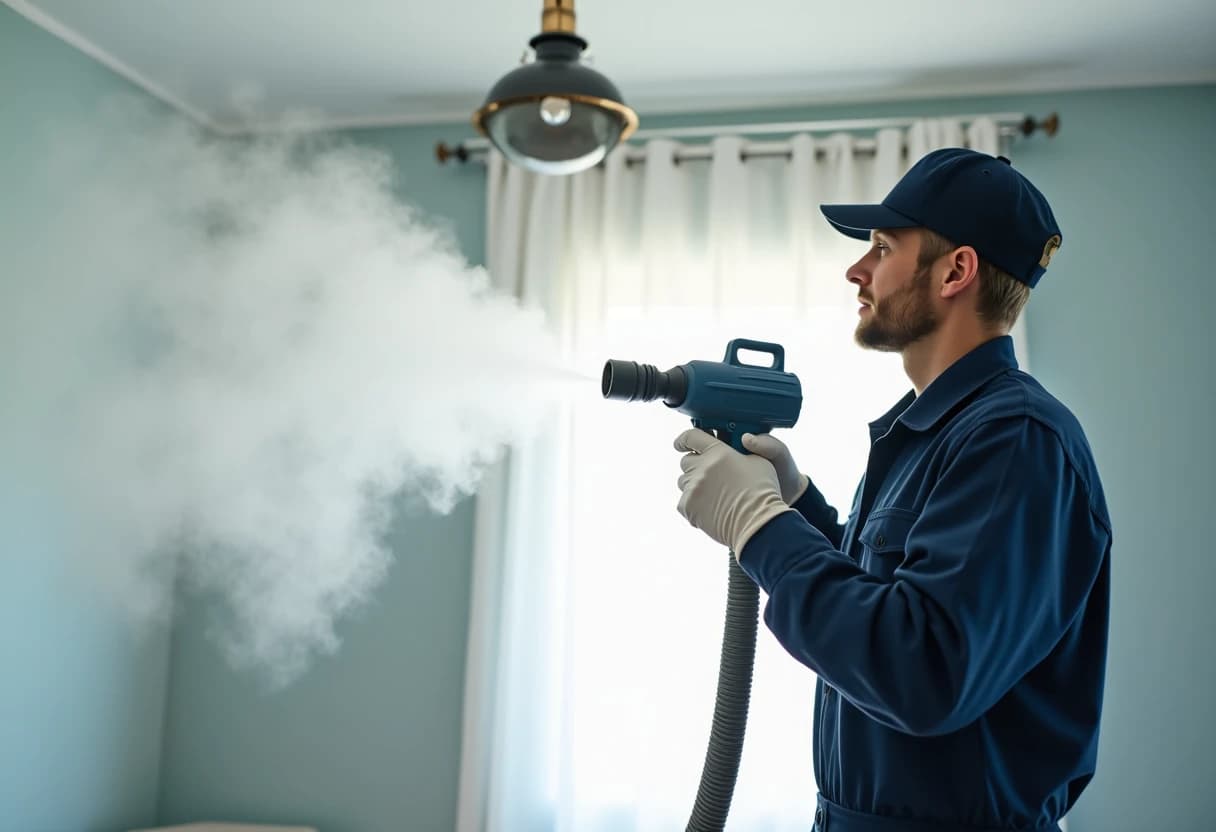
Fogging is the delivery method that makes duct sanitizing whole-system rather than spot treatment. Atomized at the micron scale, the antimicrobial behaves like the air itself, riding the airflow into every branch, riser and return the blower serves. Everywhere your air travels, the treatment travels — which is precisely why it works on odors that a hand-sprayed register never touches.
5Coil, Drain Pan & Blower Treatment
Every fogging visit includes hands-on treatment of the components the fog alone cannot adequately address: coil fins treated with appropriate cleaner, drain pan scrubbed and sanitized, condensate line flushed, blower compartment wiped and treated. If we find heavy coil fouling or standing water that signals a bigger problem, we document it with photos and quote the fix separately — informed consent, never ambush.
6Deodorizing Pass for Stubborn Odors
Antimicrobial treatment handles biological odors, but some smells are chemical: tar and nicotine films, cooking-oil residue, fire smoke. For those, we deploy counteractants that chemically neutralize the odor compounds themselves. The distinction matters — treating a smoke house with antimicrobial alone leaves the tar film broadcasting — and diagnosing which chemistry your odor needs is exactly what the initial assessment is for.
7System Airing, Verification & Walkthrough
The finish is verification by nose and by paper: a room-by-room airflow check confirming neutral odor at every register, before-and-after photos of the duct interiors, and a written record of products applied with their EPA registration numbers. Surfaces are dry and the home fully usable by the time we pack up in nearly all cases — we review any exceptions before we start, never after.
Benefits of Professional Air Duct Sanitizing & Deodorizing in Maynard
Pet Odor Elimination That Actually Holds
Multi-pet and long-tenure pet households benefit most: the accumulation scales with animal-years, and no surface cleaning touches the duct-borne share. Post-treatment, the improvement compounds — ongoing dander still sheds, but it lands in a neutral system rather than layering onto decades of saturated film, and routine filter changes keep the new baseline for years.
Musty Summer Smell Broken for Good
That damp blast at AC start-up is bacteria metabolizing humid duct film — a cycle that returns every muggy stretch and worsens annually. Sanitizing removes the film and leaves treated surfaces the biology cannot recolonize, so the next humid week produces silence from the registers. For many Massachusetts households this is the first summer without the smell in a decade.
Smoke Ghosts Finally Evicted
Tobacco residue is the most persistent household odor there is — tar and nicotine films bond to duct metal and off-gas for years, outliving paint, carpet and every previous owner. Our layered treatment pairs antimicrobial fogging with odor-counteractant chemistry that neutralizes the smoke compounds specifically, which is why it succeeds where repainting and time both failed.
Microbial Load Reduced System-Wide
Beyond odor, the treatment is a sanitizing pass over the one surface network your household's air touches continuously. EPA-registered antimicrobials kill odor bacteria and mold spores resident in the duct film and inhibit their regrowth — meaningful for households with allergy sufferers, young children, elderly members or anyone for whom airborne biology is more than an abstraction.
Small Add-On Cost, Outsized Payoff
Standalone treatments run $250 to $500; bundled with cleaning, the marginal cost drops by half or more. That pricing asymmetry is why we encourage odor-motivated customers to book the pairing — one visit, one setup, both halves of the fix. The alternative sequence, cleaning now and a separate sanitizing visit after the smell persists, costs more and delays the result.
A True Reset for Newly Purchased Homes
For buyers of older Massachusetts homes especially, the duct system may hold half a century of prior households. A documented cleaning and EPA-registered treatment resets it to a known-clean baseline — valuable for allergy-prone families, essential where the sellers had pets or smoked, and reassuring in any home whose maintenance history is a shrug. Start fresh literally.
Signs Your Maynard Home Needs Air Duct Sanitizing & Deodorizing
After Pests, Mold or Water in the System
Water events prime duct systems for microbial bloom: damp film, warm darkness, abundant food. If your basement flooded, a pipe let go, or humidity ran uncontrolled for a season, sanitizing after cleanup suppresses the bloom before it establishes — cheaper and easier than the mold removal that established growth eventually demands.
You Just Bought the Home
Disclosure forms cover the roof and the furnace; nobody discloses the duct film. If the sellers had pets you never saw, smoked outside 'mostly,' or ran a chronically damp basement, the evidence is in the air path. New-owner sanitizing is cheap certainty — and if the walkthrough smelled of anything at all, it is close to essential.
Smoke History in the Home
After a kitchen fire, wildfire smoke event or nearby structure fire, ducts inhale smoke even when flames never touched the house, and the system re-releases the odor long after surfaces are cleaned. Restoration protocols increasingly include duct treatment as standard; if yours did not, the lingering smell is telling you what was skipped.
Odors Return No Matter How Much You Clean
The tell is the rhythm: rooms smell fine with the system off, and the odor rebuilds when it runs. Surfaces cannot cause that pattern; airflow can. Homeowners often spend months eliminating suspects — carpets, drains, trash areas, basements — before checking the one system that touches every room. The register test takes ten seconds: smell the air it delivers.
Pets Present or Past
The threshold question: can guests tell you have animals without seeing them? If yes, the ducts are broadcasting, and the smell is stronger than your adapted nose reports. Households with multiple pets or long pet tenure carry proportionally heavier duct reservoirs, and they see the most dramatic before-and-after from a single cleaning-plus-treatment visit.
Guests Notice a Smell You No Longer Can
A useful self-test: leave home for a full week, then pay attention in the first ten seconds through the front door before your nose recalibrates. Whatever you catch in that window is what everyone else gets every visit. If there is anything there — mustiness, animals, staleness — the air system is the first place to look.
Air Duct Sanitizing & Deodorizing Cost in Maynard, MA
Budget by scenario. Bundled with a full cleaning — our most common configuration — sanitizing adds $75 to $200, putting the combined odor-elimination package at roughly $425 to $900 for typical single-family systems. Standalone treatment of a recently, verifiably cleaned system runs $250 to $400 for most homes, $400 to $500 for large or multi-zone systems. Smoke remediation adds $75 to $150 for the counteractant pass. What you should not pay for: 'sanitizing' quoted per vent at prices that balloon past these ranges, mandatory add-on treatments sold from scare photos, or ozone 'shock treatments' — the EPA warns ozone is ineffective against odor sources at safe concentrations and a respiratory irritant at effective ones, so it is a product we simply do not offer. Our quotes are flat, written and scoped to your actual odor situation after the assessment — and when the assessment says your system does not need sanitizing, the quote says that instead, which happens more often than the industry would like you to know.
Want the full pricing picture? See our complete Boston-area cost guide or call (617) 390-7145 for an exact flat quote for your Maynard home.
Local Knowledge: Maynard, Middlesex County
Serving Maynard means knowing Maynard. Maynard is a compact mill town of modest workers' housing - 19th-century cottages, two-families and four-squares on small downtown lots - ringed by mid-century capes and ranches in areas like Presidential Village. Many of the older homes converted from steam or gravity heat to forced air decades ago, leaving oversized trunk lines and patched-together branch runs in low basements. The giant Assabet woolen mill that became Digital Equipment's headquarters and now Mill & Main defines Maynard, and its offices and lofts depend on large shared air-handling systems with long trunk runs. In the surrounding village homes, damp basements near the Assabet River keep humidity working into aging ductwork. Those conditions shape how we work here: which brush heads come off the truck, how we protect finishes in older interiors, and what we expect to find when the camera goes into a 01754 duct system. Our crews are in and around Maynard nearly every week — often for neighbors of past customers — so scheduling is fast and our arrival windows hold.
The Best Time of Year in Maynard
Spring earns its place in the sanitizing calendar through real estate and fresh starts. The March-through-June listing season puts thousands of Massachusetts homes in front of buyers whose first impression is olfactory, and pre-listing treatment — source-removal cleaning plus deodorizing — is the highest-leverage few hundred dollars a seller with any odor history can spend. Spring is also peak move-in season, and the between-closing-and-boxes window is the ideal moment to reset an inherited system: empty house, open access, and the previous owners' biological archive neutralized before your family's first night. Finally, spring cleaning momentum is legitimate: households already deep-cleaning surfaces get compounding returns from treating the one system that re-contaminates them — finish the job upstream, and the downstream cleaning holds.
Why Choose Boston Air Duct Cleaners
Homeowners across Middlesex County choose Boston Air Duct Cleaners for three reasons. First, honesty: our inspection camera tells you whether your system actually needs cleaning — and sometimes the answer is no. Second, capability: truck-grade negative-air machines, rotary brush systems and HEPA filtration handle everything from antique gravity-furnace conversions to brand-new high-velocity systems. Third, accountability: flat quoted pricing, before-and-after photos, insured technicians, and a real local office you can call at (617) 390-7145. That combination is rarer in this industry than it should be.
Serving Maynard and Surrounding Communities
Beyond Maynard, our crews cover the surrounding communities daily — including Acton, Sudbury, Concord, Hudson, Marlborough, Wayland. Because routes cluster geographically, booking alongside a neighboring appointment often unlocks same-day service and combined-visit savings. Wherever you are in Middlesex County, the same flat-rate pricing, insured technicians and photo-documented process applies.