
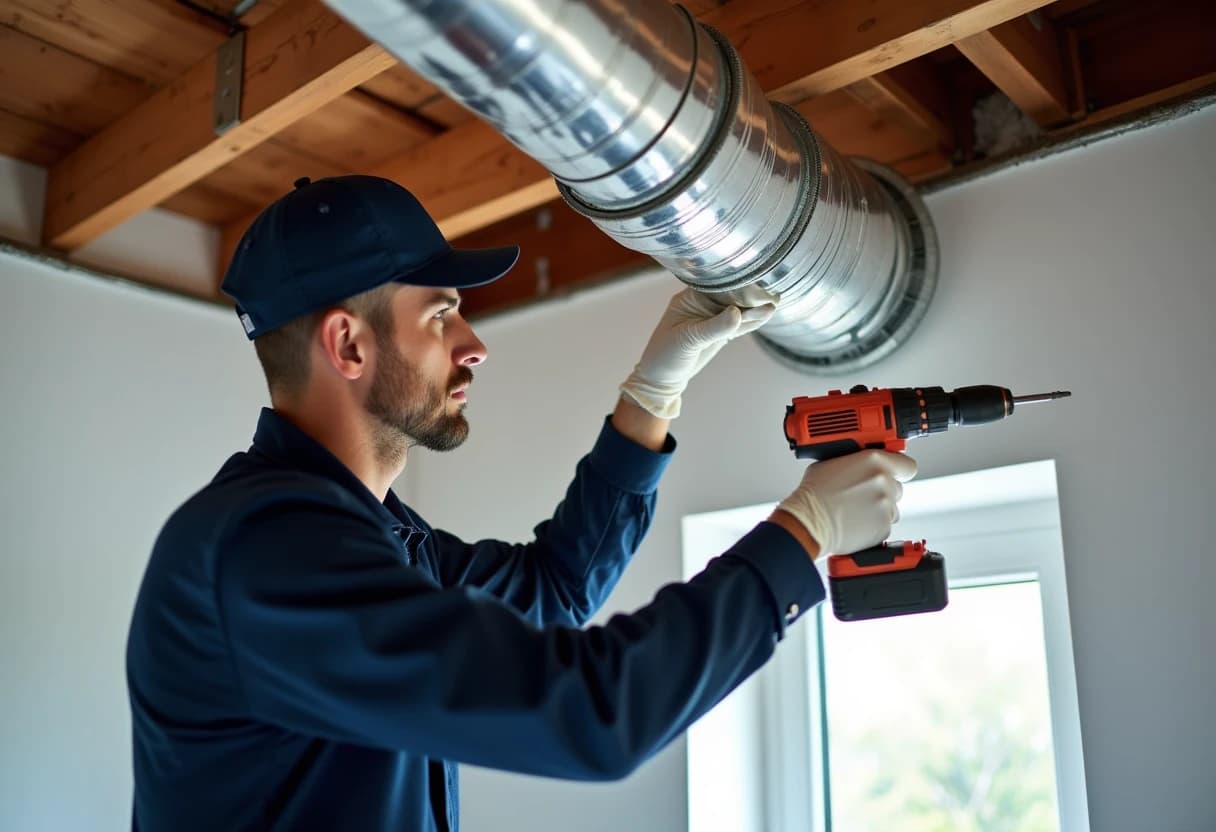
Homeowners in Maynard call us for dryer vent installation at three moments: when a new laundry location needs its first vent, when a home inspection or appliance installer condemns the existing setup, and when years of blockages and repairs make clear the old route will never work. In all three cases the job is the same discipline: route planning against the code's 35-foot equivalent-length budget, 4-inch smooth rigid metal duct, clamped and taped joints with no screws in the airstream, insulation where the run crosses unheated space, and a termination — side wall, rim joist or roof — that keeps out weather and wildlife. Flat quotes, one-day installs, and a system your annual cleaning will keep healthy for decades.
Why Dryer Vent Installation & Rerouting Matters for Maynard Homes
Length is the invisible constraint most existing vents violate. A dryer is a modest blower pushing moist, fiber-laden air, and its reach is finite: the code's 35-foot equivalent-length budget shrinks fast when elbows are counted — a typical deduction of five feet per 90-degree bend and two and a half per 45 means a run with four corners has spent twenty feet of budget before its first straight section. Exceed the limit and physics takes over: airflow velocity drops below what carries lint, fibers settle in the duct, moisture condenses instead of exiting, and the system clogs on a schedule no cleaning interval can economically match. This is precisely the condition of countless Greater Boston vents, installed when the laundry moved but routed around, rather than through, whatever stood in the way. Rerouting solves it at the root. Our crews measure the true equivalent length, find the shortest legal path — often through a rim joist or closer wall the original installer ignored — and rebuild. Customers whose dryers limped for years routinely describe the result as getting a new appliance.
Renovation activity around Maynard Clock Tower keeps our Maynard installation calendar full: finished basements, relocated laundries, in-law suites and condo conversions all need new dryer exhaust, and general contractors do not always give it the attention a fire-safety system deserves. The giant Assabet woolen mill that became Digital Equipment's headquarters and now Mill & Main defines Maynard, and its offices and lofts depend on large shared air-handling systems with long trunk runs. In the surrounding village homes, damp basements near the Assabet River keep humidity working into aging ductwork. Maynard is a compact mill town of modest workers' housing - 19th-century cottages, two-families and four-squares on small downtown lots - ringed by mid-century capes and ranches in areas like Presidential Village. Many of the older homes converted from steam or gravity heat to forced air decades ago, leaving oversized trunk lines and patched-together branch runs in low basements. We work alongside contractors and homeowners at the planning stage — advising on laundry placement while walls are still open, when a ten-minute routing decision can save thirty feet of duct — and we build the vent to code with documentation your building inspector will recognize. Neighbors in Acton and Sudbury use us the same way, which is why our trucks are on renovation sites across Middlesex County all season.
Our Dryer Vent Installation & Rerouting Process in Maynard
1Site Assessment & Route Planning
The technician maps what exists and what is possible: where the dryer sits (or will sit), which walls are exterior, what the framing and foundation allow, and where obstacles — plumbing, wiring, ductwork, finished ceilings — constrain the path. Shortest is best: fewer feet and fewer elbows mean faster drying and slower lint accumulation for the life of the system.
2Demolition of Non-Compliant Venting
Old venting comes out carefully, not destructively: we protect finishes, keep openings minimal, and document conditions as we find them. What we uncover often explains years of symptoms — a crushed flex section behind a wall, a joint that separated a decade ago, a cavity lined with escaped lint. Photos go in your record.
3Cut & Flash the Exterior Penetration
Penetrations are where amateur installs leak — water into sheathing, air into cavities. Ours are built like window details: sized to the hood, flashed to shed water over the cladding, sealed with quality exterior sealant, and finished so the termination looks intentional on the facade. On masonry we drill and anchor; we never improvise attachment.
4Install Rigid Metal Duct on the Planned Route
Support and slope are built in as we go: hangers and strapping at proper intervals so no section can sag into a condensation belly, and a continuous pitch toward the termination so any moisture that does condense drains outdoors instead of pooling. These details are invisible when the job is done and decisive for how the system ages.
5Mount the Termination Hood & Damper
Where pests are a known pressure — and in Greater Boston they are — we fit guard designs engineered for dryer exhaust: excluding birds and rodents without restricting airflow or trapping lint. We also note the hood in your service record so future cleanings include damper checks, keeping the one wear-prone component watched for the system's life.
6Connect the Appliance & Seal the System
System sealing is completed end to end: every joint taped with UL-listed foil tape, the wall penetration sealed inside and out, and the transition clamped tight. A dryer vent is a pressure system; leaks anywhere cost airflow at the termination and push lint and moisture into places they do not belong. Sealed means sealed everywhere.
7Test, Verify & Document the Installation
Before we leave: work areas vacuumed with HEPA equipment, penetration debris removed, the dryer set and leveled, and a walkthrough of the finished system — where it runs, how the damper should look during a cycle, and when the first annual cleaning is due. A correctly built vent needs almost nothing from you; we make sure you know the little it does.
Benefits of Professional Dryer Vent Installation & Rerouting in Maynard
Moisture Managed, Structure Protected
For basement laundries — the Massachusetts default — proper installation is the difference between a dry basement and a damp one. Vents that dump into crawlspaces, leak at joints or condense in cold runs feed exactly the humidity and mold problems New England basements already fight; a correct rim-joist installation removes the dryer from that fight entirely.
Code Compliance That Closes Every Question
The finished system meets the IRC's dryer exhaust provisions line by line: 4-inch smooth rigid metal, equivalent length within the 35-foot budget, no fasteners in the airstream, damper-equipped unscreened termination. For home sales, that removes a standard inspection flag; for permits and condo approvals, our documentation answers the questions before they are asked.
Decades of Service From a One-Day Job
Because we also clean and repair dryer vents across Greater Boston, we install with the next twenty years of maintenance in mind — routes our own brushes can traverse, access preserved where it matters, baselines recorded for future verification. We build systems we expect to service ourselves, and it shows in the choices.
A Laundry Located Where You Actually Want It
For renovations, early vent planning is leverage: consulted while walls are open, we can route a short, straight, fully concealed run that would be expensive or impossible after drywall. A ten-minute conversation at framing stage regularly saves homeowners hundreds of dollars and a compromised route.
Dramatically Faster Drying
Every elbow removed and every foot shortened is resistance the dryer no longer fights on every load, forever. The performance gain is not subtle on bad systems — 30 to 50 percent cycle-time reductions are common when we replace overlong flex runs — and unlike an appliance upgrade, it benefits every dryer the laundry will ever have.
Fire-Safe by Design, Not by Vigilance
A code-compliant installation attacks fire risk structurally: smooth rigid metal that lint slides across instead of catching on, a run short enough that exhaust velocity carries fibers all the way out, joints without screw tips to snag them, and a termination that cannot mat over. The system accumulates fuel slowly by design — safety that does not depend on anyone remembering anything.
Signs Your Maynard Home Needs Dryer Vent Installation & Rerouting
Inspection, Insurance or Association Requirements
Massachusetts home inspections flag improvised dryer venting constantly — flex runs, screened hoods, indoor terminations, overlong routes — and the flag follows the transaction: buyers demand fixes, sellers concede credits. A documented compliant installation clears the item permanently, whether you are listing this spring or just retiring a known liability.
The Run Is Overlong or Elbow-Heavy
Basement laundries venting to a far wall are the classic offenders — installed where the first hole was easiest, not where the route was shortest. Our assessment often finds a rim-joist or near-wall exit that cuts the run by half or more. Ask for the measurement; the equivalent-length math takes ten minutes and settles the question.
Blockages and Repairs Keep Recurring
Recurring appliance failures tell the same story from the other end: thermal fuses, heating elements and high-limit switches that fail repeatedly are a dryer protesting a duct it cannot push through. Each repair buys months. A rerouted, rigid, code-length run buys decades — and usually costs less than three appliance service calls.
The Dryer Vents Indoors — Anywhere
Window inserts and condensation boxes marketed as 'indoor dryer vents' are not a solution for a standard vented dryer in a Massachusetts home; they are humidity machines. If one is in service in your laundry, a proper exterior route almost certainly exists — our assessment will find the shortest one and price it flat.
A New Laundry Location Needs Its First Vent
Moving laundry upstairs, finishing a basement, building an in-law suite or converting a condo all create the same requirement: a new exhaust route, designed before the walls close if at all possible. Vent routing decided at the framing stage is shorter, cheaper and cleaner than the same route retrofitted through finished surfaces months later.
Your Vent Is Flexible Plastic or Foil Duct
Look behind and beyond your dryer: if the exhaust path is white vinyl or shiny foil accordion hose — especially if it disappears into a wall or ceiling that way — the system needs replacement, not another cleaning. Flex materials trap lint in every corrugation, crush at a touch, and in vinyl's case can melt. Codes and manufacturers rejected them long ago.
Dryer Vent Installation & Rerouting Cost in Maynard, MA
Dryer vent installation in Greater Boston typically runs $300 to $900, and the price is mostly the route. At the low end, $300 to $450: a straightforward side-wall or rim-joist installation with a short run — dryer near an exterior wall, one clean penetration, minimal duct. Mid-range, $450 to $650: longer routes with several elbows, full flex-to-rigid replacement along an existing path, insulation over unheated space, or masonry penetrations through brick or block foundation. The top of the range, $650 to $900: reroutes through finished space with access openings, roof terminations with proper flashing, relocations that move the laundry's exhaust across the floor plan, and multi-story routes in triple-deckers and condos. Every quote is flat and follows a site assessment — we measure the route, do the equivalent-length math, and price the specific design you approve. Materials are included: rigid metal duct, listed transition connector, clamps and foil tape, insulation where needed, and a quality damper-equipped termination hood.
Want the full pricing picture? See our complete Boston-area cost guide or call (617) 390-7145 for an exact flat quote for your Maynard home.
Local Knowledge: Maynard, Middlesex County
Serving Maynard means knowing Maynard. Maynard is a compact mill town of modest workers' housing - 19th-century cottages, two-families and four-squares on small downtown lots - ringed by mid-century capes and ranches in areas like Presidential Village. Many of the older homes converted from steam or gravity heat to forced air decades ago, leaving oversized trunk lines and patched-together branch runs in low basements. The giant Assabet woolen mill that became Digital Equipment's headquarters and now Mill & Main defines Maynard, and its offices and lofts depend on large shared air-handling systems with long trunk runs. In the surrounding village homes, damp basements near the Assabet River keep humidity working into aging ductwork. Those conditions shape how we work here: which brush heads come off the truck, how we protect finishes in older interiors, and what we expect to find when the camera goes into a 01754 duct system. Our crews are in and around Maynard nearly every week — often for neighbors of past customers — so scheduling is fast and our arrival windows hold.
The Best Time of Year in Maynard
Renovation season drives our installation rhythm as much as weather does. Greater Boston remodels from spring through fall — basements finished, laundries moved upstairs, triple-deckers converted to condos — and every one of those projects needs dryer exhaust designed rather than improvised. The economics of timing are stark: venting planned at framing stage routes shorter, conceals cleaner and costs $200 to $400 less than the same run retrofitted after drywall. We take planning calls from homeowners and contractors all season, often walking a route in fifteen minutes that saves the project real money and the homeowner a decade of compromise. If your project touches the laundry — or could move it somewhere better — the cheapest vent you will ever build is the one designed before the walls close.
Why Choose Boston Air Duct Cleaners
Choosing a duct cleaner is really a trust decision — you are letting a crew work inside the system that feeds air to your family. We make that decision easy: a local West Newton company with insured, uniformed technicians, transparent flat-rate quotes, NADCA-standard equipment and methods, and photographic proof of the finished work. No door-to-door sales, no bait-and-switch coupons, no invented 'mold emergencies.' Just honest mechanical cleaning done properly the first time, backed by a written guarantee.
Serving Maynard and Surrounding Communities
Maynard sits in the heart of our service area, and neighboring Acton, Sudbury, Concord, Hudson, Marlborough, Wayland appointments share the same routes. That density is why our response times in this part of Middlesex County are among our fastest — and why you will see our trucks in the area week after week.