
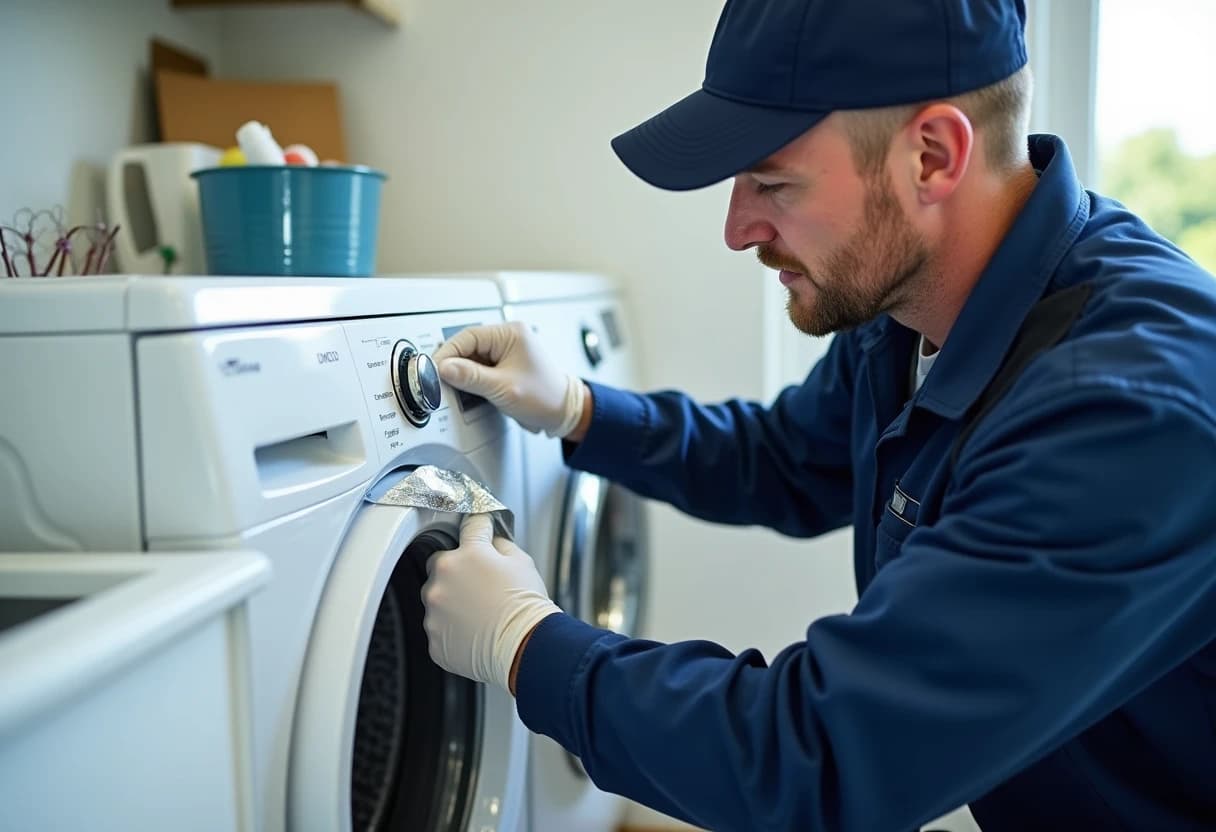
That flattened foil hose behind your dryer is doing more damage than it looks. Crushed transition ducts are the most common dryer vent failure we find in Maynard homes — the machine gets pushed back against the wall, the accordion hose collapses to a fraction of its diameter, and the dryer spends years straining against a pinched exhaust while lint packs the kink. We replace these hazards with semi-rigid aluminum connectors and repair everything downstream too: separated joints, sagging runs, holes rusted through duct walls, and exterior hoods that no longer close against weather and pests. Done right, with the materials the code requires, a repaired vent runs trouble-free for decades.
Why Dryer Vent Repair Matters for Maynard Homes
A damaged dryer vent fails on three fronts at once, and all three get worse with every load. Safety first: a disconnection or breach releases lint — one of the most flammable materials in a home — into wall cavities, ceilings and basements, where it accumulates near framing with no way to remove it, while the restriction at the damage point drives up exhaust temperatures exactly the way fire investigators describe in the roughly 2,900 US dryer fires each year. Moisture second: every load pushes about a gallon of water vapor through the vent, and a leak delivers it into building materials instead of outdoors — wet insulation, mold-friendly wall cavities, stained ceilings, rotted subfloor around the laundry. Performance third: crushed and separated ducts strangle airflow, stretching drying times and energy bills while overheating the appliance. Cleaning cannot fix any of this; the duct itself is broken. A proper repair — rigid metal, sealed joints, verified airflow — resolves all three failure modes in a single visit, usually for $150 to $450.
Multi-family Maynard properties — triple-deckers, condo conversions, brownstone associations near Assabet River — bring dryer venting problems that single-family playbooks miss: long shared-wall runs, terminations several stories up, and repairs that need association sign-off and insurance documentation. Maynard is a compact mill town of modest workers' housing - 19th-century cottages, two-families and four-squares on small downtown lots - ringed by mid-century capes and ranches in areas like Presidential Village. Many of the older homes converted from steam or gravity heat to forced air decades ago, leaving oversized trunk lines and patched-together branch runs in low basements. We handle all of it, providing certificates of insurance, written scopes for board approval, and photo documentation of completed work. The giant Assabet woolen mill that became Digital Equipment's headquarters and now Mill & Main defines Maynard, and its offices and lofts depend on large shared air-handling systems with long trunk runs. In the surrounding village homes, damp basements near the Assabet River keep humidity working into aging ductwork. When one unit's disconnected vent is loading a shared ceiling cavity with lint and moisture, the whole building has a stake in the repair — and we are the crew associations across Middlesex County call to make it right.
Our Dryer Vent Repair Process in Maynard
1Diagnose the Full Exhaust Path
We treat symptoms as evidence: lint in the basement points to a specific joint; a ceiling stain maps to a specific duct section; condensation drips tell us where the run crosses cold space. Correlating symptoms with the physical path usually pinpoints the failure within minutes — and rules out the failures you do not have.
2Protect the Area & Open Access
Laundry areas are tight, finished spaces, and we work in them accordingly: drop cloths, boot covers, and careful handling of the appliance and its gas or electrical connections. Gas dryers get particular care around the flexible connector — we never strain a gas line to reach a duct.
3Reconnect & Properly Fasten Separated Joints
Separated joints are rejoined the way code intends: sections fitted male-to-female in the direction of airflow, secured with clamps or mechanical fasteners that do not pierce the airstream, and sealed with UL-listed metal foil tape — never fabric duct tape, which heat destroys, and never screws through the duct wall, whose tips become lint hooks inside the pipe.
4Replace Crushed, Corroded or Non-Compliant Sections
Duct that is crushed, kinked, rusted through or made of prohibited material gets replaced, not patched. We install 4-inch smooth-interior rigid metal duct — the material the IRC's dryer exhaust rules specify — cut to fit, joined without airstream-piercing fasteners, and supported so it cannot sag into water-pooling bellies.
5Cure Condensation: Slope, Seal & Insulate
Where a run's routing makes condensation inevitable — long passages through cold space, low points that cannot be drained — we say so plainly and price the better fix: shortening or rerouting the run, which we quote as a separate option. Honest diagnosis beats a repair that treats symptoms the routing will simply recreate.
6Repair or Replace the Exterior Hood & Damper
Where pests have entered through a failed damper, we remove nesting material from the duct, clean the affected section, and install a termination with pest protection that does not restrict airflow. If the old hood was painted shut — common on older multi-family buildings — we free or replace it and note the repaint risk for the future.
7Replace the Transition Duct & Reset the Dryer
The appliance connection is rebuilt to spec: a UL-listed semi-rigid aluminum transition duct, as short and straight as the layout allows, secured with clamps at both ends. We position the dryer so the connector keeps its full diameter — not crushed against the wall — and mark the safe distance so future pushes do not recreate the old kink.
8Verify Airflow & Document the Repair
The proof is at the hood: with the dryer running, the damper should stand fully open under a strong, steady exhaust stream. We verify it together, compare against the pre-repair condition, and confirm no leakage remains at any repaired joint. Then the work area is cleaned, the dryer set, and the laundry room returned to service.
Benefits of Professional Dryer Vent Repair in Maynard
Code Compliance & Inspection-Ready Documentation
Compliance is not paperwork for its own sake; each code provision encodes a failure the industry learned about the hard way. Smooth interiors resist lint. Clamped joints survive heat. Unscreened dampers do not mat over. A to-code vent is simply a vent engineered not to fail the common ways.
A Serious Fire Hazard, Eliminated
Lint inside a wall cavity cannot be cleaned on any schedule; the only fix is stopping the leak that puts it there. Repairing disconnections and sealing joints confines lint to the duct, where annual cleaning can manage it. That containment is the difference between a maintainable system and a slowly growing hazard you cannot see.
Lower Energy and Repair Bills
A failed exterior damper is a hole in your heated envelope all winter — a 4-inch duct delivering January directly to your laundry room. Replacing it with a tight-closing hood pays for itself in heating savings and comfort, entirely apart from what it does for the dryer.
Moisture Out of Your Walls and Ceilings
Condensation repairs — slope, sealing, insulation — end the drip-and-pool cycle that rusts ducts from the inside and stains ceilings from above. Laundry areas dry out, winter window condensation eases, and the musty smell that clung to the wall behind the dryer leaves with the moisture feeding it.
Restored Drying Performance
A crushed or separated duct throttles airflow just like a lint clog, and no amount of cleaning fixes it. Repair restores the full 4-inch path, and drying performance returns immediately — one-cycle loads, accurate sensor-dry behavior, and a machine that stops straining against backpressure it was never designed to fight.
Pest Entry Points Closed
We remove existing nesting material as part of termination repair and clean the affected duct section, because a nest is both a blockage and a sanitation issue in an airstream that passes your clothing. The new hood's pest protection is chosen to exclude animals without the lint-trapping mesh that code prohibits.
Signs Your Maynard Home Needs Dryer Vent Repair
A Home Inspection or Appliance Tech Flagged the Vent
When an appliance technician condemns your vent while servicing the dryer, believe them: they have just measured the backpressure your machine fights on every load. Repairing the duct protects the repair they made — a new heating element or thermal fuse installed against a failed vent will simply fail again.
Exterior Damper Broken, Stuck or Missing
Look at the hood outside: a damper flap hanging loose, rusted stiff, cracked off, painted shut or missing entirely is a failed termination. Stuck open, it drains heat and admits pests all winter; stuck shut, it blocks the vent completely. Either way the fix is a proper replacement hood — one of the fastest, most cost-effective repairs on our list.
Musty or Mildew Smell in the Laundry Area
A persistent damp smell around the laundry — or in one adjacent wall or ceiling — often means exhaust moisture has been feeding hidden mildew via a leak or chronic condensation. The odor is the nose's report on a moisture problem the eyes cannot see. A vent-path inspection locates the escape point, and repair dries up its food supply.
Lint Appearing Where It Shouldn't
Lint drifting from a basement ceiling, gathering on joists, puffing from a wall register or collecting behind the dryer means exhaust is escaping the duct before the termination. Lint marks the leak like dye in water — follow it and you find the separated joint or breach. This is a repair call, not a cleaning call, and it should not wait.
Water Stains, Drips or Peeling Paint Near the Vent Path
A ceiling stain below a second-floor laundry, paint bubbling behind the dryer, or drips from a basement duct joint all point to exhaust moisture escaping or condensing in the run. Each load adds another gallon of vapor to the problem. Repair — sealing, sloping, insulating or replacing the affected section — stops the source; cosmetic fixes without it just repaint the symptom.
Visibly Damaged, Kinked or Sagging Duct
Trust your eyes: a transition hose flattened behind the dryer, a dented or crushed section in the basement, duct sagging between supports into a low belly, or a run held together with fabric duct tape are all failures in progress. Each restricts airflow, collects lint and moisture, and worsens with time. Photograph what you see and call — the quote is quick.
Dryer Vent Repair Cost in Maynard, MA
It helps to know what drives repair pricing, because the failure type matters more than the home's size. Accessibility is the biggest factor: a joint hanging exposed in a basement is a fast fix, while the same failure above a finished ceiling involves careful access and restoration planning. Materials are second: quality rigid metal duct, UL-listed connectors, foil tape and a solid termination hood carry real parts costs — roughly $30 to $120 of most invoices — but they are why the repair lasts decades. Scope is third: many vents present multiple failures at once (a crushed transition and a failed damper and a leaking joint), and bundling them into one visit is significantly cheaper than three separate calls. What does not drive our pricing: drama. We quote from the diagnosis, show you the photos, and price the fix flat. Massachusetts homeowners have seen enough scare-based selling around dryer fires; the facts are alarming enough without embellishment, and the honest repair is usually a few hundred dollars.
Want the full pricing picture? See our complete Boston-area cost guide or call (617) 390-7145 for an exact flat quote for your Maynard home.
Local Knowledge: Maynard, Middlesex County
Serving Maynard means knowing Maynard. Maynard is a compact mill town of modest workers' housing - 19th-century cottages, two-families and four-squares on small downtown lots - ringed by mid-century capes and ranches in areas like Presidential Village. Many of the older homes converted from steam or gravity heat to forced air decades ago, leaving oversized trunk lines and patched-together branch runs in low basements. The giant Assabet woolen mill that became Digital Equipment's headquarters and now Mill & Main defines Maynard, and its offices and lofts depend on large shared air-handling systems with long trunk runs. In the surrounding village homes, damp basements near the Assabet River keep humidity working into aging ductwork. Those conditions shape how we work here: which brush heads come off the truck, how we protect finishes in older interiors, and what we expect to find when the camera goes into a 01754 duct system. Our crews are in and around Maynard nearly every week — often for neighbors of past customers — so scheduling is fast and our arrival windows hold.
The Best Time of Year in Maynard
Spring is nesting season, and a dryer vent with a compromised damper is prime real estate: warm, dry, sheltered, and lined with soft lint. Birds, squirrels and mice move in between March and June, and by summer the nest has become a full blockage — often discovered when drying times collapse or a burning smell appears. The seasonal logic favors acting early: repair a failing damper in late winter and the nest never happens; wait, and the spring repair includes nest removal, duct cleaning and sanitizing on top of the hood replacement. If you heard scratching or chirping near the laundry last spring, put the termination inspection on this year's calendar before the wildlife does.
Why Choose Boston Air Duct Cleaners
We built this company around the jobs other duct cleaners do badly: the 130-year-old Victorian with panned-joist returns, the Maynard condo with a 60-foot dryer run to the roof, the post-renovation house full of drywall dust. Our crews see Greater Boston's hardest systems every week, and the experience shows in the details — floor protection on the way in, sealed registers during the work, HEPA-vacuumed work areas on the way out, and imagery that proves the ducts are actually clean. Call (617) 390-7145 and judge the difference from the first conversation.
Serving Maynard and Surrounding Communities
Beyond Maynard, our crews cover the surrounding communities daily — including Acton, Sudbury, Concord, Hudson, Marlborough, Wayland. Because routes cluster geographically, booking alongside a neighboring appointment often unlocks same-day service and combined-visit savings. Wherever you are in Middlesex County, the same flat-rate pricing, insured technicians and photo-documented process applies.