
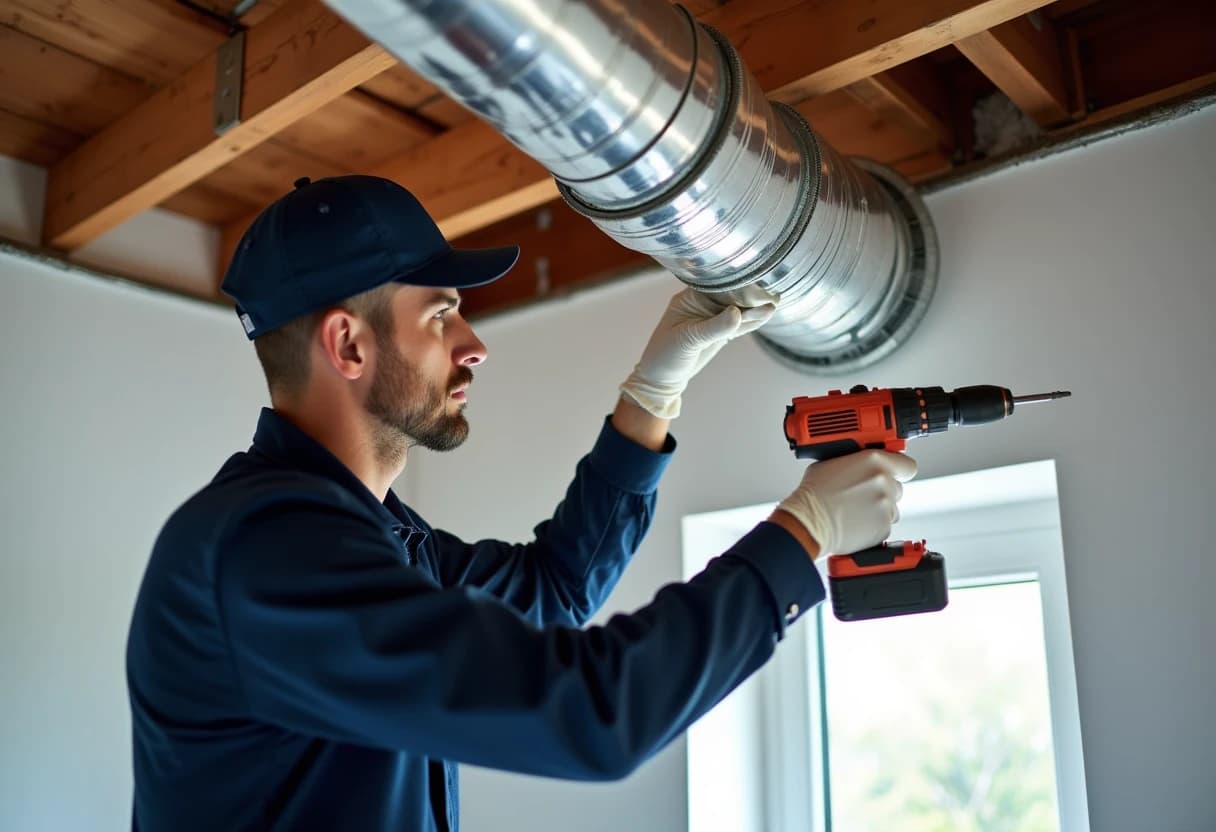
Some dryer vents cannot be cleaned or repaired into safety — they were never right to begin with. Runs assembled from vinyl or foil flex duct, routes that wander fifty feet through a basement, dryers venting into crawlspaces or garages, laundry areas with no vent at all: these call for installation, not maintenance. Our Hudson crews design and build code-compliant dryer exhaust systems from scratch — 4-inch smooth rigid metal duct, the shortest practical route to outdoors, joints without airstream-piercing screws, and a proper damper-equipped termination through the side wall, roof or rim joist. Priced flat from $300 to $900, finished in a day, and built to outlast the dryer itself.
Why Dryer Vent Installation & Rerouting Matters for Hudson Homes
There is also a straightforward performance and cost case. A dryer on a proper vent dries a standard load in one cycle; on a bad vent, in two — doubling energy per load, roughly $10 to $20 a month for a busy household, while heat-cycling the machine toward early component failure. A rigid, correctly sloped, correctly sized system also changes the maintenance economics: annual cleanings on smooth duct are quick and thorough, blockage-level service calls largely disappear, and appliance repairs caused by backpressure — thermal fuses, elements, high-limit switches — stop recurring. Add the avoided moisture damage (each load carries about a gallon of water that either exits the termination or enters your building assemblies) and the installation typically pays a real fraction of its cost back within a couple of years, then keeps paying. For homes about to sell, documented code-compliant venting removes a standard inspection flag before it costs a negotiation. For homes about to install a new dryer, it protects the warranty, which manufacturers condition on adequate exhaust. Either way, it is infrastructure bought once and used every laundry day for decades.
Renovation activity around Hudson Town Hall keeps our Hudson installation calendar full: finished basements, relocated laundries, in-law suites and condo conversions all need new dryer exhaust, and general contractors do not always give it the attention a fire-safety system deserves. Hudson's celebrated Main Street revival has translated into constant renovation work in the surrounding older homes, and post-remodel construction dust is one of the most frequent contaminations we clear here. Mill-era buildings along the Assabet also carry long, unconventional duct and dryer vent runs that were shoehorned into industrial structures. Hudson grew up around its Assabet River shoe factories, leaving a downtown core of 19th-century workers' housing and multifamily homes, ringed by postwar capes and 1970s-1990s subdivisions farther out. Several former mill buildings have been converted to apartments and offices, and the town's revitalized Main Street has spurred steady renovation of the older housing nearby - much of it involving first-time forced-air retrofits. We work alongside contractors and homeowners at the planning stage — advising on laundry placement while walls are still open, when a ten-minute routing decision can save thirty feet of duct — and we build the vent to code with documentation your building inspector will recognize. Neighbors in Marlborough and Bolton use us the same way, which is why our trucks are on renovation sites across Middlesex County all season.
Our Dryer Vent Installation & Rerouting Process in Hudson
1Site Assessment & Route Planning
The technician maps what exists and what is possible: where the dryer sits (or will sit), which walls are exterior, what the framing and foundation allow, and where obstacles — plumbing, wiring, ductwork, finished ceilings — constrain the path. Shortest is best: fewer feet and fewer elbows mean faster drying and slower lint accumulation for the life of the system.
2Demolition of Non-Compliant Venting
Replacement jobs start with removing what failed: vinyl and foil flex pulled from cavities and joist bays, abandoned duct capped or extracted, screened hoods and window inserts taken out, and improvised terminations into attics or crawlspaces closed off. We vacuum the lint these systems have shed along their routes — hidden accumulation that should not stay in the structure.
3Cut & Flash the Exterior Penetration
Penetrations are where amateur installs leak — water into sheathing, air into cavities. Ours are built like window details: sized to the hood, flashed to shed water over the cladding, sealed with quality exterior sealant, and finished so the termination looks intentional on the facade. On masonry we drill and anchor; we never improvise attachment.
4Install Rigid Metal Duct on the Planned Route
Support and slope are built in as we go: hangers and strapping at proper intervals so no section can sag into a condensation belly, and a continuous pitch toward the termination so any moisture that does condense drains outdoors instead of pooling. These details are invisible when the job is done and decisive for how the system ages.
5Mount the Termination Hood & Damper
Where pests are a known pressure — and in Greater Boston they are — we fit guard designs engineered for dryer exhaust: excluding birds and rodents without restricting airflow or trapping lint. We also note the hood in your service record so future cleanings include damper checks, keeping the one wear-prone component watched for the system's life.
6Connect the Appliance & Seal the System
At the dryer, we install a short UL-listed semi-rigid aluminum transition duct — the only place flexible material belongs — clamped at both ends and routed so it keeps full diameter when the machine is pushed to its working position. We mark the safe setback so the connector is never crushed by a future shove against the wall.
7Test, Verify & Document the Installation
Before we leave: work areas vacuumed with HEPA equipment, penetration debris removed, the dryer set and leveled, and a walkthrough of the finished system — where it runs, how the damper should look during a cycle, and when the first annual cleaning is due. A correctly built vent needs almost nothing from you; we make sure you know the little it does.
Benefits of Professional Dryer Vent Installation & Rerouting in Hudson
Code Compliance That Closes Every Question
Compliance has practical teeth in transactions: dryer venting is among the most commonly flagged items in Massachusetts home inspections, and an improvised system becomes a negotiation item or a closing repair. A documented compliant installation converts that liability into a selling point — visible evidence of a well-maintained house.
Dramatically Faster Drying
New high-efficiency dryers are especially sensitive to backpressure, and manufacturers condition warranties on adequate venting. Installing the vent right protects the appliance investment and lets its efficiency ratings actually materialize — a heat-pump or sensor dryer on a choked vent never performs to its label.
Permanently Lower Energy Costs
A dryer that finishes in one cycle instead of two uses half the energy per load — a difference worth $10 to $20 a month to a busy household, recurring for the life of the system. Few building improvements have a payback mechanism this direct: the installation cost is fixed once, and the savings arrive with every laundry day after.
A Laundry Located Where You Actually Want It
Relocation also fixes inherited mistakes: many Hudson-area laundries sit where a previous owner could most easily improvise a vent, not where the household actually wants to do laundry. Once the exhaust is treated as a designed system, the laundry can finally move to where life happens.
Moisture Managed, Structure Protected
Every load pushes about a gallon of water vapor through the vent, and an engineered system delivers all of it outdoors: continuous slope drains any condensate to the termination, insulation keeps exhaust above its dew point across cold spaces, and sealed joints leave nothing to drip. Your framing, insulation and finishes stay dry, load after load, year after year.
Decades of Service From a One-Day Job
Because we also clean and repair dryer vents across Greater Boston, we install with the next twenty years of maintenance in mind — routes our own brushes can traverse, access preserved where it matters, baselines recorded for future verification. We build systems we expect to service ourselves, and it shows in the choices.
Signs Your Hudson Home Needs Dryer Vent Installation & Rerouting
Your Vent Is Flexible Plastic or Foil Duct
Flex duct concealed in walls and cavities is the worst case: it cannot be effectively brushed, so no cleaning ever truly clears it, and it accumulates lint until it blocks. If a cleaning service has ever told you your run 'can't really be cleaned,' this is what they meant — and rigid replacement is the answer.
Blockages and Repairs Keep Recurring
Recurring appliance failures tell the same story from the other end: thermal fuses, heating elements and high-limit switches that fail repeatedly are a dryer protesting a duct it cannot push through. Each repair buys months. A rerouted, rigid, code-length run buys decades — and usually costs less than three appliance service calls.
Chronic Condensation the Route Guarantees
Watch the laundry itself: loads that come out damp-smelling, a duct that drips after cycles, rust tracks under joints. Chronic internal moisture is rotting the system from the inside while it feeds blockages. The permanent fix is a route engineered for New England winters, not another season of drip trays and patches.
The Dryer Vents Indoors — Anywhere
A vent that ends in an attic, crawlspace, garage, ceiling cavity or bucket-style indoor 'lint trap' is an urgent installation call. Every load pumps a gallon of moisture and a charge of fine lint into the structure or living space — feeding mold, soaking insulation, and accumulating fuel where no one will ever clean it. This setup should not run another season.
The Run Is Overlong or Elbow-Heavy
Count the route: if your duct wanders more than roughly 25 linear feet, or turns more than three corners, it is likely past the code's 35-foot equivalent-length budget once elbows are deducted — typically five feet per 90-degree bend. Beyond the budget, the dryer physically cannot keep lint moving to the outlet, and chronic clogging is built in.
A New Laundry Location Needs Its First Vent
New dryer purchases trigger the question too: installers deliver the machine but rarely build ductwork, and a new appliance connected to no vent — or a condemned one — sits unusable. If your delivery is scheduled, get the vent designed and installed ahead of it, so the first load runs the day the dryer arrives.
Dryer Vent Installation & Rerouting Cost in Hudson, MA
Understanding the cost drivers helps you compare quotes intelligently. Distance and elbows set the duct budget — both in dollars and in the code's 35-foot equivalent-length allowance — so the shortest workable route is cheapest twice over. The penetration is the next driver: hole-sawing clapboard is quick; core-drilling stone foundation or flashing a roof cap takes equipment and time. Access is third: exposed basement routes install fast, while runs concealed through finished walls and ceilings involve careful openings and coordination on restoration. Termination choice matters modestly — quality wall hoods, rim-joist hoods and dryer-rated roof caps span roughly $30 to $150 in parts — but skimping there is false economy, since the damper is the system's one wear component. Beware quotes that reach a low number with flex duct, screened hoods or screwed joints: each is a code violation that converts your installation savings into years of accelerated lint accumulation and future service calls. The correct comparison is rigid-to-rigid, and on that basis our pricing is consistently competitive across Eastern Massachusetts.
Want the full pricing picture? See our complete Boston-area cost guide or call (617) 390-7145 for an exact flat quote for your Hudson home.
Local Knowledge: Hudson, Middlesex County
Serving Hudson means knowing Hudson. Hudson grew up around its Assabet River shoe factories, leaving a downtown core of 19th-century workers' housing and multifamily homes, ringed by postwar capes and 1970s-1990s subdivisions farther out. Several former mill buildings have been converted to apartments and offices, and the town's revitalized Main Street has spurred steady renovation of the older housing nearby - much of it involving first-time forced-air retrofits. Hudson's celebrated Main Street revival has translated into constant renovation work in the surrounding older homes, and post-remodel construction dust is one of the most frequent contaminations we clear here. Mill-era buildings along the Assabet also carry long, unconventional duct and dryer vent runs that were shoehorned into industrial structures. Those conditions shape how we work here: which brush heads come off the truck, how we protect finishes in older interiors, and what we expect to find when the camera goes into a 01749 duct system. Our crews are in and around Hudson nearly every week — often for neighbors of past customers — so scheduling is fast and our arrival windows hold.
The Best Time of Year in Hudson
Humid summers argue for good vent design from the opposite direction. When dew points sit in the seventies, dryer exhaust barely cools before reaching saturation, and any route flaw — a belly, a leak, an oversized dead-air section — collects water through the muggy months while basement laundries add ambient humidity of their own. Summer is also when improvised indoor venting does its worst damage, loading attics and crawlspaces with moisture exactly when the structure cannot dry. And at the termination, summer is nesting season: hoods without proper dampers and guards acquire tenants between March and June. A properly designed system shrugs all of it off — sealed, sloped, insulated, guarded — which is why summer's symptoms are so often what finally send homeowners to the phone.
Why Choose Boston Air Duct Cleaners
What separates us from the coupon crowd is simple: we do the whole job, we prove it, and we charge what we quoted. Our technicians clean supplies, returns, trunks and blower compartments on every visit — never a cosmetic vent wipe. Photo documentation comes standard, pricing is flat and confirmed up front, and our trucks carry true commercial vacuum equipment, not rented shop-vacs. Based in West Newton and serving Hudson year-round, we answer our own phone at (617) 390-7145 and stand behind every cleaning with a satisfaction guarantee.
Serving Hudson and Surrounding Communities
We serve every community around Hudson as well: Marlborough, Bolton, Sudbury, Maynard, Northborough, Acton all fall inside our regular service routes. If you have a second property, a rental, or family nearby, ask about multi-home scheduling — grouped appointments on the same route are our most requested discount.