Buying a home means inheriting its air system exactly as the previous owners left it — their pets, their cooking, their smoking habits, their damp basement, all archived in the duct film and re-broadcast every time the heat or AC runs. Duct sanitizing is the move-in reset Bridgewater buyers ask us for most: a full source-removal cleaning followed by EPA-registered antimicrobial fogging that neutralizes the biological residue cleaning alone leaves behind. It is equally popular after pest issues, mold findings, water events and smoke exposure — any situation where you want the air path not just cleaned but decontaminated. One visit, and the house stops smelling like somebody else's.
Why Air Duct Sanitizing & Deodorizing Matters for Bridgewater Homes
Certain situations turn sanitizing from optional to strongly advised. After confirmed microbial growth or a mold finding, treatment of the cleaned surfaces inhibits recolonization while the moisture fix takes hold. After rodent or pest activity in the ductwork, sanitizing addresses the bacterial and viral load droppings leave behind — a genuine health matter, not merely an aesthetic one. After fire or heavy smoke exposure, deodorizing treatment neutralizes the acrid residue that otherwise off-gasses for years. After a water event, it suppresses the microbial bloom that damp ducts incubate. And at move-in, it resets a system whose history you cannot verify. In each case the logic is the same: cleaning removes what is visible, sanitizing addresses what is biological. Conversely — and we say this plainly because the industry often will not — a routinely maintained system with no odor, no moisture history and no contamination event does not need sanitizing, and the EPA does not recommend routine biocide use in ducts. We inspect first and recommend accordingly. Roughly a third of the time, our recommendation is to skip it.
Air in Bridgewater carries its own seasonal load. Bridgewater borders the Hockomock Swamp, and the low water table keeps many basements and crawlspaces damp enough that mold-tinged returns are a recurring find, especially in the Scotland and Titicut sections. Around the university, rental turnovers are the natural moment for a duct cleaning, and we work with several local landlords on that schedule. Bridgewater blends historic Greek Revival and Victorian homes around Central Square and the university with big 1990s-2000s colonial subdivisions carved out of former farmland, plus student-oriented rentals near campus. The rental stock sees hard use and infrequent maintenance, while the newer subdivisions run standard builder-grade duct systems now reaching the twenty-to-thirty-year mark. Between humid summers dampening duct interiors and long winters sealing houses around whatever the system holds, odors here compound year over year rather than airing out. Sanitizing resets that accumulation: after cleaning strips the film, EPA-registered treatment neutralizes the bacteria and residue that generate the smell, and the closed-window months circulate neutral air instead of concentrated history. Fall bookings from Bridgewater fill early for precisely this reason — call ahead of the season.
Our Air Duct Sanitizing & Deodorizing Process in Bridgewater
1Odor Assessment & Honest Qualification
First we determine whether sanitizing will actually fix your problem. The technician traces the odor's behavior — does it arrive with airflow, vary by season, concentrate at certain registers — inspects the duct interiors and air handler, and checks for moisture. If the source is your ducts, we quote the treatment flat. If it is not, we say so and point you at the real source.
2Source-Removal Cleaning First
Step one is removing the reservoir. The odor-saturated film lining your ducts is physically extracted under negative pressure — rotary brushes and pneumatic whips strip it from every supply, return and trunk while the HEPA vacuum captures it. Most of the odor leaves the house in this step; the fogging that follows neutralizes what remains and prevents the smell from rebuilding.
3Product Selection & Preparation
Preparation is checklist work that determines results: product selected for your specific odor profile, dilution mixed to label specification, fogging equipment matched to your system's size so droplet distribution covers the full duct network. We also plan the airflow path — which registers stay open, how the blower assists — so the treatment reaches the far end of every run, not just the trunks.
4Whole-System Antimicrobial Fogging
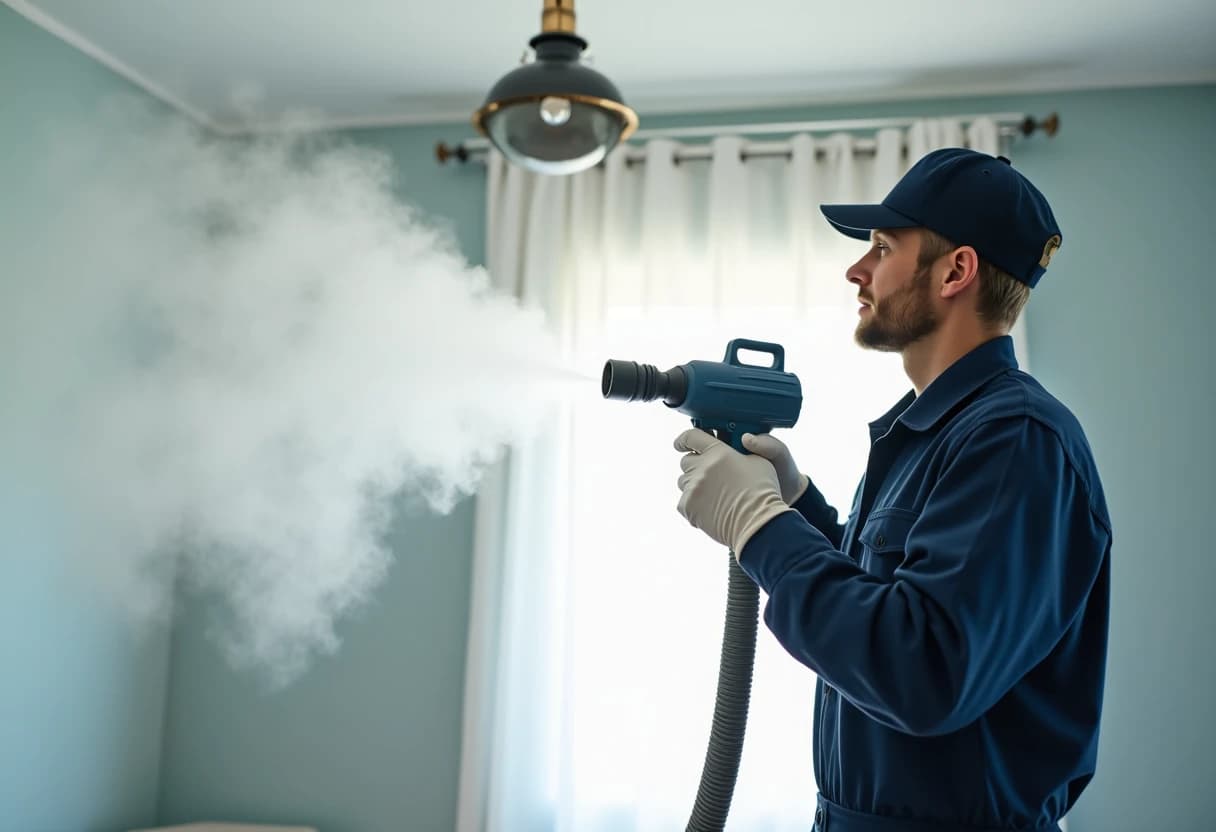
With the system freshly cleaned, the EPA-registered fog does its work at the surface level: contact-killing the bacteria that metabolize duct residue into odor, neutralizing the residual film chemically, and leaving an inhibiting layer that suppresses microbial regrowth. The application follows label contact times precisely — this is regulated chemistry applied to specification, not a scented mist waved through the vents.
5Coil, Drain Pan & Blower Treatment
Every fogging visit includes hands-on treatment of the components the fog alone cannot adequately address: coil fins treated with appropriate cleaner, drain pan scrubbed and sanitized, condensate line flushed, blower compartment wiped and treated. If we find heavy coil fouling or standing water that signals a bigger problem, we document it with photos and quote the fix separately — informed consent, never ambush.
6Deodorizing Pass for Stubborn Odors
Antimicrobial treatment handles biological odors, but some smells are chemical: tar and nicotine films, cooking-oil residue, fire smoke. For those, we deploy counteractants that chemically neutralize the odor compounds themselves. The distinction matters — treating a smoke house with antimicrobial alone leaves the tar film broadcasting — and diagnosing which chemistry your odor needs is exactly what the initial assessment is for.
7System Airing, Verification & Walkthrough
The finish is verification by nose and by paper: a room-by-room airflow check confirming neutral odor at every register, before-and-after photos of the duct interiors, and a written record of products applied with their EPA registration numbers. Surfaces are dry and the home fully usable by the time we pack up in nearly all cases — we review any exceptions before we start, never after.
Benefits of Professional Air Duct Sanitizing & Deodorizing in Bridgewater
Microbial Load Reduced System-Wide
Beyond odor, the treatment is a sanitizing pass over the one surface network your household's air touches continuously. EPA-registered antimicrobials kill odor bacteria and mold spores resident in the duct film and inhibit their regrowth — meaningful for households with allergy sufferers, young children, elderly members or anyone for whom airborne biology is more than an abstraction.
Odors Neutralized at the Source, Not Masked
Homeowners who have fought a duct-borne smell describe the same arc: sprays, candles, filters, ozone gadgets, shampooed carpets — hundreds of dollars of masking, months of frustration, smell intact. Source treatment ends the arc in one visit because it is aimed at the right target. The register air itself comes out neutral, so the rooms finally stay that way.
Pet Odor Elimination That Actually Holds
The cruel mechanics of pet odor: residents go nose-blind while every guest detects it instantly. If you have wondered whether your house 'smells like dog,' the ducts are almost certainly broadcasting more than you can perceive. Sanitizing after source-removal cleaning resets the broadcast to zero — and unlike surface remedies, it stays reset, because the reservoir itself is gone.
A True Reset for Newly Purchased Homes
The previous owners' pets, kitchen, tobacco and habits are archived in your duct film, replaying on every cycle. Cleaning plus sanitizing erases the archive — mechanically stripping the residue, then neutralizing the biology — so the house starts smelling like yours from day one. It is the single most-requested reason for this service, and the reviews it generates say 'finally smells like our home.'
Smoke Ghosts Finally Evicted
If a home smelled of cigarettes at the showing and still does after renovation, the air system is the unrenovated room. Smoke rode the returns for years, coating the full duct network with residue no one ever addresses. Treating that network is routinely the missing piece that finally clears a smoker's house — and the step savvy buyers now negotiate into the purchase.
Musty Summer Smell Broken for Good
Beyond comfort, the musty smell is diagnostic: it means active microbial metabolism in your air path, which trends toward visible colonization if the conditions persist. Treating it early — film removed, surfaces sanitized, moisture noted and addressed — is both the fix and the prevention, and materially cheaper than the mold removal that unchecked growth eventually requires.
Signs Your Bridgewater Home Needs Air Duct Sanitizing & Deodorizing
Smoke History in the Home
If any era of the home's life included indoor smoking, the duct network carries the tar-and-nicotine film to prove it — and that film off-gasses for years, strongest on warm humid days when the residue softens. Paint and carpet replacement miss it entirely. Counteractant duct treatment is the step that finally clears a smoker's house.
After Pests, Mold or Water in the System
Rodent or insect activity in ductwork leaves droppings, nesting debris and bacterial contamination that mechanical cleaning removes but does not neutralize — the sanitizing pass is what addresses the biological load. Any pest history that touched the air system should end with an EPA-registered treatment, and the odor benefit arrives as a bonus.
Musty Blast When the Heat or AC Starts
A damp, sour or dirty-sock note in the first minutes of a cycle, fading as the system runs, points to microbial activity on the coil, in the drain pan or along the duct film. It is most common in cooling season and after humid stretches. The pattern is diagnostic — and it is exactly what cleaning plus antimicrobial treatment eliminates.
Odors Return No Matter How Much You Clean
If deep-cleaning the house buys only a day or two before the smell creeps back, the source is upstream of everything you cleaned — in the air system, re-scenting the rooms on every cycle. That resupply pattern is the signature of duct-borne odor, and it means the fix is in the ducts, not in another weekend of scrubbing.
You Just Bought the Home
Even a home that smells fine at purchase benefits from the reset when history is unknown: odor thresholds are personal, previous owners' normal may not be yours, and the first heating season has a way of releasing what summer showings concealed. Buyers who sanitize at move-in never have to wonder what October's first furnace cycle will announce.
Pets Present or Past
The threshold question: can guests tell you have animals without seeing them? If yes, the ducts are broadcasting, and the smell is stronger than your adapted nose reports. Households with multiple pets or long pet tenure carry proportionally heavier duct reservoirs, and they see the most dramatic before-and-after from a single cleaning-plus-treatment visit.
Air Duct Sanitizing & Deodorizing Cost in Bridgewater, MA
A note on what drives our costs, because transparency beats mystery pricing. EPA-registered antimicrobials labeled for HVAC use cost genuinely more than the hardware-store alternatives we refuse to use — registration means the product's efficacy and safety data were reviewed for exactly this application, and label-rate application means measured dilutions, not eyeballed ones. Fogging equipment sized for whole-duct-network coverage, technician time for the coil-pan-blower wet section, and the assessment that qualifies the job honestly all live in the price. So does the callback promise: if the odor we treated returns in the following months, we return with it. What is not in the price: routine-maintenance upsell — the EPA does not recommend scheduled biocide application in residential ducts, and a company suggesting annual sanitizing regardless of conditions is selling chemistry you do not need. Sanitize when odors, contamination events or move-ins warrant it; between those moments, a clean system and decent filtration are all your ducts require, and we will tell you exactly that.
Want the full pricing picture? See our complete Boston-area cost guide or call (617) 390-7145 for an exact flat quote for your Bridgewater home.
Local Knowledge: Bridgewater, Plymouth County
What makes Bridgewater different? Bridgewater blends historic Greek Revival and Victorian homes around Central Square and the university with big 1990s-2000s colonial subdivisions carved out of former farmland, plus student-oriented rentals near campus. The rental stock sees hard use and infrequent maintenance, while the newer subdivisions run standard builder-grade duct systems now reaching the twenty-to-thirty-year mark. Bridgewater borders the Hockomock Swamp, and the low water table keeps many basements and crawlspaces damp enough that mold-tinged returns are a recurring find, especially in the Scotland and Titicut sections. Around the university, rental turnovers are the natural moment for a duct cleaning, and we work with several local landlords on that schedule. For duct and dryer vent systems, those local factors translate into specific, predictable problems — and predictable problems are the ones we solve fastest. Call (617) 390-7145, tell us your street and home style, and we will quote the job accurately the first time, usually in under five minutes.
The Best Time of Year in Bridgewater
Winter changes the odor equation by sealing the laboratory. From November through March, Massachusetts houses close tight, ventilation drops to mechanical minimums, and the blower runs hours daily — so whatever the duct film holds is recirculated and concentrated through the very months the household spends most indoors. Pet and smoke odors that summer's open windows diluted become suddenly, embarrassingly prominent by January. This is why mid-winter odor calls are among our most urgent-sounding, and why the pre-season treatment is worth disproportionately more than the same service in April: sanitize in fall, and the five sealed months circulate neutral air; wait, and the sealed months amplify the problem while you live inside it.
Why Choose Boston Air Duct Cleaners
Homeowners across Plymouth County choose Boston Air Duct Cleaners for three reasons. First, honesty: our inspection camera tells you whether your system actually needs cleaning — and sometimes the answer is no. Second, capability: truck-grade negative-air machines, rotary brush systems and HEPA filtration handle everything from antique gravity-furnace conversions to brand-new high-velocity systems. Third, accountability: flat quoted pricing, before-and-after photos, insured technicians, and a real local office you can call at (617) 390-7145. That combination is rarer in this industry than it should be.
Serving Bridgewater and Surrounding Communities
We serve every community around Bridgewater as well: East Bridgewater, Brockton, Easton, Whitman, Hanson all fall inside our regular service routes. If you have a second property, a rental, or family nearby, ask about multi-home scheduling — grouped appointments on the same route are our most requested discount.