
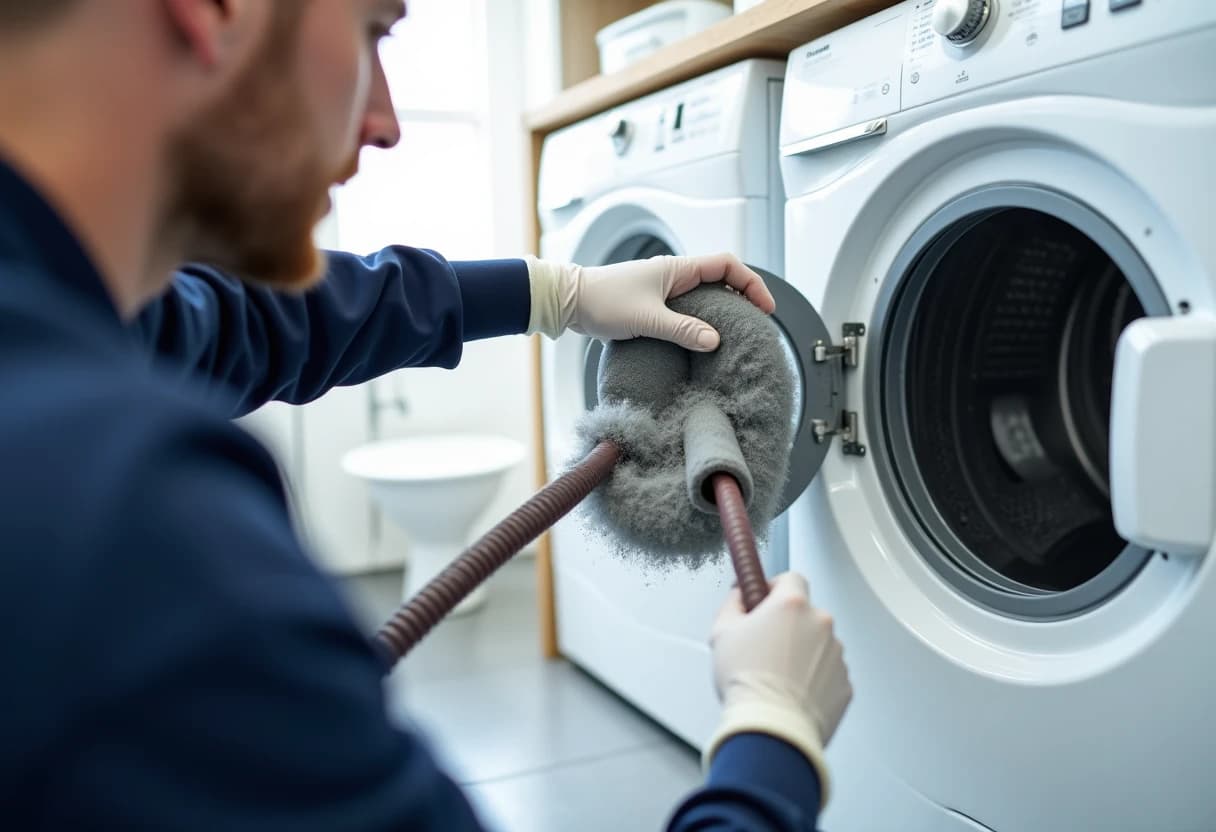
Homeowners in Bridgewater typically call us for dryer vent cleaning after one of three moments: a load that will not dry, a burning odor from the laundry area, or a repair technician who condemned the vent while servicing the dryer. All three trace to the same lint accumulation that builds silently for years. Our service removes it completely — rotary brush agitation through the full duct length, HEPA vacuum extraction, exterior hood cleaning, and a check of the transition duct behind the dryer where crushing and kinks hide. We are local, insured, and we quote flat pricing that covers the entire run, roof terminations included.
Why Dryer Vent Cleaning Matters for Bridgewater Homes
Some homeowners ask whether they can just clean the vent themselves with a leaf blower or a hardware-store brush kit — and for a short, straight, first-floor vent, a diligent DIY cleaning is better than nothing. The trouble is that most Greater Boston vents are not short or straight. Runs from basement or interior laundry rooms commonly stretch 15 to 35 feet with three or four elbows, and consumer brush kits lose effectiveness with every bend, often compacting lint into a plug instead of removing it. Leaf blowers can blow a soft clog into a dense one, or blow the exterior damper shut. Professional equipment is different in kind: motor-driven rotary brushes that maintain scrubbing force through every elbow, HEPA vacuums that capture lint at the same time, inspection of the transition duct and termination, and an airflow measurement that verifies the result. We also spot the problems a brush cannot fix — crushed duct, disconnected joints, illegal flex materials — before they turn a maintenance visit into an emergency.
Ask around Bridgewater Town Common and you will find neighbors who learned about dryer vent fires the hard way — a scorched load, a melted transition hose, a fire department visit. Bridgewater borders the Hockomock Swamp, and the low water table keeps many basements and crawlspaces damp enough that mold-tinged returns are a recurring find, especially in the Scotland and Titicut sections. Around the university, rental turnovers are the natural moment for a duct cleaning, and we work with several local landlords on that schedule. Bridgewater blends historic Greek Revival and Victorian homes around Central Square and the university with big 1990s-2000s colonial subdivisions carved out of former farmland, plus student-oriented rentals near campus. The rental stock sees hard use and infrequent maintenance, while the newer subdivisions run standard builder-grade duct systems now reaching the twenty-to-thirty-year mark. Those local conditions are why we treat Bridgewater dryer vent cleaning as a safety service, not a courtesy add-on: full-length rotary brush cleaning, HEPA capture, termination and damper service, transition duct inspection, and an airflow check at the end that proves the line is clear. Residents of East Bridgewater and Brockton book the same service, which is why our trucks are in this part of Plymouth County nearly every week.
Our Dryer Vent Cleaning Process in Bridgewater
1Inspect the Dryer, Transition Duct & Vent Path
Every job opens with a walkthrough of the complete exhaust path. The technician checks the lint screen housing, inspects the transition hose behind the dryer, locates every accessible section of duct, and finds the termination — wall hood, soffit outlet or roof cap. Photos document the starting condition so you can compare against the finished result.
2Protect the Laundry Area & Disconnect the Dryer
We treat laundry rooms — often tight, finished spaces — with the same care as any living area: drop cloths down, dryer walked out on protective sliders, and the work zone contained. Disconnecting at the appliance gives us a clean entry point into the duct and a chance to inspect the connection hardware that so often leaks lint into the wall cavity.
3Rotary Brush the Full Length of the Duct
Mechanical agitation is what separates professional cleaning from blow-through methods. The rotary brush physically breaks up compacted lint that air pressure alone would only compress further. We select brush heads sized to your duct — standard 4-inch for code-compliant lines, alternates for older oversized or reduced runs — so the bristles actually contact the duct wall the whole way.
4Capture Everything With HEPA Vacuum Extraction
Extraction runs continuously during brushing so debris moves in one controlled direction. On long or heavily blocked runs we alternate: brush a section, extract, advance. This staged approach clears even fully plugged ducts — the ones where the exterior damper has not opened in years — without compacting the blockage deeper.
5Clean From the Exterior Termination Inward
Cleaning from both ends is non-negotiable on longer runs. The last few feet before the termination, and the hood itself, accumulate the densest lint — it is where moist exhaust meets cold outdoor air and fibers mat together. We open the hood, clear the damper, remove nesting if present, and brush the final duct section back toward the vacuum.
6Service the Transition Duct & Reconnect
Before reconnecting, we vacuum the dryer's own lint trap housing and accessible internal ducting, where years of screen bypass collects near the heating element. Then the transition duct is cleaned or replaced, clamped properly — never screwed, since screw tips inside the airstream snag lint — and the dryer is positioned to leave the duct an easy, unkinked path.
7Verify Airflow & Walk You Through the Results
We run the dryer and inspect the termination together — you should see the damper flap standing open under confident airflow, something many homeowners have literally never observed on their own vent. Your technician reviews photos, flags any code or condition issues for future attention, and records your service date for an annual reminder.
Benefits of Professional Dryer Vent Cleaning in Bridgewater
Lower Energy Bills
Every minute of unnecessary drying time is metered energy. A restricted vent that doubles cycle times roughly doubles the dryer's share of your utility bill — often $10 to $20 a month for an average household. Annual cleaning typically pays for a large fraction of itself in the first year of restored efficiency.
Documentation for Insurance, Condos & Peace of Mind
The quiet benefit is simply knowing. A dryer vent is invisible infrastructure that most homeowners have never once seen inside — and after our visit, you have photos, airflow numbers and a professional's assessment on file. That certainty, renewed once a year, is worth the modest price by itself.
Faster Drying Times
Airflow is what dries clothes; heat just helps. Restore full exhaust capacity and loads that limped through two cycles finish in one, towels stop coming out damp at the seams, and the dryer's moisture sensors — which many modern machines rely on — start reading accurately again. Most customers notice the difference on the first load after our visit.
Dramatically Reduced Fire Risk
After cleaning, your dryer's exhaust runs cool and free, its high-temperature safety switches stop cycling, and the duct holds no fuel load waiting for a spark. For households that run daily laundry — big families, home businesses, multi-generational homes — that risk reduction compounds with every load.
Longer Dryer Lifespan & Fewer Repairs
New dryers deserve clean vents from day one — manufacturers require adequate exhaust airflow for warranty coverage, and delivery crews almost never clean the existing duct. If you have recently replaced your dryer and skipped the vent, you have connected a new engine to a clogged tailpipe.
Less Moisture, Mildew & Musty Odor
Each load exhausts about a gallon of water as vapor. When the vent is blocked, that moisture backs into the laundry room and the duct itself — condensing on walls, peeling paint, and feeding mildew. A clear vent sends the humidity outside, drying out the laundry area and eliminating the damp, musty smell that clings to blocked systems.
Signs Your Bridgewater Home Needs Dryer Vent Cleaning
The Exterior Vent Flap Barely Opens
Many Bridgewater-area vents terminate on roofs or high walls where owners never look — which is exactly why blockages there grow uninterrupted for years. If you cannot see your termination or have never checked it, assume it needs inspection. We check and clean terminations, roof-mounted included, on every visit.
It Has Been More Than a Year
The NFPA, FEMA and every major dryer manufacturer converge on the same guidance: professional vent cleaning at least annually, more often for heavy use. If you cannot remember your last cleaning — or know there has never been one — the schedule alone says you are due, whatever the symptoms.
Dryer or Clothes Are Hot to the Touch
Some heat is normal; radiating heat is not. When the exhaust cannot escape, the drum, cabinet and surrounding wall absorb it instead. Homes where we measure the highest cabinet temperatures reliably produce the fullest lint bags — the correlation between heat and blockage is nearly one to one.
Burning Smell During a Cycle
Never normalize a burning odor from a dryer. Investigators repeatedly find that households smelled scorching lint for weeks before an ignition. A cleaning visit resolves the source in about an hour and includes vacuuming the dryer's internal lint paths near the element — where the smell most often starts.
Laundry Room Gets Hot and Humid
Watch for secondary evidence: peeling paint near the dryer, mildew spots on the ceiling above it, a musty smell that lingers after laundry day, rust on shelf brackets. All are condensation footprints from exhaust escaping into the room through a restricted or leaking duct rather than exiting the house.
Lint Building Up Behind or Inside the Dryer
Check your lint screen pattern too: if the screen suddenly catches less than usual, lint is bypassing it into the machine and duct — often because backpressure from a blocked vent is redirecting airflow. Less lint on the screen frequently means more in the duct, not cleaner laundry.
Dryer Vent Cleaning Cost in Bridgewater, MA
Dryer vent cleaning in Greater Boston typically costs $149 to $299, and the honest drivers of price are the run itself: length, number of elbows, and where it terminates. A first-floor laundry with a short straight shot to a side wall sits at the low end near $149. A basement laundry venting up and across to a second-story wall, or any roof termination, sits toward $249 to $299 because of the added access work and ladder or roof time. Severely blocked ducts that need staged extraction, nest removal from the termination, or cleaning from both ends of a very long run can add modestly, and we tell you before proceeding. What never changes: our quote covers the complete line — dryer connection to exterior hood, elbows included — plus transition duct inspection, exterior damper service and airflow verification. Beware pricing that covers 'the first six feet' with per-foot charges after; a dryer vent is only clean if all of it is clean.
Want the full pricing picture? See our complete Boston-area cost guide or call (617) 390-7145 for an exact flat quote for your Bridgewater home.
Local Knowledge: Bridgewater, Plymouth County
What makes Bridgewater different? Bridgewater blends historic Greek Revival and Victorian homes around Central Square and the university with big 1990s-2000s colonial subdivisions carved out of former farmland, plus student-oriented rentals near campus. The rental stock sees hard use and infrequent maintenance, while the newer subdivisions run standard builder-grade duct systems now reaching the twenty-to-thirty-year mark. Bridgewater borders the Hockomock Swamp, and the low water table keeps many basements and crawlspaces damp enough that mold-tinged returns are a recurring find, especially in the Scotland and Titicut sections. Around the university, rental turnovers are the natural moment for a duct cleaning, and we work with several local landlords on that schedule. For duct and dryer vent systems, those local factors translate into specific, predictable problems — and predictable problems are the ones we solve fastest. Call (617) 390-7145, tell us your street and home style, and we will quote the job accurately the first time, usually in under five minutes.
The Best Time of Year in Bridgewater
New England's humid summers work on dryer vents from the other direction. High dew points mean exhaust moisture lingers in the duct instead of flashing away, and damp lint packs harder and grips duct walls tighter than dry lint ever does. Basement laundry areas — the Massachusetts default — add their own ambient humidity to the mix. By September, a vent that entered summer marginal is often matted solid. Summer is also nesting season at the other end of the line: birds and squirrels find an unscreened, warm, sheltered dryer termination irresistible, and a spring nest becomes a fall blockage. Our cleanings clear both problems and note whether your termination needs a code-compliant guard.
Why Choose Boston Air Duct Cleaners
Boston Air Duct Cleaners is a local, owner-operated company based at 1121 Washington St in West Newton — not a national franchise dispatching subcontractors. Every crew is our own: background-checked, factory-trained on commercial negative-pressure equipment, and fully insured. We quote flat prices before work begins, document every job with before-and-after photos, and follow NADCA-standard source-removal methods on every system we touch. That is why so much of our work comes from repeat customers, property managers and word-of-mouth referrals across Plymouth County.
Serving Bridgewater and Surrounding Communities
Beyond Bridgewater, our crews cover the surrounding communities daily — including East Bridgewater, Brockton, Easton, Whitman, Hanson. Because routes cluster geographically, booking alongside a neighboring appointment often unlocks same-day service and combined-visit savings. Wherever you are in Plymouth County, the same flat-rate pricing, insured technicians and photo-documented process applies.