Buying a home means inheriting its air system exactly as the previous owners left it — their pets, their cooking, their smoking habits, their damp basement, all archived in the duct film and re-broadcast every time the heat or AC runs. Duct sanitizing is the move-in reset Seaport District buyers ask us for most: a full source-removal cleaning followed by EPA-registered antimicrobial fogging that neutralizes the biological residue cleaning alone leaves behind. It is equally popular after pest issues, mold findings, water events and smoke exposure — any situation where you want the air path not just cleaned but decontaminated. One visit, and the house stops smelling like somebody else's.
Why Air Duct Sanitizing & Deodorizing Matters for Seaport District Homes
Pet households face duct odor mechanics that surface cleaning cannot beat. Dander is an aerosol: it rides the return airflow into the duct network, settles into the interior film, and accumulates for as long as the pet lives there — often across multiple pets and many years. The film becomes an odor reservoir with the system's full distribution reach, which is why the smell is strongest when the heat kicks on and why guests detect it instantly while residents have gone nose-blind. The same mechanism archives cigarette and cannabis smoke, cooking oils, and the general biological signature every household writes into its air system over time. When the home changes hands, the new owners inherit the archive. Source-removal cleaning strips the reservoir; EPA-registered fogging neutralizes the residue and the bacteria feeding on it; and the system stops broadcasting. For sellers, this pairing is one of the highest-leverage pre-listing investments available — showings live and die on the first thirty seconds of smell — and for buyers it is the cleanest possible start in a home with an unknown history.
Air in Seaport District carries its own seasonal load. New construction is no guarantee of clean ducts: Seaport units routinely carry construction debris from their own build-out, and the towers' sealed windows mean residents breathe only what the mechanical systems deliver. Harbor humidity and salt air are hard on rooftop equipment and vent terminations, and in-unit washer-dryer setups with long concealed vent runs to the building exterior are a lint problem we service throughout the district. The Seaport is Boston's newest neighborhood, dominated by glass luxury high-rises built almost entirely since 2010, with the Fort Point fringe adding century-old brick-and-beam warehouse lofts converted to condos. The towers run sophisticated central systems - vertical risers, unit-level fan coils and heat pumps, and shared corridor ventilation - where individual condo ductwork is compact but works hard year-round. Fort Point lofts feature long exposed spiral duct runs strung across timber ceilings. Between humid summers dampening duct interiors and long winters sealing houses around whatever the system holds, odors here compound year over year rather than airing out. Sanitizing resets that accumulation: after cleaning strips the film, EPA-registered treatment neutralizes the bacteria and residue that generate the smell, and the closed-window months circulate neutral air instead of concentrated history. Fall bookings from Seaport District fill early for precisely this reason — call ahead of the season.
Our Air Duct Sanitizing & Deodorizing Process in Seaport District
1Odor Assessment & Honest Qualification
First we determine whether sanitizing will actually fix your problem. The technician traces the odor's behavior — does it arrive with airflow, vary by season, concentrate at certain registers — inspects the duct interiors and air handler, and checks for moisture. If the source is your ducts, we quote the treatment flat. If it is not, we say so and point you at the real source.
2Source-Removal Cleaning First
Sanitizer applied over dirt is wasted — no chemistry penetrates a mat of dust and biofilm. So the system is cleaned first to NADCA-standard bare surfaces: registers sealed, ductwork under HEPA-filtered negative pressure, every run mechanically agitated with brushes and air whips. If your ducts were professionally cleaned very recently, we verify by camera and credit the step accordingly.
3Product Selection & Preparation
We match the chemistry to the problem: an EPA-registered antimicrobial labeled for HVAC use as the base treatment, with odor-counteractant chemistry added for smoke, pet or severe musty situations. You see the product names and safety data sheets before application — never a vague 'proprietary treatment' — and we review re-entry timing, typically just a few hours, with you up front.
4Whole-System Antimicrobial Fogging
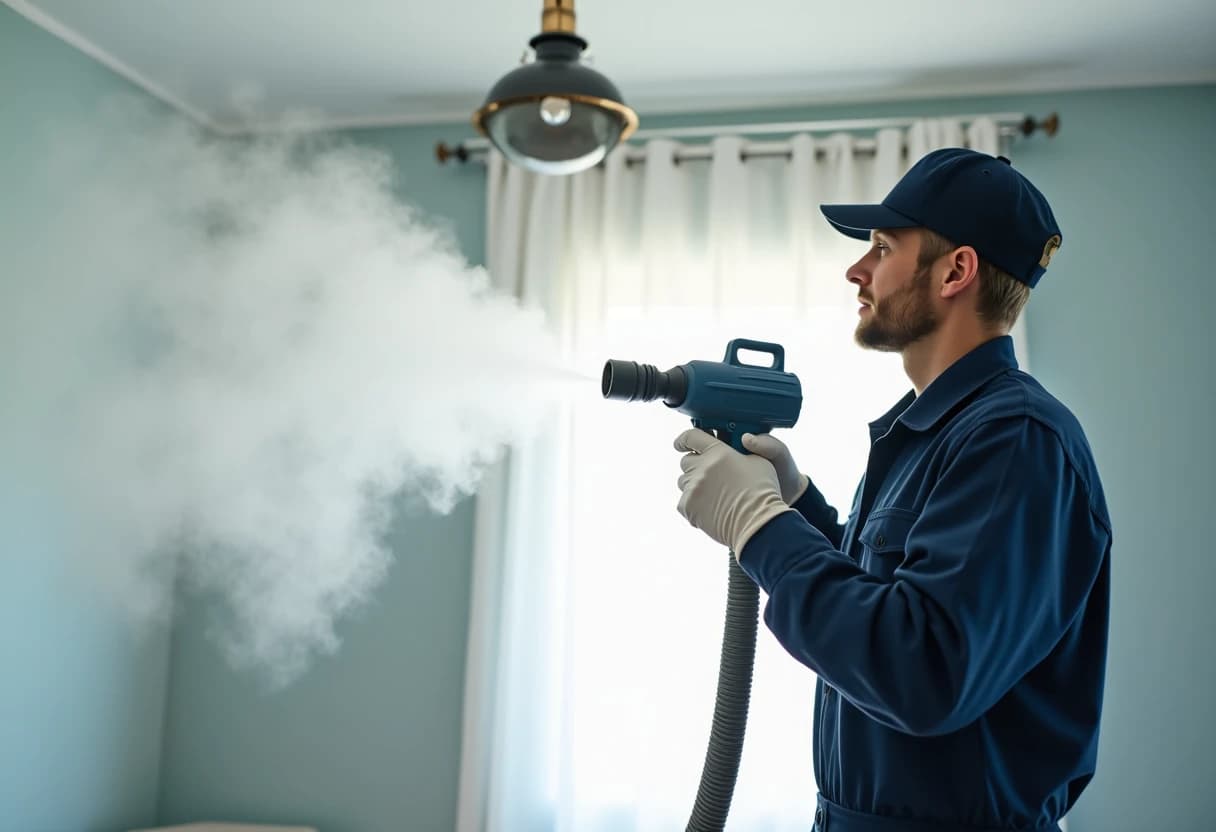
Fogging is the delivery method that makes duct sanitizing whole-system rather than spot treatment. Atomized at the micron scale, the antimicrobial behaves like the air itself, riding the airflow into every branch, riser and return the blower serves. Everywhere your air travels, the treatment travels — which is precisely why it works on odors that a hand-sprayed register never touches.
5Coil, Drain Pan & Blower Treatment
Your system's odor epicenter is usually the equipment, not the ducts: the coil and drain pan stay wet all cooling season, breeding the bacteria behind classic dirty-sock smell. We clean and treat both, clear the condensate trap, and sanitize the blower assembly that pushes air past them — closing the loop so the freshly treated ductwork is not immediately re-contaminated from upstream.
6Deodorizing Pass for Stubborn Odors
Smoke and heavy pet situations get a second, targeted pass with odor-counteractant chemistry — products that bind and neutralize odor molecules rather than perfume over them. Tobacco residue in particular clings aggressively to metal and re-releases for years; the counteractant pass addresses it specifically. This step is included when the assessment calls for it and skipped, with the price reflecting that, when it does not.
7System Airing, Verification & Walkthrough
After label contact time elapses, we run the system to air the treatment through, reinstall registers, and walk the home with you register by register. You should smell neutral air — not fragrance, not chemicals, nothing. You receive the product documentation, re-entry guidance already satisfied by the airing process in most cases, and our callback commitment if any trace of the original odor resurfaces.
Benefits of Professional Air Duct Sanitizing & Deodorizing in Seaport District
Microbial Load Reduced System-Wide
After specific contamination events — pest activity in the ducts, confirmed mold, water intrusion — this benefit becomes the headline: droppings, spores and bloom residue carry genuine pathogen and allergen loads, and mechanical cleaning alone does not neutralize them. The EPA-registered treatment does, which is why sanitizing moves from optional to advised the moment contamination history enters the picture.
Odors Neutralized at the Source, Not Masked
Homeowners who have fought a duct-borne smell describe the same arc: sprays, candles, filters, ozone gadgets, shampooed carpets — hundreds of dollars of masking, months of frustration, smell intact. Source treatment ends the arc in one visit because it is aimed at the right target. The register air itself comes out neutral, so the rooms finally stay that way.
Smoke Ghosts Finally Evicted
If a home smelled of cigarettes at the showing and still does after renovation, the air system is the unrenovated room. Smoke rode the returns for years, coating the full duct network with residue no one ever addresses. Treating that network is routinely the missing piece that finally clears a smoker's house — and the step savvy buyers now negotiate into the purchase.
Pet Odor Elimination That Actually Holds
Dander is airborne, the return ducts inhale it continuously, and years of accumulation turn the duct film into a dander reservoir with whole-house reach — which is why the pet smell survives every carpet shampoo. Removing the reservoir and neutralizing the residue takes the system out of the equation, and most households report the smell simply gone, permanently, after one treatment.
A True Reset for Newly Purchased Homes
You inspected the roof, the furnace and the foundation before buying; the air system's biological history was invisible on every report. A move-in sanitizing closes that gap, decontaminating the one system that touches every room before your family settles in. Scheduled between closing and move-in, it is the cheapest and easiest it will ever be — empty house, open access, one afternoon.
Musty Summer Smell Broken for Good
The musty cycle is self-reinforcing: each humid season's growth adds residue that feeds the next season's growth. Breaking it requires actually removing the substrate, which is what the cleaning-plus-treatment pairing does. Homeowners who assumed the smell was 'just what old houses do' discover it was just what untreated ducts do — old houses smell fine with a neutral air path.
Signs Your Seaport District Home Needs Air Duct Sanitizing & Deodorizing
You Just Bought the Home
Even a home that smells fine at purchase benefits from the reset when history is unknown: odor thresholds are personal, previous owners' normal may not be yours, and the first heating season has a way of releasing what summer showings concealed. Buyers who sanitize at move-in never have to wonder what October's first furnace cycle will announce.
Musty Blast When the Heat or AC Starts
Cycle-start odor means the smell is being generated inside the system and flushed out with the first air movement. Intermittent mustiness responds fully to sanitizing; a strong, constant or worsening version can indicate active mold colonization, which our inspection distinguishes — a difference that matters, since mold removal involves containment protocols and different pricing.
Pets Present or Past
The threshold question: can guests tell you have animals without seeing them? If yes, the ducts are broadcasting, and the smell is stronger than your adapted nose reports. Households with multiple pets or long pet tenure carry proportionally heavier duct reservoirs, and they see the most dramatic before-and-after from a single cleaning-plus-treatment visit.
Odors Return No Matter How Much You Clean
The tell is the rhythm: rooms smell fine with the system off, and the odor rebuilds when it runs. Surfaces cannot cause that pattern; airflow can. Homeowners often spend months eliminating suspects — carpets, drains, trash areas, basements — before checking the one system that touches every room. The register test takes ten seconds: smell the air it delivers.
Guests Notice a Smell You No Longer Can
The cruelest version arrives during a home sale: buyers and agents smell in thirty seconds what you have not smelled in years, and it costs you at the negotiating table either way. Pre-listing duct sanitizing addresses the odor you cannot perceive at its distribution point — which is why experienced listing agents put it on the prep checklist.
Smoke History in the Home
If any era of the home's life included indoor smoking, the duct network carries the tar-and-nicotine film to prove it — and that film off-gasses for years, strongest on warm humid days when the residue softens. Paint and carpet replacement miss it entirely. Counteractant duct treatment is the step that finally clears a smoker's house.
Air Duct Sanitizing & Deodorizing Cost in Seaport District, MA
Air duct sanitizing in Greater Boston runs $250 to $500 as a standalone service, and $75 to $200 when bundled with duct cleaning — the bundle discount reflects that the system is already sealed, accessed and under negative pressure, so the marginal cost is chemistry and application time rather than a second full mobilization. Within those ranges, price tracks system size (number of runs and zones determines product volume and fogging time), the odor profile (straightforward musty or pet situations need the antimicrobial pass alone, while smoke and severe cases add counteractant treatment), and how much wet-section work the coil, drain pan and blower need. One structural note on honest pricing: because effective sanitizing requires clean surfaces, a standalone quote for a system with dirty ducts must include cleaning — which is why legitimate standalone pricing converges toward the bundle anyway. A company happy to fog your uncleaned ducts for $149 is selling you a scented failure; the EPA's guidance that biocides follow mechanical cleaning is not a formality, it is why the treatment works at all.
Want the full pricing picture? See our complete Boston-area cost guide or call (617) 390-7145 for an exact flat quote for your Seaport District home.
Local Knowledge: Seaport District, Suffolk County
What makes Seaport District different? The Seaport is Boston's newest neighborhood, dominated by glass luxury high-rises built almost entirely since 2010, with the Fort Point fringe adding century-old brick-and-beam warehouse lofts converted to condos. The towers run sophisticated central systems - vertical risers, unit-level fan coils and heat pumps, and shared corridor ventilation - where individual condo ductwork is compact but works hard year-round. Fort Point lofts feature long exposed spiral duct runs strung across timber ceilings. New construction is no guarantee of clean ducts: Seaport units routinely carry construction debris from their own build-out, and the towers' sealed windows mean residents breathe only what the mechanical systems deliver. Harbor humidity and salt air are hard on rooftop equipment and vent terminations, and in-unit washer-dryer setups with long concealed vent runs to the building exterior are a lint problem we service throughout the district. For duct and dryer vent systems, those local factors translate into specific, predictable problems — and predictable problems are the ones we solve fastest. Call (617) 390-7145, tell us your street and home style, and we will quote the job accurately the first time, usually in under five minutes.
The Best Time of Year in Seaport District
The first furnace start of October is New England's annual duct-odor reveal. Summer's humidity left the system's film damp and biologically active; the first heating cycles bake it, and the house fills with a musty-dusty note that is equal parts burnt accumulation and volatilized microbial residue. Households that smelled nothing all summer suddenly field questions at the door. If last October's first fires announced themselves this way, book cleaning and sanitizing in September — the treatment lands on the year's heaviest odor load, and the heating season opens with clean, neutral startup cycles instead. Fall slots fill fastest for exactly this reason; the smart calendar position is ahead of the rush, not inside it.
Why Choose Boston Air Duct Cleaners
We built this company around the jobs other duct cleaners do badly: the 130-year-old Victorian with panned-joist returns, the Seaport District condo with a 60-foot dryer run to the roof, the post-renovation house full of drywall dust. Our crews see Greater Boston's hardest systems every week, and the experience shows in the details — floor protection on the way in, sealed registers during the work, HEPA-vacuumed work areas on the way out, and imagery that proves the ducts are actually clean. Call (617) 390-7145 and judge the difference from the first conversation.
Serving Seaport District and Surrounding Communities
Beyond Seaport District, our crews cover the surrounding communities daily — including South Boston, Boston, Back Bay, South End, East Boston, Dorchester. Because routes cluster geographically, booking alongside a neighboring appointment often unlocks same-day service and combined-visit savings. Wherever you are in Suffolk County, the same flat-rate pricing, insured technicians and photo-documented process applies.