
When South Boston homeowners call about duct odors, the stories rhyme: a musty smell every time the AC starts, a dog smell guests notice before they see the dog, cigarette ghosts from an owner two sales ago, or a basement note that follows the airflow upstairs. All of them live in the same place — the microbial and organic residue lining the duct system — and all of them respond to the same two-step fix: source-removal cleaning followed by EPA-registered antimicrobial fogging. We quote the pairing as a flat price, complete it in a single visit, and back it with a straightforward promise: if the odor problem is in your ducts, this ends it. If it is not, our inspection will tell you where to look instead.
Why Air Duct Sanitizing & Deodorizing Matters for South Boston Homes
Pet households face duct odor mechanics that surface cleaning cannot beat. Dander is an aerosol: it rides the return airflow into the duct network, settles into the interior film, and accumulates for as long as the pet lives there — often across multiple pets and many years. The film becomes an odor reservoir with the system's full distribution reach, which is why the smell is strongest when the heat kicks on and why guests detect it instantly while residents have gone nose-blind. The same mechanism archives cigarette and cannabis smoke, cooking oils, and the general biological signature every household writes into its air system over time. When the home changes hands, the new owners inherit the archive. Source-removal cleaning strips the reservoir; EPA-registered fogging neutralizes the residue and the bacteria feeding on it; and the system stops broadcasting. For sellers, this pairing is one of the highest-leverage pre-listing investments available — showings live and die on the first thirty seconds of smell — and for buyers it is the cleanest possible start in a home with an unknown history.
Duct odors in South Boston have local fingerprints. South Boston's grid is filled with 19th-century brick rowhouses and wood-frame triple-deckers, a huge share of which have been gut-renovated into upscale condos over the past two decades, with new mid-rise buildings rising along West Broadway and the Dorchester Avenue corridor. Those gut rehabs almost always added central air and new ductwork, but tight rowhouse footprints force ducts through soffits and party-wall chases with plenty of bends. Roof decks and penthouse additions frequently put condensers and air handlers in salt-exposed locations. Systems in these homes have been absorbing household life for decades — pets, kitchens, tobacco, damp cellars — and the interior film holds all of it. Southie juts into Boston Harbor, and homes near Castle Island and the beaches live with genuine coastal conditions - salt air that corrodes vent hoods and dampness that finds any duct run passing through an unconditioned space. The neighborhood's condo conversion boom also left a generation of systems installed fast during renovations, and we regularly pull construction debris from ducts in units sold as brand new. When our crews sanitize South Boston systems, the before-and-after is often startling to owners who had gone nose-blind: the EPA-registered fogging lands on freshly cleaned metal, the biological residue neutralizes, and the house exhales decades of accumulated character in a single afternoon.
Our Air Duct Sanitizing & Deodorizing Process in South Boston
1Odor Assessment & Honest Qualification
First we determine whether sanitizing will actually fix your problem. The technician traces the odor's behavior — does it arrive with airflow, vary by season, concentrate at certain registers — inspects the duct interiors and air handler, and checks for moisture. If the source is your ducts, we quote the treatment flat. If it is not, we say so and point you at the real source.
2Source-Removal Cleaning First
EPA guidance is explicit that treatments belong on cleaned surfaces only, and our sequence honors it: full source-removal cleaning before any product is introduced. This is the honest-versus-theater divide in duct sanitizing. Fog through dirty ducts and the smell returns in weeks as bacteria recolonize the untouched film; clean first and the treatment bonds to bare metal, where it can actually work.
3Product Selection & Preparation
We match the chemistry to the problem: an EPA-registered antimicrobial labeled for HVAC use as the base treatment, with odor-counteractant chemistry added for smoke, pet or severe musty situations. You see the product names and safety data sheets before application — never a vague 'proprietary treatment' — and we review re-entry timing, typically just a few hours, with you up front.
4Whole-System Antimicrobial Fogging
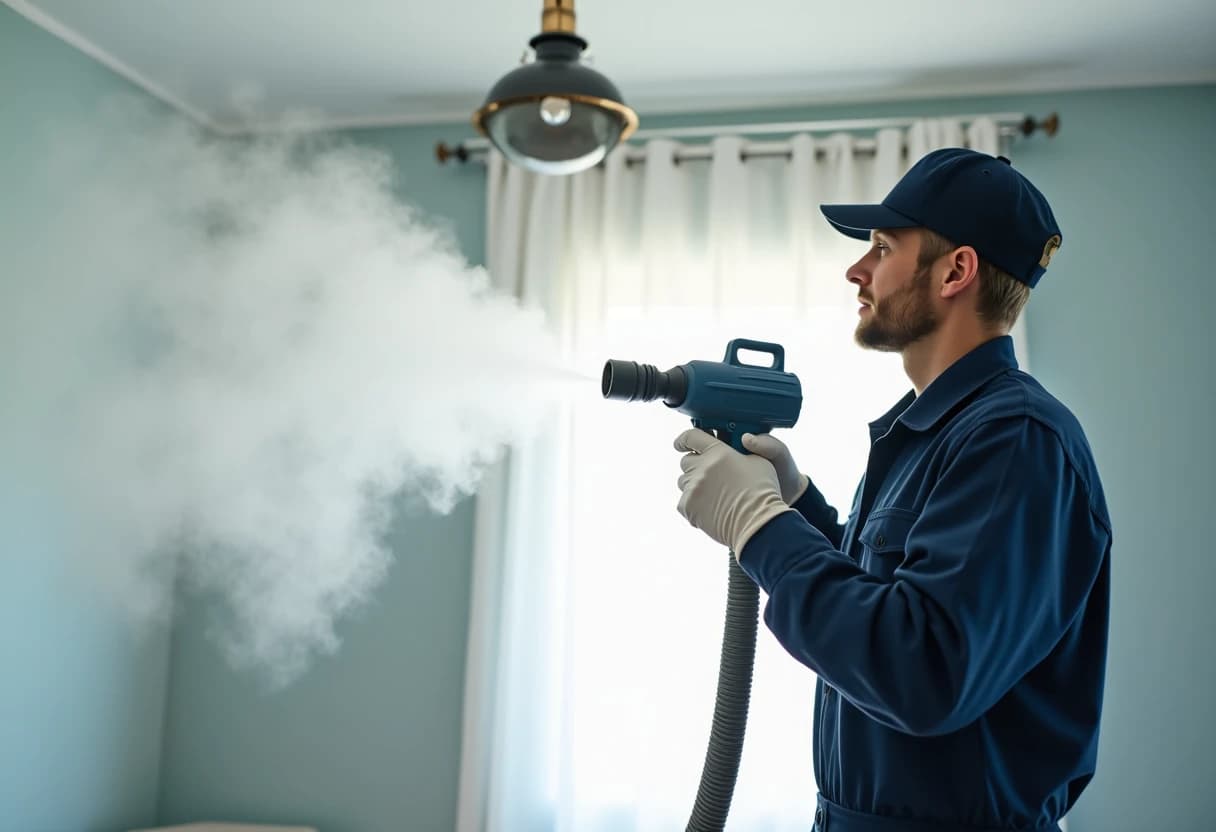
The treatment is atomized into a fine fog and introduced through the duct network while controlled airflow carries it the length of every supply and return. The fog deposits on all interior surfaces — including the seams, joints and corrugations mechanical cleaning cannot polish — killing odor-causing bacteria and neutralizing microbial residue on contact. Full-system coverage takes under an hour in most homes.
5Coil, Drain Pan & Blower Treatment
The dampest components carry the strongest biology, so the air handler wet section gets direct treatment: evaporator coil surfaces, the drain pan and its trap, and the blower wheel and housing. Musty odors disproportionately originate here — a slimy pan or biofilmed coil can perfume an entire house — and treating the ducts while skipping the equipment leaves the source in place.
6Deodorizing Pass for Stubborn Odors
Smoke and heavy pet situations get a second, targeted pass with odor-counteractant chemistry — products that bind and neutralize odor molecules rather than perfume over them. Tobacco residue in particular clings aggressively to metal and re-releases for years; the counteractant pass addresses it specifically. This step is included when the assessment calls for it and skipped, with the price reflecting that, when it does not.
7System Airing, Verification & Walkthrough
The finish is verification by nose and by paper: a room-by-room airflow check confirming neutral odor at every register, before-and-after photos of the duct interiors, and a written record of products applied with their EPA registration numbers. Surfaces are dry and the home fully usable by the time we pack up in nearly all cases — we review any exceptions before we start, never after.
Benefits of Professional Air Duct Sanitizing & Deodorizing in South Boston
Odors Neutralized at the Source, Not Masked
The failure of masking is chemical: fragrance molecules and odor molecules coexist, so the nose gets both — that sickly candle-over-dog note every guest recognizes. Neutralization is different chemistry entirely: the odor compounds are broken down or bound, and the bacteria regenerating them are killed. Once the source stops producing, nothing needs covering, and the difference is unmistakable at the front door.
Pet Odor Elimination That Actually Holds
The cruel mechanics of pet odor: residents go nose-blind while every guest detects it instantly. If you have wondered whether your house 'smells like dog,' the ducts are almost certainly broadcasting more than you can perceive. Sanitizing after source-removal cleaning resets the broadcast to zero — and unlike surface remedies, it stays reset, because the reservoir itself is gone.
A True Reset for Newly Purchased Homes
For buyers of older Massachusetts homes especially, the duct system may hold half a century of prior households. A documented cleaning and EPA-registered treatment resets it to a known-clean baseline — valuable for allergy-prone families, essential where the sellers had pets or smoked, and reassuring in any home whose maintenance history is a shrug. Start fresh literally.
Smoke Ghosts Finally Evicted
If a home smelled of cigarettes at the showing and still does after renovation, the air system is the unrenovated room. Smoke rode the returns for years, coating the full duct network with residue no one ever addresses. Treating that network is routinely the missing piece that finally clears a smoker's house — and the step savvy buyers now negotiate into the purchase.
Musty Summer Smell Broken for Good
Beyond comfort, the musty smell is diagnostic: it means active microbial metabolism in your air path, which trends toward visible colonization if the conditions persist. Treating it early — film removed, surfaces sanitized, moisture noted and addressed — is both the fix and the prevention, and materially cheaper than the mold removal that unchecked growth eventually requires.
Small Add-On Cost, Outsized Payoff
Bundled with duct cleaning, sanitizing adds roughly $75 to $200 to the visit — the system is already sealed, accessed and under negative pressure, so you pay for chemistry and application time, not a second mobilization. Against the hundreds homeowners spend annually on masking products that fix nothing, the one-time source treatment is the plainly economical choice.
Signs Your South Boston Home Needs Air Duct Sanitizing & Deodorizing
Musty Blast When the Heat or AC Starts
A damp, sour or dirty-sock note in the first minutes of a cycle, fading as the system runs, points to microbial activity on the coil, in the drain pan or along the duct film. It is most common in cooling season and after humid stretches. The pattern is diagnostic — and it is exactly what cleaning plus antimicrobial treatment eliminates.
Pets Present or Past
Allergy dynamics compound the odor case: duct-borne dander affects sensitive visitors and family members even when the smell is subtle. A treated system cuts both the odor and the circulating allergen load, which is why families expecting a new baby, hosting an allergic relative, or rehoming after a pet's passing all book this same service.
Smoke History in the Home
After a kitchen fire, wildfire smoke event or nearby structure fire, ducts inhale smoke even when flames never touched the house, and the system re-releases the odor long after surfaces are cleaned. Restoration protocols increasingly include duct treatment as standard; if yours did not, the lingering smell is telling you what was skipped.
After Pests, Mold or Water in the System
Rodent or insect activity in ductwork leaves droppings, nesting debris and bacterial contamination that mechanical cleaning removes but does not neutralize — the sanitizing pass is what addresses the biological load. Any pest history that touched the air system should end with an EPA-registered treatment, and the odor benefit arrives as a bonus.
Guests Notice a Smell You No Longer Can
The cruelest version arrives during a home sale: buyers and agents smell in thirty seconds what you have not smelled in years, and it costs you at the negotiating table either way. Pre-listing duct sanitizing addresses the odor you cannot perceive at its distribution point — which is why experienced listing agents put it on the prep checklist.
Odors Return No Matter How Much You Clean
Count what you have already tried: shampooed carpets, washed walls, new air filters, open windows, every candle in the store. When that entire arsenal fails against a smell, you are not fighting a surface — you are fighting a reservoir with a fan attached. Treating the reservoir is the move that finally works.
Air Duct Sanitizing & Deodorizing Cost in South Boston, MA
A note on what drives our costs, because transparency beats mystery pricing. EPA-registered antimicrobials labeled for HVAC use cost genuinely more than the hardware-store alternatives we refuse to use — registration means the product's efficacy and safety data were reviewed for exactly this application, and label-rate application means measured dilutions, not eyeballed ones. Fogging equipment sized for whole-duct-network coverage, technician time for the coil-pan-blower wet section, and the assessment that qualifies the job honestly all live in the price. So does the callback promise: if the odor we treated returns in the following months, we return with it. What is not in the price: routine-maintenance upsell — the EPA does not recommend scheduled biocide application in residential ducts, and a company suggesting annual sanitizing regardless of conditions is selling chemistry you do not need. Sanitize when odors, contamination events or move-ins warrant it; between those moments, a clean system and decent filtration are all your ducts require, and we will tell you exactly that.
Want the full pricing picture? See our complete Boston-area cost guide or call (617) 390-7145 for an exact flat quote for your South Boston home.
Local Knowledge: South Boston, Suffolk County
Every town's ductwork tells the story of its housing. South Boston's grid is filled with 19th-century brick rowhouses and wood-frame triple-deckers, a huge share of which have been gut-renovated into upscale condos over the past two decades, with new mid-rise buildings rising along West Broadway and the Dorchester Avenue corridor. Those gut rehabs almost always added central air and new ductwork, but tight rowhouse footprints force ducts through soffits and party-wall chases with plenty of bends. Roof decks and penthouse additions frequently put condensers and air handlers in salt-exposed locations. Southie juts into Boston Harbor, and homes near Castle Island and the beaches live with genuine coastal conditions - salt air that corrodes vent hoods and dampness that finds any duct run passing through an unconditioned space. The neighborhood's condo conversion boom also left a generation of systems installed fast during renovations, and we regularly pull construction debris from ducts in units sold as brand new. We plan South Boston jobs around those realities, from equipment selection to time on site, and it shows in the results. If you live near East Broadway or anywhere across South Boston's 02127 area, we have almost certainly cleaned a system like yours before — and we can tell you exactly what to expect before we arrive.
The Best Time of Year in South Boston
Spring earns its place in the sanitizing calendar through real estate and fresh starts. The March-through-June listing season puts thousands of Massachusetts homes in front of buyers whose first impression is olfactory, and pre-listing treatment — source-removal cleaning plus deodorizing — is the highest-leverage few hundred dollars a seller with any odor history can spend. Spring is also peak move-in season, and the between-closing-and-boxes window is the ideal moment to reset an inherited system: empty house, open access, and the previous owners' biological archive neutralized before your family's first night. Finally, spring cleaning momentum is legitimate: households already deep-cleaning surfaces get compounding returns from treating the one system that re-contaminates them — finish the job upstream, and the downstream cleaning holds.
Why Choose Boston Air Duct Cleaners
Homeowners across Suffolk County choose Boston Air Duct Cleaners for three reasons. First, honesty: our inspection camera tells you whether your system actually needs cleaning — and sometimes the answer is no. Second, capability: truck-grade negative-air machines, rotary brush systems and HEPA filtration handle everything from antique gravity-furnace conversions to brand-new high-velocity systems. Third, accountability: flat quoted pricing, before-and-after photos, insured technicians, and a real local office you can call at (617) 390-7145. That combination is rarer in this industry than it should be.
Serving South Boston and Surrounding Communities
Beyond South Boston, our crews cover the surrounding communities daily — including Seaport District, Dorchester, South End, Boston, Back Bay, Quincy. Because routes cluster geographically, booking alongside a neighboring appointment often unlocks same-day service and combined-visit savings. Wherever you are in Suffolk County, the same flat-rate pricing, insured technicians and photo-documented process applies.