
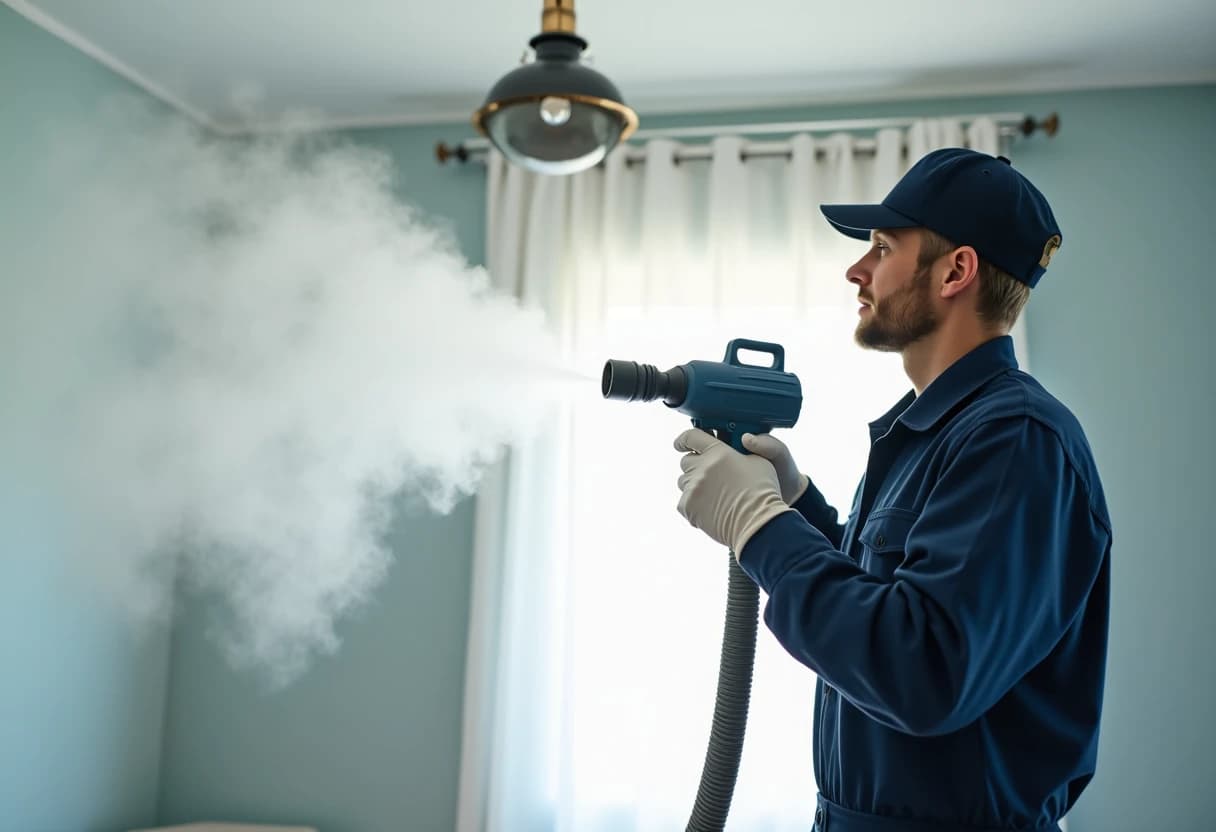
There is an honest version of duct sanitizing and a dishonest one, and the difference is sequence. Fogging chemicals through dirty ducts — the discount version — is theater: no product penetrates a mat of dust and biofilm, so the smell returns within weeks. The effective version treats sanitizing as step two of two: mechanical source-removal cleaning first, so surfaces are bare; then an EPA-registered, HVAC-labeled antimicrobial applied under airflow so coverage is complete. That is the only version we sell in Ashland. Applied correctly, one treatment neutralizes pet, smoke and musty odors at their source, sanitizes the full air path, and keeps the system smelling neutral for years rather than days.
Why Air Duct Sanitizing & Deodorizing Matters for Ashland Homes
Pet households face duct odor mechanics that surface cleaning cannot beat. Dander is an aerosol: it rides the return airflow into the duct network, settles into the interior film, and accumulates for as long as the pet lives there — often across multiple pets and many years. The film becomes an odor reservoir with the system's full distribution reach, which is why the smell is strongest when the heat kicks on and why guests detect it instantly while residents have gone nose-blind. The same mechanism archives cigarette and cannabis smoke, cooking oils, and the general biological signature every household writes into its air system over time. When the home changes hands, the new owners inherit the archive. Source-removal cleaning strips the reservoir; EPA-registered fogging neutralizes the residue and the bacteria feeding on it; and the system stops broadcasting. For sellers, this pairing is one of the highest-leverage pre-listing investments available — showings live and die on the first thirty seconds of smell — and for buyers it is the cleanest possible start in a home with an unknown history.
The housing stock around Ashland gives duct odors unusual staying power. Ashland mixes older mill-era homes and capes near its downtown with big tracts of 1980s-2000s colonials and a fast-growing crop of new townhouse and apartment communities near the commuter rail station. The newer construction is tight, well-insulated and fully ducted, which keeps energy bills down but concentrates any dust, dander or construction debris inside the duct system. Many of these systems include long trunk runs, joint-heavy older metal and returns that have never once been opened — surface area that has absorbed generations of household life. Ashland is one of the MetroWest's most active new-construction corridors, and we clean a steady stream of nearly new homes whose ducts were never cleared of drywall dust and sawdust after the build. Tighter envelopes in these transit-oriented developments mean the same air recirculates constantly, so what is in the ducts is in your lungs. A masking spray has no chance against that reservoir. Our approach — mechanical source removal first, then EPA-registered antimicrobial fogging through the full air path — is built for systems with this much history, and we bring it to Ashland, Framingham and Holliston weekly.
Our Air Duct Sanitizing & Deodorizing Process in Ashland
1Odor Assessment & Honest Qualification
First we determine whether sanitizing will actually fix your problem. The technician traces the odor's behavior — does it arrive with airflow, vary by season, concentrate at certain registers — inspects the duct interiors and air handler, and checks for moisture. If the source is your ducts, we quote the treatment flat. If it is not, we say so and point you at the real source.
2Source-Removal Cleaning First
Sanitizer applied over dirt is wasted — no chemistry penetrates a mat of dust and biofilm. So the system is cleaned first to NADCA-standard bare surfaces: registers sealed, ductwork under HEPA-filtered negative pressure, every run mechanically agitated with brushes and air whips. If your ducts were professionally cleaned very recently, we verify by camera and credit the step accordingly.
3Product Selection & Preparation
Only two kinds of products enter your air path: antimicrobials EPA-registered specifically for use in HVAC systems, and deodorizing counteractants formulated for duct application. No bleach, which corrodes ducts; no ozone shock treatments, which the EPA warns are ineffective at safe concentrations; no fragrance bombs that mask rather than neutralize. Dilutions follow the label exactly — that is what EPA registration means.
4Whole-System Antimicrobial Fogging
Fogging is the delivery method that makes duct sanitizing whole-system rather than spot treatment. Atomized at the micron scale, the antimicrobial behaves like the air itself, riding the airflow into every branch, riser and return the blower serves. Everywhere your air travels, the treatment travels — which is precisely why it works on odors that a hand-sprayed register never touches.
5Coil, Drain Pan & Blower Treatment
Your system's odor epicenter is usually the equipment, not the ducts: the coil and drain pan stay wet all cooling season, breeding the bacteria behind classic dirty-sock smell. We clean and treat both, clear the condensate trap, and sanitize the blower assembly that pushes air past them — closing the loop so the freshly treated ductwork is not immediately re-contaminated from upstream.
6Deodorizing Pass for Stubborn Odors
Antimicrobial treatment handles biological odors, but some smells are chemical: tar and nicotine films, cooking-oil residue, fire smoke. For those, we deploy counteractants that chemically neutralize the odor compounds themselves. The distinction matters — treating a smoke house with antimicrobial alone leaves the tar film broadcasting — and diagnosing which chemistry your odor needs is exactly what the initial assessment is for.
7System Airing, Verification & Walkthrough
The finish is verification by nose and by paper: a room-by-room airflow check confirming neutral odor at every register, before-and-after photos of the duct interiors, and a written record of products applied with their EPA registration numbers. Surfaces are dry and the home fully usable by the time we pack up in nearly all cases — we review any exceptions before we start, never after.
Benefits of Professional Air Duct Sanitizing & Deodorizing in Ashland
A True Reset for Newly Purchased Homes
For buyers of older Massachusetts homes especially, the duct system may hold half a century of prior households. A documented cleaning and EPA-registered treatment resets it to a known-clean baseline — valuable for allergy-prone families, essential where the sellers had pets or smoked, and reassuring in any home whose maintenance history is a shrug. Start fresh literally.
Microbial Load Reduced System-Wide
Ducts are a microbial habitat by design — dark, textured, dust-fed and periodically damp. Sanitizing knocks the resident population down to baseline and leaves an inhibiting residue that slows recolonization for years. It is not sterility, and no honest company promises that; it is a substantially cleaner biological starting point for all the air you breathe at home.
Smoke Ghosts Finally Evicted
Fire and smoke events leave the same signature at higher intensity: acrid residue through every duct the system ran during or after the event. Alongside your restoration work, duct cleaning with counteractant treatment prevents the classic post-fire complaint — a rebuilt, repainted home that still exhales smoke on warm days. We coordinate with restoration timelines regularly.
Pet Odor Elimination That Actually Holds
The cruel mechanics of pet odor: residents go nose-blind while every guest detects it instantly. If you have wondered whether your house 'smells like dog,' the ducts are almost certainly broadcasting more than you can perceive. Sanitizing after source-removal cleaning resets the broadcast to zero — and unlike surface remedies, it stays reset, because the reservoir itself is gone.
Small Add-On Cost, Outsized Payoff
Standalone treatments run $250 to $500; bundled with cleaning, the marginal cost drops by half or more. That pricing asymmetry is why we encourage odor-motivated customers to book the pairing — one visit, one setup, both halves of the fix. The alternative sequence, cleaning now and a separate sanitizing visit after the smell persists, costs more and delays the result.
Musty Summer Smell Broken for Good
Beyond comfort, the musty smell is diagnostic: it means active microbial metabolism in your air path, which trends toward visible colonization if the conditions persist. Treating it early — film removed, surfaces sanitized, moisture noted and addressed — is both the fix and the prevention, and materially cheaper than the mold removal that unchecked growth eventually requires.
Signs Your Ashland Home Needs Air Duct Sanitizing & Deodorizing
Pets Present or Past
Allergy dynamics compound the odor case: duct-borne dander affects sensitive visitors and family members even when the smell is subtle. A treated system cuts both the odor and the circulating allergen load, which is why families expecting a new baby, hosting an allergic relative, or rehoming after a pet's passing all book this same service.
Musty Blast When the Heat or AC Starts
Many households normalize this smell for years — a funky thirty seconds, then fine, so it never quite becomes a project. It should: the odor is live biology metabolizing residue in your air path, it recurs because the substrate remains, and it trends worse. One treatment visit ends a nuisance you had stopped noticing you tolerated.
Guests Notice a Smell You No Longer Can
The cruelest version arrives during a home sale: buyers and agents smell in thirty seconds what you have not smelled in years, and it costs you at the negotiating table either way. Pre-listing duct sanitizing addresses the odor you cannot perceive at its distribution point — which is why experienced listing agents put it on the prep checklist.
After Pests, Mold or Water in the System
Post-mold-remediation, treating the cleaned duct surfaces inhibits recolonization while moisture corrections take effect — standard best practice, and typically specified in remediation protocols. If your home had mold work done and the ducts were cleaned but never treated, that gap is worth closing before the next humid season tests it.
Odors Return No Matter How Much You Clean
The tell is the rhythm: rooms smell fine with the system off, and the odor rebuilds when it runs. Surfaces cannot cause that pattern; airflow can. Homeowners often spend months eliminating suspects — carpets, drains, trash areas, basements — before checking the one system that touches every room. The register test takes ten seconds: smell the air it delivers.
You Just Bought the Home
Disclosure forms cover the roof and the furnace; nobody discloses the duct film. If the sellers had pets you never saw, smoked outside 'mostly,' or ran a chronically damp basement, the evidence is in the air path. New-owner sanitizing is cheap certainty — and if the walkthrough smelled of anything at all, it is close to essential.
Air Duct Sanitizing & Deodorizing Cost in Ashland, MA
A note on what drives our costs, because transparency beats mystery pricing. EPA-registered antimicrobials labeled for HVAC use cost genuinely more than the hardware-store alternatives we refuse to use — registration means the product's efficacy and safety data were reviewed for exactly this application, and label-rate application means measured dilutions, not eyeballed ones. Fogging equipment sized for whole-duct-network coverage, technician time for the coil-pan-blower wet section, and the assessment that qualifies the job honestly all live in the price. So does the callback promise: if the odor we treated returns in the following months, we return with it. What is not in the price: routine-maintenance upsell — the EPA does not recommend scheduled biocide application in residential ducts, and a company suggesting annual sanitizing regardless of conditions is selling chemistry you do not need. Sanitize when odors, contamination events or move-ins warrant it; between those moments, a clean system and decent filtration are all your ducts require, and we will tell you exactly that.
Want the full pricing picture? See our complete Boston-area cost guide or call (617) 390-7145 for an exact flat quote for your Ashland home.
Local Knowledge: Ashland, Middlesex County
What makes Ashland different? Ashland mixes older mill-era homes and capes near its downtown with big tracts of 1980s-2000s colonials and a fast-growing crop of new townhouse and apartment communities near the commuter rail station. The newer construction is tight, well-insulated and fully ducted, which keeps energy bills down but concentrates any dust, dander or construction debris inside the duct system. Ashland is one of the MetroWest's most active new-construction corridors, and we clean a steady stream of nearly new homes whose ducts were never cleared of drywall dust and sawdust after the build. Tighter envelopes in these transit-oriented developments mean the same air recirculates constantly, so what is in the ducts is in your lungs. For duct and dryer vent systems, those local factors translate into specific, predictable problems — and predictable problems are the ones we solve fastest. Call (617) 390-7145, tell us your street and home style, and we will quote the job accurately the first time, usually in under five minutes.
The Best Time of Year in Ashland
Duct odors in Massachusetts follow the calendar, and so should treatment timing. Late summer is peak mustiness: July and August humidity has been condensing in the system for weeks, the microbial film is at maximum activity, and the smell at AC start-up is at its yearly worst — sanitizing now delivers the most dramatic before-and-after. Early fall is the strategic window: treating the system before the heating season means the closed-window months ahead circulate neutral air instead of concentrating whatever summer grew. The heating season itself is when odor complaints peak — not because ducts get dirtier in winter, but because sealed houses concentrate what the system holds, and the household finally notices what open windows had been diluting since May.
Why Choose Boston Air Duct Cleaners
As a West Newton-based company, we treat Ashland like the neighborhood it is — because for us, it is. Our reputation lives or dies on local referrals, so every job gets the full process: complete system cleaning under negative pressure, mechanical agitation of every run, blower compartment service, and a documented walkthrough before we leave. We are licensed and insured, our estimates are free and flat, and our schedule holds same-day slots for urgent calls. One visit and you will understand why neighbors keep our magnet on the fridge.
Serving Ashland and Surrounding Communities
Beyond Ashland, our crews cover the surrounding communities daily — including Framingham, Holliston, Hopkinton, Natick, Sherborn. Because routes cluster geographically, booking alongside a neighboring appointment often unlocks same-day service and combined-visit savings. Wherever you are in Middlesex County, the same flat-rate pricing, insured technicians and photo-documented process applies.