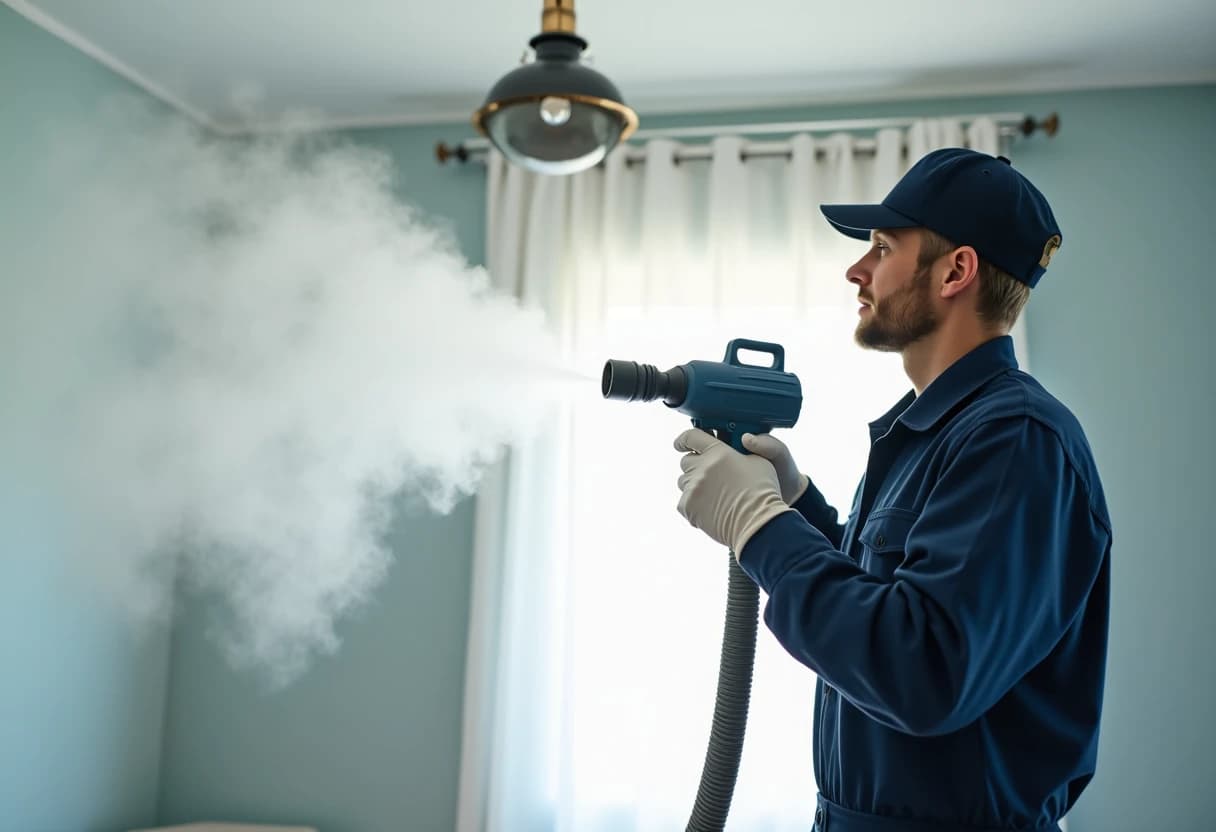
Air duct sanitizing is the finishing treatment that mechanical cleaning alone cannot provide: an EPA-registered antimicrobial, fogged through the freshly cleaned duct system under airflow so it reaches every surface the air touches. Where cleaning removes the dust, sanitizing neutralizes what lives in the residue — odor-causing bacteria, mold spores and the microbial film that gives ducts that stale, musty character. For Natick homeowners fighting pet odors, previous-owner smells, smoke history or the damp-basement note that rides the airflow every summer, it is the difference between ducts that are clean and ducts that smell clean. We apply it honestly: only after source-removal cleaning, only with HVAC-labeled products, and only when your situation actually warrants it.
Why Air Duct Sanitizing & Deodorizing Matters for Natick Homes
Cleaning and sanitizing solve two different problems, and stubborn duct odors need both solved. Mechanical cleaning removes the bulk contamination — the dust, dander and debris load. But odors are chemical and biological: they persist in the thin film of oils, microbial residue and volatile compounds bonded to duct surfaces, in seams and joints, and in the porous textures brushes cannot polish. That is why homeowners who buy a standard cleaning to fix a smell are sometimes disappointed — the ducts are genuinely clean, and the odor faintly persists. An EPA-registered antimicrobial fogged through the cleaned system finishes the job: it kills the odor-producing bacteria metabolizing that residue, neutralizes the residue itself, and inhibits the regrowth that would otherwise rebuild the smell over the following months. The sequence matters enormously — chemistry over dirt fails, chemistry over clean metal works — which is why we position sanitizing as the second half of a two-part service rather than a standalone spray, and why our results last years rather than the weeks a discount fog delivers.
Anyone who has spent a humid August near Natick Mall knows the Natick basement smell — and in homes with forced-air systems, that smell rarely stays in the basement. Natick spans everything from South Natick's antique Colonials along the Charles to dense postwar capes and ranches built for returning GIs, plus a fast-growing crop of luxury condos and apartments around the mall and West Natick commuter rail. The postwar neighborhoods are heavily retrofitted with central air riding on original 1950s ductwork, while the new multifamily buildings run compact fan-coil and shared-riser systems. Teardown-rebuild activity keeps construction dust circulating through whole streets. Return leaks and duct runs through damp below-grade spaces pull musty air into the system, where it saturates the interior film and re-broadcasts upstairs all season. Natick's teardown wave means many homes sit next to active construction for months, and we constantly clear drywall and silica dust from systems near rebuild sites. Homes around Lake Cochituate also deal with elevated humidity and summer algae-season odors that get pulled into ductwork through basement returns. Our cleaning-plus-sanitizing pairing removes the saturated film and neutralizes the biology behind the odor, which is why Natick mustiness calls are among our most satisfying jobs: the fix is genuinely complete.
Our Air Duct Sanitizing & Deodorizing Process in Natick
1Odor Assessment & Honest Qualification
Not every odor is a duct odor, and not every duct needs sanitizing — the EPA does not recommend routine biocide use, and neither do we. Your visit starts with diagnosis: camera inspection of the duct film, a look at the coil and drain pan, moisture readings where mustiness is the complaint. You get a straight answer about whether treatment is warranted before anyone sells you anything.
2Source-Removal Cleaning First
Sanitizer applied over dirt is wasted — no chemistry penetrates a mat of dust and biofilm. So the system is cleaned first to NADCA-standard bare surfaces: registers sealed, ductwork under HEPA-filtered negative pressure, every run mechanically agitated with brushes and air whips. If your ducts were professionally cleaned very recently, we verify by camera and credit the step accordingly.
3Product Selection & Preparation
Preparation is checklist work that determines results: product selected for your specific odor profile, dilution mixed to label specification, fogging equipment matched to your system's size so droplet distribution covers the full duct network. We also plan the airflow path — which registers stay open, how the blower assists — so the treatment reaches the far end of every run, not just the trunks.
4Whole-System Antimicrobial Fogging
With the system freshly cleaned, the EPA-registered fog does its work at the surface level: contact-killing the bacteria that metabolize duct residue into odor, neutralizing the residual film chemically, and leaving an inhibiting layer that suppresses microbial regrowth. The application follows label contact times precisely — this is regulated chemistry applied to specification, not a scented mist waved through the vents.
5Coil, Drain Pan & Blower Treatment
Every fogging visit includes hands-on treatment of the components the fog alone cannot adequately address: coil fins treated with appropriate cleaner, drain pan scrubbed and sanitized, condensate line flushed, blower compartment wiped and treated. If we find heavy coil fouling or standing water that signals a bigger problem, we document it with photos and quote the fix separately — informed consent, never ambush.
6Deodorizing Pass for Stubborn Odors
Severe cases get layered treatment: antimicrobial fogging for the biology, counteractant application for chemical residue, and where warranted, guidance on the adjacent surfaces — returns pull air across ceilings and walls, and a smoke-saturated house can re-seed clean ducts. We are candid about that boundary: ducts are our domain, and we will tell you when a whole-home odor needs remediation beyond them.
7System Airing, Verification & Walkthrough
We leave the system running clean and documented: registers remounted, a fresh filter installed on request, treatment records in your file, and honest guidance on what to expect — a faint clean-neutral note for a day or two as the treatment cures, then nothing. If the odor you hired us to kill ever returns in the following months, you call, we come back. That simple.
Benefits of Professional Air Duct Sanitizing & Deodorizing in Natick
Musty Summer Smell Broken for Good
That damp blast at AC start-up is bacteria metabolizing humid duct film — a cycle that returns every muggy stretch and worsens annually. Sanitizing removes the film and leaves treated surfaces the biology cannot recolonize, so the next humid week produces silence from the registers. For many Massachusetts households this is the first summer without the smell in a decade.
Odors Neutralized at the Source, Not Masked
Homeowners who have fought a duct-borne smell describe the same arc: sprays, candles, filters, ozone gadgets, shampooed carpets — hundreds of dollars of masking, months of frustration, smell intact. Source treatment ends the arc in one visit because it is aimed at the right target. The register air itself comes out neutral, so the rooms finally stay that way.
Smoke Ghosts Finally Evicted
If a home smelled of cigarettes at the showing and still does after renovation, the air system is the unrenovated room. Smoke rode the returns for years, coating the full duct network with residue no one ever addresses. Treating that network is routinely the missing piece that finally clears a smoker's house — and the step savvy buyers now negotiate into the purchase.
Pet Odor Elimination That Actually Holds
Multi-pet and long-tenure pet households benefit most: the accumulation scales with animal-years, and no surface cleaning touches the duct-borne share. Post-treatment, the improvement compounds — ongoing dander still sheds, but it lands in a neutral system rather than layering onto decades of saturated film, and routine filter changes keep the new baseline for years.
A True Reset for Newly Purchased Homes
The previous owners' pets, kitchen, tobacco and habits are archived in your duct film, replaying on every cycle. Cleaning plus sanitizing erases the archive — mechanically stripping the residue, then neutralizing the biology — so the house starts smelling like yours from day one. It is the single most-requested reason for this service, and the reviews it generates say 'finally smells like our home.'
Microbial Load Reduced System-Wide
Ducts are a microbial habitat by design — dark, textured, dust-fed and periodically damp. Sanitizing knocks the resident population down to baseline and leaves an inhibiting residue that slows recolonization for years. It is not sterility, and no honest company promises that; it is a substantially cleaner biological starting point for all the air you breathe at home.
Signs Your Natick Home Needs Air Duct Sanitizing & Deodorizing
Guests Notice a Smell You No Longer Can
A useful self-test: leave home for a full week, then pay attention in the first ten seconds through the front door before your nose recalibrates. Whatever you catch in that window is what everyone else gets every visit. If there is anything there — mustiness, animals, staleness — the air system is the first place to look.
Odors Return No Matter How Much You Clean
The tell is the rhythm: rooms smell fine with the system off, and the odor rebuilds when it runs. Surfaces cannot cause that pattern; airflow can. Homeowners often spend months eliminating suspects — carpets, drains, trash areas, basements — before checking the one system that touches every room. The register test takes ten seconds: smell the air it delivers.
Pets Present or Past
The threshold question: can guests tell you have animals without seeing them? If yes, the ducts are broadcasting, and the smell is stronger than your adapted nose reports. Households with multiple pets or long pet tenure carry proportionally heavier duct reservoirs, and they see the most dramatic before-and-after from a single cleaning-plus-treatment visit.
Musty Blast When the Heat or AC Starts
A damp, sour or dirty-sock note in the first minutes of a cycle, fading as the system runs, points to microbial activity on the coil, in the drain pan or along the duct film. It is most common in cooling season and after humid stretches. The pattern is diagnostic — and it is exactly what cleaning plus antimicrobial treatment eliminates.
You Just Bought the Home
An unknown air system is a reasonable default for sanitizing: you cannot see the duct film's history, and whatever the previous owners' household deposited — pets, smoke, cooking, dampness — is now on replay in your air. Between closing and move-in is the ideal window: empty rooms, open access, and a fresh biological baseline before your family breathes the system daily.
After Pests, Mold or Water in the System
Water events prime duct systems for microbial bloom: damp film, warm darkness, abundant food. If your basement flooded, a pipe let go, or humidity ran uncontrolled for a season, sanitizing after cleanup suppresses the bloom before it establishes — cheaper and easier than the mold removal that established growth eventually demands.
Air Duct Sanitizing & Deodorizing Cost in Natick, MA
A note on what drives our costs, because transparency beats mystery pricing. EPA-registered antimicrobials labeled for HVAC use cost genuinely more than the hardware-store alternatives we refuse to use — registration means the product's efficacy and safety data were reviewed for exactly this application, and label-rate application means measured dilutions, not eyeballed ones. Fogging equipment sized for whole-duct-network coverage, technician time for the coil-pan-blower wet section, and the assessment that qualifies the job honestly all live in the price. So does the callback promise: if the odor we treated returns in the following months, we return with it. What is not in the price: routine-maintenance upsell — the EPA does not recommend scheduled biocide application in residential ducts, and a company suggesting annual sanitizing regardless of conditions is selling chemistry you do not need. Sanitize when odors, contamination events or move-ins warrant it; between those moments, a clean system and decent filtration are all your ducts require, and we will tell you exactly that.
Want the full pricing picture? See our complete Boston-area cost guide or call (617) 390-7145 for an exact flat quote for your Natick home.
Local Knowledge: Natick, Middlesex County
What makes Natick different? Natick spans everything from South Natick's antique Colonials along the Charles to dense postwar capes and ranches built for returning GIs, plus a fast-growing crop of luxury condos and apartments around the mall and West Natick commuter rail. The postwar neighborhoods are heavily retrofitted with central air riding on original 1950s ductwork, while the new multifamily buildings run compact fan-coil and shared-riser systems. Teardown-rebuild activity keeps construction dust circulating through whole streets. Natick's teardown wave means many homes sit next to active construction for months, and we constantly clear drywall and silica dust from systems near rebuild sites. Homes around Lake Cochituate also deal with elevated humidity and summer algae-season odors that get pulled into ductwork through basement returns. For duct and dryer vent systems, those local factors translate into specific, predictable problems — and predictable problems are the ones we solve fastest. Call (617) 390-7145, tell us your street and home style, and we will quote the job accurately the first time, usually in under five minutes.
The Best Time of Year in Natick
Summer humidity is the engine of Greater Boston's duct-odor cycle. When dew points camp in the high 60s, moisture condenses on every cool surface in the air path — coil, pan, basement trunk lines — and the organic film absorbs it like a sponge. Bacteria respond within days, and their metabolism is the musty smell that arrives with every cooling cycle from July onward. Coastal and near-coastal homes get an extended version, with marine air keeping duct-adjacent spaces damp well into fall. Sanitizing breaks the biological half of the cycle; pairing it with the moisture-side fixes — insulating sweating runs, managing basement humidity, keeping condensate lines clear — breaks the whole loop, and the pairing is what turns a yearly complaint into a solved problem.
Why Choose Boston Air Duct Cleaners
What separates us from the coupon crowd is simple: we do the whole job, we prove it, and we charge what we quoted. Our technicians clean supplies, returns, trunks and blower compartments on every visit — never a cosmetic vent wipe. Photo documentation comes standard, pricing is flat and confirmed up front, and our trucks carry true commercial vacuum equipment, not rented shop-vacs. Based in West Newton and serving Natick year-round, we answer our own phone at (617) 390-7145 and stand behind every cleaning with a satisfaction guarantee.
Serving Natick and Surrounding Communities
Beyond Natick, our crews cover the surrounding communities daily — including Framingham, Wellesley, Sherborn, Wayland, Ashland, Dover. Because routes cluster geographically, booking alongside a neighboring appointment often unlocks same-day service and combined-visit savings. Wherever you are in Middlesex County, the same flat-rate pricing, insured technicians and photo-documented process applies.