
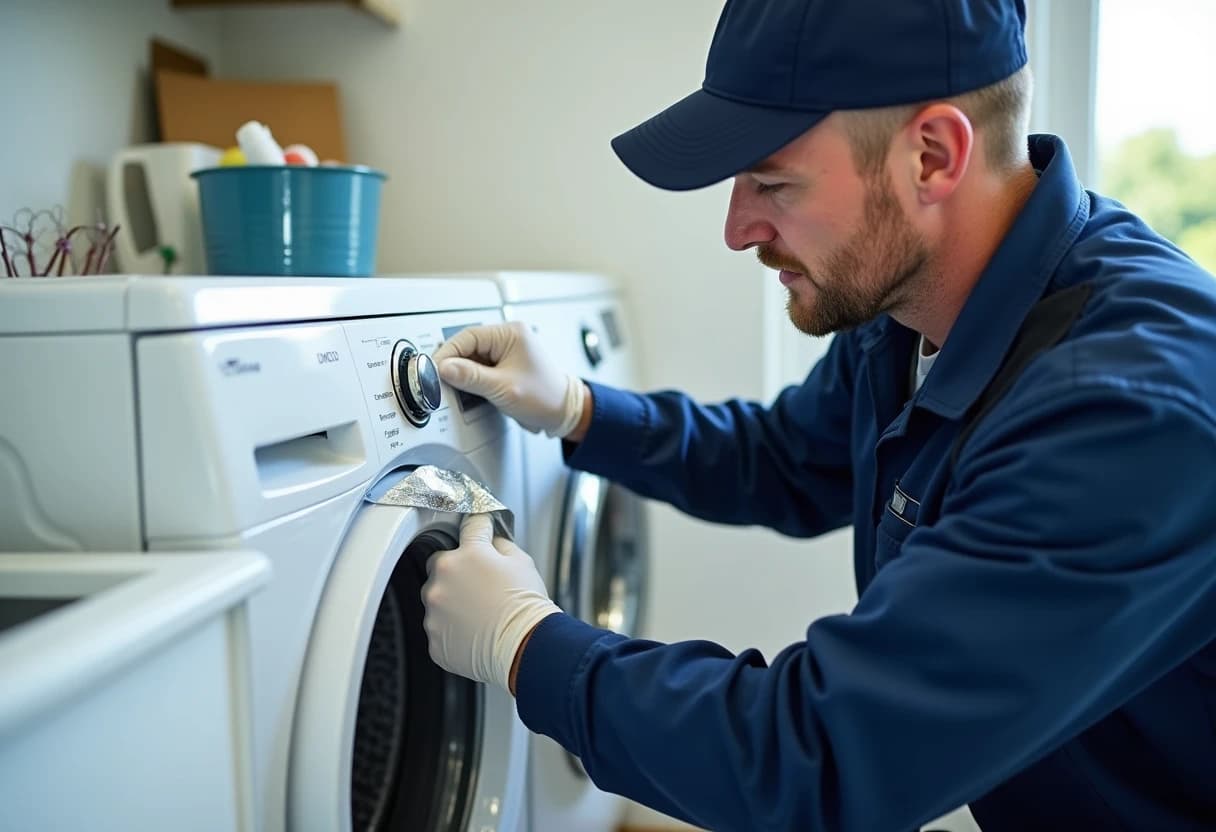
Dryer exhaust is hot, humid, lint-laden air, and every foot of duct it travels through must be intact and sealed. A single disconnected joint dumps a gallon of moisture per load into a wall cavity or ceiling — along with a steady supply of highly flammable lint. We repair dryer vents throughout Natick: reconnecting and properly securing separated ducts, replacing damaged runs and non-compliant flex materials with smooth rigid metal, curing chronic condensation problems, and replacing broken exterior hoods and bird-guard dampers. Repairs are quoted flat after diagnosis, typically $150 to $450, and every job ends with an airflow verification and photos of the completed work.
Why Dryer Vent Repair Matters for Natick Homes
The materials in your dryer vent matter as much as its condition, and much of Greater Boston's housing stock carries materials that should never have been installed. White vinyl accordion hose — sold for decades and still lurking behind older dryers — is a documented fire hazard: it melts, its ridges pack with lint, and manufacturers and codes alike have disowned it. Thin foil accordion duct is only marginally better, crushing at a touch and snagging lint on every corrugation. Long concealed runs of flex duct, plastic terminations, screen-covered hoods that mat over with lint, and duct-taped seams round out the list of what we routinely find and replace. Modern code — the IRC's dryer exhaust provisions — calls for smooth-interior rigid metal duct, joints without protruding fasteners, and a proper damper-equipped termination, because decades of fire data show those details are where dryer venting goes wrong. Repairing with compliant materials is not bureaucratic box-checking: it is the difference between a vent that needs annual cleaning and a vent that builds a new hazard every year.
Winters around Natick are hard on dryer vents in ways warmer regions never see. Natick's teardown wave means many homes sit next to active construction for months, and we constantly clear drywall and silica dust from systems near rebuild sites. Homes around Lake Cochituate also deal with elevated humidity and summer algae-season odors that get pulled into ductwork through basement returns. Exhaust moisture condenses and freezes in duct sections crossing cold basements and exterior walls, dampers ice shut, and snow buries grade-level hoods. Natick spans everything from South Natick's antique Colonials along the Charles to dense postwar capes and ranches built for returning GIs, plus a fast-growing crop of luxury condos and apartments around the mall and West Natick commuter rail. The postwar neighborhoods are heavily retrofitted with central air riding on original 1950s ductwork, while the new multifamily buildings run compact fan-coil and shared-riser systems. Teardown-rebuild activity keeps construction dust circulating through whole streets. Those homes often route vents through the coldest parts of the structure, which is why our Natick condensation repairs so often involve insulating and re-sloping duct in unheated space. We fix the winter failure and the design weakness behind it, so the same problem does not return with the next cold snap.
Our Dryer Vent Repair Process in Natick
1Diagnose the Full Exhaust Path
We treat symptoms as evidence: lint in the basement points to a specific joint; a ceiling stain maps to a specific duct section; condensation drips tell us where the run crosses cold space. Correlating symptoms with the physical path usually pinpoints the failure within minutes — and rules out the failures you do not have.
2Protect the Area & Open Access
Before repair work, we protect floors and finishes along the work path, move the dryer out carefully on sliders, and set up at the failure points. Where a concealed joint requires access, we discuss options first — many repairs can be made from existing openings, and when cutting is unavoidable we keep openings minimal and tell you exactly what restoration will involve.
3Reconnect & Properly Fasten Separated Joints
We do not just push a failed joint back together; we rebuild it so it cannot fail the same way. That means cleaning mating surfaces, correcting the misalignment or unsupported weight that pulled the joint apart, adding hangers or strapping where the run lacked support, and sealing the finished connection against both air and moisture leakage.
4Replace Crushed, Corroded or Non-Compliant Sections
Replacement is also the moment to correct design faults we find: a kink where two sections meet at a bad angle becomes a pair of smooth elbows; an unsupported span gets hangers; an oversized or undersized segment is brought back to uniform 4-inch diameter so airflow stops tumbling at transitions. We fix what failed and what made it fail.
5Cure Condensation: Slope, Seal & Insulate
Condensation repairs follow the water. We restore continuous slope toward the termination so condensate drains out instead of pooling; seal the joints it has been leaking through with foil tape rated for the duty; and insulate duct sections crossing unheated basements, garages, attics and exterior wall bays so exhaust stays above its dew point until it exits.
6Repair or Replace the Exterior Hood & Damper
The new hood is sealed to the wall correctly: fastened to siding or masonry, flashed and caulked so wind-driven rain stays out of the wall assembly, with the duct connection sealed inside. On brick and stone, we drill and anchor rather than improvise; on clapboard, we integrate with the siding plane. The termination should outlast the roof.
7Replace the Transition Duct & Reset the Dryer
The appliance connection is rebuilt to spec: a UL-listed semi-rigid aluminum transition duct, as short and straight as the layout allows, secured with clamps at both ends. We position the dryer so the connector keeps its full diameter — not crushed against the wall — and mark the safe distance so future pushes do not recreate the old kink.
8Verify Airflow & Document the Repair
The proof is at the hood: with the dryer running, the damper should stand fully open under a strong, steady exhaust stream. We verify it together, compare against the pre-repair condition, and confirm no leakage remains at any repaired joint. Then the work area is cleaned, the dryer set, and the laundry room returned to service.
Benefits of Professional Dryer Vent Repair in Natick
Moisture Out of Your Walls and Ceilings
Every load of laundry exhausts about a gallon of water. A repaired, sealed vent delivers all of it outdoors; a leaking one delivers it into insulation, framing and drywall. Stopping that daily soaking is the benefit homeowners feel longest — no more spreading stains, peeling paint, mildew odors or the mold remediation bills that chronic wall moisture eventually writes.
Decades of Reliable Service From One Repair
Done with rigid metal, mechanical fastening and a quality termination, a dryer vent repair is not a patch — it is infrastructure. Properly installed rigid duct routinely outlasts the dryers connected to it, needing only annual cleaning. The failure-prone materials and joints that caused your problem simply are not there anymore.
Pest Entry Points Closed
A dryer vent with a failed damper is an open, warm, sheltered 4-inch doorway — irresistible to birds, squirrels and mice, whose nests then block the duct and whose presence contaminates it. Repairing the termination closes the doorway with a damper and guard designed for dryer exhaust, ending the nest-remove-repeat cycle for good.
Restored Drying Performance
Customers are often startled by the change: a vent we repaired after years of gradual crushing gives them back the dryer they bought. If your drying times worsened after an appliance delivery, a renovation, or a move of the machine — events that crush transitions and separate joints — repair, not replacement, is very likely the answer.
Code Compliance & Inspection-Ready Documentation
Dryer venting is a standard flag on Massachusetts home inspections: vinyl flex, taped joints, screened hoods and overlong runs all appear in reports and complicate sales. Our repairs bring the system to current code — rigid metal, compliant joints, proper termination — with photo documentation that answers inspector and buyer questions before they are asked.
A Serious Fire Hazard, Eliminated
Code-compliant materials are themselves a safety upgrade: smooth rigid metal resists lint accumulation, clamped joints hold under heat and vibration, and a proper termination keeps nesting animals from plugging the line. A repaired vent is not just fixed — it is a fundamentally lower-risk system than what it replaces.
Signs Your Natick Home Needs Dryer Vent Repair
Musty or Mildew Smell in the Laundry Area
EPA guidance on mold is unambiguous: control the moisture and you control the growth. In laundry areas the dryer vent is a prime suspect moisture source, and a $150 to $450 repair is dramatically cheaper than the remediation an ignored leak can eventually require.
Visibly Damaged, Kinked or Sagging Duct
Sag matters more than it looks: a bellied section pools condensate, which soaks lint into a mat, which adds weight, which deepens the sag. The cycle ends in a blocked or rusted-through low point. Adding proper support and restoring slope while the duct is still sound is a small repair that prevents a large one.
Slow Drying That Cleaning Didn't Fix
If a vent cleaning did not restore drying performance, the airflow restriction is structural: a crushed section, a collapsed inner liner, a separated joint dumping exhaust short of the hood, or a damper that cannot open. The next step is diagnosis, not another cleaning — we trace the path, find the mechanical fault, and quote its repair flat.
Exterior Damper Broken, Stuck or Missing
Look at the hood outside: a damper flap hanging loose, rusted stiff, cracked off, painted shut or missing entirely is a failed termination. Stuck open, it drains heat and admits pests all winter; stuck shut, it blocks the vent completely. Either way the fix is a proper replacement hood — one of the fastest, most cost-effective repairs on our list.
Lint Appearing Where It Shouldn't
Check the floor and framing along the vent's path, especially in basements where runs hang exposed: a dusting of gray fiber below any joint is a positive test for leakage there. The joint may look intact from below while a gap on top sheds lint and moisture into the cavity above it.
A Home Inspection or Appliance Tech Flagged the Vent
Condo associations increasingly require documented vent compliance after regional dryer fire losses. If your building has sent a notice, we handle the full cycle: inspection, written scope for board approval, code-compliant repair, and completion records with photos. One visit, and your unit's file is closed.
Dryer Vent Repair Cost in Natick, MA
Compare the repair cost against what the failure costs to keep. A leaking vent delivers roughly a gallon of water per load into your building assemblies — and chronic wall moisture matures into mold remediation and drywall work that starts around $1,500 and climbs steeply. A crushed or blocked duct overworks the dryer into $150 to $400 appliance repairs (thermal fuses, elements, switches) that recur until the vent is fixed, while adding $10 to $20 a month in energy waste. A failed damper leaks heated air all winter and invites nest blockages every spring. And every one of these failures raises fire risk in a system that already accounts for about 2,900 US home fires a year. Against that ledger, $150 to $450 for a permanent, code-compliant repair is one of the clearest-value maintenance purchases in the home. Most customers who see the diagnostic photos do not need convincing; the duct makes the argument itself.
Want the full pricing picture? See our complete Boston-area cost guide or call (617) 390-7145 for an exact flat quote for your Natick home.
Local Knowledge: Natick, Middlesex County
Serving Natick means knowing Natick. Natick spans everything from South Natick's antique Colonials along the Charles to dense postwar capes and ranches built for returning GIs, plus a fast-growing crop of luxury condos and apartments around the mall and West Natick commuter rail. The postwar neighborhoods are heavily retrofitted with central air riding on original 1950s ductwork, while the new multifamily buildings run compact fan-coil and shared-riser systems. Teardown-rebuild activity keeps construction dust circulating through whole streets. Natick's teardown wave means many homes sit next to active construction for months, and we constantly clear drywall and silica dust from systems near rebuild sites. Homes around Lake Cochituate also deal with elevated humidity and summer algae-season odors that get pulled into ductwork through basement returns. Those conditions shape how we work here: which brush heads come off the truck, how we protect finishes in older interiors, and what we expect to find when the camera goes into a 01760 duct system. Our crews are in and around Natick nearly every week — often for neighbors of past customers — so scheduling is fast and our arrival windows hold.
The Best Time of Year in Natick
Spring is nesting season, and a dryer vent with a compromised damper is prime real estate: warm, dry, sheltered, and lined with soft lint. Birds, squirrels and mice move in between March and June, and by summer the nest has become a full blockage — often discovered when drying times collapse or a burning smell appears. The seasonal logic favors acting early: repair a failing damper in late winter and the nest never happens; wait, and the spring repair includes nest removal, duct cleaning and sanitizing on top of the hood replacement. If you heard scratching or chirping near the laundry last spring, put the termination inspection on this year's calendar before the wildlife does.
Why Choose Boston Air Duct Cleaners
What separates us from the coupon crowd is simple: we do the whole job, we prove it, and we charge what we quoted. Our technicians clean supplies, returns, trunks and blower compartments on every visit — never a cosmetic vent wipe. Photo documentation comes standard, pricing is flat and confirmed up front, and our trucks carry true commercial vacuum equipment, not rented shop-vacs. Based in West Newton and serving Natick year-round, we answer our own phone at (617) 390-7145 and stand behind every cleaning with a satisfaction guarantee.
Serving Natick and Surrounding Communities
We serve every community around Natick as well: Framingham, Wellesley, Sherborn, Wayland, Ashland, Dover all fall inside our regular service routes. If you have a second property, a rental, or family nearby, ask about multi-home scheduling — grouped appointments on the same route are our most requested discount.