
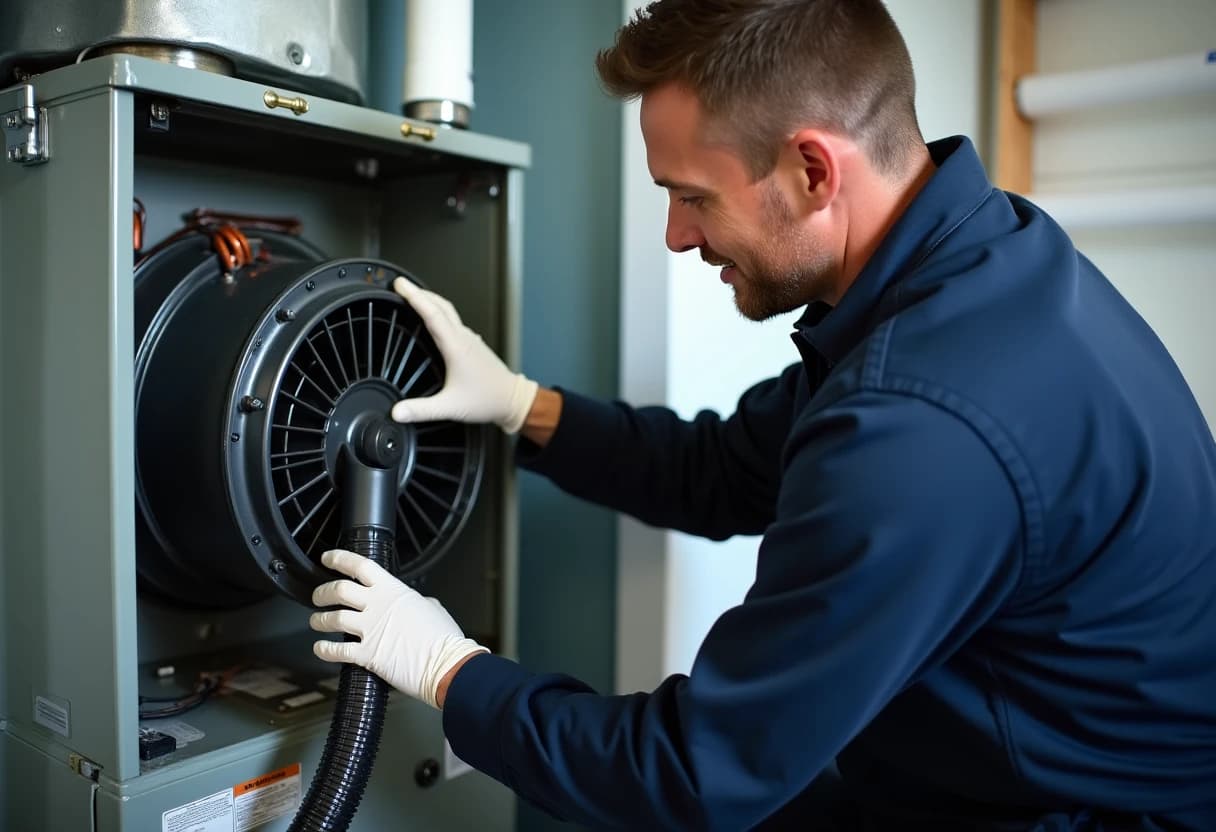
When Ashland homeowners describe their HVAC complaints — weak airflow upstairs, bills creeping higher every year, an AC that runs all afternoon without catching up, a burnt-dust smell each October — they are usually describing one underlying condition: a dirty air side. Filters protect the equipment imperfectly and the ducts not at all, so a decade of operation loads every component with exactly the buildup that produces those symptoms. Our whole-system cleaning addresses the condition rather than the symptoms: complete duct network, blower assembly, evaporator coil, plenums and cabinet, cleaned to source-removal standards in a single visit. We quote flat by system, show our work in before-and-after photos, and back the results across Middlesex County every week of the year.
Why HVAC System Cleaning Matters for Ashland Homes
Filters cannot do this job, and understanding why explains the service. A furnace filter sits at one point in the circuit, typically protecting only the equipment downstream of the return drop — everything upstream of it, meaning the entire return duct network, runs unfiltered by design, inhaling whatever the rooms produce. Standard filters also pass a large share of fine particulate even where they do sit, and every gap, bypass and late filter change compounds the leakage. The result is universal: open any air handler that has run a decade on filter changes alone and the blower wheel carries a felt of compacted dust, the coil face is gray, and the cabinet floor holds drifts. None of that is a filter failure exactly — it is the filter doing a limited job in a system that needs more. Periodic whole-system cleaning is the more: it removes the accumulation the filter was never positioned to prevent, resets the equipment to clean baseline, and — paired with a quality filter afterward — dramatically slows the rebuild.
The equipment serving Ashland homes was mostly asked to do a job it was never sized for. Ashland mixes older mill-era homes and capes near its downtown with big tracts of 1980s-2000s colonials and a fast-growing crop of new townhouse and apartment communities near the commuter rail station. The newer construction is tight, well-insulated and fully ducted, which keeps energy bills down but concentrates any dust, dander or construction debris inside the duct system. Systems extended through renovations, condo conversions and added zones run higher static pressure than their designs intended — and interior dust buildup pushes them past the margin. Ashland is one of the MetroWest's most active new-construction corridors, and we clean a steady stream of nearly new homes whose ducts were never cleared of drywall dust and sawdust after the build. Tighter envelopes in these transit-oriented developments mean the same air recirculates constantly, so what is in the ducts is in your lungs. Whole-system cleaning recovers what the buildup took: we clean the complete duct network, then detail the blower, coil, plenums and cabinet, restoring capacity these hard-working systems cannot spare. Ashland, Framingham and Holliston are on our routes every week.
Our HVAC System Cleaning Process in Ashland
1Full System Inspection & Airflow Baseline
We begin where the problems live: the air handler comes open first, because blower and coil condition determine half the scope. The technician documents the equipment, cameras representative duct runs, checks the condensate path, and walks you through findings with photos. The quote you approve reflects exactly what the inspection found — no mid-job discoveries priced from a flashlight.
2Protection, Sealing & Negative Pressure
Floor protection goes down along every work path, registers come off, and all supply and return openings are sealed. A HEPA-filtered negative-air machine connects to the main trunks, placing the full duct network under continuous vacuum — the containment that lets us clean aggressively while your living spaces stay dust-free throughout the visit.
3Complete Duct Network Cleaning
The duct phase follows NADCA source-removal method end to end: mechanical agitation of every supply and return, trunk lines cleaned last so debris always moves toward the collection point, and appropriate tooling per duct type — aggressive brushes on rigid metal, gentler whips on flex runs and older panned returns common in Massachusetts homes.
4Blower Wheel & Motor Compartment Detailing
The blower assembly gets restoration-grade attention: wheel removed where design allows or detailed in place, blades cleared of the compacted felt that steals airflow, motor housing vacuumed and wiped, and the compartment HEPA-cleaned to bare metal. A clean wheel moves dramatically more air — this single component is where most of the felt recovery lives.
5Evaporator Coil Cleaning
Coil cleaning is precision work: fin surfaces are delicate, and the right approach depends on fouling depth — from HEPA vacuuming and soft brushing for surface dust to application of appropriate coil cleaners for bonded buildup. We work carefully, protect the surrounding cabinet and drain path, and photograph the coil face before and after so the recovery is visible fin by fin.
6Cabinet, Plenums & Condensate Service
This stage finishes the wet section: pan cleaned of the biofilm and sludge that clog drains and breed odor, trap flushed, line verified flowing, float switch checked where fitted. Cooling-season backups — water around the air handler, tripped switches, ceiling stains under attic units — trace here, and ten minutes of prevention now beats an August service call later.
7Fresh Filter, Reassembly & Verified Results
We close the system with a fresh filter — quality pleated media, or your preferred spec — reinstall every register, and run the system live. The walkthrough covers register-by-register airflow against the morning's baseline, the complete before-and-after photo set, and written notes on anything worth watching. You see the recovery, not just an invoice describing it.
Benefits of Professional HVAC System Cleaning in Ashland
Cleaner Air From a Cleaner Machine
The equipment matters to air quality more than the ducts do, per square inch: the coil and pan stay damp all cooling season, hosting the biology behind musty odors, while the blower sheds its buildup into the airstream continuously. Cleaning ducts around contaminated equipment leaves the worst sources running; cleaning the whole system actually finishes the job.
Years Added to Equipment Life
HVAC technicians will tell you which systems reach old age: the ones with clean airflow. Limit-switch trips, cracked exchangers and burned motors cluster in fouled systems because restriction stresses everything upstream and downstream of it. Periodic whole-system cleaning is how a homeowner buys into the long-lived cohort — and why tune-up techs are among our steadiest referral sources.
Quieter Operation, Fewer Odors
The burnt-dust smell of October's first furnace cycle is the equipment announcing its buildup — accumulation on the exchanger and in the plenums cooking off at first heat. A system cleaned before the season starts silent and neutral instead. Likewise the musty cooling-season note from a biofilmed coil and pan: cleaned and treated, the wet section stops perfuming the house.
Cooling That Keeps Up in July
Icing is the dramatic version: a starved coil runs too cold, condensation freezes, airflow collapses entirely and the system shuts down mid-heat-wave. The root cause is almost always airflow restriction — dirty coil, matted blower, choked returns. Cleaning the circuit end to end is both the cure and the prevention, and July is when the prevention proves its price.
Airflow Restored to Design Capacity
Airflow is the product your HVAC system exists to deliver, and dust taxes it at every stage — matted blower blades, blanketed coil fins, narrowed duct runs. Whole-system cleaning refunds the tax in full. The most common customer report after our visits: rooms that had not heated or cooled properly in years suddenly behave, with no equipment replaced and nothing adjusted but cleanliness.
One Visit, Complete Documentation
For condo associations, landlords and buyers, the documentation is the deliverable: proof the full air side was professionally cleaned to NADCA method, dated, photographed and itemized. It answers inspector questions before they are asked, satisfies board maintenance requirements in one submission, and reads — accurately — as the record of a well-kept mechanical plant.
Signs Your Ashland Home Needs HVAC System Cleaning
Weak Airflow at Some or All Registers
Hold a hand to the registers: airflow you can barely feel — especially in far rooms and upper floors — means the system is losing delivered air to restriction somewhere between blower and grille. Matted wheels, blanketed coils and dust-narrowed runs are the usual suspects, and whole-system cleaning addresses all three in one pass.
Uneven Rooms, Noisy Cycles, Dust Everywhere
Temperature spread between floors — sweltering upstairs in summer, cold bedrooms over the garage in winter — is often delivered-airflow starvation at the duct path's far end, not a zoning flaw. Before pricing dampers, mini-splits or a bigger system, restore the airflow you already own; the far rooms are where cleaning shows its work first and most.
AC Struggling, Icing, or Running Nonstop
Ice on the refrigerant lines or coil is a stop-what-you-are-doing symptom: a restricted, dirty airflow path is letting the coil run below freezing, and continued operation risks the compressor — the most expensive component in the system. Shut the system down and get the air side inspected; in a large share of icing cases, cleaning is the entire cure.
Burnt-Dust Smell at Furnace Startup
The acrid smell when the heat first fires each fall is accumulation cooking off the heat exchanger, plenums and duct surfaces — a direct sensory report of what the system carries. A faint note that clears in an hour is common; a strong smell recurring for days, or returning at every cold-snap restart, indicates a load worth removing before the season.
No Record of the System Ever Being Cleaned
Filters changed, burners tuned, blower and coil never once opened: that is the maintenance biography of most residential systems, and it means decades of accumulation on the components that matter most. If you cannot name the year the equipment side was cleaned, it has not been — and the first whole-system service will be the dramatic one.
Energy Bills Creeping Up Year Over Year
Compare this January's usage to the same month three years back, weather-adjusted even roughly. Steady growth without a rate change means the system works harder for the same heat — the signature of accumulating restriction. Cleaning recovers what buildup took; if the bills do not respond, the inspection will have flagged the mechanical issue that is actually responsible.
HVAC System Cleaning Cost in Ashland, MA
Budget by scenario. A compact single-zone system — a Cape or condo with one furnace, ten to twelve runs, accessible equipment — lands near $450 to $550. The Greater Boston median — a colonial with one or two zones, fifteen to twenty runs, a basement furnace with A-coil — runs $550 to $750. Large or complex systems — three zones, twenty-five-plus runs, attic air handlers, hydro-air setups — reach $750 to $900, occasionally beyond for multi-equipment homes quoted per system. What moves a quote within these bands is mostly labor time: coil access that requires cutting in a service panel, blower wheels that must come out for proper cleaning, and heavy fouling needing repeat agitation all add hours. What never moves a quote: things 'discovered' after work begins. Our inspection sets the scope, the scope sets the flat price, and surprises we find mid-job — a failed damper, a disconnected run — get documented and quoted separately for your decision, never folded silently into the bill.
Want the full pricing picture? See our complete Boston-area cost guide or call (617) 390-7145 for an exact flat quote for your Ashland home.
Local Knowledge: Ashland, Middlesex County
Serving Ashland means knowing Ashland. Ashland mixes older mill-era homes and capes near its downtown with big tracts of 1980s-2000s colonials and a fast-growing crop of new townhouse and apartment communities near the commuter rail station. The newer construction is tight, well-insulated and fully ducted, which keeps energy bills down but concentrates any dust, dander or construction debris inside the duct system. Ashland is one of the MetroWest's most active new-construction corridors, and we clean a steady stream of nearly new homes whose ducts were never cleared of drywall dust and sawdust after the build. Tighter envelopes in these transit-oriented developments mean the same air recirculates constantly, so what is in the ducts is in your lungs. Those conditions shape how we work here: which brush heads come off the truck, how we protect finishes in older interiors, and what we expect to find when the camera goes into a 01721 duct system. Our crews are in and around Ashland nearly every week — often for neighbors of past customers — so scheduling is fast and our arrival windows hold.
The Best Time of Year in Ashland
New England's equipment stock adds a seasonal wrinkle worth naming: an enormous share of local systems are conversions and hybrids — forced-air retrofitted into homes built for radiators, hydro-air systems marrying boilers to air handlers, condo conversions threading flex duct through triple-decker framing. These systems run higher static pressure than clean-sheet designs, which means less margin for fouling: buildup that a generously ducted suburban system tolerates will noticeably choke a retrofit. The seasonal moisture cycle compounds it — humid summers make basement equipment buildup damp and sticky, long winters bake it hard — so accumulation here bonds faster and restricts sooner than national rules of thumb suggest. For conversion-era systems, we recommend the inspection interval owners of old houses already apply to everything else: regularly, and before the hard season rather than after it.
Why Choose Boston Air Duct Cleaners
Boston Air Duct Cleaners is a local, owner-operated company based at 1121 Washington St in West Newton — not a national franchise dispatching subcontractors. Every crew is our own: background-checked, factory-trained on commercial negative-pressure equipment, and fully insured. We quote flat prices before work begins, document every job with before-and-after photos, and follow NADCA-standard source-removal methods on every system we touch. That is why so much of our work comes from repeat customers, property managers and word-of-mouth referrals across Middlesex County.
Serving Ashland and Surrounding Communities
Ashland sits in the heart of our service area, and neighboring Framingham, Holliston, Hopkinton, Natick, Sherborn appointments share the same routes. That density is why our response times in this part of Middlesex County are among our fastest — and why you will see our trucks in the area week after week.