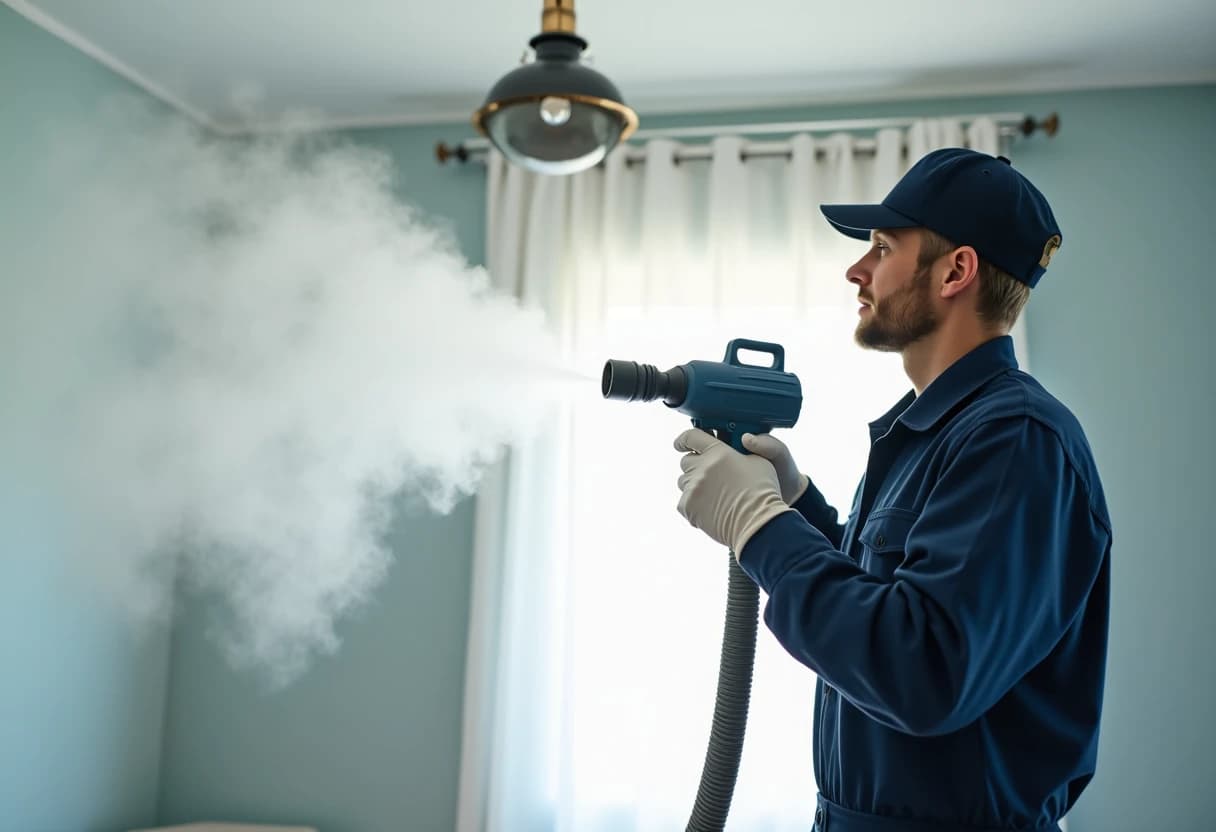
Air duct sanitizing is the finishing treatment that mechanical cleaning alone cannot provide: an EPA-registered antimicrobial, fogged through the freshly cleaned duct system under airflow so it reaches every surface the air touches. Where cleaning removes the dust, sanitizing neutralizes what lives in the residue — odor-causing bacteria, mold spores and the microbial film that gives ducts that stale, musty character. For Malden homeowners fighting pet odors, previous-owner smells, smoke history or the damp-basement note that rides the airflow every summer, it is the difference between ducts that are clean and ducts that smell clean. We apply it honestly: only after source-removal cleaning, only with HVAC-labeled products, and only when your situation actually warrants it.
Why Air Duct Sanitizing & Deodorizing Matters for Malden Homes
Pet households face duct odor mechanics that surface cleaning cannot beat. Dander is an aerosol: it rides the return airflow into the duct network, settles into the interior film, and accumulates for as long as the pet lives there — often across multiple pets and many years. The film becomes an odor reservoir with the system's full distribution reach, which is why the smell is strongest when the heat kicks on and why guests detect it instantly while residents have gone nose-blind. The same mechanism archives cigarette and cannabis smoke, cooking oils, and the general biological signature every household writes into its air system over time. When the home changes hands, the new owners inherit the archive. Source-removal cleaning strips the reservoir; EPA-registered fogging neutralizes the residue and the bacteria feeding on it; and the system stops broadcasting. For sellers, this pairing is one of the highest-leverage pre-listing investments available — showings live and die on the first thirty seconds of smell — and for buyers it is the cleanest possible start in a home with an unknown history.
Malden real estate moves fast, and smell is part of every showing. Malden is packed with early-1900s two-families, triple-deckers and Victorians on small lots, joined by a fast-growing cluster of mid-rise apartment and condo buildings around Malden Center's Orange Line stop. The older multifamilies carry a mix of steam, retrofitted forced-air and per-floor furnace setups, while the new transit-oriented buildings depend on shared ventilation shafts and long dryer duct runs to the roof. Buyers walking into a home that smells of previous owners — pets, smoke, mustiness — mentally discount the price within seconds, and sellers who have lived with the odor for years often cannot detect it at all. Malden's condo boom around the Orange Line has filled the city with stacked in-unit laundry, and multi-story dryer runs here clog with lint far faster than a typical single-family vent. In the older two-family stock, basement furnaces shared between floors spread one unit's dust problems through the whole house. We work pre-listing sanitizing jobs across Malden on tight timelines: source-removal cleaning plus EPA-registered deodorizing treatment, one visit, documented for the disclosure file. Agents in the area refer us for exactly this reason.
Our Air Duct Sanitizing & Deodorizing Process in Malden
1Odor Assessment & Honest Qualification
First we determine whether sanitizing will actually fix your problem. The technician traces the odor's behavior — does it arrive with airflow, vary by season, concentrate at certain registers — inspects the duct interiors and air handler, and checks for moisture. If the source is your ducts, we quote the treatment flat. If it is not, we say so and point you at the real source.
2Source-Removal Cleaning First
Step one is removing the reservoir. The odor-saturated film lining your ducts is physically extracted under negative pressure — rotary brushes and pneumatic whips strip it from every supply, return and trunk while the HEPA vacuum captures it. Most of the odor leaves the house in this step; the fogging that follows neutralizes what remains and prevents the smell from rebuilding.
3Product Selection & Preparation
Preparation is checklist work that determines results: product selected for your specific odor profile, dilution mixed to label specification, fogging equipment matched to your system's size so droplet distribution covers the full duct network. We also plan the airflow path — which registers stay open, how the blower assists — so the treatment reaches the far end of every run, not just the trunks.
4Whole-System Antimicrobial Fogging
The treatment is atomized into a fine fog and introduced through the duct network while controlled airflow carries it the length of every supply and return. The fog deposits on all interior surfaces — including the seams, joints and corrugations mechanical cleaning cannot polish — killing odor-causing bacteria and neutralizing microbial residue on contact. Full-system coverage takes under an hour in most homes.
5Coil, Drain Pan & Blower Treatment
The dampest components carry the strongest biology, so the air handler wet section gets direct treatment: evaporator coil surfaces, the drain pan and its trap, and the blower wheel and housing. Musty odors disproportionately originate here — a slimy pan or biofilmed coil can perfume an entire house — and treating the ducts while skipping the equipment leaves the source in place.
6Deodorizing Pass for Stubborn Odors
Smoke and heavy pet situations get a second, targeted pass with odor-counteractant chemistry — products that bind and neutralize odor molecules rather than perfume over them. Tobacco residue in particular clings aggressively to metal and re-releases for years; the counteractant pass addresses it specifically. This step is included when the assessment calls for it and skipped, with the price reflecting that, when it does not.
7System Airing, Verification & Walkthrough
After label contact time elapses, we run the system to air the treatment through, reinstall registers, and walk the home with you register by register. You should smell neutral air — not fragrance, not chemicals, nothing. You receive the product documentation, re-entry guidance already satisfied by the airing process in most cases, and our callback commitment if any trace of the original odor resurfaces.
Benefits of Professional Air Duct Sanitizing & Deodorizing in Malden
Smoke Ghosts Finally Evicted
Tobacco residue is the most persistent household odor there is — tar and nicotine films bond to duct metal and off-gas for years, outliving paint, carpet and every previous owner. Our layered treatment pairs antimicrobial fogging with odor-counteractant chemistry that neutralizes the smoke compounds specifically, which is why it succeeds where repainting and time both failed.
Pet Odor Elimination That Actually Holds
Dander is airborne, the return ducts inhale it continuously, and years of accumulation turn the duct film into a dander reservoir with whole-house reach — which is why the pet smell survives every carpet shampoo. Removing the reservoir and neutralizing the residue takes the system out of the equation, and most households report the smell simply gone, permanently, after one treatment.
Small Add-On Cost, Outsized Payoff
Standalone treatments run $250 to $500; bundled with cleaning, the marginal cost drops by half or more. That pricing asymmetry is why we encourage odor-motivated customers to book the pairing — one visit, one setup, both halves of the fix. The alternative sequence, cleaning now and a separate sanitizing visit after the smell persists, costs more and delays the result.
Microbial Load Reduced System-Wide
Ducts are a microbial habitat by design — dark, textured, dust-fed and periodically damp. Sanitizing knocks the resident population down to baseline and leaves an inhibiting residue that slows recolonization for years. It is not sterility, and no honest company promises that; it is a substantially cleaner biological starting point for all the air you breathe at home.
Odors Neutralized at the Source, Not Masked
Homeowners who have fought a duct-borne smell describe the same arc: sprays, candles, filters, ozone gadgets, shampooed carpets — hundreds of dollars of masking, months of frustration, smell intact. Source treatment ends the arc in one visit because it is aimed at the right target. The register air itself comes out neutral, so the rooms finally stay that way.
Musty Summer Smell Broken for Good
Beyond comfort, the musty smell is diagnostic: it means active microbial metabolism in your air path, which trends toward visible colonization if the conditions persist. Treating it early — film removed, surfaces sanitized, moisture noted and addressed — is both the fix and the prevention, and materially cheaper than the mold removal that unchecked growth eventually requires.
Signs Your Malden Home Needs Air Duct Sanitizing & Deodorizing
Smoke History in the Home
After a kitchen fire, wildfire smoke event or nearby structure fire, ducts inhale smoke even when flames never touched the house, and the system re-releases the odor long after surfaces are cleaned. Restoration protocols increasingly include duct treatment as standard; if yours did not, the lingering smell is telling you what was skipped.
Odors Return No Matter How Much You Clean
The tell is the rhythm: rooms smell fine with the system off, and the odor rebuilds when it runs. Surfaces cannot cause that pattern; airflow can. Homeowners often spend months eliminating suspects — carpets, drains, trash areas, basements — before checking the one system that touches every room. The register test takes ten seconds: smell the air it delivers.
After Pests, Mold or Water in the System
Post-mold-remediation, treating the cleaned duct surfaces inhibits recolonization while moisture corrections take effect — standard best practice, and typically specified in remediation protocols. If your home had mold work done and the ducts were cleaned but never treated, that gap is worth closing before the next humid season tests it.
Musty Blast When the Heat or AC Starts
Cycle-start odor means the smell is being generated inside the system and flushed out with the first air movement. Intermittent mustiness responds fully to sanitizing; a strong, constant or worsening version can indicate active mold colonization, which our inspection distinguishes — a difference that matters, since mold removal involves containment protocols and different pricing.
Guests Notice a Smell You No Longer Can
Nose-blindness is real and universal: constant exposure deletes a smell from your perception while every visitor gets it full strength at the door. If a candid friend, a relative or a real estate agent has mentioned a pet, smoke or musty note you cannot detect, believe them — and suspect the ducts, because whole-house odors are almost always airflow-distributed.
You Just Bought the Home
Disclosure forms cover the roof and the furnace; nobody discloses the duct film. If the sellers had pets you never saw, smoked outside 'mostly,' or ran a chronically damp basement, the evidence is in the air path. New-owner sanitizing is cheap certainty — and if the walkthrough smelled of anything at all, it is close to essential.
Air Duct Sanitizing & Deodorizing Cost in Malden, MA
A note on what drives our costs, because transparency beats mystery pricing. EPA-registered antimicrobials labeled for HVAC use cost genuinely more than the hardware-store alternatives we refuse to use — registration means the product's efficacy and safety data were reviewed for exactly this application, and label-rate application means measured dilutions, not eyeballed ones. Fogging equipment sized for whole-duct-network coverage, technician time for the coil-pan-blower wet section, and the assessment that qualifies the job honestly all live in the price. So does the callback promise: if the odor we treated returns in the following months, we return with it. What is not in the price: routine-maintenance upsell — the EPA does not recommend scheduled biocide application in residential ducts, and a company suggesting annual sanitizing regardless of conditions is selling chemistry you do not need. Sanitize when odors, contamination events or move-ins warrant it; between those moments, a clean system and decent filtration are all your ducts require, and we will tell you exactly that.
Want the full pricing picture? See our complete Boston-area cost guide or call (617) 390-7145 for an exact flat quote for your Malden home.
Local Knowledge: Malden, Middlesex County
What makes Malden different? Malden is packed with early-1900s two-families, triple-deckers and Victorians on small lots, joined by a fast-growing cluster of mid-rise apartment and condo buildings around Malden Center's Orange Line stop. The older multifamilies carry a mix of steam, retrofitted forced-air and per-floor furnace setups, while the new transit-oriented buildings depend on shared ventilation shafts and long dryer duct runs to the roof. Malden's condo boom around the Orange Line has filled the city with stacked in-unit laundry, and multi-story dryer runs here clog with lint far faster than a typical single-family vent. In the older two-family stock, basement furnaces shared between floors spread one unit's dust problems through the whole house. For duct and dryer vent systems, those local factors translate into specific, predictable problems — and predictable problems are the ones we solve fastest. Call (617) 390-7145, tell us your street and home style, and we will quote the job accurately the first time, usually in under five minutes.
The Best Time of Year in Malden
Summer humidity is the engine of Greater Boston's duct-odor cycle. When dew points camp in the high 60s, moisture condenses on every cool surface in the air path — coil, pan, basement trunk lines — and the organic film absorbs it like a sponge. Bacteria respond within days, and their metabolism is the musty smell that arrives with every cooling cycle from July onward. Coastal and near-coastal homes get an extended version, with marine air keeping duct-adjacent spaces damp well into fall. Sanitizing breaks the biological half of the cycle; pairing it with the moisture-side fixes — insulating sweating runs, managing basement humidity, keeping condensate lines clear — breaks the whole loop, and the pairing is what turns a yearly complaint into a solved problem.
Why Choose Boston Air Duct Cleaners
We built this company around the jobs other duct cleaners do badly: the 130-year-old Victorian with panned-joist returns, the Malden condo with a 60-foot dryer run to the roof, the post-renovation house full of drywall dust. Our crews see Greater Boston's hardest systems every week, and the experience shows in the details — floor protection on the way in, sealed registers during the work, HEPA-vacuumed work areas on the way out, and imagery that proves the ducts are actually clean. Call (617) 390-7145 and judge the difference from the first conversation.
Serving Malden and Surrounding Communities
Malden sits in the heart of our service area, and neighboring Medford, Melrose, Everett, Revere, Saugus, Stoneham appointments share the same routes. That density is why our response times in this part of Middlesex County are among our fastest — and why you will see our trucks in the area week after week.