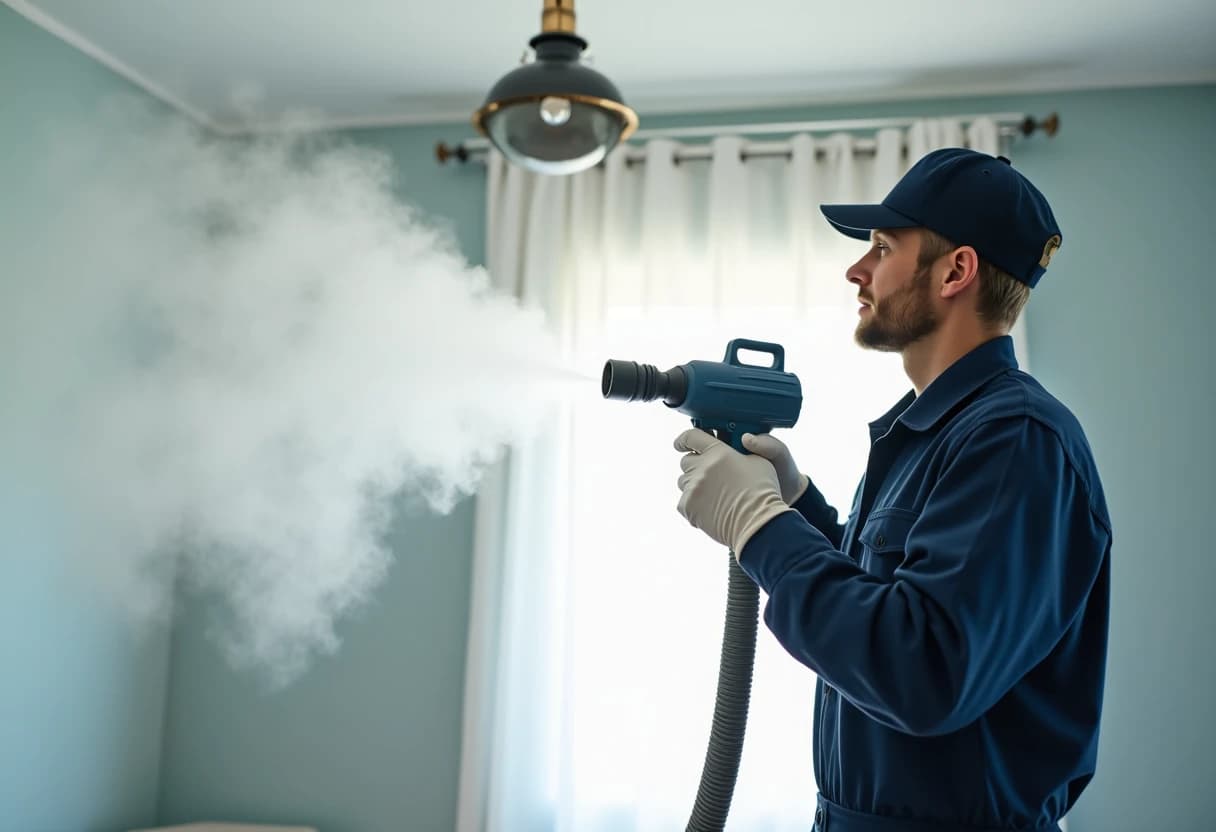
Air duct sanitizing is the finishing treatment that mechanical cleaning alone cannot provide: an EPA-registered antimicrobial, fogged through the freshly cleaned duct system under airflow so it reaches every surface the air touches. Where cleaning removes the dust, sanitizing neutralizes what lives in the residue — odor-causing bacteria, mold spores and the microbial film that gives ducts that stale, musty character. For Randolph homeowners fighting pet odors, previous-owner smells, smoke history or the damp-basement note that rides the airflow every summer, it is the difference between ducts that are clean and ducts that smell clean. We apply it honestly: only after source-removal cleaning, only with HVAC-labeled products, and only when your situation actually warrants it.
Why Air Duct Sanitizing & Deodorizing Matters for Randolph Homes
Cleaning and sanitizing solve two different problems, and stubborn duct odors need both solved. Mechanical cleaning removes the bulk contamination — the dust, dander and debris load. But odors are chemical and biological: they persist in the thin film of oils, microbial residue and volatile compounds bonded to duct surfaces, in seams and joints, and in the porous textures brushes cannot polish. That is why homeowners who buy a standard cleaning to fix a smell are sometimes disappointed — the ducts are genuinely clean, and the odor faintly persists. An EPA-registered antimicrobial fogged through the cleaned system finishes the job: it kills the odor-producing bacteria metabolizing that residue, neutralizes the residue itself, and inhibits the regrowth that would otherwise rebuild the smell over the following months. The sequence matters enormously — chemistry over dirt fails, chemistry over clean metal works — which is why we position sanitizing as the second half of a two-part service rather than a standalone spray, and why our results last years rather than the weeks a discount fog delivers.
Duct odors in Randolph have local fingerprints. Randolph built out fast in the 1950s and 60s, so the dominant stock is modest capes, ranches and split-levels on tidy lots, with older Victorians clustered near Crawford Square and Stetson Hall. Most of these post-war homes came with forced-air furnaces from day one, which means original sheet-metal ductwork that is now sixty-plus years old and often has never been professionally cleaned. Systems in these homes have been absorbing household life for decades — pets, kitchens, tobacco, damp cellars — and the interior film holds all of it. Because so much of Randolph's housing shares the same 1950s-60s construction vintage, we routinely find duct systems that have accumulated a half-century of dust, pet dander and renovation debris. Homes backing up to the Blue Hills Reservation side of town also pull in heavy seasonal pollen that settles deep in supply runs. When our crews sanitize Randolph systems, the before-and-after is often startling to owners who had gone nose-blind: the EPA-registered fogging lands on freshly cleaned metal, the biological residue neutralizes, and the house exhales decades of accumulated character in a single afternoon.
Our Air Duct Sanitizing & Deodorizing Process in Randolph
1Odor Assessment & Honest Qualification
First we determine whether sanitizing will actually fix your problem. The technician traces the odor's behavior — does it arrive with airflow, vary by season, concentrate at certain registers — inspects the duct interiors and air handler, and checks for moisture. If the source is your ducts, we quote the treatment flat. If it is not, we say so and point you at the real source.
2Source-Removal Cleaning First
Step one is removing the reservoir. The odor-saturated film lining your ducts is physically extracted under negative pressure — rotary brushes and pneumatic whips strip it from every supply, return and trunk while the HEPA vacuum captures it. Most of the odor leaves the house in this step; the fogging that follows neutralizes what remains and prevents the smell from rebuilding.
3Product Selection & Preparation
Only two kinds of products enter your air path: antimicrobials EPA-registered specifically for use in HVAC systems, and deodorizing counteractants formulated for duct application. No bleach, which corrodes ducts; no ozone shock treatments, which the EPA warns are ineffective at safe concentrations; no fragrance bombs that mask rather than neutralize. Dilutions follow the label exactly — that is what EPA registration means.
4Whole-System Antimicrobial Fogging
With the system freshly cleaned, the EPA-registered fog does its work at the surface level: contact-killing the bacteria that metabolize duct residue into odor, neutralizing the residual film chemically, and leaving an inhibiting layer that suppresses microbial regrowth. The application follows label contact times precisely — this is regulated chemistry applied to specification, not a scented mist waved through the vents.
5Coil, Drain Pan & Blower Treatment
Every fogging visit includes hands-on treatment of the components the fog alone cannot adequately address: coil fins treated with appropriate cleaner, drain pan scrubbed and sanitized, condensate line flushed, blower compartment wiped and treated. If we find heavy coil fouling or standing water that signals a bigger problem, we document it with photos and quote the fix separately — informed consent, never ambush.
6Deodorizing Pass for Stubborn Odors
Severe cases get layered treatment: antimicrobial fogging for the biology, counteractant application for chemical residue, and where warranted, guidance on the adjacent surfaces — returns pull air across ceilings and walls, and a smoke-saturated house can re-seed clean ducts. We are candid about that boundary: ducts are our domain, and we will tell you when a whole-home odor needs remediation beyond them.
7System Airing, Verification & Walkthrough
After label contact time elapses, we run the system to air the treatment through, reinstall registers, and walk the home with you register by register. You should smell neutral air — not fragrance, not chemicals, nothing. You receive the product documentation, re-entry guidance already satisfied by the airing process in most cases, and our callback commitment if any trace of the original odor resurfaces.
Benefits of Professional Air Duct Sanitizing & Deodorizing in Randolph
Small Add-On Cost, Outsized Payoff
For sellers, the return is measurable: smell shapes showings within seconds, and a few hundred dollars of source treatment protects list price far better than thousands in cosmetic touch-ups layered over an odor buyers will attribute to bigger problems. Agents who have watched a musty or pet-scented listing sit know exactly why they refer us pre-listing.
Smoke Ghosts Finally Evicted
If a home smelled of cigarettes at the showing and still does after renovation, the air system is the unrenovated room. Smoke rode the returns for years, coating the full duct network with residue no one ever addresses. Treating that network is routinely the missing piece that finally clears a smoker's house — and the step savvy buyers now negotiate into the purchase.
Pet Odor Elimination That Actually Holds
The cruel mechanics of pet odor: residents go nose-blind while every guest detects it instantly. If you have wondered whether your house 'smells like dog,' the ducts are almost certainly broadcasting more than you can perceive. Sanitizing after source-removal cleaning resets the broadcast to zero — and unlike surface remedies, it stays reset, because the reservoir itself is gone.
Microbial Load Reduced System-Wide
After specific contamination events — pest activity in the ducts, confirmed mold, water intrusion — this benefit becomes the headline: droppings, spores and bloom residue carry genuine pathogen and allergen loads, and mechanical cleaning alone does not neutralize them. The EPA-registered treatment does, which is why sanitizing moves from optional to advised the moment contamination history enters the picture.
Musty Summer Smell Broken for Good
Beyond comfort, the musty smell is diagnostic: it means active microbial metabolism in your air path, which trends toward visible colonization if the conditions persist. Treating it early — film removed, surfaces sanitized, moisture noted and addressed — is both the fix and the prevention, and materially cheaper than the mold removal that unchecked growth eventually requires.
A True Reset for Newly Purchased Homes
The previous owners' pets, kitchen, tobacco and habits are archived in your duct film, replaying on every cycle. Cleaning plus sanitizing erases the archive — mechanically stripping the residue, then neutralizing the biology — so the house starts smelling like yours from day one. It is the single most-requested reason for this service, and the reviews it generates say 'finally smells like our home.'
Signs Your Randolph Home Needs Air Duct Sanitizing & Deodorizing
Odors Return No Matter How Much You Clean
Count what you have already tried: shampooed carpets, washed walls, new air filters, open windows, every candle in the store. When that entire arsenal fails against a smell, you are not fighting a surface — you are fighting a reservoir with a fan attached. Treating the reservoir is the move that finally works.
Guests Notice a Smell You No Longer Can
Nose-blindness is real and universal: constant exposure deletes a smell from your perception while every visitor gets it full strength at the door. If a candid friend, a relative or a real estate agent has mentioned a pet, smoke or musty note you cannot detect, believe them — and suspect the ducts, because whole-house odors are almost always airflow-distributed.
You Just Bought the Home
Even a home that smells fine at purchase benefits from the reset when history is unknown: odor thresholds are personal, previous owners' normal may not be yours, and the first heating season has a way of releasing what summer showings concealed. Buyers who sanitize at move-in never have to wonder what October's first furnace cycle will announce.
Musty Blast When the Heat or AC Starts
Cycle-start odor means the smell is being generated inside the system and flushed out with the first air movement. Intermittent mustiness responds fully to sanitizing; a strong, constant or worsening version can indicate active mold colonization, which our inspection distinguishes — a difference that matters, since mold removal involves containment protocols and different pricing.
Smoke History in the Home
After a kitchen fire, wildfire smoke event or nearby structure fire, ducts inhale smoke even when flames never touched the house, and the system re-releases the odor long after surfaces are cleaned. Restoration protocols increasingly include duct treatment as standard; if yours did not, the lingering smell is telling you what was skipped.
Pets Present or Past
Allergy dynamics compound the odor case: duct-borne dander affects sensitive visitors and family members even when the smell is subtle. A treated system cuts both the odor and the circulating allergen load, which is why families expecting a new baby, hosting an allergic relative, or rehoming after a pet's passing all book this same service.
Air Duct Sanitizing & Deodorizing Cost in Randolph, MA
Compare the cost against what duct-borne odors actually extract from households. Masking products — candles, plug-ins, sprays — run $200 to $500 annually for a committed household and resolve nothing. Consumer ozone generators cost $100 to $400, carry EPA warnings, and leave the odor source intact. Carpet replacement motivated by a smell that turns out to be duct-borne runs $2,000 to $6,000 and fails on arrival, since the system re-scents new fibers within months. Repainting for smoke odor without treating the ducts: $3,000 to $8,000, same outcome. Against that landscape, $250 to $500 for professional source treatment — or $75 to $200 added to a cleaning you may need anyway — is not the premium option; it is the only option priced against the actual problem. For sellers the math sharpens further: listing agents consistently report that odor-flagged homes show worse and negotiate weaker, with concessions that dwarf the treatment cost by an order of magnitude. Fresh-smelling is the cheapest staging money can buy.
Want the full pricing picture? See our complete Boston-area cost guide or call (617) 390-7145 for an exact flat quote for your Randolph home.
Local Knowledge: Randolph, Norfolk County
What makes Randolph different? Randolph built out fast in the 1950s and 60s, so the dominant stock is modest capes, ranches and split-levels on tidy lots, with older Victorians clustered near Crawford Square and Stetson Hall. Most of these post-war homes came with forced-air furnaces from day one, which means original sheet-metal ductwork that is now sixty-plus years old and often has never been professionally cleaned. Because so much of Randolph's housing shares the same 1950s-60s construction vintage, we routinely find duct systems that have accumulated a half-century of dust, pet dander and renovation debris. Homes backing up to the Blue Hills Reservation side of town also pull in heavy seasonal pollen that settles deep in supply runs. For duct and dryer vent systems, those local factors translate into specific, predictable problems — and predictable problems are the ones we solve fastest. Call (617) 390-7145, tell us your street and home style, and we will quote the job accurately the first time, usually in under five minutes.
The Best Time of Year in Randolph
The first furnace start of October is New England's annual duct-odor reveal. Summer's humidity left the system's film damp and biologically active; the first heating cycles bake it, and the house fills with a musty-dusty note that is equal parts burnt accumulation and volatilized microbial residue. Households that smelled nothing all summer suddenly field questions at the door. If last October's first fires announced themselves this way, book cleaning and sanitizing in September — the treatment lands on the year's heaviest odor load, and the heating season opens with clean, neutral startup cycles instead. Fall slots fill fastest for exactly this reason; the smart calendar position is ahead of the rush, not inside it.
Why Choose Boston Air Duct Cleaners
Homeowners across Norfolk County choose Boston Air Duct Cleaners for three reasons. First, honesty: our inspection camera tells you whether your system actually needs cleaning — and sometimes the answer is no. Second, capability: truck-grade negative-air machines, rotary brush systems and HEPA filtration handle everything from antique gravity-furnace conversions to brand-new high-velocity systems. Third, accountability: flat quoted pricing, before-and-after photos, insured technicians, and a real local office you can call at (617) 390-7145. That combination is rarer in this industry than it should be.
Serving Randolph and Surrounding Communities
Randolph sits in the heart of our service area, and neighboring Quincy, Braintree, Holbrook, Avon, Canton, Stoughton appointments share the same routes. That density is why our response times in this part of Norfolk County are among our fastest — and why you will see our trucks in the area week after week.