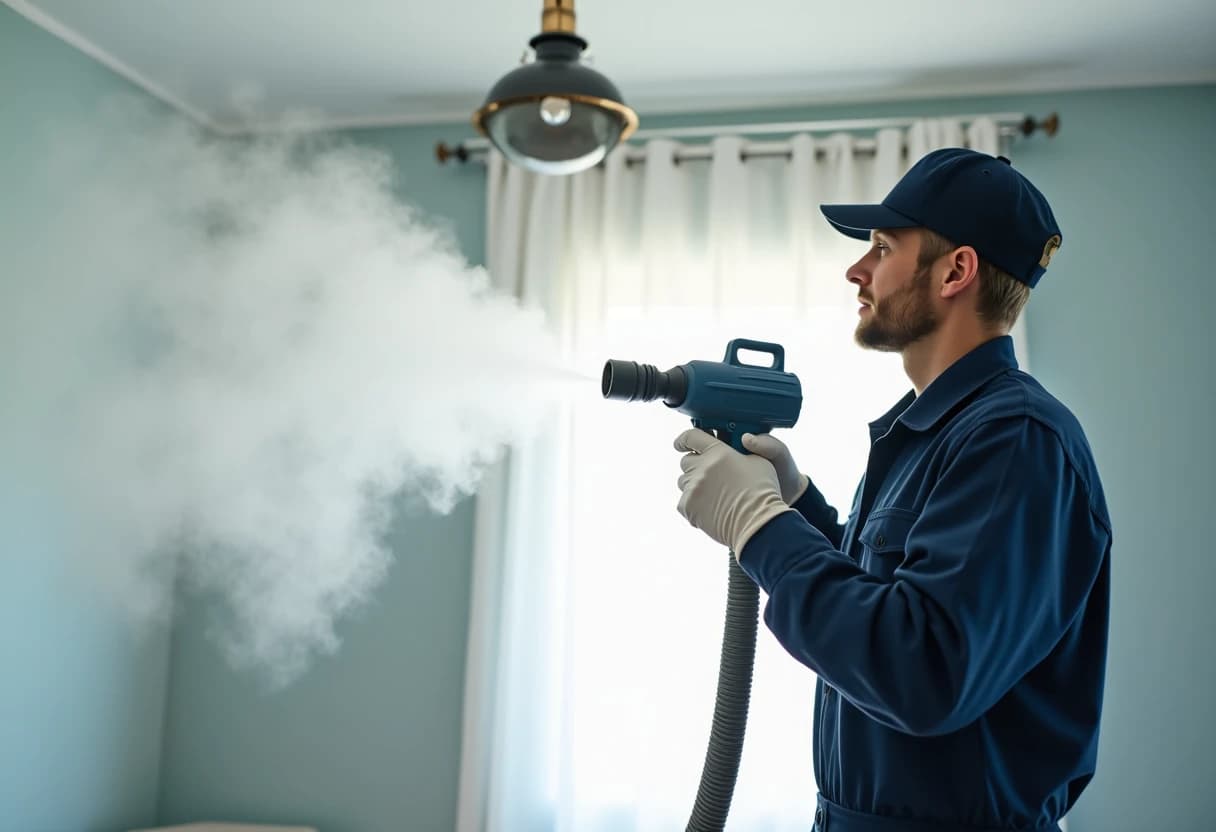
The EPA's guidance on duct treatments is specific: chemical biocides should be applied only after mechanical cleaning, and only products registered for use in HVAC systems belong in your air path. That is exactly how we sanitize ducts in Canton. First the system is cleaned to bare surfaces under negative pressure; then an EPA-registered antimicrobial is atomized through the supply and return network at label rates, treating the seams, joints and textures no brush can fully reach. The treatment kills odor-causing bacteria, neutralizes microbial residue and inhibits regrowth — and because it lands on clean metal rather than a dust blanket, it actually works. We will also tell you plainly when your system does not need it.
Why Air Duct Sanitizing & Deodorizing Matters for Canton Homes
Pet households face duct odor mechanics that surface cleaning cannot beat. Dander is an aerosol: it rides the return airflow into the duct network, settles into the interior film, and accumulates for as long as the pet lives there — often across multiple pets and many years. The film becomes an odor reservoir with the system's full distribution reach, which is why the smell is strongest when the heat kicks on and why guests detect it instantly while residents have gone nose-blind. The same mechanism archives cigarette and cannabis smoke, cooking oils, and the general biological signature every household writes into its air system over time. When the home changes hands, the new owners inherit the archive. Source-removal cleaning strips the reservoir; EPA-registered fogging neutralizes the residue and the bacteria feeding on it; and the system stops broadcasting. For sellers, this pairing is one of the highest-leverage pre-listing investments available — showings live and die on the first thirty seconds of smell — and for buyers it is the cleanest possible start in a home with an unknown history.
Anyone who has spent a humid August near Blue Hills Reservation knows the Canton basement smell — and in homes with forced-air systems, that smell rarely stays in the basement. Canton mixes Victorian and early-1900s homes near Canton Center with large tracts of 1960s-1980s colonials and split-levels, plus a wave of newer townhouse and apartment construction around Canton Junction and the Route 138 corridor. The commuter-rail neighborhoods have seen heavy renovation, and many mid-century homes here run long basement trunk ducts that collect decades of debris. Return leaks and duct runs through damp below-grade spaces pull musty air into the system, where it saturates the interior film and re-broadcasts upstairs all season. Homes bordering the Blue Hills Reservation and Ponkapoag Pond deal with heavy seasonal pollen and damp, wooded lots that keep basements humid - a combination that feeds mold in unlined ductwork. Canton's corporate parks off Royall Street also give us regular commercial duct and rooftop-unit work. Our cleaning-plus-sanitizing pairing removes the saturated film and neutralizes the biology behind the odor, which is why Canton mustiness calls are among our most satisfying jobs: the fix is genuinely complete.
Our Air Duct Sanitizing & Deodorizing Process in Canton
1Odor Assessment & Honest Qualification
Not every odor is a duct odor, and not every duct needs sanitizing — the EPA does not recommend routine biocide use, and neither do we. Your visit starts with diagnosis: camera inspection of the duct film, a look at the coil and drain pan, moisture readings where mustiness is the complaint. You get a straight answer about whether treatment is warranted before anyone sells you anything.
2Source-Removal Cleaning First
Step one is removing the reservoir. The odor-saturated film lining your ducts is physically extracted under negative pressure — rotary brushes and pneumatic whips strip it from every supply, return and trunk while the HEPA vacuum captures it. Most of the odor leaves the house in this step; the fogging that follows neutralizes what remains and prevents the smell from rebuilding.
3Product Selection & Preparation
Preparation is checklist work that determines results: product selected for your specific odor profile, dilution mixed to label specification, fogging equipment matched to your system's size so droplet distribution covers the full duct network. We also plan the airflow path — which registers stay open, how the blower assists — so the treatment reaches the far end of every run, not just the trunks.
4Whole-System Antimicrobial Fogging
The treatment is atomized into a fine fog and introduced through the duct network while controlled airflow carries it the length of every supply and return. The fog deposits on all interior surfaces — including the seams, joints and corrugations mechanical cleaning cannot polish — killing odor-causing bacteria and neutralizing microbial residue on contact. Full-system coverage takes under an hour in most homes.
5Coil, Drain Pan & Blower Treatment
Every fogging visit includes hands-on treatment of the components the fog alone cannot adequately address: coil fins treated with appropriate cleaner, drain pan scrubbed and sanitized, condensate line flushed, blower compartment wiped and treated. If we find heavy coil fouling or standing water that signals a bigger problem, we document it with photos and quote the fix separately — informed consent, never ambush.
6Deodorizing Pass for Stubborn Odors
Smoke and heavy pet situations get a second, targeted pass with odor-counteractant chemistry — products that bind and neutralize odor molecules rather than perfume over them. Tobacco residue in particular clings aggressively to metal and re-releases for years; the counteractant pass addresses it specifically. This step is included when the assessment calls for it and skipped, with the price reflecting that, when it does not.
7System Airing, Verification & Walkthrough
After label contact time elapses, we run the system to air the treatment through, reinstall registers, and walk the home with you register by register. You should smell neutral air — not fragrance, not chemicals, nothing. You receive the product documentation, re-entry guidance already satisfied by the airing process in most cases, and our callback commitment if any trace of the original odor resurfaces.
Benefits of Professional Air Duct Sanitizing & Deodorizing in Canton
Microbial Load Reduced System-Wide
After specific contamination events — pest activity in the ducts, confirmed mold, water intrusion — this benefit becomes the headline: droppings, spores and bloom residue carry genuine pathogen and allergen loads, and mechanical cleaning alone does not neutralize them. The EPA-registered treatment does, which is why sanitizing moves from optional to advised the moment contamination history enters the picture.
Small Add-On Cost, Outsized Payoff
Bundled with duct cleaning, sanitizing adds roughly $75 to $200 to the visit — the system is already sealed, accessed and under negative pressure, so you pay for chemistry and application time, not a second mobilization. Against the hundreds homeowners spend annually on masking products that fix nothing, the one-time source treatment is the plainly economical choice.
Pet Odor Elimination That Actually Holds
Multi-pet and long-tenure pet households benefit most: the accumulation scales with animal-years, and no surface cleaning touches the duct-borne share. Post-treatment, the improvement compounds — ongoing dander still sheds, but it lands in a neutral system rather than layering onto decades of saturated film, and routine filter changes keep the new baseline for years.
Smoke Ghosts Finally Evicted
If a home smelled of cigarettes at the showing and still does after renovation, the air system is the unrenovated room. Smoke rode the returns for years, coating the full duct network with residue no one ever addresses. Treating that network is routinely the missing piece that finally clears a smoker's house — and the step savvy buyers now negotiate into the purchase.
Odors Neutralized at the Source, Not Masked
Homeowners who have fought a duct-borne smell describe the same arc: sprays, candles, filters, ozone gadgets, shampooed carpets — hundreds of dollars of masking, months of frustration, smell intact. Source treatment ends the arc in one visit because it is aimed at the right target. The register air itself comes out neutral, so the rooms finally stay that way.
Musty Summer Smell Broken for Good
That damp blast at AC start-up is bacteria metabolizing humid duct film — a cycle that returns every muggy stretch and worsens annually. Sanitizing removes the film and leaves treated surfaces the biology cannot recolonize, so the next humid week produces silence from the registers. For many Massachusetts households this is the first summer without the smell in a decade.
Signs Your Canton Home Needs Air Duct Sanitizing & Deodorizing
After Pests, Mold or Water in the System
Post-mold-remediation, treating the cleaned duct surfaces inhibits recolonization while moisture corrections take effect — standard best practice, and typically specified in remediation protocols. If your home had mold work done and the ducts were cleaned but never treated, that gap is worth closing before the next humid season tests it.
Musty Blast When the Heat or AC Starts
Cycle-start odor means the smell is being generated inside the system and flushed out with the first air movement. Intermittent mustiness responds fully to sanitizing; a strong, constant or worsening version can indicate active mold colonization, which our inspection distinguishes — a difference that matters, since mold removal involves containment protocols and different pricing.
Guests Notice a Smell You No Longer Can
The cruelest version arrives during a home sale: buyers and agents smell in thirty seconds what you have not smelled in years, and it costs you at the negotiating table either way. Pre-listing duct sanitizing addresses the odor you cannot perceive at its distribution point — which is why experienced listing agents put it on the prep checklist.
Pets Present or Past
Allergy dynamics compound the odor case: duct-borne dander affects sensitive visitors and family members even when the smell is subtle. A treated system cuts both the odor and the circulating allergen load, which is why families expecting a new baby, hosting an allergic relative, or rehoming after a pet's passing all book this same service.
You Just Bought the Home
An unknown air system is a reasonable default for sanitizing: you cannot see the duct film's history, and whatever the previous owners' household deposited — pets, smoke, cooking, dampness — is now on replay in your air. Between closing and move-in is the ideal window: empty rooms, open access, and a fresh biological baseline before your family breathes the system daily.
Odors Return No Matter How Much You Clean
If deep-cleaning the house buys only a day or two before the smell creeps back, the source is upstream of everything you cleaned — in the air system, re-scenting the rooms on every cycle. That resupply pattern is the signature of duct-borne odor, and it means the fix is in the ducts, not in another weekend of scrubbing.
Air Duct Sanitizing & Deodorizing Cost in Canton, MA
Air duct sanitizing in Greater Boston runs $250 to $500 as a standalone service, and $75 to $200 when bundled with duct cleaning — the bundle discount reflects that the system is already sealed, accessed and under negative pressure, so the marginal cost is chemistry and application time rather than a second full mobilization. Within those ranges, price tracks system size (number of runs and zones determines product volume and fogging time), the odor profile (straightforward musty or pet situations need the antimicrobial pass alone, while smoke and severe cases add counteractant treatment), and how much wet-section work the coil, drain pan and blower need. One structural note on honest pricing: because effective sanitizing requires clean surfaces, a standalone quote for a system with dirty ducts must include cleaning — which is why legitimate standalone pricing converges toward the bundle anyway. A company happy to fog your uncleaned ducts for $149 is selling you a scented failure; the EPA's guidance that biocides follow mechanical cleaning is not a formality, it is why the treatment works at all.
Want the full pricing picture? See our complete Boston-area cost guide or call (617) 390-7145 for an exact flat quote for your Canton home.
Local Knowledge: Canton, Norfolk County
What makes Canton different? Canton mixes Victorian and early-1900s homes near Canton Center with large tracts of 1960s-1980s colonials and split-levels, plus a wave of newer townhouse and apartment construction around Canton Junction and the Route 138 corridor. The commuter-rail neighborhoods have seen heavy renovation, and many mid-century homes here run long basement trunk ducts that collect decades of debris. Homes bordering the Blue Hills Reservation and Ponkapoag Pond deal with heavy seasonal pollen and damp, wooded lots that keep basements humid - a combination that feeds mold in unlined ductwork. Canton's corporate parks off Royall Street also give us regular commercial duct and rooftop-unit work. For duct and dryer vent systems, those local factors translate into specific, predictable problems — and predictable problems are the ones we solve fastest. Call (617) 390-7145, tell us your street and home style, and we will quote the job accurately the first time, usually in under five minutes.
The Best Time of Year in Canton
Duct odors in Massachusetts follow the calendar, and so should treatment timing. Late summer is peak mustiness: July and August humidity has been condensing in the system for weeks, the microbial film is at maximum activity, and the smell at AC start-up is at its yearly worst — sanitizing now delivers the most dramatic before-and-after. Early fall is the strategic window: treating the system before the heating season means the closed-window months ahead circulate neutral air instead of concentrating whatever summer grew. The heating season itself is when odor complaints peak — not because ducts get dirtier in winter, but because sealed houses concentrate what the system holds, and the household finally notices what open windows had been diluting since May.
Why Choose Boston Air Duct Cleaners
We built this company around the jobs other duct cleaners do badly: the 130-year-old Victorian with panned-joist returns, the Canton condo with a 60-foot dryer run to the roof, the post-renovation house full of drywall dust. Our crews see Greater Boston's hardest systems every week, and the experience shows in the details — floor protection on the way in, sealed registers during the work, HEPA-vacuumed work areas on the way out, and imagery that proves the ducts are actually clean. Call (617) 390-7145 and judge the difference from the first conversation.
Serving Canton and Surrounding Communities
Beyond Canton, our crews cover the surrounding communities daily — including Stoughton, Sharon, Norwood, Westwood, Milton, Randolph. Because routes cluster geographically, booking alongside a neighboring appointment often unlocks same-day service and combined-visit savings. Wherever you are in Norfolk County, the same flat-rate pricing, insured technicians and photo-documented process applies.