
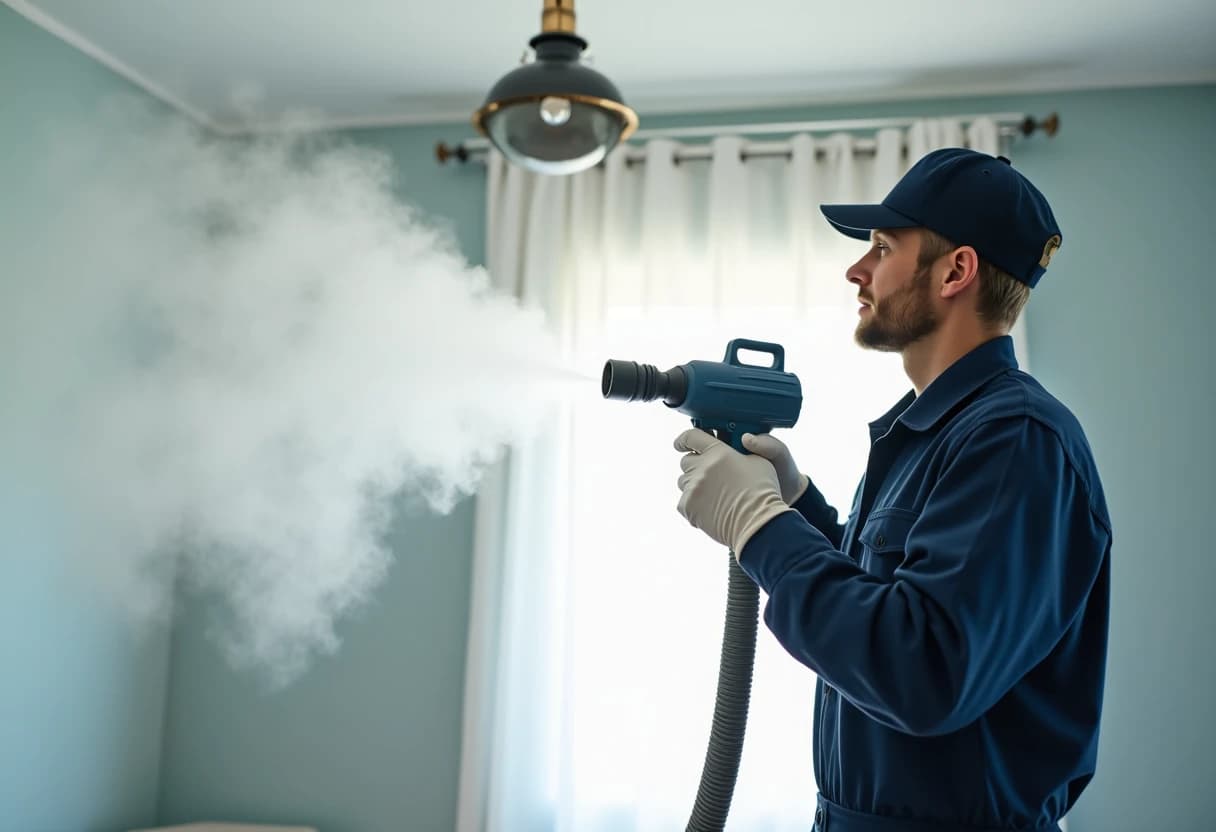
The EPA's guidance on duct treatments is specific: chemical biocides should be applied only after mechanical cleaning, and only products registered for use in HVAC systems belong in your air path. That is exactly how we sanitize ducts in Georgetown. First the system is cleaned to bare surfaces under negative pressure; then an EPA-registered antimicrobial is atomized through the supply and return network at label rates, treating the seams, joints and textures no brush can fully reach. The treatment kills odor-causing bacteria, neutralizes microbial residue and inhibits regrowth — and because it lands on clean metal rather than a dust blanket, it actually works. We will also tell you plainly when your system does not need it.
Why Air Duct Sanitizing & Deodorizing Matters for Georgetown Homes
Cleaning and sanitizing solve two different problems, and stubborn duct odors need both solved. Mechanical cleaning removes the bulk contamination — the dust, dander and debris load. But odors are chemical and biological: they persist in the thin film of oils, microbial residue and volatile compounds bonded to duct surfaces, in seams and joints, and in the porous textures brushes cannot polish. That is why homeowners who buy a standard cleaning to fix a smell are sometimes disappointed — the ducts are genuinely clean, and the odor faintly persists. An EPA-registered antimicrobial fogged through the cleaned system finishes the job: it kills the odor-producing bacteria metabolizing that residue, neutralizes the residue itself, and inhibits the regrowth that would otherwise rebuild the smell over the following months. The sequence matters enormously — chemistry over dirt fails, chemistry over clean metal works — which is why we position sanitizing as the second half of a two-part service rather than a standalone spray, and why our results last years rather than the weeks a discount fog delivers.
Air in Georgetown carries its own seasonal load. Many Georgetown properties sit on well water and are surrounded by woods and hayfields, so seasonal pollen and fine organic debris load up return grilles quickly here. The oversized colonials common in town also mean second-floor duct branches that have often never been cleaned since the house was built. Georgetown pairs antique center-chimney Colonials and Victorians clustered around the town common with large 1990s and 2000s Colonial subdivisions carved out of former woodland along its rural roads. The newer homes run big - often 2,500 square feet and up - with long duct runs to bonus rooms over garages that are notorious for weak airflow and dust accumulation at the far ends of the system. Between humid summers dampening duct interiors and long winters sealing houses around whatever the system holds, odors here compound year over year rather than airing out. Sanitizing resets that accumulation: after cleaning strips the film, EPA-registered treatment neutralizes the bacteria and residue that generate the smell, and the closed-window months circulate neutral air instead of concentrated history. Fall bookings from Georgetown fill early for precisely this reason — call ahead of the season.
Our Air Duct Sanitizing & Deodorizing Process in Georgetown
1Odor Assessment & Honest Qualification
First we determine whether sanitizing will actually fix your problem. The technician traces the odor's behavior — does it arrive with airflow, vary by season, concentrate at certain registers — inspects the duct interiors and air handler, and checks for moisture. If the source is your ducts, we quote the treatment flat. If it is not, we say so and point you at the real source.
2Source-Removal Cleaning First
Sanitizer applied over dirt is wasted — no chemistry penetrates a mat of dust and biofilm. So the system is cleaned first to NADCA-standard bare surfaces: registers sealed, ductwork under HEPA-filtered negative pressure, every run mechanically agitated with brushes and air whips. If your ducts were professionally cleaned very recently, we verify by camera and credit the step accordingly.
3Product Selection & Preparation
Preparation is checklist work that determines results: product selected for your specific odor profile, dilution mixed to label specification, fogging equipment matched to your system's size so droplet distribution covers the full duct network. We also plan the airflow path — which registers stay open, how the blower assists — so the treatment reaches the far end of every run, not just the trunks.
4Whole-System Antimicrobial Fogging
Fogging is the delivery method that makes duct sanitizing whole-system rather than spot treatment. Atomized at the micron scale, the antimicrobial behaves like the air itself, riding the airflow into every branch, riser and return the blower serves. Everywhere your air travels, the treatment travels — which is precisely why it works on odors that a hand-sprayed register never touches.
5Coil, Drain Pan & Blower Treatment
Your system's odor epicenter is usually the equipment, not the ducts: the coil and drain pan stay wet all cooling season, breeding the bacteria behind classic dirty-sock smell. We clean and treat both, clear the condensate trap, and sanitize the blower assembly that pushes air past them — closing the loop so the freshly treated ductwork is not immediately re-contaminated from upstream.
6Deodorizing Pass for Stubborn Odors
Antimicrobial treatment handles biological odors, but some smells are chemical: tar and nicotine films, cooking-oil residue, fire smoke. For those, we deploy counteractants that chemically neutralize the odor compounds themselves. The distinction matters — treating a smoke house with antimicrobial alone leaves the tar film broadcasting — and diagnosing which chemistry your odor needs is exactly what the initial assessment is for.
7System Airing, Verification & Walkthrough
We leave the system running clean and documented: registers remounted, a fresh filter installed on request, treatment records in your file, and honest guidance on what to expect — a faint clean-neutral note for a day or two as the treatment cures, then nothing. If the odor you hired us to kill ever returns in the following months, you call, we come back. That simple.
Benefits of Professional Air Duct Sanitizing & Deodorizing in Georgetown
Microbial Load Reduced System-Wide
Ducts are a microbial habitat by design — dark, textured, dust-fed and periodically damp. Sanitizing knocks the resident population down to baseline and leaves an inhibiting residue that slows recolonization for years. It is not sterility, and no honest company promises that; it is a substantially cleaner biological starting point for all the air you breathe at home.
Musty Summer Smell Broken for Good
The musty cycle is self-reinforcing: each humid season's growth adds residue that feeds the next season's growth. Breaking it requires actually removing the substrate, which is what the cleaning-plus-treatment pairing does. Homeowners who assumed the smell was 'just what old houses do' discover it was just what untreated ducts do — old houses smell fine with a neutral air path.
Pet Odor Elimination That Actually Holds
Multi-pet and long-tenure pet households benefit most: the accumulation scales with animal-years, and no surface cleaning touches the duct-borne share. Post-treatment, the improvement compounds — ongoing dander still sheds, but it lands in a neutral system rather than layering onto decades of saturated film, and routine filter changes keep the new baseline for years.
Smoke Ghosts Finally Evicted
Fire and smoke events leave the same signature at higher intensity: acrid residue through every duct the system ran during or after the event. Alongside your restoration work, duct cleaning with counteractant treatment prevents the classic post-fire complaint — a rebuilt, repainted home that still exhales smoke on warm days. We coordinate with restoration timelines regularly.
Small Add-On Cost, Outsized Payoff
Standalone treatments run $250 to $500; bundled with cleaning, the marginal cost drops by half or more. That pricing asymmetry is why we encourage odor-motivated customers to book the pairing — one visit, one setup, both halves of the fix. The alternative sequence, cleaning now and a separate sanitizing visit after the smell persists, costs more and delays the result.
Odors Neutralized at the Source, Not Masked
Every consumer odor product adds scent on top of the problem; sanitizing subtracts the problem. With the odor-holding film removed and the residue chemically neutralized, the ducts stop producing smell altogether. The house does not smell like a candle aisle afterward — it smells like nothing, which is what fresh actually is, and what no masking product can counterfeit.
Signs Your Georgetown Home Needs Air Duct Sanitizing & Deodorizing
Musty Blast When the Heat or AC Starts
Cycle-start odor means the smell is being generated inside the system and flushed out with the first air movement. Intermittent mustiness responds fully to sanitizing; a strong, constant or worsening version can indicate active mold colonization, which our inspection distinguishes — a difference that matters, since mold removal involves containment protocols and different pricing.
Guests Notice a Smell You No Longer Can
The cruelest version arrives during a home sale: buyers and agents smell in thirty seconds what you have not smelled in years, and it costs you at the negotiating table either way. Pre-listing duct sanitizing addresses the odor you cannot perceive at its distribution point — which is why experienced listing agents put it on the prep checklist.
After Pests, Mold or Water in the System
Rodent or insect activity in ductwork leaves droppings, nesting debris and bacterial contamination that mechanical cleaning removes but does not neutralize — the sanitizing pass is what addresses the biological load. Any pest history that touched the air system should end with an EPA-registered treatment, and the odor benefit arrives as a bonus.
Smoke History in the Home
The classic frustration: a fully renovated home that still exhales cigarettes on the first hot day. The renovation never entered the ductwork, where smoke residue coats every run the returns fed for years. If your renovation checklist did not include the air system, the smell has a protected reservoir — and an easy explanation for its persistence.
Pets Present or Past
The threshold question: can guests tell you have animals without seeing them? If yes, the ducts are broadcasting, and the smell is stronger than your adapted nose reports. Households with multiple pets or long pet tenure carry proportionally heavier duct reservoirs, and they see the most dramatic before-and-after from a single cleaning-plus-treatment visit.
Odors Return No Matter How Much You Clean
If deep-cleaning the house buys only a day or two before the smell creeps back, the source is upstream of everything you cleaned — in the air system, re-scenting the rooms on every cycle. That resupply pattern is the signature of duct-borne odor, and it means the fix is in the ducts, not in another weekend of scrubbing.
Air Duct Sanitizing & Deodorizing Cost in Georgetown, MA
Three questions set your price. First, is the system clean? Freshly cleaned ducts qualify for standalone treatment pricing; ducts carrying normal accumulation need the cleaning-plus-sanitizing bundle, because fogging over dust fails chemically. Second, what is the odor? Musty, pet and general staleness respond to the EPA-registered antimicrobial pass; tobacco, fire smoke and heavy cooking residue need the additional counteractant chemistry, which adds modestly to the price. Third, how big is the system? A compact ranch with ten runs sits at the range's bottom; a three-zone colonial with twenty-five runs sits at the top, purely on product volume and application time. Across Essex County, typical outcomes: $325 to $550 bundled for average homes, $500 to $700 bundled for large ones, standalone treatments from $250. Every quote includes the wet-section work — coil, pan, blower — because skipping the system's dampest components to hit a teaser price defeats the treatment, and we would rather explain the honest number than discount our way to a callback.
Want the full pricing picture? See our complete Boston-area cost guide or call (617) 390-7145 for an exact flat quote for your Georgetown home.
Local Knowledge: Georgetown, Essex County
What makes Georgetown different? Georgetown pairs antique center-chimney Colonials and Victorians clustered around the town common with large 1990s and 2000s Colonial subdivisions carved out of former woodland along its rural roads. The newer homes run big - often 2,500 square feet and up - with long duct runs to bonus rooms over garages that are notorious for weak airflow and dust accumulation at the far ends of the system. Many Georgetown properties sit on well water and are surrounded by woods and hayfields, so seasonal pollen and fine organic debris load up return grilles quickly here. The oversized colonials common in town also mean second-floor duct branches that have often never been cleaned since the house was built. For duct and dryer vent systems, those local factors translate into specific, predictable problems — and predictable problems are the ones we solve fastest. Call (617) 390-7145, tell us your street and home style, and we will quote the job accurately the first time, usually in under five minutes.
The Best Time of Year in Georgetown
Duct odors in Massachusetts follow the calendar, and so should treatment timing. Late summer is peak mustiness: July and August humidity has been condensing in the system for weeks, the microbial film is at maximum activity, and the smell at AC start-up is at its yearly worst — sanitizing now delivers the most dramatic before-and-after. Early fall is the strategic window: treating the system before the heating season means the closed-window months ahead circulate neutral air instead of concentrating whatever summer grew. The heating season itself is when odor complaints peak — not because ducts get dirtier in winter, but because sealed houses concentrate what the system holds, and the household finally notices what open windows had been diluting since May.
Why Choose Boston Air Duct Cleaners
Homeowners across Essex County choose Boston Air Duct Cleaners for three reasons. First, honesty: our inspection camera tells you whether your system actually needs cleaning — and sometimes the answer is no. Second, capability: truck-grade negative-air machines, rotary brush systems and HEPA filtration handle everything from antique gravity-furnace conversions to brand-new high-velocity systems. Third, accountability: flat quoted pricing, before-and-after photos, insured technicians, and a real local office you can call at (617) 390-7145. That combination is rarer in this industry than it should be.
Serving Georgetown and Surrounding Communities
We serve every community around Georgetown as well: Rowley, Topsfield, North Andover, Ipswich, Middleton, Andover all fall inside our regular service routes. If you have a second property, a rental, or family nearby, ask about multi-home scheduling — grouped appointments on the same route are our most requested discount.