
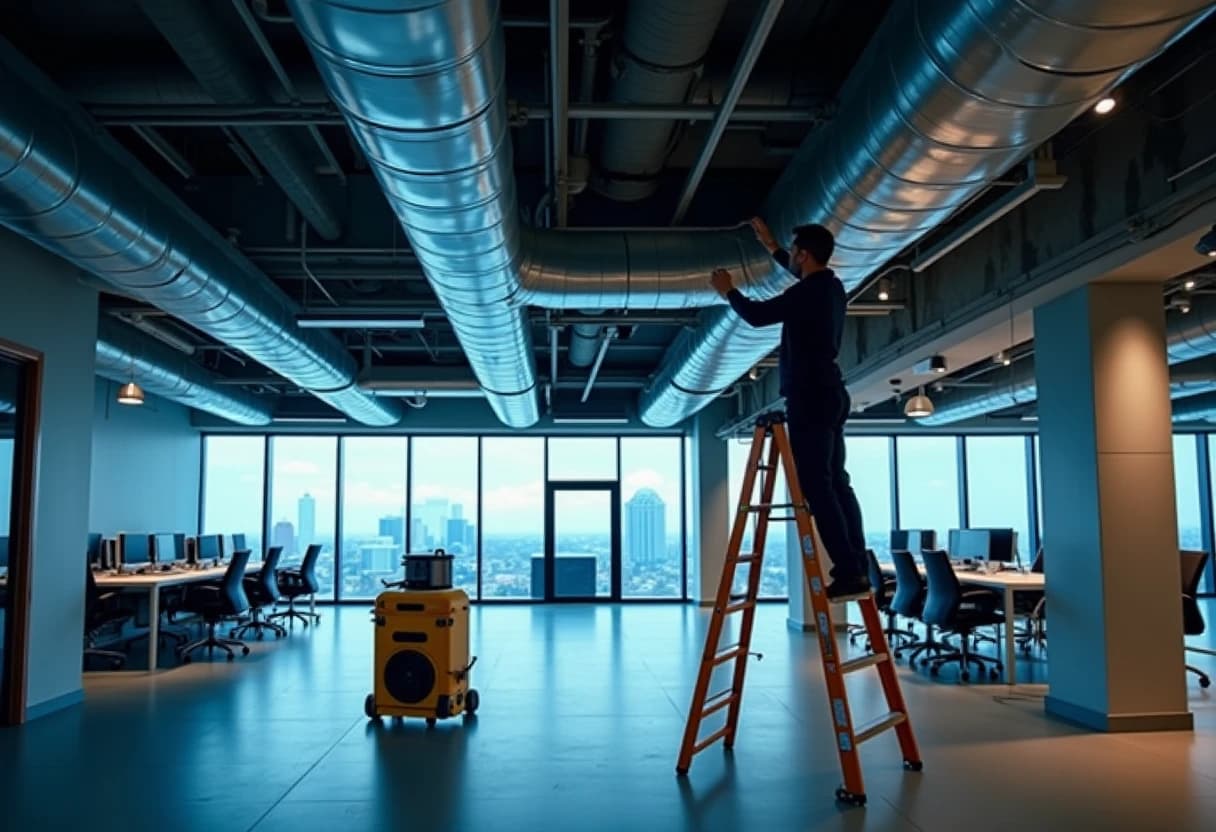
Commercial HVAC systems move enormous volumes of air through long trunk lines, VAV boxes, rooftop units and hundreds of diffusers — and every square foot of that ductwork collects dust, fibers, and whatever the building's occupants generate. Our commercial air duct cleaning crews serve Georgetown offices, retail spaces, restaurants, medical suites, schools and fitness facilities with the same NADCA-standard source-removal method we use everywhere: the system goes under negative pressure with HEPA-filtered collection equipment, every run is mechanically agitated, and the work is documented in a written report your insurer, landlord or facilities director can file. We schedule nights and weekends so your business never loses an operating hour, and we carry the certificates of insurance commercial properties require before we ever set foot on site.
Why Commercial Air Duct Cleaning Matters for Georgetown Homes
Certain commercial situations make duct cleaning non-negotiable. After tenant fit-outs and renovations, drywall and concrete dust saturates the duct network and ceiling plenum; occupying the space without cleaning means months of construction particulate raining onto desks and merchandise. After fire or smoke events — even minor ones — soot embeds in duct dust and re-releases odor indefinitely, and remediation scopes routinely require documented duct cleaning. After water intrusion, roof leaks or humidification failures, damp duct interiors become microbial growth sites within days, and the EPA's guidance is explicit that visibly contaminated ducts serving occupied spaces should be professionally cleaned. Ownership transitions matter too: buyers inherit the previous owner's deferred maintenance, and a pre-purchase duct inspection is one of the cheapest due-diligence items available. Finally, some tenants simply require it — medical uses, labs, food production and childcare leases often carry IAQ maintenance clauses. In each case, the combination of proper source-removal cleaning and a formal completion report satisfies the requirement and closes the file.
Commercial spaces in Georgetown are exactly where duct contamination hides in plain sight. Georgetown pairs antique center-chimney Colonials and Victorians clustered around the town common with large 1990s and 2000s Colonial subdivisions carved out of former woodland along its rural roads. The newer homes run big - often 2,500 square feet and up - with long duct runs to bonus rooms over garages that are notorious for weak airflow and dust accumulation at the far ends of the system. Many of the area's storefronts, offices and mixed-use buildings run on HVAC systems that have served a parade of tenants, each fit-out leaving its construction dust in the trunk lines and ceiling plenums. Many Georgetown properties sit on well water and are surrounded by woods and hayfields, so seasonal pollen and fine organic debris load up return grilles quickly here. The oversized colonials common in town also mean second-floor duct branches that have often never been cleaned since the house was built. Our commercial crews work Georgetown regularly and arrive equipped for its building stock — roof access gear for rooftop units, negative-air machines sized for long trunk runs, and containment that protects finished retail and office space. Certificates of insurance naming your property go out before the crew does, and overnight scheduling means your customers never see a hose.
Our Commercial Air Duct Cleaning Process in Georgetown
1Site Walk, System Mapping & Flat Quote
First we scope the job properly: which units serve which spaces, where the trunk lines run, what the ceiling plenum situation looks like, and what condition the ducts are actually in. A borescope camera look at representative runs keeps the assessment honest. The result is a fixed project price and a phasing plan built around your operating hours — no unit rates that balloon mid-project.
2Certificates of Insurance & Scheduling Around Your Operations
Commercial work runs on paperwork and timing, and we treat both as part of the service. COIs naming your entity and landlord go out in advance; technicians carry ID and follow your building's access and alarm protocols. Scheduling is genuinely flexible — most of our commercial cleaning happens between close and open, and phased projects are sequenced so each area is finished, cleaned and back in service before occupants return.
3Containment & Protection of Finished Spaces
Retail merchandise, exam rooms, server closets, commercial kitchens — commercial spaces contain things that must not get dusty, and our protection plan is written into every project scope. Sensitive areas are draped or excluded and sequenced appropriately, negative pressure ensures loosened debris travels into HEPA collection rather than the space, and each night's work area is inspected and restored before the crew leaves.
4Negative Pressure on Each Zone
Zone by zone, the duct network becomes a controlled vacuum circuit. Our negative-air machines pull thousands of cubic feet per minute through HEPA filtration, maintaining continuous negative pressure for the entire agitation phase. On multi-unit buildings we isolate and clean one system at a time, which keeps containment tight and lets partially occupied buildings continue operating around the work.
5Mechanical Agitation of Trunks, Branches & Terminal Units
With each zone under vacuum, technicians agitate every run: rotary brushes sized to duct dimensions scrub mains and branches, compressed-air whips chase debris from diffuser takeoffs back toward collection, and directional skipper nozzles sweep long horizontal trunks. VAV and fan-powered boxes are opened and hand-cleaned — they are debris traps that blown-air-only crews skip entirely.
6Air Handler, Rooftop Unit & Coil Cleaning
A clean duct system fed by a dirty air handler recontaminates in months, so units are part of every complete scope. We open each RTU or interior handler and detail the components the airstream touches: blower wheel, housing interior, plenum sections and accessible panels. Coil condition is documented with photos; where fouling is significant we quote in-place coil cleaning honestly, using appropriate coil-safe methods.
7Verification, Restoration & Completion Report
The last step is a walkthrough with your facilities contact or property manager: systems running, airflow verified at representative diffusers, documentation reviewed page by page. Everything we observed inside your system goes in writing, including items outside our scope that deserve your HVAC contractor's attention. We then log your property for the maintenance interval you choose, so recurring cleanings arrive as calendar items, not emergencies.
Benefits of Professional Commercial Air Duct Cleaning in Georgetown
Extended Rooftop Unit & Equipment Life
Replacing a commercial rooftop unit in Massachusetts runs well into five figures with crane time, curb adapters and controls. Dust is the primary aging accelerant — insulating coils, overheating motors, unbalancing blowers. Keeping the air path clean lets equipment run at design conditions, deferring the largest capital expenses on a building's mechanical schedule.
Fewer IAQ Complaints, Happier Tenants & Staff
Stale-air tickets, dust complaints and mystery odors trace back to the duct network more often than any other building system. Cleaning it removes the source rather than treating symptoms, which is why properties see complaint volume drop sharply after service — and why the photo report is such an effective tool in tenant communications and renewal conversations.
A Visibly Cleaner, Fresher-Smelling Space
Odors live in the organic film inside ductwork — cooking residue in food service, sweat and rubber in gyms, general staleness everywhere — and re-release with every operating hour. Air fresheners mask the symptom on top of the cause. Source removal takes the saturated dust out of the building, which is the only fix that survives the week.
One Vendor for Whole Portfolios
Property managers running multiple buildings get one point of contact, consistent pricing logic across properties, standardized reporting, and a maintenance calendar that schedules each site on its own interval. Adding a property to the program takes one site walk. It is the difference between managing a vendor and managing a program.
Lower Energy Costs Across Long Operating Hours
Your mechanical systems were commissioned to move a specific volume of air. Years of accumulation quietly steal that capacity, and buildings compensate with longer runtimes and lower comfort. A full air-side cleaning — ducts, boxes, blowers and coils — is the cheapest capacity recovery available, restoring performance no thermostat adjustment can reach.
Documentation for Insurance, Leases & Compliance
Every project produces a completion report with photographic evidence, scope checklist and service date — the paper trail insurers, medical tenants, franchise inspectors and boards increasingly expect. When an air-quality question arises later, a documented maintenance history is the difference between a closed inquiry and an exposure. We format reports for exactly that use.
Signs Your Georgetown Home Needs Commercial Air Duct Cleaning
Dust Streaking on Diffusers, Grilles & Ceiling Tiles
Janitorial crews wiping the same diffusers every month are documenting the problem, not fixing it. Persistent re-soiling of terminals means the duct interiors upstream are shedding continuously. After a proper source-removal cleaning, terminal surfaces stay clean for years instead of weeks — an easy before-and-after your maintenance log will show.
Recent Fit-Out, Renovation or Construction
Tenant fit-outs fill duct systems with drywall, concrete and wood dust — the system inhales the job site through every open takeoff and unsealed return, and ceiling plenums collect the rest. Occupying the space without a post-construction duct cleaning means months of construction particulate delivered to desks, merchandise and lungs.
Water Intrusion, Mold Findings or Pest Evidence
Roof leaks, burst pipes and humidification failures routinely wet commercial ductwork, and damp duct dust becomes a microbial growth site within about 48 hours. Any water event near air-handling equipment warrants a duct inspection now — EPA guidance is explicit that visibly contaminated ducts serving occupied space should be professionally cleaned.
Tenant or Employee Air Quality Complaints
IAQ tickets that keep reopening are expensive in management time and tenant goodwill. Before commissioning air-quality testing or consultant studies, look inside the ducts — in older commercial buildings, visible accumulation is the overwhelmingly common finding, and source-removal cleaning is the direct, documentable fix.
Odors That Return Every Operating Day
Gyms, restaurants and older offices each develop signature odors, and all three share the same mechanism: saturated duct dust re-emitting what the building's operations deposited. Post-cleaning, optionally finished with an EPA-registered deodorizing treatment, spaces smell neutral — which occupants register immediately even if they never identify why.
No Service History Anyone Can Find
NADCA guidance calls for periodic inspection of commercial air systems, with cleaning as conditions warrant — and in Greater Boston's older commercial stock, conditions almost always warrant. Starting a documented maintenance cycle now costs a site walk; explaining a decade of missing records to an insurer or a tenant's counsel later costs considerably more.
Commercial Air Duct Cleaning Cost in Georgetown, MA
Budget-minded facilities teams should weigh interval against invoice. A commercial system cleaned to NADCA standards stays serviceably clean for three to five years in typical use, so a $3,000 project annualizes to under a thousand dollars — less than most buildings lose annually to the energy penalty of fouled coils and choked airflow. Recurring-program clients do better still: properties on our maintenance calendar receive locked interval pricing, priority scheduling in the spring and fall rush, and inspection-first service where we camera-check the system and clean only when imaging justifies it. That inspect-first discipline matters; some intervals we recommend deferring a cleaning, and clients tell us that honesty is why entire portfolios end up on our schedule. Multi-property managers should ask about portfolio pricing — consolidated scheduling across sites reduces our mobilization costs, and we pass the difference through.
Want the full pricing picture? See our complete Boston-area cost guide or call (617) 390-7145 for an exact flat quote for your Georgetown home.
Local Knowledge: Georgetown, Essex County
Serving Georgetown means knowing Georgetown. Georgetown pairs antique center-chimney Colonials and Victorians clustered around the town common with large 1990s and 2000s Colonial subdivisions carved out of former woodland along its rural roads. The newer homes run big - often 2,500 square feet and up - with long duct runs to bonus rooms over garages that are notorious for weak airflow and dust accumulation at the far ends of the system. Many Georgetown properties sit on well water and are surrounded by woods and hayfields, so seasonal pollen and fine organic debris load up return grilles quickly here. The oversized colonials common in town also mean second-floor duct branches that have often never been cleaned since the house was built. Those conditions shape how we work here: which brush heads come off the truck, how we protect finishes in older interiors, and what we expect to find when the camera goes into a 01833 duct system. Our crews are in and around Georgetown nearly every week — often for neighbors of past customers — so scheduling is fast and our arrival windows hold.
The Best Time of Year in Georgetown
Commercial buildings in Massachusetts live on a two-season HVAC cycle — heating from October into April, cooling through the humid summer — and both seasons punish dirty ductwork. Fall is the smartest window for commercial cleaning: systems get a clean start before near-continuous winter runtime, and the first heating cycles do not broadcast burnt-dust odor through the workplace. Late spring is the second-best slot, clearing winter accumulation before cooling season seals the building. For retail, the calendar adds its own logic — holiday-season floors should be cleaned by early November, not during it — and schools and daycares book vacation weeks months ahead. We hold overnight and weekend capacity year-round, but the fall commercial rush is real; property managers who schedule in September choose their dates rather than taking what remains.
Why Choose Boston Air Duct Cleaners
Choosing a duct cleaner is really a trust decision — you are letting a crew work inside the system that feeds air to your family. We make that decision easy: a local West Newton company with insured, uniformed technicians, transparent flat-rate quotes, NADCA-standard equipment and methods, and photographic proof of the finished work. No door-to-door sales, no bait-and-switch coupons, no invented 'mold emergencies.' Just honest mechanical cleaning done properly the first time, backed by a written guarantee.
Serving Georgetown and Surrounding Communities
Georgetown sits in the heart of our service area, and neighboring Rowley, Topsfield, North Andover, Ipswich, Middleton, Andover appointments share the same routes. That density is why our response times in this part of Essex County are among our fastest — and why you will see our trucks in the area week after week.