
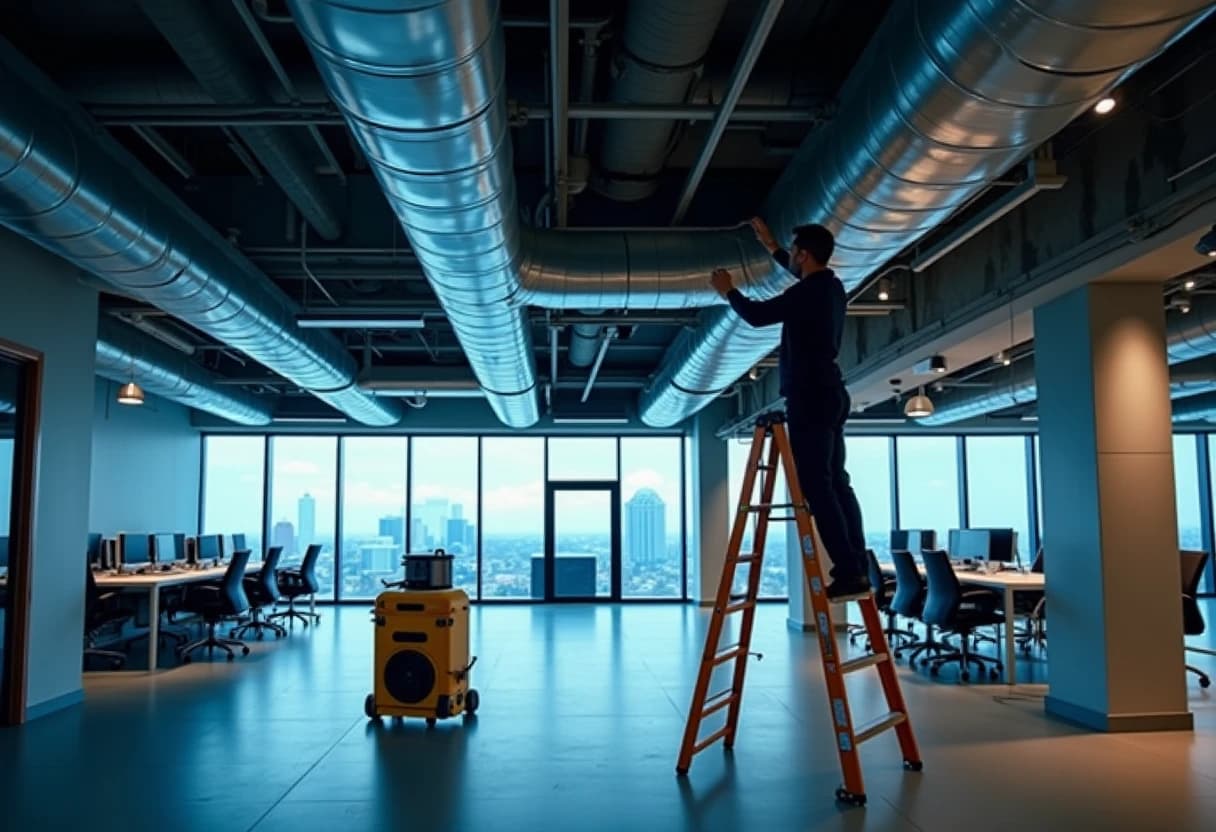
When employees complain about stuffy air, tenants file IAQ tickets, or customers notice dust streaming from ceiling diffusers, the ductwork is usually the culprit — and in commercial buildings it is measured in thousands of square feet of hidden sheet metal. Boston Air Duct Cleaners provides full source-removal duct cleaning for commercial properties in East Boston: supply and return trunks, branch runs, VAV and fan-powered boxes, rooftop unit interiors, and the diffusers and grilles your occupants actually see. Our crews are experienced with roof access, ceiling plenum returns, and the long horizontal trunk runs typical of office and retail construction. Every project includes pre- and post-cleaning photo documentation, after-hours or phased scheduling, and a certificate of insurance issued to your property before work begins.
Why Commercial Air Duct Cleaning Matters for East Boston Homes
The energy case for commercial duct cleaning is straightforward arithmetic. Commercial HVAC is typically the largest line on a building's utility bill, and air-side fouling attacks it from every direction: dust-blanketed evaporator coils lose heat-transfer capacity, dirt-loaded blower wheels lose airflow, and debris-narrowed ducts raise static pressure so fans work harder to deliver less. Studies of commercial systems consistently attribute meaningful efficiency losses to fouled air-side components, which is why coil and system cleaning frequently pays back within a season or two on buildings with long operating hours. Beyond kilowatt-hours, restored airflow rebalances the building — the conference room that never cools, the corner suite that never heats, the back-of-house that always smells stale are frequently airflow problems wearing comfort-complaint costumes. Cleaning the ducts, boxes and unit interiors restores the design airflow the mechanical engineer originally specified. Pair it with a coil cleaning on your rooftop units and the building runs closer to its commissioned performance than it has in years — measurable at the meter and noticeable in the comfort log.
Ask any facilities manager responsible for property near LoPresti Park: tenant IAQ complaints are among the hardest tickets to close, because filter changes and thermostat checks never reach the real problem. East Boston's streets are lined with tightly packed triple-deckers and brick rowhouses from the immigrant boom of the early 1900s, now joined by a fast-growing waterfront of new condo buildings along the harbor at Jeffries Point and Clippership Wharf. The old stock carries the usual retrofit story - radiator-era buildings with forced air added unit by unit - while the new waterfront buildings use heat pumps and ERV systems whose compact ductwork still needs regular cleaning. Basements sit low and damp this close to the harbor. In buildings like these, the duct network itself carries decades of accumulation, and the complaints keep returning until it is cleaned. Eastie homes deal with a distinctive air mix: salt-laden harbor humidity, jet exhaust and particulates from Logan's runways, and dust from a decade of waterfront construction. Many residents keep windows closed under the flight paths, which makes the condition of the ductwork matter even more since the HVAC system handles nearly all air turnover. Corroded exterior vent hoods from the salt air are something we replace here routinely. Our East Boston commercial projects follow NADCA source-removal standards — negative pressure, mechanical agitation, HEPA collection — and finish with photo documentation that lets you show tenants exactly what was done. We phase work by floor or suite so occupied buildings keep operating, and we hold COI, W-9 and access-protocol paperwork ready for property management onboarding.
Our Commercial Air Duct Cleaning Process in East Boston
1Site Walk, System Mapping & Flat Quote
Every engagement begins with documentation, not equipment. We map your system zone by zone, photograph baseline conditions inside representative ducts and unit interiors, flag any disconnections, damage or microbial concerns, and confirm insurance and access requirements with your property team. Only after you approve the written scope, price and schedule does the crew mobilize.
2Certificates of Insurance & Scheduling Around Your Operations
We plan commercial projects like contractors, not like a residential crew squeezing in a big job. That means pre-mobilization insurance certificates, coordination with your facilities or property management team, protection plans for finished spaces and merchandise, and crews scheduled for the windows when your building is emptiest — nights, weekends and holidays included at no scheduling premium for standard projects.
3Containment & Protection of Finished Spaces
Retail merchandise, exam rooms, server closets, commercial kitchens — commercial spaces contain things that must not get dusty, and our protection plan is written into every project scope. Sensitive areas are draped or excluded and sequenced appropriately, negative pressure ensures loosened debris travels into HEPA collection rather than the space, and each night's work area is inspected and restored before the crew leaves.
4Negative Pressure on Each Zone
Negative pressure is the backbone of NADCA-standard cleaning, and commercial ductwork tests it: hundred-foot trunk runs, multiple branch takeoffs, VAV boxes and plenum returns all between the debris and the vacuum. We establish collection points strategically along the mains, verify draw at the far ends of each run, and only then begin agitation — ensuring every loosened particle has a clear path out of the building.
5Mechanical Agitation of Trunks, Branches & Terminal Units
This is the labor the price reflects. Every supply branch from diffuser to trunk, every return path including plenum-connected grilles, and every accessible terminal unit gets individual mechanical agitation — not just a blast of air from one end. Stubborn accumulation gets repeat passes until inspection imaging shows clean metal. Access panels are installed where the system lacks them, per NADCA standards, and sealed properly afterward.
6Air Handler, Rooftop Unit & Coil Cleaning
A clean duct system fed by a dirty air handler recontaminates in months, so units are part of every complete scope. We open each RTU or interior handler and detail the components the airstream touches: blower wheel, housing interior, plenum sections and accessible panels. Coil condition is documented with photos; where fouling is significant we quote in-place coil cleaning honestly, using appropriate coil-safe methods.
7Verification, Restoration & Completion Report
Before the crew demobilizes, every work area is inspected and restored: tiles back, grilles remounted, floors HEPA-vacuumed, protection removed. The final report is a genuine deliverable — photo-documented evidence of cleaned trunks, branches and units, notes on anything we found (disconnections, leaks, insulation damage, pest evidence), and maintenance recommendations with honest intervals. Many clients tell us the report alone justified choosing a certified crew.
Benefits of Professional Commercial Air Duct Cleaning in East Boston
A Visibly Cleaner, Fresher-Smelling Space
Dust-streaked diffusers and gray-ringed ceiling tiles quietly undermine every impression your space makes — customers, patients and job candidates all register them. Cleaning the system and its visible terminals removes both the staining source and the stains, and the persistent stale-building odor that clings to occupied commercial space typically leaves with the duct dust that harbored it.
Fewer IAQ Complaints, Happier Tenants & Staff
Occupants judge a building by how it feels to breathe in, and no janitorial contract reaches the ductwork. A documented duct cleaning gives property managers a concrete, visible answer to IAQ concerns: here is what was in the system, here is the clean result, here is the maintenance schedule going forward. Complaints become conversations you can close.
One Vendor for Whole Portfolios
Recurring commercial clients get priority scheduling, locked maintenance-interval pricing and proactive reminders when each property comes due. For managers, that converts duct cleaning from a reactive scramble — usually triggered by a tenant complaint — into a quiet line item that renews itself, with documentation accumulating in each property's file automatically.
Documentation for Insurance, Leases & Compliance
Every project produces a completion report with photographic evidence, scope checklist and service date — the paper trail insurers, medical tenants, franchise inspectors and boards increasingly expect. When an air-quality question arises later, a documented maintenance history is the difference between a closed inquiry and an exposure. We format reports for exactly that use.
Extended Rooftop Unit & Equipment Life
Deferred air-side maintenance shows up later as compressor failures, burned motors and heat-exchanger problems — repairs that dwarf the cost of cleaning. Facilities teams that fold duct and coil cleaning into their preventive maintenance calendar consistently see fewer emergency calls and longer equipment lifecycles, which is exactly the argument that wins budget approval.
Lower Energy Costs Across Long Operating Hours
Your mechanical systems were commissioned to move a specific volume of air. Years of accumulation quietly steal that capacity, and buildings compensate with longer runtimes and lower comfort. A full air-side cleaning — ducts, boxes, blowers and coils — is the cheapest capacity recovery available, restoring performance no thermostat adjustment can reach.
Signs Your East Boston Home Needs Commercial Air Duct Cleaning
Water Intrusion, Mold Findings or Pest Evidence
Droppings, nesting material or insect debris in ceiling plenums and duct runs contaminate the airstream serving every occupant downstream. Pest remediation that stops at traps and exclusion leaves the duct-borne residue circulating. Include the ductwork in the cleanup scope and document it — it is the part occupants are actually breathing.
Rising Energy Bills or Weak Airflow in Certain Zones
Before your HVAC contractor quotes a rebalancing or an equipment upgrade, verify the air path is clean. We regularly find the 'undersized unit' serving a chronically uncomfortable zone is actually a properly sized unit breathing through a decade of accumulation. The cleaning costs a fraction of the equipment change it prevents.
Recent Fit-Out, Renovation or Construction
Tenant fit-outs fill duct systems with drywall, concrete and wood dust — the system inhales the job site through every open takeoff and unsealed return, and ceiling plenums collect the rest. Occupying the space without a post-construction duct cleaning means months of construction particulate delivered to desks, merchandise and lungs.
Odors That Return Every Operating Day
Gyms, restaurants and older offices each develop signature odors, and all three share the same mechanism: saturated duct dust re-emitting what the building's operations deposited. Post-cleaning, optionally finished with an EPA-registered deodorizing treatment, spaces smell neutral — which occupants register immediately even if they never identify why.
No Service History Anyone Can Find
If neither the maintenance file nor the longest-tenured employee can name when the ducts were last cleaned, they almost certainly never have been. Commercial systems accumulate contamination continuously across every tenancy; a camera inspection settles the question in an hour and costs little, and we quote cleaning only when the imaging justifies it.
Dust Streaking on Diffusers, Grilles & Ceiling Tiles
Janitorial crews wiping the same diffusers every month are documenting the problem, not fixing it. Persistent re-soiling of terminals means the duct interiors upstream are shedding continuously. After a proper source-removal cleaning, terminal surfaces stay clean for years instead of weeks — an easy before-and-after your maintenance log will show.
Commercial Air Duct Cleaning Cost in East Boston, MA
Commercial air duct cleaning in Greater Boston is typically priced per project, with most jobs landing between $500 and $5,000 and large or multi-unit properties above that. The most useful rule of thumb is $0.15 to $0.50 per square foot of conditioned space: a straightforward 3,000-square-foot office suite might run $600–$1,200, while a 15,000-square-foot building with several rooftop units, plenum returns and after-hours access requirements lands toward the higher rate. The honest price drivers are system count and complexity (each air handler or RTU is effectively its own project), duct construction and length, contamination level, ceiling heights and access, and scheduling constraints. We quote flat from a site walk or mechanical drawings, in writing, before anything is booked — and the quoted number is the invoice number.
Want the full pricing picture? See our complete Boston-area cost guide or call (617) 390-7145 for an exact flat quote for your East Boston home.
Local Knowledge: East Boston, Suffolk County
Serving East Boston means knowing East Boston. East Boston's streets are lined with tightly packed triple-deckers and brick rowhouses from the immigrant boom of the early 1900s, now joined by a fast-growing waterfront of new condo buildings along the harbor at Jeffries Point and Clippership Wharf. The old stock carries the usual retrofit story - radiator-era buildings with forced air added unit by unit - while the new waterfront buildings use heat pumps and ERV systems whose compact ductwork still needs regular cleaning. Basements sit low and damp this close to the harbor. Eastie homes deal with a distinctive air mix: salt-laden harbor humidity, jet exhaust and particulates from Logan's runways, and dust from a decade of waterfront construction. Many residents keep windows closed under the flight paths, which makes the condition of the ductwork matter even more since the HVAC system handles nearly all air turnover. Corroded exterior vent hoods from the salt air are something we replace here routinely. Those conditions shape how we work here: which brush heads come off the truck, how we protect finishes in older interiors, and what we expect to find when the camera goes into a 02128 duct system. Our crews are in and around East Boston nearly every week — often for neighbors of past customers — so scheduling is fast and our arrival windows hold.
The Best Time of Year in East Boston
Winter is when commercial IAQ complaints peak in Greater Boston, and the mechanism is simple: buildings close up tight, ventilation air is minimized against heating costs, and occupants spend the darkest months breathing recirculated air that passes through the duct system dozens of times a day. Whatever the ducts hold — dust, fibers, allergens, odor-saturated film — winter concentrates it. HR inboxes and property management ticket queues both show the January-February spike. A system cleaned before the closed-window months delivers its benefit exactly when occupants need it most, which is why our commercial calendar fills from the fall backward and why recurring clients anchor their intervals to early autumn.
Why Choose Boston Air Duct Cleaners
We built this company around the jobs other duct cleaners do badly: the 130-year-old Victorian with panned-joist returns, the East Boston condo with a 60-foot dryer run to the roof, the post-renovation house full of drywall dust. Our crews see Greater Boston's hardest systems every week, and the experience shows in the details — floor protection on the way in, sealed registers during the work, HEPA-vacuumed work areas on the way out, and imagery that proves the ducts are actually clean. Call (617) 390-7145 and judge the difference from the first conversation.
Serving East Boston and Surrounding Communities
We serve every community around East Boston as well: Winthrop, Revere, Chelsea, Charlestown, Boston, Everett all fall inside our regular service routes. If you have a second property, a rental, or family nearby, ask about multi-home scheduling — grouped appointments on the same route are our most requested discount.