
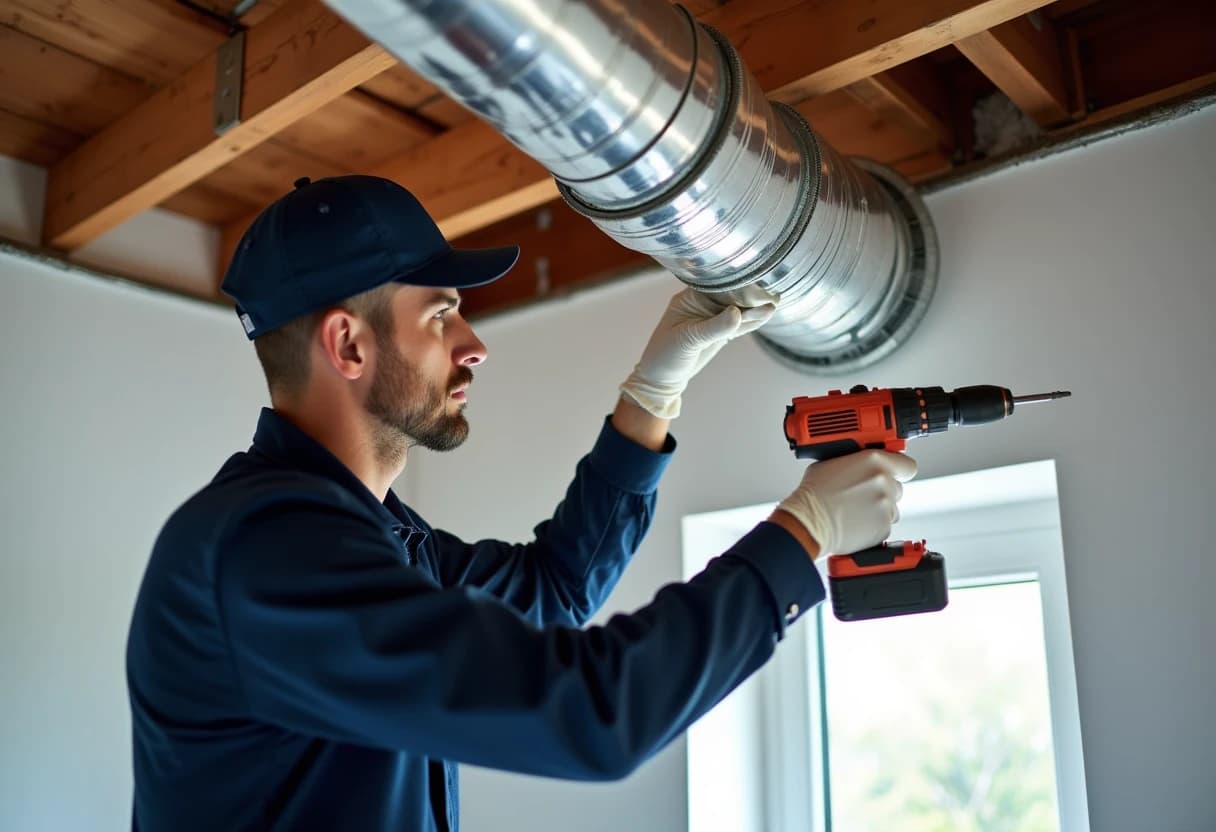
Moving your laundry to a better spot? Finishing a basement? Buying a home whose inspection flagged the venting? Those are the moments to get the dryer exhaust right permanently. We install and reroute dryer vents throughout Billerica: planning the shortest code-legal path from the appliance to outdoors, cutting clean penetrations through clapboard, brick or rim joist, hanging rigid metal duct with proper support and slope, and finishing with a quality hood whose damper seals against New England weather. A correctly built vent needs nothing but an annual cleaning for decades — and it dries clothes the way the appliance manual promised.
Why Dryer Vent Installation & Rerouting Matters for Billerica Homes
There is also a straightforward performance and cost case. A dryer on a proper vent dries a standard load in one cycle; on a bad vent, in two — doubling energy per load, roughly $10 to $20 a month for a busy household, while heat-cycling the machine toward early component failure. A rigid, correctly sloped, correctly sized system also changes the maintenance economics: annual cleanings on smooth duct are quick and thorough, blockage-level service calls largely disappear, and appliance repairs caused by backpressure — thermal fuses, elements, high-limit switches — stop recurring. Add the avoided moisture damage (each load carries about a gallon of water that either exits the termination or enters your building assemblies) and the installation typically pays a real fraction of its cost back within a couple of years, then keeps paying. For homes about to sell, documented code-compliant venting removes a standard inspection flag before it costs a negotiation. For homes about to install a new dryer, it protects the warranty, which manufacturers condition on adequate exhaust. Either way, it is infrastructure bought once and used every laundry day for decades.
Renovation activity around Vietnam Veterans Memorial Park keeps our Billerica installation calendar full: finished basements, relocated laundries, in-law suites and condo conversions all need new dryer exhaust, and general contractors do not always give it the attention a fire-safety system deserves. Billerica's panned-joist return systems are a specialty of ours: those open framing cavities pull in insulation fibers, pet dander and basement dust for fifty years before anyone looks inside. Around Nutting Lake, seasonal homes converted to year-round use add damp crawlspace runs to the mix, so we bring moisture meters as standard practice. Billerica boomed as a blue-collar suburb in the 1950s through 70s, leaving it thick with capes, ranches and split-entries, many of them expanded with family-room additions and finished basements over the decades. Original ductwork in these homes is often undersized panned-joist returns - literally the floor framing used as duct - which collects decades of debris and is a top reason Billerica systems test dirty. We work alongside contractors and homeowners at the planning stage — advising on laundry placement while walls are still open, when a ten-minute routing decision can save thirty feet of duct — and we build the vent to code with documentation your building inspector will recognize. Neighbors in Burlington and Chelmsford use us the same way, which is why our trucks are on renovation sites across Middlesex County all season.
Our Dryer Vent Installation & Rerouting Process in Billerica
1Site Assessment & Route Planning
Planning is where installations succeed or fail, so we do it deliberately: equivalent-length math on paper, termination clearances checked against grade, snow line, openings and property conditions, and the penetration point chosen for both duct efficiency and envelope integrity. For renovations, we are glad to plan while walls are open — the cheapest routing decisions are made before drywall.
2Demolition of Non-Compliant Venting
Where the old route will be reused, we strip it to sound structure; where it is abandoned, we seal the redundant penetrations properly — foam and blocking inside, patched and flashed outside — so the old path does not remain as an air leak or pest entry. Clean removal is part of the installation, not an extra.
3Cut & Flash the Exterior Penetration
The exterior opening is cut precisely for the termination: hole saw through clapboard and sheathing, core drill through brick, block or stone, or a framed opening at the rim joist. We locate it to respect required clearances from grade, openings and inside corners, then flash and seal it so wind-driven New England rain stays out of the wall assembly permanently.
4Install Rigid Metal Duct on the Planned Route
Support and slope are built in as we go: hangers and strapping at proper intervals so no section can sag into a condensation belly, and a continuous pitch toward the termination so any moisture that does condense drains outdoors instead of pooling. These details are invisible when the job is done and decisive for how the system ages.
5Mount the Termination Hood & Damper
Where pests are a known pressure — and in Greater Boston they are — we fit guard designs engineered for dryer exhaust: excluding birds and rodents without restricting airflow or trapping lint. We also note the hood in your service record so future cleanings include damper checks, keeping the one wear-prone component watched for the system's life.
6Connect the Appliance & Seal the System
At the dryer, we install a short UL-listed semi-rigid aluminum transition duct — the only place flexible material belongs — clamped at both ends and routed so it keeps full diameter when the machine is pushed to its working position. We mark the safe setback so the connector is never crushed by a future shove against the wall.
7Test, Verify & Document the Installation
Before we leave: work areas vacuumed with HEPA equipment, penetration debris removed, the dryer set and leveled, and a walkthrough of the finished system — where it runs, how the damper should look during a cycle, and when the first annual cleaning is due. A correctly built vent needs almost nothing from you; we make sure you know the little it does.
Benefits of Professional Dryer Vent Installation & Rerouting in Billerica
Dramatically Faster Drying
Shortening a wandering 40-foot run to a direct 12-foot route transforms drying performance: full airflow means each cycle actually exhausts the gallon of moisture a load releases, so sensor dryers stop running overtime and heavy loads finish in one pass. Customers routinely describe post-installation performance as having bought a new machine.
Code Compliance That Closes Every Question
Insurers and condo associations increasingly ask about dryer venting after regional fire losses, and 'professionally installed to code, with photos' is the answer that ends the conversation. We provide certificates of insurance for association work and per-unit records for multi-family buildings as standard practice.
Permanently Lower Energy Costs
The efficiency also shows up in maintenance economics: smooth, short, sealed runs need only quick annual cleanings, while flex mazes generate blockage-level service calls and appliance repairs. Over ten years, the well-installed vent is the cheaper vent by a wide margin, before counting a single kilowatt-hour.
Decades of Service From a One-Day Job
Because we also clean and repair dryer vents across Greater Boston, we install with the next twenty years of maintenance in mind — routes our own brushes can traverse, access preserved where it matters, baselines recorded for future verification. We build systems we expect to service ourselves, and it shows in the choices.
A Laundry Located Where You Actually Want It
For renovations, early vent planning is leverage: consulted while walls are open, we can route a short, straight, fully concealed run that would be expensive or impossible after drywall. A ten-minute conversation at framing stage regularly saves homeowners hundreds of dollars and a compromised route.
Moisture Managed, Structure Protected
Every load pushes about a gallon of water vapor through the vent, and an engineered system delivers all of it outdoors: continuous slope drains any condensate to the termination, insulation keeps exhaust above its dew point across cold spaces, and sealed joints leave nothing to drip. Your framing, insulation and finishes stay dry, load after load, year after year.
Signs Your Billerica Home Needs Dryer Vent Installation & Rerouting
Your Vent Is Flexible Plastic or Foil Duct
Flex duct concealed in walls and cavities is the worst case: it cannot be effectively brushed, so no cleaning ever truly clears it, and it accumulates lint until it blocks. If a cleaning service has ever told you your run 'can't really be cleaned,' this is what they meant — and rigid replacement is the answer.
A New Laundry Location Needs Its First Vent
Moving laundry upstairs, finishing a basement, building an in-law suite or converting a condo all create the same requirement: a new exhaust route, designed before the walls close if at all possible. Vent routing decided at the framing stage is shorter, cheaper and cleaner than the same route retrofitted through finished surfaces months later.
Chronic Condensation the Route Guarantees
Watch the laundry itself: loads that come out damp-smelling, a duct that drips after cycles, rust tracks under joints. Chronic internal moisture is rotting the system from the inside while it feeds blockages. The permanent fix is a route engineered for New England winters, not another season of drip trays and patches.
Inspection, Insurance or Association Requirements
Condo associations across Greater Boston have tightened dryer vent requirements after regional fire losses, and some now mandate compliant installation on unit turnover or renovation. If your building has issued requirements, we handle the full sequence: scope for board approval, insured installation, and per-unit documentation for the association's records.
The Run Is Overlong or Elbow-Heavy
The symptom pattern of an overlong run: drying times that were never good, cleanings that help briefly and fade fast, and lint accumulating mid-run rather than at the ends. No maintenance schedule fixes a route that exceeds the appliance's reach; rerouting to a shorter path is the only durable answer.
The Dryer Vents Indoors — Anywhere
A vent that ends in an attic, crawlspace, garage, ceiling cavity or bucket-style indoor 'lint trap' is an urgent installation call. Every load pumps a gallon of moisture and a charge of fine lint into the structure or living space — feeding mold, soaking insulation, and accumulating fuel where no one will ever clean it. This setup should not run another season.
Dryer Vent Installation & Rerouting Cost in Billerica, MA
Understanding the cost drivers helps you compare quotes intelligently. Distance and elbows set the duct budget — both in dollars and in the code's 35-foot equivalent-length allowance — so the shortest workable route is cheapest twice over. The penetration is the next driver: hole-sawing clapboard is quick; core-drilling stone foundation or flashing a roof cap takes equipment and time. Access is third: exposed basement routes install fast, while runs concealed through finished walls and ceilings involve careful openings and coordination on restoration. Termination choice matters modestly — quality wall hoods, rim-joist hoods and dryer-rated roof caps span roughly $30 to $150 in parts — but skimping there is false economy, since the damper is the system's one wear component. Beware quotes that reach a low number with flex duct, screened hoods or screwed joints: each is a code violation that converts your installation savings into years of accelerated lint accumulation and future service calls. The correct comparison is rigid-to-rigid, and on that basis our pricing is consistently competitive across Eastern Massachusetts.
Want the full pricing picture? See our complete Boston-area cost guide or call (617) 390-7145 for an exact flat quote for your Billerica home.
Local Knowledge: Billerica, Middlesex County
Serving Billerica means knowing Billerica. Billerica boomed as a blue-collar suburb in the 1950s through 70s, leaving it thick with capes, ranches and split-entries, many of them expanded with family-room additions and finished basements over the decades. Original ductwork in these homes is often undersized panned-joist returns - literally the floor framing used as duct - which collects decades of debris and is a top reason Billerica systems test dirty. Billerica's panned-joist return systems are a specialty of ours: those open framing cavities pull in insulation fibers, pet dander and basement dust for fifty years before anyone looks inside. Around Nutting Lake, seasonal homes converted to year-round use add damp crawlspace runs to the mix, so we bring moisture meters as standard practice. Those conditions shape how we work here: which brush heads come off the truck, how we protect finishes in older interiors, and what we expect to find when the camera goes into a 01821 duct system. Our crews are in and around Billerica nearly every week — often for neighbors of past customers — so scheduling is fast and our arrival windows hold.
The Best Time of Year in Billerica
Winter is the season your vent's design gets examined, whether it passed inspection or not. Cold amplifies every routing flaw: exhaust crossing uninsulated basements and garages condenses hard, marginal slopes pool water into lint mats, and terminations without quality dampers ice open or shut. Meanwhile the laundry load peaks — sweaters, blankets, snow-soaked layers — pushing maximum moisture through the system at its coldest. Installations we design for New England build the winter case in from the start: insulated duct across unheated space, continuous outward slope, and dampers chosen to swing free at ten degrees in a nor'easter. If last winter exposed your current vent's design — drips, frost, February blockages — this year's install season is the time to retire it.
Why Choose Boston Air Duct Cleaners
Boston Air Duct Cleaners is a local, owner-operated company based at 1121 Washington St in West Newton — not a national franchise dispatching subcontractors. Every crew is our own: background-checked, factory-trained on commercial negative-pressure equipment, and fully insured. We quote flat prices before work begins, document every job with before-and-after photos, and follow NADCA-standard source-removal methods on every system we touch. That is why so much of our work comes from repeat customers, property managers and word-of-mouth referrals across Middlesex County.
Serving Billerica and Surrounding Communities
Beyond Billerica, our crews cover the surrounding communities daily — including Burlington, Chelmsford, Tewksbury, Wilmington, Bedford, Lowell. Because routes cluster geographically, booking alongside a neighboring appointment often unlocks same-day service and combined-visit savings. Wherever you are in Middlesex County, the same flat-rate pricing, insured technicians and photo-documented process applies.