
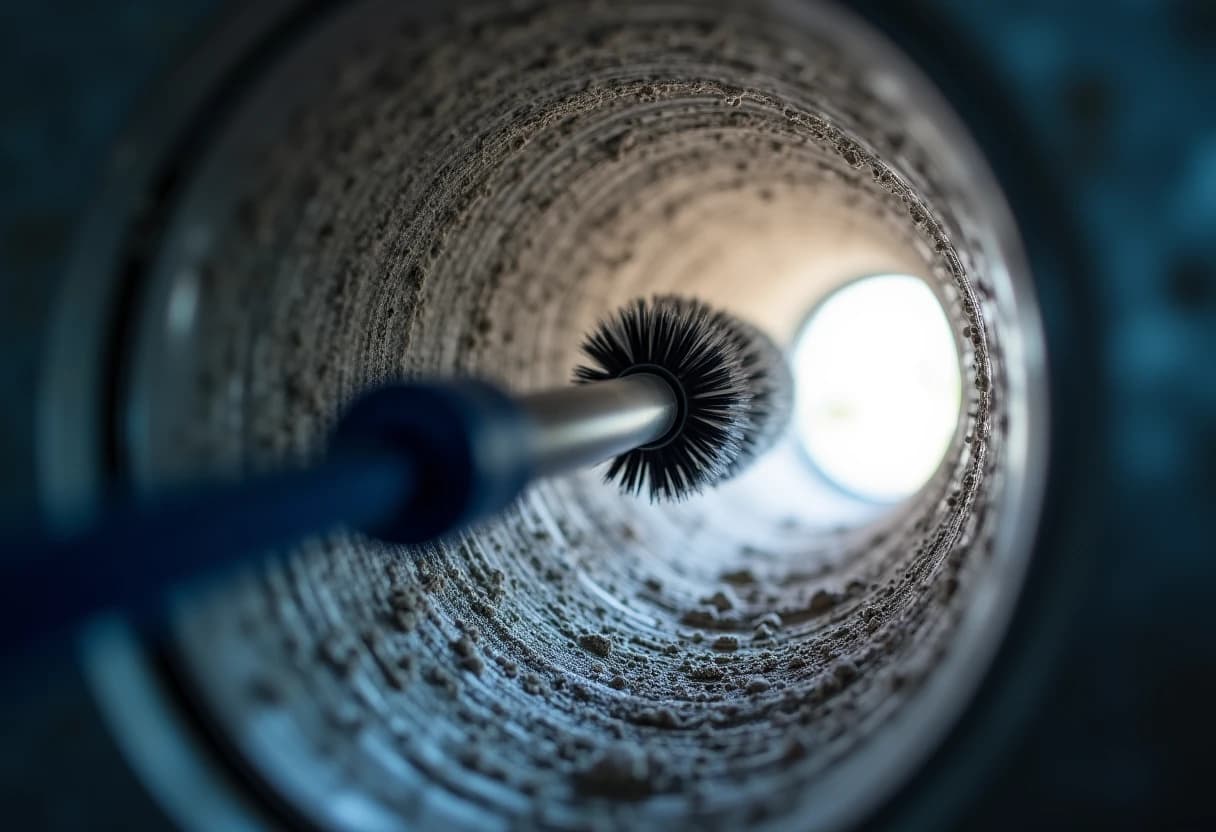
Professional air duct cleaning removes years of accumulated dust, pet dander, pollen, construction debris and microbial growth from the hidden network of supply and return ducts that carries every breath of air through your home. Our Boston crews use NADCA-standard source-removal: the entire system is placed under powerful negative pressure while rotary brushes and compressed-air whips agitate debris off duct walls, so contaminants travel into our HEPA-filtered collection system instead of your living room. The result is measurably cleaner airflow, less dust on your furniture, and an HVAC system that no longer recirculates the same pollutants day after day.
Why Air Duct Cleaning Matters for Boston Homes
Ductwork is the respiratory system of a home, and like any respiratory system it suffers when it is dirty. The EPA reports that indoor air is commonly two to five times more polluted than outdoor air, and duct-borne dust is a major contributor: every cycle of the blower lifts settled particles off duct walls and pushes them through your registers. For allergy and asthma sufferers, that means a fresh dose of dander, dust-mite debris and pollen with every heating or cooling cycle. For everyone else, it means more dusting, dingier filters, and an HVAC system working harder than it should. Source-removal cleaning breaks the cycle by physically extracting the reservoir of contamination rather than masking it. It also gives a technician eyes on the inside of your system — catching crushed flex duct, disconnected joints, moisture staining or pest activity before they become expensive problems. A clean system moves more air with less energy, which is why many customers notice rooms that finally heat and cool evenly after years of imbalance.
From condos near Boston Common to single-families out toward Freedom Trail, Boston duct systems share a common biography: installed decades ago, modified during every renovation since, and cleaned rarely if ever. Boston's housing runs the full spectrum of American urban building: 1800s brownstones and brick rowhouses in Back Bay, Beacon Hill and the South End, wood-frame triple-deckers across Dorchester and the streetcar neighborhoods, mid-rise brick apartment blocks near the universities, and glass condo towers downtown and along the harbor. Countless older buildings have been carved into condos with each unit given its own furnace or heat pump, so ductwork is often squeezed through 19th-century joist bays, chases and dropped ceilings never designed for it. The result is a city full of long, tight, hard-to-reach duct runs that trap decades of dust. The result is a hidden layer of dust, dander and debris that recirculates through living spaces every time the blower starts. We work in Boston every week, from rowhouse condos on gas-fired forced air to triple-decker units with attic air handlers. City-specific issues come up constantly: shared-wall dust migration in rowhouse blocks, renovation debris left in ducts after condo conversions, and dryer vent runs that snake thirty-plus feet to reach an outside wall - a genuine fire risk we flag on nearly every Boston visit. As a local company based just 11 miles away in West Newton, we have cleaned hundreds of systems like these across Suffolk County. We quote flat, honest pricing by system — never per-vent teaser rates that balloon on site.
Our Air Duct Cleaning Process in Boston
1Whole-Home Inspection & System Assessment
Every job starts with eyes on the system. Your technician inspects the furnace or air handler, counts and maps every supply and return, checks filter condition, and looks inside accessible ducts — with an inspection camera when useful. You get a clear picture of contamination levels and a confirmed flat price before any work begins.
2Protect the Home & Seal the System
Cleanliness during the job matters as much as cleanliness after it. We protect floors and finishes along every path our hoses travel, then seal all supply and return openings. Sealing converts your ductwork into a closed loop under vacuum, which is what allows a true deep cleaning without dust escaping into living spaces.
3Establish Negative Pressure
A commercial vacuum unit is coupled to the trunk lines near the air handler, placing the full system under strong negative pressure. This is the heart of source-removal cleaning: with the ducts depressurized, agitated debris cannot drift back into rooms — it is pulled the length of the system and captured in HEPA filtration.
4Mechanical Agitation of Every Duct Run
Each branch line is cleaned individually with mechanical agitation — not just blown air. Rotary brushes handle rigid metal duct; gentler whip systems protect flex duct and older panned returns. We work from the registers toward the trunks, then clean the trunks themselves, so debris always moves toward the vacuum and never back toward your rooms.
5Clean the Air Handler Components
Ducts are only part of the system. We clean the blower compartment, blower wheel and housing, the return plenum and supply plenum, and accessible components around the air handler. On request we add evaporator coil cleaning — a fouled coil is one of the biggest hidden airflow thieves in any HVAC system.
6Optional Sanitizing & Deodorizing Treatment
Where odors or microbial growth were present, we can fog an EPA-registered, HVAC-approved antimicrobial through the freshly cleaned system. Applied under airflow, it reaches every surface the air touches, neutralizing odor sources and inhibiting regrowth. We only recommend it when conditions warrant — after mold findings, pest activity, smoke exposure or persistent mustiness.
7Final Verification & Walkthrough
The job ends with proof, not promises: after-photos matched to the before-photos, a completed checklist of every run cleaned, and a live system test confirming strong, clean airflow at every register. Any observations about duct condition — recommended repairs, insulation issues, sealing opportunities — go in writing so you can plan ahead.
Benefits of Professional Air Duct Cleaning in Boston
A Documented, Healthier Home
You receive before-and-after photo documentation of your actual ducts — valuable at resale, useful for allergy management plans, and definitive proof the work was real. For landlords and condo associations, our reports satisfy due-diligence and insurance documentation needs in one visit.
Elimination of Musty & Stale Odors
When guests can tell you have pets before they see them, your ducts are broadcasting. Duct-borne odor is a stubborn, whole-house problem that candles and sprays only paper over. Cleaning removes the saturated dust layer where the smells actually live, which is the only fix that lasts.
Longer HVAC Equipment Life
Replacing a furnace or condenser in Massachusetts routinely runs five figures. Dust is a primary aging agent for both — it insulates coils, unbalances blowers and overheats motors. Periodic cleaning keeps components operating at design conditions, which is why HVAC manufacturers and technicians alike endorse it as core preventive maintenance.
Less Dust on Every Surface
If you dust on Saturday and see a fresh film by Wednesday, your ducts are the supplier. Every blower cycle lifts particles off contaminated duct walls and distributes them across shelves, screens and furniture. Customers repeatedly tell us the two-week dusting cycle stretches to six or more after cleaning.
Measurably Cleaner Indoor Air
Removing the duct-borne reservoir of dust, dander, pollen and spores means the air leaving your registers is no longer recontaminated on its way to you. Households consistently report less airborne dust, fresher-smelling rooms and easier breathing within a day of a proper source-removal cleaning — because the source really is gone.
Relief for Allergy & Asthma Sufferers
Dust mites, pet dander, pollen and mold spores are the four dominant household allergy triggers, and ductwork stores all four. Families with allergic or asthmatic members frequently see symptom improvement after cleaning because trigger levels in circulated air drop sharply — particularly overnight, when bedroom supply ducts run for hours.
Signs Your Boston Home Needs Air Duct Cleaning
Allergies or Asthma Acting Up Indoors
When symptoms flare at home but ease outdoors or at work, your indoor air is the suspect — and ducts are its distribution system. Sneezing on waking, congestion that tracks the heating season, and asthma that worsens when the AC runs all point toward duct-borne allergen circulation.
It Has Simply Never Been Done
If you cannot name the year your ducts were last cleaned, they almost certainly never have been. A system installed decades ago holds decades of accumulation. A camera inspection settles the question in minutes, and we will show you exactly what we find before recommending anything.
Recent Renovation or Construction Work
Post-construction cleaning is standard practice for good reason: fine silica and gypsum particulates are respiratory irritants, and ducts inhale them by the pound during any project involving cutting or sanding. A source-removal cleaning is the only way to fully evict them.
Musty Smell When Heat or AC Turns On
'Dirty sock syndrome' — a sour, musty blast when the system starts — comes from bacteria and mold metabolizing the organic film inside your air path. Masking it with fragrance feeds the cycle. Source-removal cleaning plus an EPA-registered sanitizing treatment eliminates it.
Visible Dust Blowing From Registers
If you see puffs of dust when the system starts, or gray streaking on walls and ceilings around supply registers, the ducts are shedding their accumulation into your rooms. That visible fraction is a small sample of what the airstream carries invisibly — a classic, unambiguous sign the system needs cleaning.
Dust Returns Days After Cleaning House
A freshly dusted home should stay presentable for weeks. When film reappears on dark furniture within days, the HVAC system is redepositing duct-stored dust faster than any housekeeping can keep up. The fix is upstream, in the ducts themselves.
Air Duct Cleaning Cost in Boston, MA
Whole-home air duct cleaning in the Boston area typically runs $350 to $700 for an average single-family system, with larger homes, multiple air handlers, or heavily contaminated systems ranging up to $1,000 or more. The honest drivers of price are system size (number of supply and return runs), accessibility (finished basements, tight crawlspaces, roof-mounted units), contamination level (routine dust versus renovation debris or microbial growth), and add-on services such as coil cleaning or antimicrobial fogging. Be wary of $99 'whole house' coupons — that price cannot cover a truck-mounted crew for half a day, and the business model behind it is on-site upselling or a cosmetic vent wipe. We quote a flat, all-inclusive price after counting your vents by phone or on arrival, and the number we quote is the number you pay.
Want the full pricing picture? See our complete Boston-area cost guide or call (617) 390-7145 for an exact flat quote for your Boston home.
Local Knowledge: Boston, Suffolk County
Serving Boston means knowing Boston. Boston's housing runs the full spectrum of American urban building: 1800s brownstones and brick rowhouses in Back Bay, Beacon Hill and the South End, wood-frame triple-deckers across Dorchester and the streetcar neighborhoods, mid-rise brick apartment blocks near the universities, and glass condo towers downtown and along the harbor. Countless older buildings have been carved into condos with each unit given its own furnace or heat pump, so ductwork is often squeezed through 19th-century joist bays, chases and dropped ceilings never designed for it. The result is a city full of long, tight, hard-to-reach duct runs that trap decades of dust. We work in Boston every week, from rowhouse condos on gas-fired forced air to triple-decker units with attic air handlers. City-specific issues come up constantly: shared-wall dust migration in rowhouse blocks, renovation debris left in ducts after condo conversions, and dryer vent runs that snake thirty-plus feet to reach an outside wall - a genuine fire risk we flag on nearly every Boston visit. Those conditions shape how we work here: which brush heads come off the truck, how we protect finishes in older interiors, and what we expect to find when the camera goes into a 02108 duct system. Our crews are in and around Boston nearly every week — often for neighbors of past customers — so scheduling is fast and our arrival windows hold.
The Best Time of Year in Boston
Pollen season gives ducts a spring workload most people overlook: April through June, tree and grass pollen infiltrates every open window and door, and the return ducts inhale it. The system then faithfully re-serves that pollen through July air conditioning — which is why 'summer allergies' indoors are often spring pollen on replay. A late-spring or early-summer cleaning breaks the loop. Coastal and near-coastal homes face the additional factor of salt-laden humid air, which accelerates both dust adhesion and metal duct corrosion, making periodic inspection doubly worthwhile.
Why Choose Boston Air Duct Cleaners
We built this company around the jobs other duct cleaners do badly: the 130-year-old Victorian with panned-joist returns, the Boston condo with a 60-foot dryer run to the roof, the post-renovation house full of drywall dust. Our crews see Greater Boston's hardest systems every week, and the experience shows in the details — floor protection on the way in, sealed registers during the work, HEPA-vacuumed work areas on the way out, and imagery that proves the ducts are actually clean. Call (617) 390-7145 and judge the difference from the first conversation.
Serving Boston and Surrounding Communities
We serve every community around Boston as well: Back Bay, South End, Cambridge, Brookline, Somerville, Dorchester all fall inside our regular service routes. If you have a second property, a rental, or family nearby, ask about multi-home scheduling — grouped appointments on the same route are our most requested discount.