
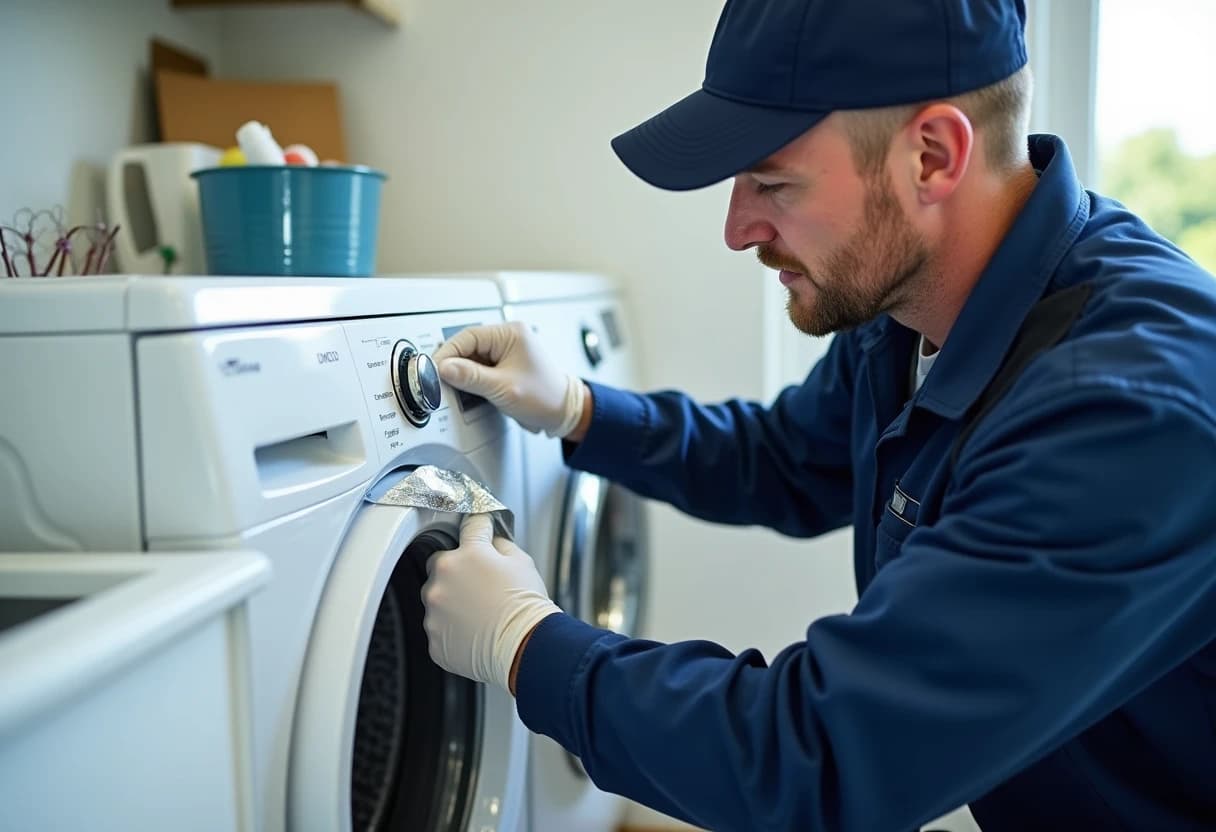
When a dryer vent leaks, the evidence shows up everywhere except the duct: lint drifting from a basement ceiling, a musty smell in the wall behind the laundry, moisture stains spreading across drywall, drying times that no cleaning improves. Our Braintree technicians diagnose the actual failure — a joint that separated, a section crushed during a renovation, a transition hose flattened behind the dryer, a hood damper wedged open or shut — and repair it properly with rigid metal duct, mechanical fastening and sealed seams. Most repairs finish the same visit, and we verify the result the only way that counts: strong, complete airflow at the exterior termination with the dryer running.
Why Dryer Vent Repair Matters for Braintree Homes
The materials in your dryer vent matter as much as its condition, and much of Greater Boston's housing stock carries materials that should never have been installed. White vinyl accordion hose — sold for decades and still lurking behind older dryers — is a documented fire hazard: it melts, its ridges pack with lint, and manufacturers and codes alike have disowned it. Thin foil accordion duct is only marginally better, crushing at a touch and snagging lint on every corrugation. Long concealed runs of flex duct, plastic terminations, screen-covered hoods that mat over with lint, and duct-taped seams round out the list of what we routinely find and replace. Modern code — the IRC's dryer exhaust provisions — calls for smooth-interior rigid metal duct, joints without protruding fasteners, and a proper damper-equipped termination, because decades of fire data show those details are where dryer venting goes wrong. Repairing with compliant materials is not bureaucratic box-checking: it is the difference between a vent that needs annual cleaning and a vent that builds a new hazard every year.
From the older streets near Sunset Lake to the renovated blocks around General Sylvanus Thayer Birthplace, we see the same Braintree pattern: dryer vents that were adequate when installed and have been quietly failing ever since. Braintree's neighborhoods are dominated by sturdy 1920s-40s colonials and capes near the squares, with postwar ranches and split-levels spreading through the Highlands and larger newer homes scattered on infill lots. Gas conversions from oil are nearly universal here, and many homes pair an older basement furnace and original trunk lines with newer flexible branch runs added during remodels. Renovations disturb concealed runs, appliance swaps crush transition hoses, and decades of hot-humid exhaust cycles bake tape joints loose. Braintree homes near the Route 3 and I-93 split live with some of the South Shore's heaviest highway particulate, and it shows up as dark streaking around supply registers well before ducts are due by age alone. East Braintree's coastal edge along the Fore River adds humid summer air that keeps basement returns damp and musty. Because our shop is about 16 miles away in West Newton, Braintree diagnostic visits are easy to schedule — and most repairs are completed the same visit, from the truck stock we carry for exactly these homes.
Our Dryer Vent Repair Process in Braintree
1Diagnose the Full Exhaust Path
We treat symptoms as evidence: lint in the basement points to a specific joint; a ceiling stain maps to a specific duct section; condensation drips tell us where the run crosses cold space. Correlating symptoms with the physical path usually pinpoints the failure within minutes — and rules out the failures you do not have.
2Protect the Area & Open Access
Before repair work, we protect floors and finishes along the work path, move the dryer out carefully on sliders, and set up at the failure points. Where a concealed joint requires access, we discuss options first — many repairs can be made from existing openings, and when cutting is unavoidable we keep openings minimal and tell you exactly what restoration will involve.
3Reconnect & Properly Fasten Separated Joints
Where lint and moisture have escaped into a cavity through a long-standing disconnection, we vacuum accessible accumulation with HEPA equipment and document conditions with photos. Removing that hidden fuel load matters as much as the reconnection itself — and the photos give you a record for insurance or future renovation planning.
4Replace Crushed, Corroded or Non-Compliant Sections
Duct that is crushed, kinked, rusted through or made of prohibited material gets replaced, not patched. We install 4-inch smooth-interior rigid metal duct — the material the IRC's dryer exhaust rules specify — cut to fit, joined without airstream-piercing fasteners, and supported so it cannot sag into water-pooling bellies.
5Cure Condensation: Slope, Seal & Insulate
Condensation repairs follow the water. We restore continuous slope toward the termination so condensate drains out instead of pooling; seal the joints it has been leaking through with foil tape rated for the duty; and insulate duct sections crossing unheated basements, garages, attics and exterior wall bays so exhaust stays above its dew point until it exits.
6Repair or Replace the Exterior Hood & Damper
Failed terminations get quality metal replacements: a hood sized to the 4-inch duct with a free-swinging damper that opens fully under airflow and closes tight against weather and pests. Screened hoods — a code violation on dryer vents because mesh mats over with lint — are replaced with proper damper-and-guard designs made for dryer exhaust.
7Replace the Transition Duct & Reset the Dryer
The appliance connection is rebuilt to spec: a UL-listed semi-rigid aluminum transition duct, as short and straight as the layout allows, secured with clamps at both ends. We position the dryer so the connector keeps its full diameter — not crushed against the wall — and mark the safe distance so future pushes do not recreate the old kink.
8Verify Airflow & Document the Repair
You receive photo documentation of the failures found and the repairs made — valuable for insurance files, condo associations, home sales and your own records. We also note the condition of everything we did not repair, so you have an honest picture of the vent's remaining lifespan and its next likely maintenance date.
Benefits of Professional Dryer Vent Repair in Braintree
Code Compliance & Inspection-Ready Documentation
Dryer venting is a standard flag on Massachusetts home inspections: vinyl flex, taped joints, screened hoods and overlong runs all appear in reports and complicate sales. Our repairs bring the system to current code — rigid metal, compliant joints, proper termination — with photo documentation that answers inspector and buyer questions before they are asked.
Lower Energy and Repair Bills
Blocked and breached vents are behind a large share of dryer service calls: blown thermal fuses, burned heating elements, failed high-limit switches. Each is a $150 to $400 appliance visit that recurs until the vent is fixed. One proper duct repair typically costs less than two of those visits and ends the cycle.
A Serious Fire Hazard, Eliminated
Lint inside a wall cavity cannot be cleaned on any schedule; the only fix is stopping the leak that puts it there. Repairing disconnections and sealing joints confines lint to the duct, where annual cleaning can manage it. That containment is the difference between a maintainable system and a slowly growing hazard you cannot see.
Restored Drying Performance
Because the leak or crush also lets conditioned air escape or exhaust recirculate, repairs frequently improve more than laundry: cold-air infiltration through a stuck-open damper ends, and the laundry room stops swinging between sauna and icebox with the seasons.
Decades of Reliable Service From One Repair
Done with rigid metal, mechanical fastening and a quality termination, a dryer vent repair is not a patch — it is infrastructure. Properly installed rigid duct routinely outlasts the dryers connected to it, needing only annual cleaning. The failure-prone materials and joints that caused your problem simply are not there anymore.
Moisture Out of Your Walls and Ceilings
Every load of laundry exhausts about a gallon of water. A repaired, sealed vent delivers all of it outdoors; a leaking one delivers it into insulation, framing and drywall. Stopping that daily soaking is the benefit homeowners feel longest — no more spreading stains, peeling paint, mildew odors or the mold remediation bills that chronic wall moisture eventually writes.
Signs Your Braintree Home Needs Dryer Vent Repair
Water Stains, Drips or Peeling Paint Near the Vent Path
Rust streaks on duct exteriors, corroded clamps and white mineral tracks at joints are the slow-motion version of the same evidence: repeated internal condensation escaping over months. Left alone it rusts through the duct wall; caught early, the fix is sealing and insulation rather than replacement.
A Home Inspection or Appliance Tech Flagged the Vent
When an appliance technician condemns your vent while servicing the dryer, believe them: they have just measured the backpressure your machine fights on every load. Repairing the duct protects the repair they made — a new heating element or thermal fuse installed against a failed vent will simply fail again.
Musty or Mildew Smell in the Laundry Area
EPA guidance on mold is unambiguous: control the moisture and you control the growth. In laundry areas the dryer vent is a prime suspect moisture source, and a $150 to $450 repair is dramatically cheaper than the remediation an ignored leak can eventually require.
Visibly Damaged, Kinked or Sagging Duct
Sag matters more than it looks: a bellied section pools condensate, which soaks lint into a mat, which adds weight, which deepens the sag. The cycle ends in a blocked or rusted-through low point. Adding proper support and restoring slope while the duct is still sound is a small repair that prevents a large one.
Lint Appearing Where It Shouldn't
Lint drifting from a basement ceiling, gathering on joists, puffing from a wall register or collecting behind the dryer means exhaust is escaping the duct before the termination. Lint marks the leak like dye in water — follow it and you find the separated joint or breach. This is a repair call, not a cleaning call, and it should not wait.
Exterior Damper Broken, Stuck or Missing
Evidence of animals — chirping in the duct, nesting material at the hood, droppings near the vent line — means the termination has already failed as a barrier. We remove the nest, clean the affected duct, and install a hood with real pest protection. Spring is nesting season; the repair is best made before it.
Dryer Vent Repair Cost in Braintree, MA
Repair versus replace is the judgment call at the heart of this service, and our rule is simple: repair when the underlying system is sound, replace when it is not. A rigid metal run with one separated joint, one crushed section, or a failed hood is worth repairing — the fix restores a fundamentally good system for $150 to $450. A run made entirely of accordion flex, a duct routed far beyond code's 35-foot equivalent length with no path to compliance, or a system so corroded that each repair reveals the next failure is not worth patching — full replacement or rerouting (our dryer vent installation service, typically $300 to $900) serves you better and often costs less than serial repairs would. We price both options when the call is close and give you our recommendation with reasons. Either way, the visit ends with a verified, documented exhaust path — and an honest answer about how long it should last.
Want the full pricing picture? See our complete Boston-area cost guide or call (617) 390-7145 for an exact flat quote for your Braintree home.
Local Knowledge: Braintree, Norfolk County
Every town's ductwork tells the story of its housing. Braintree's neighborhoods are dominated by sturdy 1920s-40s colonials and capes near the squares, with postwar ranches and split-levels spreading through the Highlands and larger newer homes scattered on infill lots. Gas conversions from oil are nearly universal here, and many homes pair an older basement furnace and original trunk lines with newer flexible branch runs added during remodels. Braintree homes near the Route 3 and I-93 split live with some of the South Shore's heaviest highway particulate, and it shows up as dark streaking around supply registers well before ducts are due by age alone. East Braintree's coastal edge along the Fore River adds humid summer air that keeps basement returns damp and musty. We plan Braintree jobs around those realities, from equipment selection to time on site, and it shows in the results. If you live near Pond Meadow Park or anywhere across Braintree's 02184 area, we have almost certainly cleaned a system like yours before — and we can tell you exactly what to expect before we arrive.
The Best Time of Year in Braintree
Humid Massachusetts summers stress the concealed portions of the vent. High dew points mean exhaust barely cools before reaching saturation, so any bellied, unsloped or leaking duct section collects water through the muggy months — soaking lint into mats, feeding the mildew smells homeowners notice in August, and rusting galvanized duct from the inside. Basement laundry areas, already fighting ambient summer humidity, compound the effect. Summer is consequently when condensation damage advances fastest and when its symptoms — sour-smelling laundry, damp walls near the vent path, visible drips at joints — are easiest to catch. A summer diagnostic visit finds the moisture while it is active, which makes the repair scope precise rather than speculative.
Why Choose Boston Air Duct Cleaners
As a West Newton-based company, we treat Braintree like the neighborhood it is — because for us, it is. Our reputation lives or dies on local referrals, so every job gets the full process: complete system cleaning under negative pressure, mechanical agitation of every run, blower compartment service, and a documented walkthrough before we leave. We are licensed and insured, our estimates are free and flat, and our schedule holds same-day slots for urgent calls. One visit and you will understand why neighbors keep our magnet on the fridge.
Serving Braintree and Surrounding Communities
Braintree sits in the heart of our service area, and neighboring Quincy, Weymouth, Randolph, Holbrook, Milton, Canton appointments share the same routes. That density is why our response times in this part of Norfolk County are among our fastest — and why you will see our trucks in the area week after week.