
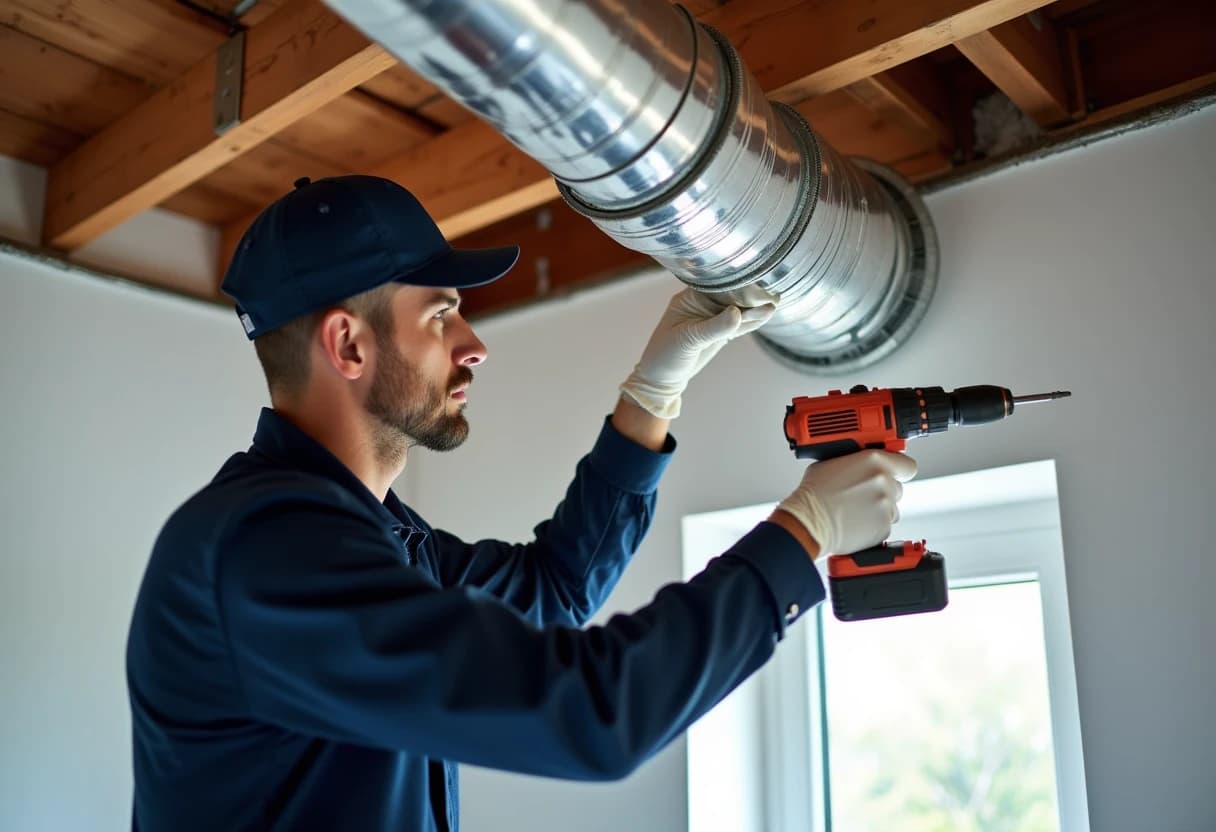
An overlong dryer vent is a permanent tax on every load of laundry. Each foot of duct and every elbow adds resistance; the code caps the total at 35 equivalent feet — with each 90-degree elbow typically counting as five feet — because beyond that, dryers simply cannot push lint and moisture to the outlet. Yet Greater Boston basements are full of runs half again that long, snaking around decades of renovations. Our rerouting service shortens them: we find the nearest legal path outdoors, often cutting a 40-foot wander to a 12-foot straight shot, and rebuild it in rigid metal. Drying times drop immediately, lint accumulation slows permanently, and the fire-risk math improves for good.
Why Dryer Vent Installation & Rerouting Matters for Dover Homes
Where the vent terminates shapes both the house and the maintenance schedule. Every option has an engineering trade: side-wall terminations are shortest and easiest to inspect, but must clear grade, snow line, and required distances from openings; rim-joist terminations serve basement laundries elegantly with minimal envelope disruption; roof terminations suit interior laundry rooms in condos and capes but load up faster — lint fights gravity the whole vertical run — and need durable, steep-weather-rated caps. What is never acceptable: terminating into an attic, crawlspace, garage, soffit vent or chimney, all of which we find regularly and all of which pump moisture and lint into the structure. The termination itself must have a backdraft damper that closes against winter wind and pests, and no screen — mesh mats over with lint in months, which is why the code forbids it. Our installations weigh the options against your home's layout and Massachusetts weather, cut clean penetrations through clapboard, shingle, brick or block, and flash and seal them so the envelope stays weather-tight for decades.
Routing a dryer vent through Dover housing is a local craft. Dover is a low-density estate town of large custom colonials, contemporaries and gentleman's farms set on multi-acre wooded lots, with a scattering of 18th-century farmhouses along Dedham and Farm Streets. Its big houses commonly run three or four separate forced-air zones, attic air handlers and long insulated flex runs that few owners have ever had inspected. Laundry areas in homes like these were carved out of basements, back halls and closets long after construction, and the legal path outdoors is rarely obvious — it threads between old framing, past stone or brick foundation, around a century of renovations. Dover's sprawling square footage means a single home here can carry more duct surface than three average houses, and horse farms and hay fields around Powisset add organic dust you will not find in denser suburbs. Deep-wooded lots also keep shaded basements cool and damp well into summer. Our installers plan Dover routes against the code's 35-foot equivalent-length budget on site, carry the masonry bits and flashing older walls demand, and build in rigid metal that the next owner will never have to think about.
Our Dryer Vent Installation & Rerouting Process in Dover
1Site Assessment & Route Planning
The technician maps what exists and what is possible: where the dryer sits (or will sit), which walls are exterior, what the framing and foundation allow, and where obstacles — plumbing, wiring, ductwork, finished ceilings — constrain the path. Shortest is best: fewer feet and fewer elbows mean faster drying and slower lint accumulation for the life of the system.
2Demolition of Non-Compliant Venting
Where the old route will be reused, we strip it to sound structure; where it is abandoned, we seal the redundant penetrations properly — foam and blocking inside, patched and flashed outside — so the old path does not remain as an air leak or pest entry. Clean removal is part of the installation, not an extra.
3Cut & Flash the Exterior Penetration
Penetrations are where amateur installs leak — water into sheathing, air into cavities. Ours are built like window details: sized to the hood, flashed to shed water over the cladding, sealed with quality exterior sealant, and finished so the termination looks intentional on the facade. On masonry we drill and anchor; we never improvise attachment.
4Install Rigid Metal Duct on the Planned Route
Support and slope are built in as we go: hangers and strapping at proper intervals so no section can sag into a condensation belly, and a continuous pitch toward the termination so any moisture that does condense drains outdoors instead of pooling. These details are invisible when the job is done and decisive for how the system ages.
5Mount the Termination Hood & Damper
Where pests are a known pressure — and in Greater Boston they are — we fit guard designs engineered for dryer exhaust: excluding birds and rodents without restricting airflow or trapping lint. We also note the hood in your service record so future cleanings include damper checks, keeping the one wear-prone component watched for the system's life.
6Connect the Appliance & Seal the System
Gas dryers are handled with the care the fuel demands: the flexible gas connector unstrained, the machine leveled and positioned, and the connection checked before operation. Electric units get cords routed clear of the duct. The appliance end is where good systems get ruined by casual reconnection, so we finish it to the same standard as the concealed run.
7Test, Verify & Document the Installation
Before we leave: work areas vacuumed with HEPA equipment, penetration debris removed, the dryer set and leveled, and a walkthrough of the finished system — where it runs, how the damper should look during a cycle, and when the first annual cleaning is due. A correctly built vent needs almost nothing from you; we make sure you know the little it does.
Benefits of Professional Dryer Vent Installation & Rerouting in Dover
Permanently Lower Energy Costs
The efficiency also shows up in maintenance economics: smooth, short, sealed runs need only quick annual cleanings, while flex mazes generate blockage-level service calls and appliance repairs. Over ten years, the well-installed vent is the cheaper vent by a wide margin, before counting a single kilowatt-hour.
Decades of Service From a One-Day Job
Rigid metal duct, properly supported and sealed, is lifetime infrastructure: it does not kink, sag, melt or degrade, and it routinely outlasts several dryers. After installation day, the system's entire maintenance schedule is an annual cleaning and an occasional glance at the damper. Most homeowners never think about it again — which is the point.
A Laundry Located Where You Actually Want It
For renovations, early vent planning is leverage: consulted while walls are open, we can route a short, straight, fully concealed run that would be expensive or impossible after drywall. A ten-minute conversation at framing stage regularly saves homeowners hundreds of dollars and a compromised route.
Code Compliance That Closes Every Question
The finished system meets the IRC's dryer exhaust provisions line by line: 4-inch smooth rigid metal, equivalent length within the 35-foot budget, no fasteners in the airstream, damper-equipped unscreened termination. For home sales, that removes a standard inspection flag; for permits and condo approvals, our documentation answers the questions before they are asked.
Fire-Safe by Design, Not by Vigilance
A code-compliant installation attacks fire risk structurally: smooth rigid metal that lint slides across instead of catching on, a run short enough that exhaust velocity carries fibers all the way out, joints without screw tips to snag them, and a termination that cannot mat over. The system accumulates fuel slowly by design — safety that does not depend on anyone remembering anything.
Dramatically Faster Drying
Shortening a wandering 40-foot run to a direct 12-foot route transforms drying performance: full airflow means each cycle actually exhausts the gallon of moisture a load releases, so sensor dryers stop running overtime and heavy loads finish in one pass. Customers routinely describe post-installation performance as having bought a new machine.
Signs Your Dover Home Needs Dryer Vent Installation & Rerouting
Blockages and Repairs Keep Recurring
If your vent needs cleaning twice a year, blocks anyway, and has accumulated a history of repairs, the route itself is the problem — too long, too bent, wrong materials, or condensation-prone by design. At some point serial maintenance costs more than the reroute that ends it. We will do that math with you honestly; often the crossover is closer than expected.
The Run Is Overlong or Elbow-Heavy
Basement laundries venting to a far wall are the classic offenders — installed where the first hole was easiest, not where the route was shortest. Our assessment often finds a rim-joist or near-wall exit that cuts the run by half or more. Ask for the measurement; the equivalent-length math takes ten minutes and settles the question.
Inspection, Insurance or Association Requirements
Condo associations across Greater Boston have tightened dryer vent requirements after regional fire losses, and some now mandate compliant installation on unit turnover or renovation. If your building has issued requirements, we handle the full sequence: scope for board approval, insured installation, and per-unit documentation for the association's records.
A New Laundry Location Needs Its First Vent
Moving laundry upstairs, finishing a basement, building an in-law suite or converting a condo all create the same requirement: a new exhaust route, designed before the walls close if at all possible. Vent routing decided at the framing stage is shorter, cheaper and cleaner than the same route retrofitted through finished surfaces months later.
The Dryer Vents Indoors — Anywhere
Window inserts and condensation boxes marketed as 'indoor dryer vents' are not a solution for a standard vented dryer in a Massachusetts home; they are humidity machines. If one is in service in your laundry, a proper exterior route almost certainly exists — our assessment will find the shortest one and price it flat.
Chronic Condensation the Route Guarantees
Some vents condense because of damage; others condense because of design — long uninsulated passages through cold basements, garages or attics where exhaust cannot stay above its dew point, or bellied routes with no slope to drain. When repair visits keep treating water in the same duct, the route is the diagnosis, and rerouting or rebuilt insulation and slope is the cure.
Dryer Vent Installation & Rerouting Cost in Dover, MA
Dryer vent installation in Greater Boston typically runs $300 to $900, and the price is mostly the route. At the low end, $300 to $450: a straightforward side-wall or rim-joist installation with a short run — dryer near an exterior wall, one clean penetration, minimal duct. Mid-range, $450 to $650: longer routes with several elbows, full flex-to-rigid replacement along an existing path, insulation over unheated space, or masonry penetrations through brick or block foundation. The top of the range, $650 to $900: reroutes through finished space with access openings, roof terminations with proper flashing, relocations that move the laundry's exhaust across the floor plan, and multi-story routes in triple-deckers and condos. Every quote is flat and follows a site assessment — we measure the route, do the equivalent-length math, and price the specific design you approve. Materials are included: rigid metal duct, listed transition connector, clamps and foil tape, insulation where needed, and a quality damper-equipped termination hood.
Want the full pricing picture? See our complete Boston-area cost guide or call (617) 390-7145 for an exact flat quote for your Dover home.
Local Knowledge: Dover, Norfolk County
What makes Dover different? Dover is a low-density estate town of large custom colonials, contemporaries and gentleman's farms set on multi-acre wooded lots, with a scattering of 18th-century farmhouses along Dedham and Farm Streets. Its big houses commonly run three or four separate forced-air zones, attic air handlers and long insulated flex runs that few owners have ever had inspected. Dover's sprawling square footage means a single home here can carry more duct surface than three average houses, and horse farms and hay fields around Powisset add organic dust you will not find in denser suburbs. Deep-wooded lots also keep shaded basements cool and damp well into summer. For duct and dryer vent systems, those local factors translate into specific, predictable problems — and predictable problems are the ones we solve fastest. Call (617) 390-7145, tell us your street and home style, and we will quote the job accurately the first time, usually in under five minutes.
The Best Time of Year in Dover
There is a right season for dryer vent installation in Massachusetts, and it is earlier than most homeowners think. Exterior penetrations, flashing and sealant all prefer dry, above-freezing weather, and roof terminations essentially require it — which makes late spring through fall the natural construction window. Demand tells the same story from the other side: our installation calendar fills through fall as households discover failing vents during the first heavy-laundry weeks, and winter installs, while entirely doable for wall and rim-joist routes, involve weather scheduling around the exterior work. The strategic move is the one our repeat customers make: assess in summer, install in early fall, and enter the heating season — when the dryer works hardest and the house seals tightest — on a fresh, verified, code-compliant system.
Why Choose Boston Air Duct Cleaners
Boston Air Duct Cleaners is a local, owner-operated company based at 1121 Washington St in West Newton — not a national franchise dispatching subcontractors. Every crew is our own: background-checked, factory-trained on commercial negative-pressure equipment, and fully insured. We quote flat prices before work begins, document every job with before-and-after photos, and follow NADCA-standard source-removal methods on every system we touch. That is why so much of our work comes from repeat customers, property managers and word-of-mouth referrals across Norfolk County.
Serving Dover and Surrounding Communities
Beyond Dover, our crews cover the surrounding communities daily — including Needham, Medfield, Sherborn, Westwood, Natick, Wellesley. Because routes cluster geographically, booking alongside a neighboring appointment often unlocks same-day service and combined-visit savings. Wherever you are in Norfolk County, the same flat-rate pricing, insured technicians and photo-documented process applies.