
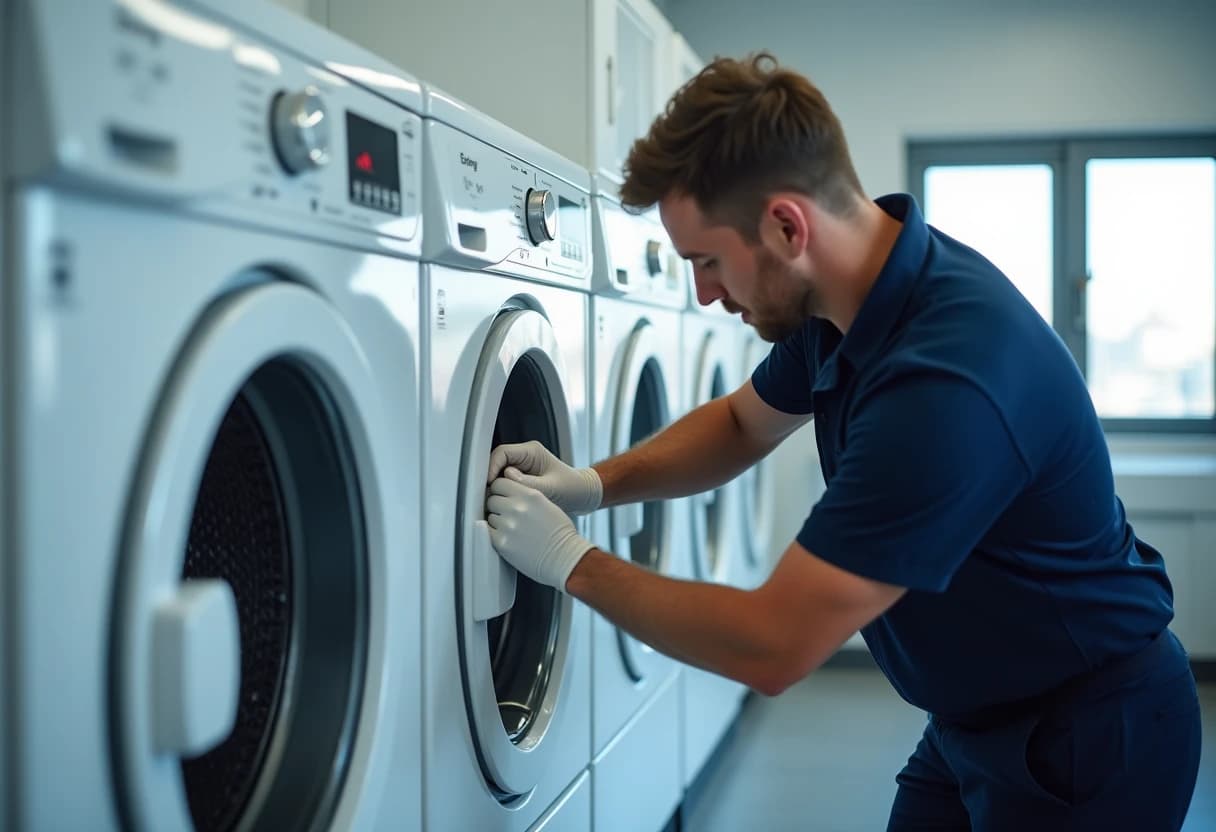
Multi-unit dryer vent cleaning is a logistics problem as much as a technical one, and we have built our commercial program around both. One project coordinator schedules the building; residents get clear notice windows; crews move unit by unit with rotary brush systems and high-powered vacuums, cleaning each vent from the dryer connection to the exterior termination; and shared risers and common trunk lines are cleaned from roof or wall terminations with equipment sized for vertical runs. Easton associations and management companies get per-unit volume pricing that drops steeply below single-home rates, a completion report listing every unit's condition, and a documented answer to the question insurers increasingly ask: when were the dryer vents last professionally cleaned?
Why Commercial & Multi-Unit Dryer Vent Cleaning Matters for Easton Homes
The fire math of multi-unit buildings is unforgiving. FEMA estimates about 2,900 residential clothes dryer fires per year, causing deaths, injuries and roughly $35 million in property loss — and the leading factor, cited in around a third of these fires, is failure to clean. A single-family dryer fire endangers one household; the same fire in a triple-decker, garden apartment or high-rise endangers dozens, spreads through shared walls and chases, and lands on the association's master policy. Every dryer in your building produces lint with every load, and every foot of vent duct collects it — narrowing airflow, extending dry times, and raising temperatures inside the duct until the day lint, heat and airflow restriction intersect. Professional cleaning resets every run in the building to clear, and the documentation resets your liability posture: when an insurer, an attorney or a fire marshal asks about vent maintenance, a dated per-unit report is the difference between diligence and exposure. No board wants to explain a preventable fire; a maintenance program means never having to.
From the residential blocks around Stonehill College to the condo buildings near Borderland State Park, Easton associations share a common blind spot: nobody can name when the building's dryer vents were last cleaned. North Easton village is a nationally significant landscape of H.H. Richardson buildings and Ames-era worker housing, including the converted Ames Shovel Works lofts, while South Easton and Eastondale carry the town's postwar capes and its 1980s-2000s colonial subdivisions. The shovel-works and other mill conversions rely on modern ducted systems threaded through 19th-century stone and timber structures. That means lint accumulating in runs and risers for years across every unit. Easton's historic mill-condo conversions around Shovel Shop Pond give us distinctive jobs where new ductwork meets 150-year-old masonry and moisture behaves unpredictably. Wetlands around Borderland State Park and the Hockomock Swamp also push summer humidity higher than residents expect from an inland town. Because our shop sits 27 miles away in West Newton, Easton buildings get responsive scheduling — walkthroughs within days, whole-building projects completed in one to three days with resident notices handled by our coordinator, and volume per-unit pricing that makes an annual program an easy board approval.
Our Commercial & Multi-Unit Dryer Vent Cleaning Process in Easton
1Building Walkthrough & Per-Unit Proposal
We scope before we quote: unit count and layout, vent configurations and lengths, termination locations and access (ladder, lift or roof), laundry room and common-area equipment, and any known problem units. Associations receive a fixed proposal with volume per-unit pricing, a project schedule with resident notice templates, and the reporting format agreed in advance so the board knows exactly what deliverable closes the project.
2Resident Coordination & Scheduling
For occupied buildings, logistics decide whether a project succeeds. Ours run on a simple system: management distributes our notice template with dates; we sequence units floor by floor to keep crews moving; a coordinator handles reschedules and lockouts as they arise; and the final report distinguishes cleaned, no-access and exception units explicitly, because an insurer reading it will want exactly that distinction.
3Dryer-Side Service: Transition Duct & Connection
Each unit visit starts at the machine: lint screen housing vacuumed, dryer pulled and the fire-load of lint behind it removed, transition duct inspected against IRC M1502 requirements — smooth interior, proper material, no screws projecting into the airstream, no excessive length or crushing. Deficiencies are photographed for the unit's report line, and simple corrections are completed during the same visit with owner approval.
4Mechanical Cleaning of the Full Vent Run
Compressed-air whips and rotary brushes work the duct from the unit connection toward the termination, mechanically stripping the lint mat that blowers and leaf-blower shortcuts merely compact. Every elbow — each one worth 5 feet of equivalent length under code math, and each one a lint trap in practice — gets deliberate attention. Extracted lint is bagged per unit, which residents find quietly persuasive.
5Shared Risers, Common Trunks & Booster Fans
Common-element ducts get common-element treatment: documented condition before and after, cleaning with equipment sized for vertical and long-trunk work, and function checks on the mechanical components — booster fans, backdraft dampers, rooftop exhaust terminations — that keep a shared system moving air. For associations, this is the portion of the project that most clearly discharges the board's maintenance duty, and we document it accordingly.
6Termination Service & Exterior Verification
We finish each run where the air does: at the outside wall or roof. The termination is cleaned, its flap or damper exercised and verified, screens and nests removed, and the exhaust confirmed to discharge outdoors — not into an attic, soffit or crawlspace, a dangerous and surprisingly common Massachusetts finding. Interior-terminating vents are documented as the priority hazards they are.
7Airflow Verification & Building Compliance Report
The project closes with documentation built for its real audiences. Management receives a unit-by-unit log with service dates and technician notes; the board receives a summary with building-level findings — riser condition, termination issues, prohibited transition ducts by unit — and prioritized recommendations; and the insurance-ready certificate states scope, method and completion date. Next year's cycle is calendared before we leave.
Benefits of Professional Commercial & Multi-Unit Dryer Vent Cleaning in Easton
Shorter Dry Times & Lower Utility Costs
A lint-restricted vent forces dryers to run longer per load — frequently twice as long — and in buildings with common laundry or owner-paid utilities, that waste lands directly on the operating budget. Restored airflow returns machines to single-cycle drying, and laundromats often see the gas savings alone repay the cleaning within months.
Hazard Discovery Before It Costs You
The inspection value of a building-wide project rivals the cleaning value. Our unit-by-unit documentation regularly surfaces conditions associations did not know they had — moisture damage from leaking ducts, code violations from old renovations, pest entry at damaged terminations — while they are still inexpensive line items rather than insurance claims.
Insurance & Liability Documentation That Holds Up
Boards carry a duty to maintain common elements, and in most governing documents the vent path beyond the unit wall qualifies. A dated, unit-by-unit report demonstrates that duty discharged — and the annual repetition of it demonstrates a program, which is what diligence actually looks like to a carrier or a court.
Volume Pricing That Beats Unit-by-Unit Service
Left to individual residents, vent cleaning happens rarely, unevenly and at retail prices — and the shared ducts never get cleaned at all. Building-wide service inverts every part of that: complete coverage, common elements included, standardized quality, one invoice, and a per-unit rate that makes the line item easy to defend at budget time.
A Program, Not a Project
The real deliverable is the recurring cycle: annual (or duty-matched) cleanings calendared in advance, consistent per-unit pricing locked for program clients, the same report format every year so building condition trends are visible, and reminders that arrive before renewal questionnaires do. Boards approve it once; it protects the building indefinitely.
Directly Reduced Fire Risk, Building-Wide
Fire prevention in shared-wall housing is collective by nature: one blocked vent endangers the neighbors, and no resident can clean the common risers. A coordinated cleaning is the only mechanism that actually resets the whole building's risk — every run, every riser, every termination verified clear on the same dated report.
Signs Your Easton Home Needs Commercial & Multi-Unit Dryer Vent Cleaning
Burning Smells, Hot Laundry Areas or Tripped Thermal Fuses
Laundry rooms that run noticeably hot and humid indicate exhaust air staying in the building — restricted ducts, failed boosters or leaking joints. Beyond discomfort, that moisture feeds mold in shared spaces and the heat stresses every machine in the room. Both symptoms resolve when the common venting actually moves its design airflow.
No One Can Say When Vents Were Last Cleaned
New management contracts and board turnovers routinely surface this gap: dryer vents appear in no budget, no vendor list and no maintenance log. It is among the first items worth correcting, because it combines genuine fire risk with an insurer-facing documentation hole — and because the first cleaning doubles as a building-wide inspection.
Foil Accordion Ducts or Improvised Vent Runs in Units
Walk any older building's units and you will find them: shiny foil accordion transitions sagging behind dryers, trapping lint in every corrugation. Manufacturers prohibit them and the IRC's requirements for smooth-interior duct exist because they burn. Each one found is a unit-level hazard flag — and a building-wide survey usually finds many.
Dryers Taking Two or More Cycles Per Load
Residents report it as an appliance problem — 'the dryer is getting old' — but two-cycle drying is a venting symptom far more often than a machine failure. Before replacing dryers or fielding another season of complaints, verify the exhaust path; in multi-unit buildings a pattern of slow-dry complaints maps reliably onto clogged runs and risers.
High-Duty Operations: Laundromats & Common Laundry Rooms
Shared laundry rooms in apartment and condo buildings combine commercial duty with residential oversight — machines run all day, but no one owns the maintenance. Booster fans cake with lint and stall, common trunks load up, and the room runs hot. If your building's laundry room fits that description, it is the building's single most overdue vent.
Lint Visible at Terminations or on the Building Exterior
Walk the building perimeter and look at every vent hood: visible lint at the flap, caps that no longer close, vegetation fuzzy with fibers below the outlet. These external tells are free inspection data, and they reliably indicate runs overdue for mechanical cleaning — plus terminations that need damper service while the crew is there.
Commercial & Multi-Unit Dryer Vent Cleaning Cost in Easton, MA
Annual program pricing is where the economics get genuinely favorable. Buildings on our recurring schedule receive locked per-unit rates, priority booking in the spring and fall rush, and lighter-touch renewal cleanings — because a vent cleaned twelve months ago needs maintenance, not excavation, and we price the difference honestly. Most associations find the steady-state annual cost per door runs 20–30% below their first catch-up cleaning, which had years of accumulation to remove. Laundromats and common laundry rooms price by machine count and duty cycle rather than by unit: figure roughly $30–$60 per machine per visit at quarterly intervals for busy stores, with common manifolds and booster fans included in scope. Operators should weigh that against the other side of the ledger — gas waste from restricted exhaust, machine downtime, and element and fuse replacements — which for high-throughput stores routinely exceeds the cleaning cost on its own.
Want the full pricing picture? See our complete Boston-area cost guide or call (617) 390-7145 for an exact flat quote for your Easton home.
Local Knowledge: Easton, Bristol County
Serving Easton means knowing Easton. North Easton village is a nationally significant landscape of H.H. Richardson buildings and Ames-era worker housing, including the converted Ames Shovel Works lofts, while South Easton and Eastondale carry the town's postwar capes and its 1980s-2000s colonial subdivisions. The shovel-works and other mill conversions rely on modern ducted systems threaded through 19th-century stone and timber structures. Easton's historic mill-condo conversions around Shovel Shop Pond give us distinctive jobs where new ductwork meets 150-year-old masonry and moisture behaves unpredictably. Wetlands around Borderland State Park and the Hockomock Swamp also push summer humidity higher than residents expect from an inland town. Those conditions shape how we work here: which brush heads come off the truck, how we protect finishes in older interiors, and what we expect to find when the camera goes into a 02356 duct system. Our crews are in and around Easton nearly every week — often for neighbors of past customers — so scheduling is fast and our arrival windows hold.
The Best Time of Year in Easton
Budget season is the other calendar that matters. Condo boards and HOAs typically set budgets in fall for January fiscal years, and management companies batch portfolio maintenance into spring and fall windows — so the associations that get the best scheduling are the ones whose proposals are in hand before the budget meeting, not after the insurance renewal letter. Our walkthroughs and written building proposals are free and typically delivered within a week, which makes September the ideal month to price a program for board approval, October through November the prime execution window, and spring the natural slot for portfolio managers batching multiple properties. Insurance renewal dates deserve the same planning: a completed compliance report dated before the questionnaire arrives reads as a program; one dated after reads as a scramble. We calendar program buildings so the report always predates the renewal.
Why Choose Boston Air Duct Cleaners
Choosing a duct cleaner is really a trust decision — you are letting a crew work inside the system that feeds air to your family. We make that decision easy: a local West Newton company with insured, uniformed technicians, transparent flat-rate quotes, NADCA-standard equipment and methods, and photographic proof of the finished work. No door-to-door sales, no bait-and-switch coupons, no invented 'mold emergencies.' Just honest mechanical cleaning done properly the first time, backed by a written guarantee.
Serving Easton and Surrounding Communities
We serve every community around Easton as well: Stoughton, Sharon, Mansfield, Brockton, Foxborough, Avon all fall inside our regular service routes. If you have a second property, a rental, or family nearby, ask about multi-home scheduling — grouped appointments on the same route are our most requested discount.