
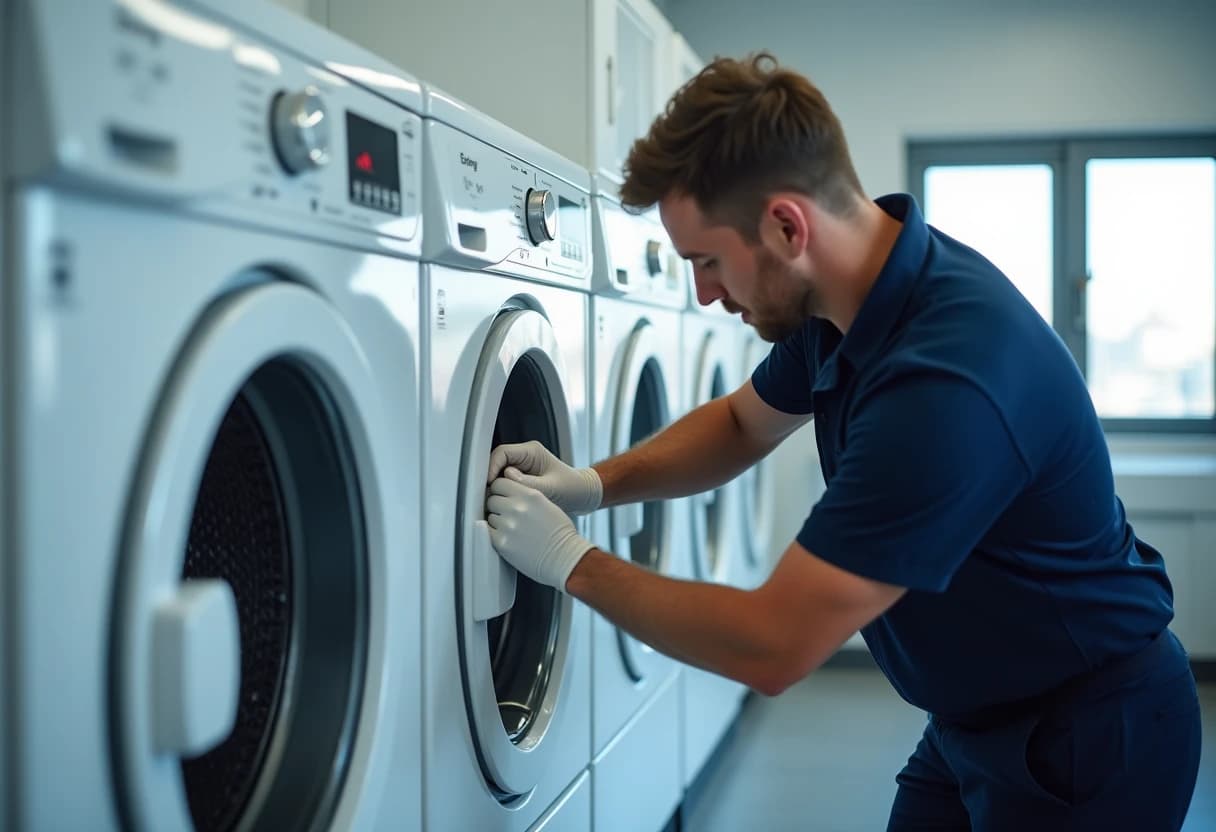
Every dryer in your building is a small fire waiting on maintenance. FEMA attributes roughly 2,900 clothes dryer fires a year in US homes to exactly the failure this service prevents — lint accumulation in vents and ducts, the leading ignition factor. For condo associations, HOAs, apartment owners and property managers in Hull, that risk multiplies by the unit count: dozens of dryers, dozens of vent runs, and in many buildings shared risers where one resident's lint becomes everyone's hazard. Our multi-unit dryer vent cleaning program handles the whole building in one coordinated visit — every unit's vent mechanically cleaned end to end, airflow verified, exceptions documented — and closes with a per-unit compliance report your board, manager and insurance carrier can file.
Why Commercial & Multi-Unit Dryer Vent Cleaning Matters for Hull Homes
For property managers, dryer vent cleaning is one of the rare maintenance items that pays three ways at once. Safety: it directly addresses the leading cause of dryer fires, in buildings where fire spreads between the units of people who share walls. Cost: clogged vents force dryers to run longer per load — often double — which in buildings with common-area laundry or included utilities lands straight on the operating budget, and which burns out heating elements, thermostats and motors years early in every case. Satisfaction: 'my dryer takes two cycles' is a steady tenant complaint generator, and residents notice when a building runs a real maintenance program. The per-unit economics make it an easy line item — volume pricing across a building brings each unit far below single-home service rates — and annual scheduling means the item renews itself without management attention. Compare that to the alternative pathway: rising utility complaints, appliance replacements, and a fire-risk exposure quietly compounding behind the walls of every unit in the portfolio.
Fire safety in Hull multi-unit housing is a shared-wall problem: one clogged vent endangers every neighbor. No town we serve takes more salt spray than Hull - homes here are surrounded by water on both sides of the peninsula, and exterior dryer vent hoods, dampers and duct components corrode remarkably fast. Constant coastal wind also drives fine sand and salt into vent terminations facing the beach. Hull occupies a narrow peninsula where nearly every home feels the ocean: the stock is a dense mix of converted summer cottages, shingled beach houses and modest year-round homes packed along the boulevard from Nantasket to Pemberton Point. Many were winterized decades after construction, so heating systems and ductwork were squeezed into buildings never designed for them, often in shallow crawlspaces just above the water table. Those conditions are precisely why FEMA's dryer-fire statistics — about 2,900 a year nationally, led by failure to clean — should read as a maintenance schedule rather than trivia. Our crews serve Hull buildings with the same program associations in Hingham and Cohasset rely on: whole-building mechanical cleaning, shared riser service, hazard flagging, airflow verification, and per-unit compliance documentation delivered to the board within days of completion.
Our Commercial & Multi-Unit Dryer Vent Cleaning Process in Hull
1Building Walkthrough & Per-Unit Proposal
We scope before we quote: unit count and layout, vent configurations and lengths, termination locations and access (ladder, lift or roof), laundry room and common-area equipment, and any known problem units. Associations receive a fixed proposal with volume per-unit pricing, a project schedule with resident notice templates, and the reporting format agreed in advance so the board knows exactly what deliverable closes the project.
2Resident Coordination & Scheduling
We treat resident experience as part of the deliverable: clear advance notices, tight arrival windows, uniformed technicians who protect floors and finish each unit in roughly 20 to 40 minutes, and a same-day completion log to management. Units we cannot access are documented — not silently skipped — and a make-up window is scheduled so the building report ends with every unit accounted for.
3Dryer-Side Service: Transition Duct & Connection
In each unit we pull the dryer, clean behind and beneath it — a major hidden lint reservoir — and service the transition duct between machine and wall. Foil accordion transitions, which manufacturers prohibit and which trap lint in every corrugation, are flagged and can be replaced on the spot with code-appropriate material. The connection is reseated and secured without airstream-penetrating screws, per code.
4Mechanical Cleaning of the Full Vent Run
We clean mechanically, not just pneumatically: a spinning brush head sized to the duct scrubs the full circumference along the entire run while vacuum extraction carries lint out of the building. Runs that exceed sensible lengths, hidden crush points and disconnections announce themselves during this pass, and anything cleaning cannot fix is documented with location and photos for the building's repair planning.
5Shared Risers, Common Trunks & Booster Fans
Common-element ducts get common-element treatment: documented condition before and after, cleaning with equipment sized for vertical and long-trunk work, and function checks on the mechanical components — booster fans, backdraft dampers, rooftop exhaust terminations — that keep a shared system moving air. For associations, this is the portion of the project that most clearly discharges the board's maintenance duty, and we document it accordingly.
6Termination Service & Exterior Verification
Every vent ends at a termination, and terminations fail constantly: flaps stuck open to pests or frozen shut with lint, screens added by well-meaning painters (code prohibits them — they trap lint), caps crushed or painted over, bird and rodent nests in the hood. We clear and verify every termination, on walls or roofs, with ladder and roof access included in the project scope.
7Airflow Verification & Building Compliance Report
Each cleaned run gets a functional verification — airflow at the termination with the dryer running, or anemometer readings where equipment access allows — so the report records outcomes, not just activity. The building deliverable lists every unit: cleaned and verified, no-access, or exception, with photos of hazards and itemized repair recommendations. Boards file it; insurers accept it; renewals cite it.
Benefits of Professional Commercial & Multi-Unit Dryer Vent Cleaning in Hull
Hazard Discovery Before It Costs You
Every exception we flag is a future incident pre-empted: the crushed run behind a renovated wall, the riser takeoff installed backwards, the termination flap frozen shut that made one unit's dryer exhaust into the building. Boards receive these findings prioritized and priced, converting unknown risks into a manageable repair list.
Longer Dryer Life & Fewer Appliance Failures
In buildings where management owns the machines — common laundry rooms, included-appliance rentals, laundromats — vent restriction is a direct capital cost: premature element, fuse and motor failures across the fleet. Regular vent service is fleet maintenance, and operators who adopt it consistently report fewer service calls and longer replacement cycles.
A Program, Not a Project
Buildings on our maintenance program stop managing this risk and start merely reviewing it: we track the interval, propose dates, coordinate residents, execute, and deliver the report to the same folder every cycle. For management companies, the program scales across portfolios with standardized reporting — one decision covering every property's most preventable hazard.
Shorter Dry Times & Lower Utility Costs
Every minute of extra runtime is heat pushed against a clogged duct: wasted energy, elevated temperatures, and accelerated wear. Post-cleaning, residents notice loads finishing in one cycle again — the most tangible everyday benefit of the program and the one that quiets the steady trickle of 'my dryer is broken' maintenance tickets.
Insurance & Liability Documentation That Holds Up
Documentation converts maintenance into protection. The same cleaning, undocumented, protects the building physically but leaves the association exposed on paper. Our reports close that gap: scope, method, dates, per-unit outcomes and photographic evidence, delivered in a format managers file once and retrieve in minutes when the renewal questionnaire arrives.
Directly Reduced Fire Risk, Building-Wide
The comparison that matters is cost per risk retired. For a modest per-door price, an association eliminates its most preventable fire hazard for the year — one whose national loss statistics, per NFPA and FEMA, are driven precisely by the maintenance being skipped. Few line items in a reserve study buy comparable protection per dollar.
Signs Your Hull Home Needs Commercial & Multi-Unit Dryer Vent Cleaning
Lint Visible at Terminations or on the Building Exterior
Lint beards on wall caps, gray fuzz on the siding below terminations, or lint scatter on the roof around stack outlets mean the ducts are so loaded they are extruding their contents. What escapes outside is the overflow; the accumulation inside the run is worse, and the affected units are drying against serious restriction.
No One Can Say When Vents Were Last Cleaned
If the answer is not in the maintenance file, the answer is effectively never — and lint has been accumulating in every run and riser since installation or the last renovation. A building-wide baseline cleaning with per-unit documentation starts the clock properly and gives the association its first real picture of vent condition.
Burning Smells, Hot Laundry Areas or Tripped Thermal Fuses
Laundry rooms that run noticeably hot and humid indicate exhaust air staying in the building — restricted ducts, failed boosters or leaking joints. Beyond discomfort, that moisture feeds mold in shared spaces and the heat stresses every machine in the room. Both symptoms resolve when the common venting actually moves its design airflow.
Insurance Questionnaires or Post-Incident Requirements
When the master-policy renewal asks 'When were dryer vents last professionally cleaned?', the underwriting message is explicit: this risk is on their radar, and undocumented buildings price accordingly. A completed building-wide cleaning with per-unit reporting answers the question directly — and answering it before renewal season is markedly cheaper than answering it after a nonrenewal notice.
Foil Accordion Ducts or Improvised Vent Runs in Units
Improvised venting accumulates in multi-unit buildings with every renovation and appliance swap: plastic flex hose, screw-joined sections snagging lint in the airstream (a specific code prohibition), runs far beyond the 35-foot equivalent-length intent once elbows are counted. A building-wide cleaning doubles as the survey that finally catalogs these conditions.
High-Duty Operations: Laundromats & Common Laundry Rooms
Watch the operational metrics: creeping gas consumption per load, customer complaints about damp clothes, machines cycling on high-limit switches. Each is restricted exhaust translated into operating cost. Duty-matched vent cleaning restores throughput and typically pays for itself in energy and uptime before its fire-safety value is even priced in.
Commercial & Multi-Unit Dryer Vent Cleaning Cost in Hull, MA
Annual program pricing is where the economics get genuinely favorable. Buildings on our recurring schedule receive locked per-unit rates, priority booking in the spring and fall rush, and lighter-touch renewal cleanings — because a vent cleaned twelve months ago needs maintenance, not excavation, and we price the difference honestly. Most associations find the steady-state annual cost per door runs 20–30% below their first catch-up cleaning, which had years of accumulation to remove. Laundromats and common laundry rooms price by machine count and duty cycle rather than by unit: figure roughly $30–$60 per machine per visit at quarterly intervals for busy stores, with common manifolds and booster fans included in scope. Operators should weigh that against the other side of the ledger — gas waste from restricted exhaust, machine downtime, and element and fuse replacements — which for high-throughput stores routinely exceeds the cleaning cost on its own.
Want the full pricing picture? See our complete Boston-area cost guide or call (617) 390-7145 for an exact flat quote for your Hull home.
Local Knowledge: Hull, Plymouth County
What makes Hull different? Hull occupies a narrow peninsula where nearly every home feels the ocean: the stock is a dense mix of converted summer cottages, shingled beach houses and modest year-round homes packed along the boulevard from Nantasket to Pemberton Point. Many were winterized decades after construction, so heating systems and ductwork were squeezed into buildings never designed for them, often in shallow crawlspaces just above the water table. No town we serve takes more salt spray than Hull - homes here are surrounded by water on both sides of the peninsula, and exterior dryer vent hoods, dampers and duct components corrode remarkably fast. Constant coastal wind also drives fine sand and salt into vent terminations facing the beach. For duct and dryer vent systems, those local factors translate into specific, predictable problems — and predictable problems are the ones we solve fastest. Call (617) 390-7145, tell us your street and home style, and we will quote the job accurately the first time, usually in under five minutes.
The Best Time of Year in Hull
Winter is dryer-fire season in New England, and the mechanics are seasonal in every direction. Cold months mean heavier laundry — flannels, fleeces, blankets — that sheds more lint per load; closed-up buildings mean any exhaust leak or interior-terminating vent dumps moisture where it condenses; and frozen or lint-jammed termination flaps restrict airflow exactly when dryers work hardest. Fire departments nationally see dryer-fire incidence peak in winter, and Massachusetts buildings fit the pattern. Fall is therefore the smart season for building-wide cleaning: every run cleared and every damper verified before the heavy-laundry months, and the project completed while roof and ladder access is still comfortable. Associations that anchor their annual cycle to September and October get the protection when it matters most — and beat the scheduling rush.
Why Choose Boston Air Duct Cleaners
Boston Air Duct Cleaners is a local, owner-operated company based at 1121 Washington St in West Newton — not a national franchise dispatching subcontractors. Every crew is our own: background-checked, factory-trained on commercial negative-pressure equipment, and fully insured. We quote flat prices before work begins, document every job with before-and-after photos, and follow NADCA-standard source-removal methods on every system we touch. That is why so much of our work comes from repeat customers, property managers and word-of-mouth referrals across Plymouth County.
Serving Hull and Surrounding Communities
Hull sits in the heart of our service area, and neighboring Hingham, Cohasset, Weymouth, Scituate, Quincy, Braintree appointments share the same routes. That density is why our response times in this part of Plymouth County are among our fastest — and why you will see our trucks in the area week after week.