
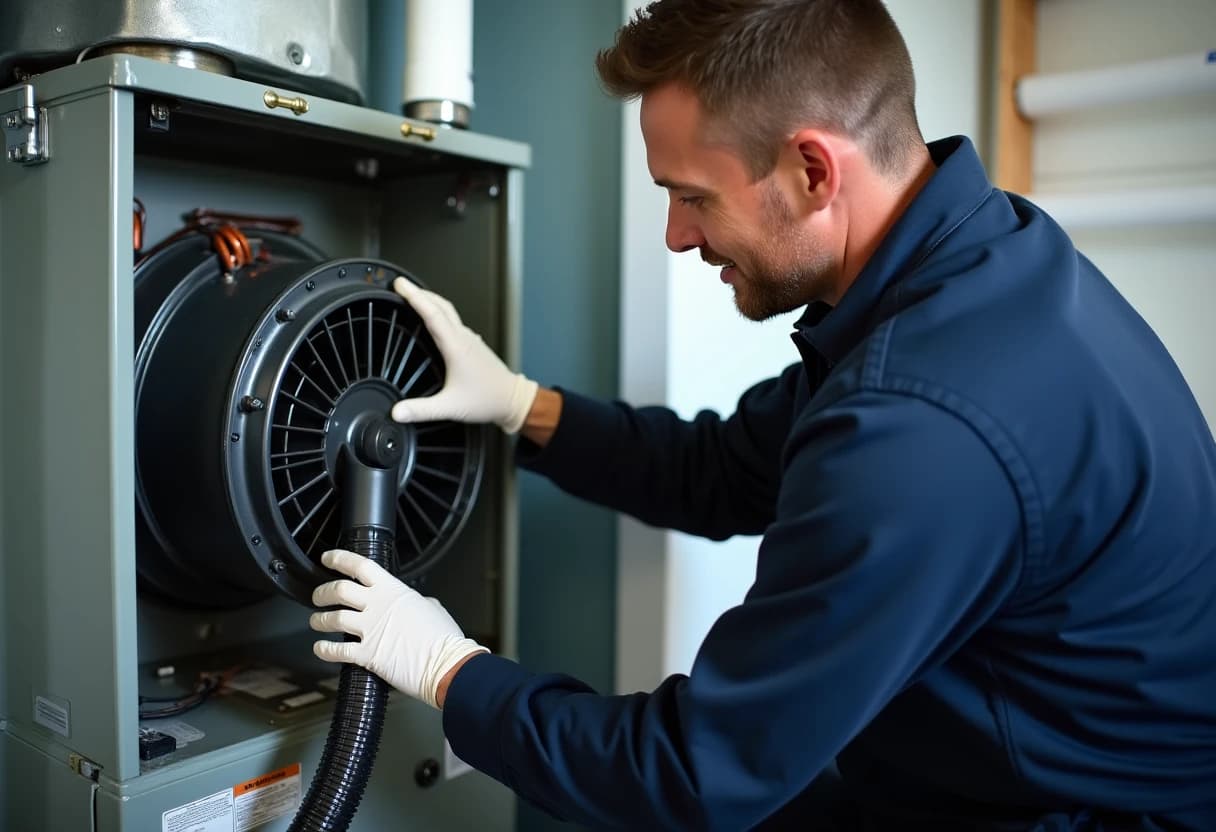
Your furnace and air conditioner were engineered around one assumption: clean airflow. Every gram of dust the system accumulates violates it — matting the blower wheel until it moves a fraction of its rated air, blanketing the evaporator coil until heat transfer chokes, and narrowing duct runs until rooms at the end of the line barely feel the system running. HVAC system cleaning reverses all of it at once. Our Hull technicians place the ductwork under commercial negative pressure, mechanically agitate every run, then open the equipment itself: blower assembly degreased and detailed, coil cleaned fin by fin, cabinet and plenums HEPA-vacuumed and wiped. The result is the closest thing to factory airflow your system has seen since installation day.
Why HVAC System Cleaning Matters for Hull Homes
The air side of an HVAC system fouls as a circuit, and it must be cleaned as one. Return ducts inhale household dust and deliver it to the blower; the blower drives it through the coil, where the wet fin surfaces trap a share of everything passing; the rest coats the supply plenum and duct runs on its way to the rooms, which shed it back toward the returns. Clean any single stage and the others reseed it — a fresh blower behind dirty returns is matted again within a season, and pristine ducts fed by a fouled blower gray out just as fast. That is the engineering case for whole-system cleaning, and it is also the economics: mobilization, system sealing and negative-pressure setup are the expensive parts of the visit, so cleaning the equipment while the system is already open costs far less than a second appointment ever would. NADCA's cleaning standard reflects the same logic — it defines HVAC cleaning as the full air-conveyance system, components included, precisely because partial cleanings produce temporary results.
The equipment serving Hull homes was mostly asked to do a job it was never sized for. Hull occupies a narrow peninsula where nearly every home feels the ocean: the stock is a dense mix of converted summer cottages, shingled beach houses and modest year-round homes packed along the boulevard from Nantasket to Pemberton Point. Many were winterized decades after construction, so heating systems and ductwork were squeezed into buildings never designed for them, often in shallow crawlspaces just above the water table. Systems extended through renovations, condo conversions and added zones run higher static pressure than their designs intended — and interior dust buildup pushes them past the margin. No town we serve takes more salt spray than Hull - homes here are surrounded by water on both sides of the peninsula, and exterior dryer vent hoods, dampers and duct components corrode remarkably fast. Constant coastal wind also drives fine sand and salt into vent terminations facing the beach. Whole-system cleaning recovers what the buildup took: we clean the complete duct network, then detail the blower, coil, plenums and cabinet, restoring capacity these hard-working systems cannot spare. Hull, Hingham and Cohasset are on our routes every week.
Our HVAC System Cleaning Process in Hull
1Full System Inspection & Airflow Baseline
The baseline matters because this service promises measurable results. We record starting conditions — equipment buildup, duct interiors, airflow strength at the weakest registers — so the after-photos and the final walkthrough demonstrate recovery rather than assert it. Systems with issues cleaning cannot fix, like failed dampers or crushed runs, get flagged now, in writing, before work begins.
2Protection, Sealing & Negative Pressure
We treat your home as a finished space: drop cloths, boot covers, corner guards on tight stairways, careful hose routing. With every opening sealed and the negative-air machine holding the ductwork under vacuum, loosened contamination has exactly one exit — through our filtration. Most customers are surprised the house is cleaner after a whole-system job than before it.
3Complete Duct Network Cleaning
Returns get equal billing with supplies in our sequence, because they are the dirtier side — unfiltered by design, inhaling everything the rooms produce. We clean the full return network including the drop into the air handler, which is the last unfiltered stretch before your blower and the reason freshly serviced equipment refouls when duct-only cleanings skip it.
4Blower Wheel & Motor Compartment Detailing
The blower assembly gets restoration-grade attention: wheel removed where design allows or detailed in place, blades cleared of the compacted felt that steals airflow, motor housing vacuumed and wiped, and the compartment HEPA-cleaned to bare metal. A clean wheel moves dramatically more air — this single component is where most of the felt recovery lives.
5Evaporator Coil Cleaning
The coil is the system's radiator and its biggest hidden airflow chokepoint — fins spaced tighter than a millimeter apart trap fine dust that filters miss, and the wet cooling-season surface glues it in place. We clean the coil face and fins with methods matched to buildup severity, restoring the heat transfer and airflow the Department of Energy identifies as central to system efficiency.
6Cabinet, Plenums & Condensate Service
This stage finishes the wet section: pan cleaned of the biofilm and sludge that clog drains and breed odor, trap flushed, line verified flowing, float switch checked where fitted. Cooling-season backups — water around the air handler, tripped switches, ceiling stains under attic units — trace here, and ten minutes of prevention now beats an August service call later.
7Fresh Filter, Reassembly & Verified Results
We close the system with a fresh filter — quality pleated media, or your preferred spec — reinstall every register, and run the system live. The walkthrough covers register-by-register airflow against the morning's baseline, the complete before-and-after photo set, and written notes on anything worth watching. You see the recovery, not just an invoice describing it.
Benefits of Professional HVAC System Cleaning in Hull
Years Added to Equipment Life
HVAC technicians will tell you which systems reach old age: the ones with clean airflow. Limit-switch trips, cracked exchangers and burned motors cluster in fouled systems because restriction stresses everything upstream and downstream of it. Periodic whole-system cleaning is how a homeowner buys into the long-lived cohort — and why tune-up techs are among our steadiest referral sources.
One Visit, Complete Documentation
For condo associations, landlords and buyers, the documentation is the deliverable: proof the full air side was professionally cleaned to NADCA method, dated, photographed and itemized. It answers inspector questions before they are asked, satisfies board maintenance requirements in one submission, and reads — accurately — as the record of a well-kept mechanical plant.
Airflow Restored to Design Capacity
The felt difference has a mechanical explanation: a fouled system fights elevated static pressure and degraded fan performance simultaneously, and the losses multiply. Removing both restores the delivered-air volume the ductwork was engineered around — which is why post-cleaning systems reach setpoint faster, cycle less, and finally push meaningful air to the far registers upstairs.
Cooling That Keeps Up in July
A blanketed evaporator coil cannot shed heat, so the AC runs longer, delivers less, and loses exactly when you need it most — the humid Massachusetts afternoons that now define our summers. Coil cleaning restores rated cooling capacity and, just as important here, dehumidification, so the house gets cool and dry instead of cool-ish and clammy.
Cleaner Air From a Cleaner Machine
Whole-system cleaning is the complete version of the air-quality upgrade: the duct reservoir removed and the equipment surfaces — wet coil, biofilmed pan, shedding blower — cleaned behind it. Air crossing clean components picks up nothing on its way to your rooms, which is why households report less dust, neutral-smelling airflow and easier breathing within days.
Quieter Operation, Fewer Odors
The burnt-dust smell of October's first furnace cycle is the equipment announcing its buildup — accumulation on the exchanger and in the plenums cooking off at first heat. A system cleaned before the season starts silent and neutral instead. Likewise the musty cooling-season note from a biofilmed coil and pan: cleaned and treated, the wet section stops perfuming the house.
Signs Your Hull Home Needs HVAC System Cleaning
AC Struggling, Icing, or Running Nonstop
An air conditioner that runs all afternoon without reaching setpoint on hot days is usually starved, not undersized: a fouled coil cannot shed heat and a matted blower cannot feed it enough air. If your AC 'got old' over a few seasons rather than gradually across decades, buildup is the likelier culprit — and cleaning is the cheaper test than replacement.
No Record of the System Ever Being Cleaned
The test costs nothing: open the blower door and look. NADCA guidance suggests inspection every couple of years; systems with no history reliably fail the eyeball test on the first try. In Greater Boston's older housing stock, where systems run long seasons and hard duty, 'never cleaned' and 'needs cleaning' are functionally the same finding.
Uneven Rooms, Noisy Cycles, Dust Everywhere
The classic trio of a fouled air side: rooms that heat and cool unevenly, a system that has grown audibly louder over the years, and dust that returns to surfaces within days of cleaning. Each has other possible causes; together they point one direction. A single whole-system cleaning typically improves all three at once, which is itself diagnostic.
Weak Airflow at Some or All Registers
Weak flow paired with a system that sounds like it is working hard — motor droning, air whistling at returns — is restriction announcing itself twice. The fan is fighting elevated static pressure and losing. Filters get checked first, and should be; when a fresh filter does not restore the registers, the buildup is deeper in the circuit and needs mechanical removal.
Visible Buildup on the Blower or Around the Air Handler
Pull the blower compartment door and look at the wheel with a flashlight: blades carrying a visible felt of compacted dust are stealing airflow every minute the system runs, and the wheel you can see is cleaner than the coil you cannot. Visible equipment buildup is definitive — no further diagnosis needed, the system is due.
Energy Bills Creeping Up Year Over Year
If usage climbs while rates and habits hold steady, your system is paying an efficiency tax somewhere — and the air side is the usual collector. Fouled blowers and coils force longer runtimes for the same comfort, and the loss compounds annually as buildup grows. A bill trending wrong across two or three seasons is a cleaning inspection's strongest referral.
HVAC System Cleaning Cost in Hull, MA
Whole-system HVAC cleaning in Greater Boston typically runs $450 to $900 — the ductwork cleaning plus blower detailing, evaporator coil cleaning, plenum and cabinet work, and condensate service in one visit. The comparison worth making: booked piecemeal, duct cleaning ($350–$700), coil cleaning ($150–$350) and blower service ($100–$250) sum well past the bundled price, because mobilization, system sealing and negative-pressure setup — the expensive parts of any visit — get paid once instead of three times. Within our range, price tracks system size (vent and return count, zone count), equipment configuration (coil accessibility varies enormously between furnace-with-A-coil setups and air handlers; some coils require panel work to reach), buildup severity (heavily fouled blowers and bonded coil blankets take repeat passes), and access (finished basements, attic air handlers, rooftop condos). Multi-system homes are quoted per system with multi-system discounts. Every quote is flat, confirmed after inspection, and inclusive — no per-main surcharges, no fuel fees, no on-site renegotiation.
Want the full pricing picture? See our complete Boston-area cost guide or call (617) 390-7145 for an exact flat quote for your Hull home.
Local Knowledge: Hull, Plymouth County
Every town's ductwork tells the story of its housing. Hull occupies a narrow peninsula where nearly every home feels the ocean: the stock is a dense mix of converted summer cottages, shingled beach houses and modest year-round homes packed along the boulevard from Nantasket to Pemberton Point. Many were winterized decades after construction, so heating systems and ductwork were squeezed into buildings never designed for them, often in shallow crawlspaces just above the water table. No town we serve takes more salt spray than Hull - homes here are surrounded by water on both sides of the peninsula, and exterior dryer vent hoods, dampers and duct components corrode remarkably fast. Constant coastal wind also drives fine sand and salt into vent terminations facing the beach. We plan Hull jobs around those realities, from equipment selection to time on site, and it shows in the results. If you live near Fort Revere Park or anywhere across Hull's 02045 area, we have almost certainly cleaned a system like yours before — and we can tell you exactly what to expect before we arrive.
The Best Time of Year in Hull
New England's equipment stock adds a seasonal wrinkle worth naming: an enormous share of local systems are conversions and hybrids — forced-air retrofitted into homes built for radiators, hydro-air systems marrying boilers to air handlers, condo conversions threading flex duct through triple-decker framing. These systems run higher static pressure than clean-sheet designs, which means less margin for fouling: buildup that a generously ducted suburban system tolerates will noticeably choke a retrofit. The seasonal moisture cycle compounds it — humid summers make basement equipment buildup damp and sticky, long winters bake it hard — so accumulation here bonds faster and restricts sooner than national rules of thumb suggest. For conversion-era systems, we recommend the inspection interval owners of old houses already apply to everything else: regularly, and before the hard season rather than after it.
Why Choose Boston Air Duct Cleaners
We built this company around the jobs other duct cleaners do badly: the 130-year-old Victorian with panned-joist returns, the Hull condo with a 60-foot dryer run to the roof, the post-renovation house full of drywall dust. Our crews see Greater Boston's hardest systems every week, and the experience shows in the details — floor protection on the way in, sealed registers during the work, HEPA-vacuumed work areas on the way out, and imagery that proves the ducts are actually clean. Call (617) 390-7145 and judge the difference from the first conversation.
Serving Hull and Surrounding Communities
Hull sits in the heart of our service area, and neighboring Hingham, Cohasset, Weymouth, Scituate, Quincy, Braintree appointments share the same routes. That density is why our response times in this part of Plymouth County are among our fastest — and why you will see our trucks in the area week after week.