
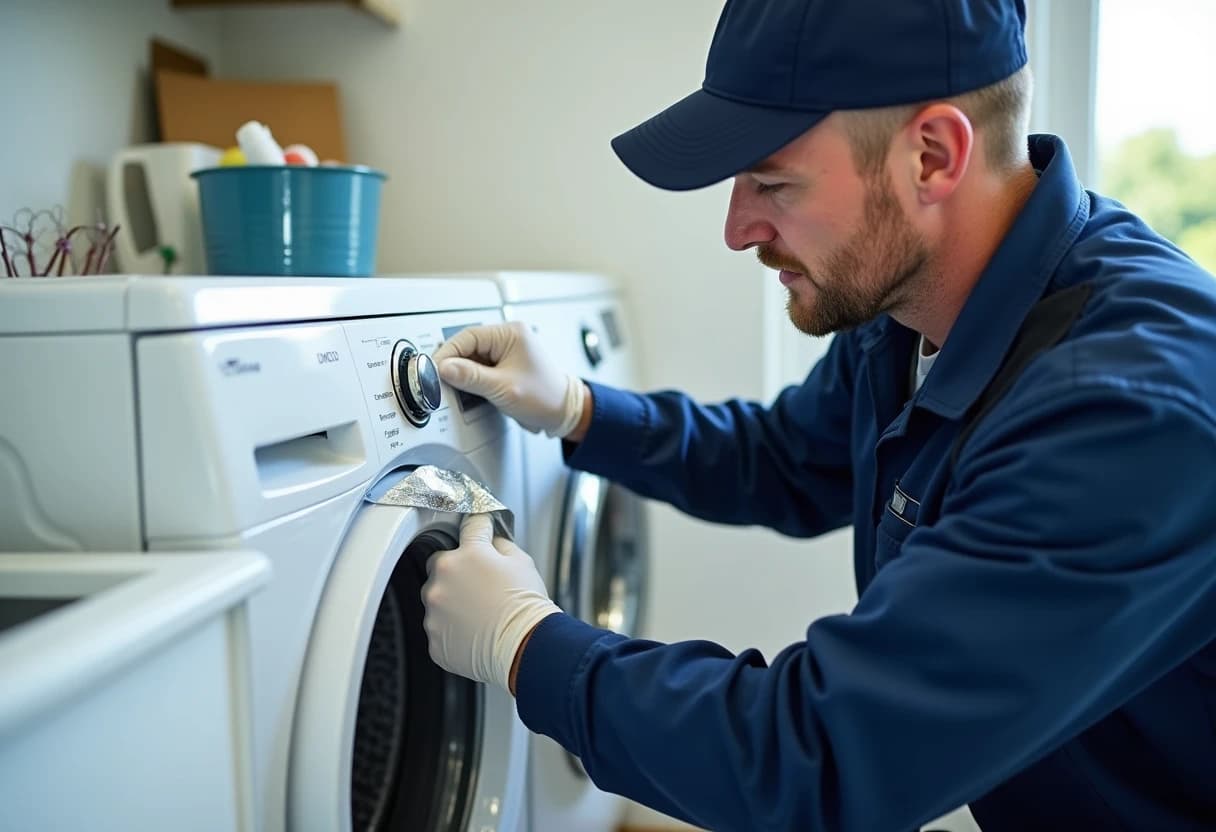
Homeowners in Jamaica Plain usually discover a broken dryer vent through a symptom that seems unrelated: a water stain on the ceiling under the laundry, lint appearing in the basement, a mildew smell in one wall, or an energy bill that crept up as the dryer strained. Our repair service finds the failure and fixes it for good — with 4-inch smooth rigid metal duct, joints fitted and clamped without airstream-piercing screws, seams sealed with UL-listed foil tape, and a new exterior hood where the old damper has failed. We are local, insured, and we photograph every repair so you can see exactly what was wrong and exactly what made it right.
Why Dryer Vent Repair Matters for Jamaica Plain Homes
The exterior termination takes the worst weather abuse of any part of the system, and its failures invite problems in both directions. A damper flap that has rusted, cracked or lost its spring no longer closes — leaving a permanent 4-inch hole in your building envelope through which winter air pours in (homeowners feel it as a cold laundry room and see it on heating bills), and through which birds, squirrels and mice enter to nest in a warm, sheltered duct. A damper wedged shut by paint, ice or a failed hinge blocks the vent as thoroughly as any lint clog. Screened hoods, common on older installs and on handyman replacements, violate dryer-vent code for a simple reason: the mesh mats over with lint in months. We replace failed terminations with quality metal hoods sized to the duct, with free-swinging dampers and pest protection designed for dryer exhaust, sealed to the siding or masonry so the wall assembly stays dry. It is often the cheapest repair on the menu and one of the most consequential.
A surprising share of our Jamaica Plain repair calls begin with a water stain. Jamaica Plain blends grand Victorian singles around Sumner Hill and Pondside with triple-deckers near Hyde and Egleston squares and brewery-era brick buildings along the Stony Brook corridor converted to lofts and condos. JP homeowners renovate enthusiastically, and many of those projects added central air to houses that never had ducts, producing attic air handlers, flexible duct runs through knee walls, and basement trunks threaded around fieldstone foundations. Older conversions often still carry dust from the original construction work. A ceiling mark below a second-floor laundry, peeling paint behind a basement dryer, a mildew odor in one wall — homeowners call a painter or a plumber before anyone thinks of the dryer vent, yet a leaking or condensing vent is the cause remarkably often. JP's tree canopy and the green wall of the Arboretum and Franklin Park make it one of Boston's leafiest neighborhoods, and every spring and fall the pollen and leaf debris load on outdoor units and intakes shows up inside the ductwork. The neighborhood's old-house environmentalist streak works in our favor: JP homeowners are quick to ask about what's actually circulating through their vents, and quick to fix it. Our diagnostic visit settles it quickly: we trace the duct path, test airflow at both ends, and either confirm the vent as the culprit and quote the repair flat, or rule it out so you can chase the real source with confidence.
Our Dryer Vent Repair Process in Jamaica Plain
1Diagnose the Full Exhaust Path
Your technician maps the vent's routing, materials and condition: transition hose state, joint integrity, crush points, sag, corrosion, termination function. Where the run is concealed, airflow measurements and inspection tools tell us what the walls hide. You get a photographed diagnosis and a flat repair quote before any work begins.
2Protect the Area & Open Access
Laundry areas are tight, finished spaces, and we work in them accordingly: drop cloths, boot covers, and careful handling of the appliance and its gas or electrical connections. Gas dryers get particular care around the flexible connector — we never strain a gas line to reach a duct.
3Reconnect & Properly Fasten Separated Joints
Separated joints are rejoined the way code intends: sections fitted male-to-female in the direction of airflow, secured with clamps or mechanical fasteners that do not pierce the airstream, and sealed with UL-listed metal foil tape — never fabric duct tape, which heat destroys, and never screws through the duct wall, whose tips become lint hooks inside the pipe.
4Replace Crushed, Corroded or Non-Compliant Sections
Replacement is also the moment to correct design faults we find: a kink where two sections meet at a bad angle becomes a pair of smooth elbows; an unsupported span gets hangers; an oversized or undersized segment is brought back to uniform 4-inch diameter so airflow stops tumbling at transitions. We fix what failed and what made it fail.
5Cure Condensation: Slope, Seal & Insulate
Condensation repairs follow the water. We restore continuous slope toward the termination so condensate drains out instead of pooling; seal the joints it has been leaking through with foil tape rated for the duty; and insulate duct sections crossing unheated basements, garages, attics and exterior wall bays so exhaust stays above its dew point until it exits.
6Repair or Replace the Exterior Hood & Damper
Failed terminations get quality metal replacements: a hood sized to the 4-inch duct with a free-swinging damper that opens fully under airflow and closes tight against weather and pests. Screened hoods — a code violation on dryer vents because mesh mats over with lint — are replaced with proper damper-and-guard designs made for dryer exhaust.
7Replace the Transition Duct & Reset the Dryer
This step catches the last common failure point: many 'vent problems' are actually transition hoses flattened to a slot behind the machine. The compliant connector, correctly fitted and protected by proper dryer placement, ensures the airflow we restored in the wall actually reaches the duct from the appliance.
8Verify Airflow & Document the Repair
You receive photo documentation of the failures found and the repairs made — valuable for insurance files, condo associations, home sales and your own records. We also note the condition of everything we did not repair, so you have an honest picture of the vent's remaining lifespan and its next likely maintenance date.
Benefits of Professional Dryer Vent Repair in Jamaica Plain
A Serious Fire Hazard, Eliminated
A breached or restricted dryer vent combines the two ingredients of the roughly 2,900 annual US dryer fires: accumulating lint and rising exhaust temperatures. Repair removes both — the escape points that seed wall cavities with fuel, and the crush points and blockages that overheat the system. It is fire prevention with a wrench, and it lasts for decades.
Pest Entry Points Closed
We remove existing nesting material as part of termination repair and clean the affected duct section, because a nest is both a blockage and a sanitation issue in an airstream that passes your clothing. The new hood's pest protection is chosen to exclude animals without the lint-trapping mesh that code prohibits.
Restored Drying Performance
Because the leak or crush also lets conditioned air escape or exhaust recirculate, repairs frequently improve more than laundry: cold-air infiltration through a stuck-open damper ends, and the laundry room stops swinging between sauna and icebox with the seasons.
Decades of Reliable Service From One Repair
We stand behind the work: repairs are documented, photographed and guaranteed, and because we also clean vents, we see our own repairs again on annual visits — a feedback loop that keeps our standards honest. The repair you buy is one we expect to inspect ourselves for years.
Moisture Out of Your Walls and Ceilings
Every load of laundry exhausts about a gallon of water. A repaired, sealed vent delivers all of it outdoors; a leaking one delivers it into insulation, framing and drywall. Stopping that daily soaking is the benefit homeowners feel longest — no more spreading stains, peeling paint, mildew odors or the mold remediation bills that chronic wall moisture eventually writes.
Lower Energy and Repair Bills
A dryer fighting a damaged vent runs longer per load and hotter per minute — both metered directly on your utility bill, often $10 to $20 a month for a busy household. Repair returns cycles to design length. The savings recur every laundry day, quietly repaying the one-time repair cost within the first year or two.
Signs Your Jamaica Plain Home Needs Dryer Vent Repair
Exterior Damper Broken, Stuck or Missing
Evidence of animals — chirping in the duct, nesting material at the hood, droppings near the vent line — means the termination has already failed as a barrier. We remove the nest, clean the affected duct, and install a hood with real pest protection. Spring is nesting season; the repair is best made before it.
Musty or Mildew Smell in the Laundry Area
A persistent damp smell around the laundry — or in one adjacent wall or ceiling — often means exhaust moisture has been feeding hidden mildew via a leak or chronic condensation. The odor is the nose's report on a moisture problem the eyes cannot see. A vent-path inspection locates the escape point, and repair dries up its food supply.
Slow Drying That Cleaning Didn't Fix
The symptom pattern is diagnostic: strong heat in the drum with weak or absent airflow at the exterior hood means exhaust is going somewhere else. That somewhere is the failure point. It is a fifteen-minute find for a technician with airflow instruments and knowledge of how these runs are routed in local housing.
Lint Appearing Where It Shouldn't
Lint around the exterior hood is normal in small amounts; lint anywhere else along the run is not. Interior lint accumulation is doubly serious because it is fuel collecting where no cleaning schedule can reach it — the escape point must be sealed, and the accessible accumulation removed.
Visibly Damaged, Kinked or Sagging Duct
Trust your eyes: a transition hose flattened behind the dryer, a dented or crushed section in the basement, duct sagging between supports into a low belly, or a run held together with fabric duct tape are all failures in progress. Each restricts airflow, collects lint and moisture, and worsens with time. Photograph what you see and call — the quote is quick.
A Home Inspection or Appliance Tech Flagged the Vent
Condo associations increasingly require documented vent compliance after regional dryer fire losses. If your building has sent a notice, we handle the full cycle: inspection, written scope for board approval, code-compliant repair, and completion records with photos. One visit, and your unit's file is closed.
Dryer Vent Repair Cost in Jamaica Plain, MA
Dryer vent repair in Greater Boston typically runs $150 to $450, and the spread is about what failed and where. At the low end: transition hose replacement with a compliant semi-rigid connector, exterior hood and damper replacement, or reconnecting an accessible separated joint — each roughly $150 to $250 including parts. Mid-range, $250 to $350, covers replacing damaged duct sections with rigid metal, curing condensation with re-sloping, sealing and insulation, or repairs involving moderate access work. The top of the range, $350 to $450, reflects concealed-joint repairs requiring access openings, multi-failure jobs combining several fixes, corroded runs needing substantial replacement, or difficult terminations on upper walls and roofs. Every quote is flat and follows a diagnosis you can see — photos of the actual failure — so you know what you are paying to fix. If damage is extensive enough that full replacement or rerouting makes better sense than repair, we say so and quote that option separately rather than selling repairs onto a duct that has reached its end.
Want the full pricing picture? See our complete Boston-area cost guide or call (617) 390-7145 for an exact flat quote for your Jamaica Plain home.
Local Knowledge: Jamaica Plain, Suffolk County
Every town's ductwork tells the story of its housing. Jamaica Plain blends grand Victorian singles around Sumner Hill and Pondside with triple-deckers near Hyde and Egleston squares and brewery-era brick buildings along the Stony Brook corridor converted to lofts and condos. JP homeowners renovate enthusiastically, and many of those projects added central air to houses that never had ducts, producing attic air handlers, flexible duct runs through knee walls, and basement trunks threaded around fieldstone foundations. Older conversions often still carry dust from the original construction work. JP's tree canopy and the green wall of the Arboretum and Franklin Park make it one of Boston's leafiest neighborhoods, and every spring and fall the pollen and leaf debris load on outdoor units and intakes shows up inside the ductwork. The neighborhood's old-house environmentalist streak works in our favor: JP homeowners are quick to ask about what's actually circulating through their vents, and quick to fix it. We plan Jamaica Plain jobs around those realities, from equipment selection to time on site, and it shows in the results. If you live near Franklin Park or anywhere across Jamaica Plain's 02130 area, we have almost certainly cleaned a system like yours before — and we can tell you exactly what to expect before we arrive.
The Best Time of Year in Jamaica Plain
Humid Massachusetts summers stress the concealed portions of the vent. High dew points mean exhaust barely cools before reaching saturation, so any bellied, unsloped or leaking duct section collects water through the muggy months — soaking lint into mats, feeding the mildew smells homeowners notice in August, and rusting galvanized duct from the inside. Basement laundry areas, already fighting ambient summer humidity, compound the effect. Summer is consequently when condensation damage advances fastest and when its symptoms — sour-smelling laundry, damp walls near the vent path, visible drips at joints — are easiest to catch. A summer diagnostic visit finds the moisture while it is active, which makes the repair scope precise rather than speculative.
Why Choose Boston Air Duct Cleaners
Choosing a duct cleaner is really a trust decision — you are letting a crew work inside the system that feeds air to your family. We make that decision easy: a local West Newton company with insured, uniformed technicians, transparent flat-rate quotes, NADCA-standard equipment and methods, and photographic proof of the finished work. No door-to-door sales, no bait-and-switch coupons, no invented 'mold emergencies.' Just honest mechanical cleaning done properly the first time, backed by a written guarantee.
Serving Jamaica Plain and Surrounding Communities
Jamaica Plain sits in the heart of our service area, and neighboring Roslindale, Roxbury, Brookline, West Roxbury, Dorchester, Boston appointments share the same routes. That density is why our response times in this part of Suffolk County are among our fastest — and why you will see our trucks in the area week after week.