
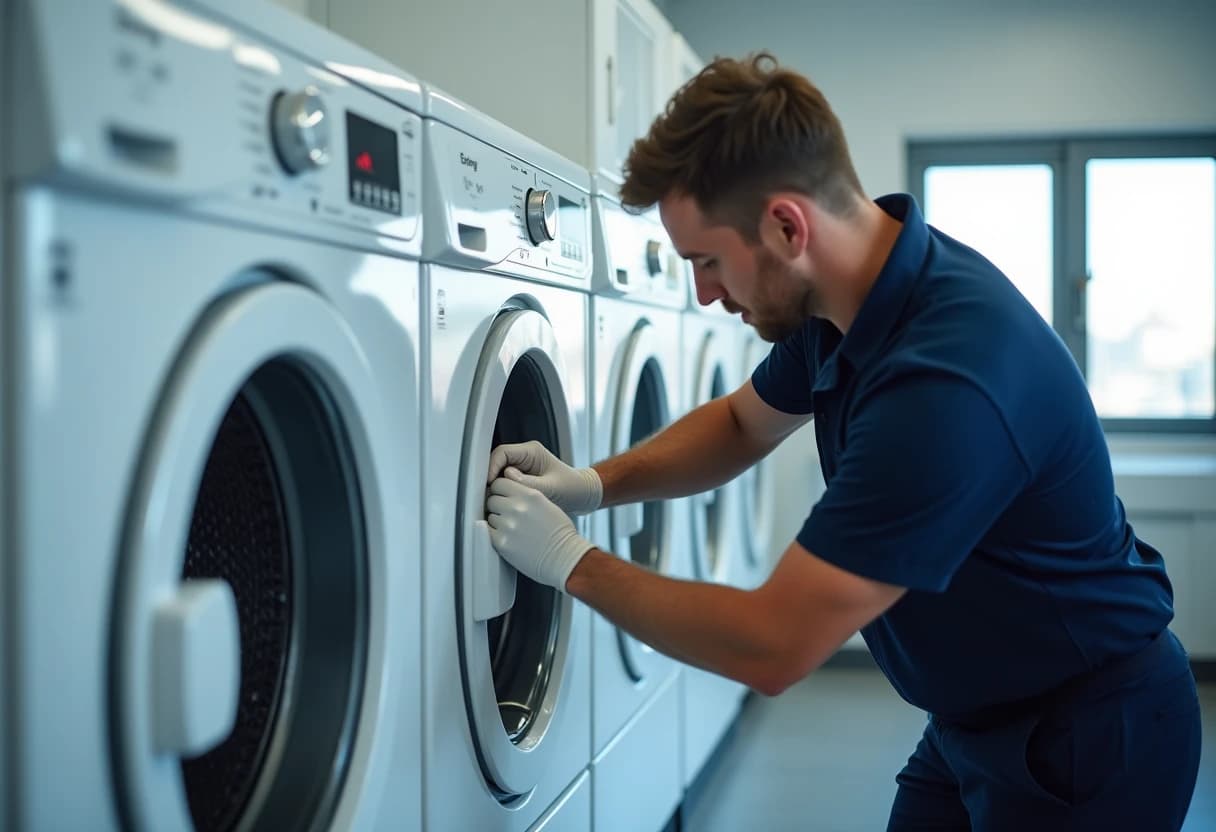
The call we never want to get from Lawrence is the one after the fire. Dryer fires are overwhelmingly preventable — lint-clogged venting is the leading cause, per FEMA and NFPA — and in multi-family buildings a single unit's blocked vent endangers every neighbor sharing the structure. That is why insurers, and increasingly master-policy underwriters, ask associations for documented vent maintenance. Our program gives Lawrence buildings the complete answer: scheduled whole-building cleanings with resident coordination handled by us, mechanical end-to-end cleaning of every vent and shared riser, immediate flagging of hazards like foil accordion transition ducts and crushed runs, and a unit-by-unit report formatted for board minutes and insurance files. Most buildings are completed in one to three days.
Why Commercial & Multi-Unit Dryer Vent Cleaning Matters for Lawrence Homes
The fire math of multi-unit buildings is unforgiving. FEMA estimates about 2,900 residential clothes dryer fires per year, causing deaths, injuries and roughly $35 million in property loss — and the leading factor, cited in around a third of these fires, is failure to clean. A single-family dryer fire endangers one household; the same fire in a triple-decker, garden apartment or high-rise endangers dozens, spreads through shared walls and chases, and lands on the association's master policy. Every dryer in your building produces lint with every load, and every foot of vent duct collects it — narrowing airflow, extending dry times, and raising temperatures inside the duct until the day lint, heat and airflow restriction intersect. Professional cleaning resets every run in the building to clear, and the documentation resets your liability posture: when an insurer, an attorney or a fire marshal asks about vent maintenance, a dated per-unit report is the difference between diligence and exposure. No board wants to explain a preventable fire; a maintenance program means never having to.
Lawrence property managers call us for three reasons more than any other: an insurance renewal questionnaire asking about vent maintenance, a resident complaint about two-cycle dry times, or a neighboring building's fire making the local news. Lawrence is the classic immigrant mill city: dense blocks of triple-deckers and wood-frame multifamilies built for textile workers around 1900, plus enormous brick mill complexes along the Merrimack that have been converted into hundreds of loft apartments. The residential stock runs old and hard-used, with heating systems layered on over a century, while the mill conversions feature very long horizontal duct and dryer vent runs through thick masonry structures. In Lawrence's converted mills, a single dryer vent can travel dozens of feet through brick and timber before reaching daylight, making lint accumulation a serious and recurring fire hazard we treat with priority. The city's triple-deckers add stacked apartments sharing tight utility chases, where one neglected duct affects the air of every floor. All three end the same way — a coordinated building-wide cleaning with per-unit documentation. We handle resident scheduling and notices, clean every run with rotary brush and vacuum extraction, service the shared risers individual residents cannot reach, and deliver the report that closes the file. Most Lawrence buildings complete in a single visit of one to three days.
Our Commercial & Multi-Unit Dryer Vent Cleaning Process in Lawrence
1Building Walkthrough & Per-Unit Proposal
First we learn your building's venting anatomy, because no two multi-unit buildings vent alike. Stacked risers, basement manifolds, improvised renovation-era runs and individual wall vents each demand different equipment and time. The walkthrough maps it, a camera check of representative runs establishes condition honestly, and your written proposal reflects the actual building — not a per-vent teaser that grows on site.
2Resident Coordination & Scheduling
We treat resident experience as part of the deliverable: clear advance notices, tight arrival windows, uniformed technicians who protect floors and finish each unit in roughly 20 to 40 minutes, and a same-day completion log to management. Units we cannot access are documented — not silently skipped — and a make-up window is scheduled so the building report ends with every unit accounted for.
3Dryer-Side Service: Transition Duct & Connection
In each unit we pull the dryer, clean behind and beneath it — a major hidden lint reservoir — and service the transition duct between machine and wall. Foil accordion transitions, which manufacturers prohibit and which trap lint in every corrugation, are flagged and can be replaced on the spot with code-appropriate material. The connection is reseated and secured without airstream-penetrating screws, per code.
4Mechanical Cleaning of the Full Vent Run
We clean mechanically, not just pneumatically: a spinning brush head sized to the duct scrubs the full circumference along the entire run while vacuum extraction carries lint out of the building. Runs that exceed sensible lengths, hidden crush points and disconnections announce themselves during this pass, and anything cleaning cannot fix is documented with location and photos for the building's repair planning.
5Shared Risers, Common Trunks & Booster Fans
High-rise and mid-rise venting is a system, not a bundle of individual runs. Our crews clean shared risers top-down from roof terminations with weighted rotary lines, verify each unit's takeoff where it joins the common duct, and confirm draft through the full stack afterward. Central exhaust fans and pressure-relief dampers serving laundry stacks are cleaned and checked in the same mobilization.
6Termination Service & Exterior Verification
Every vent ends at a termination, and terminations fail constantly: flaps stuck open to pests or frozen shut with lint, screens added by well-meaning painters (code prohibits them — they trap lint), caps crushed or painted over, bird and rodent nests in the hood. We clear and verify every termination, on walls or roofs, with ladder and roof access included in the project scope.
7Airflow Verification & Building Compliance Report
The project closes with documentation built for its real audiences. Management receives a unit-by-unit log with service dates and technician notes; the board receives a summary with building-level findings — riser condition, termination issues, prohibited transition ducts by unit — and prioritized recommendations; and the insurance-ready certificate states scope, method and completion date. Next year's cycle is calendared before we leave.
Benefits of Professional Commercial & Multi-Unit Dryer Vent Cleaning in Lawrence
Insurance & Liability Documentation That Holds Up
Documentation converts maintenance into protection. The same cleaning, undocumented, protects the building physically but leaves the association exposed on paper. Our reports close that gap: scope, method, dates, per-unit outcomes and photographic evidence, delivered in a format managers file once and retrieve in minutes when the renewal questionnaire arrives.
Hazard Discovery Before It Costs You
The inspection value of a building-wide project rivals the cleaning value. Our unit-by-unit documentation regularly surfaces conditions associations did not know they had — moisture damage from leaking ducts, code violations from old renovations, pest entry at damaged terminations — while they are still inexpensive line items rather than insurance claims.
Volume Pricing That Beats Unit-by-Unit Service
A single-home dryer vent cleaning in Greater Boston runs $150–$250; on a coordinated building project, per-unit pricing drops steeply — often to a fraction of retail — because mobilization, travel and setup are shared across dozens of units. The building gets professional service in every unit for less than residents could ever arrange individually.
A Program, Not a Project
The real deliverable is the recurring cycle: annual (or duty-matched) cleanings calendared in advance, consistent per-unit pricing locked for program clients, the same report format every year so building condition trends are visible, and reminders that arrive before renewal questionnaires do. Boards approve it once; it protects the building indefinitely.
Longer Dryer Life & Fewer Appliance Failures
Dryers venting against a clogged duct cook themselves: heating elements cycle against trapped heat, thermostats and thermal fuses trip and fail, motors run hot and die early. Clear venting is the cheapest appliance-life extension available — a point every appliance manufacturer's manual makes, and every burned-out element invoice repeats.
Shorter Dry Times & Lower Utility Costs
A lint-restricted vent forces dryers to run longer per load — frequently twice as long — and in buildings with common laundry or owner-paid utilities, that waste lands directly on the operating budget. Restored airflow returns machines to single-cycle drying, and laundromats often see the gas savings alone repay the cleaning within months.
Signs Your Lawrence Home Needs Commercial & Multi-Unit Dryer Vent Cleaning
Insurance Questionnaires or Post-Incident Requirements
When the master-policy renewal asks 'When were dryer vents last professionally cleaned?', the underwriting message is explicit: this risk is on their radar, and undocumented buildings price accordingly. A completed building-wide cleaning with per-unit reporting answers the question directly — and answering it before renewal season is markedly cheaper than answering it after a nonrenewal notice.
Burning Smells, Hot Laundry Areas or Tripped Thermal Fuses
Thermal fuses and high-limit switches exist to interrupt exactly this failure, and their tripping is diagnostic: heat had nowhere to go. Repeated no-heat service calls on building machines are the venting system burning through safety margins. Clean the exhaust paths before the next component in that chain is the lint itself.
High-Duty Operations: Laundromats & Common Laundry Rooms
Watch the operational metrics: creeping gas consumption per load, customer complaints about damp clothes, machines cycling on high-limit switches. Each is restricted exhaust translated into operating cost. Duty-matched vent cleaning restores throughput and typically pays for itself in energy and uptime before its fire-safety value is even priced in.
Foil Accordion Ducts or Improvised Vent Runs in Units
If your association has never inspected what connects residents' dryers to the walls, assume nonconformance: transition duct is resident-installed, unregulated in practice, and frequently the worst link in the chain. Our unit visits document and correct these connections — the cheap fix that removes the most flammable segment of the entire vent path.
Lint Visible at Terminations or on the Building Exterior
Walk the building perimeter and look at every vent hood: visible lint at the flap, caps that no longer close, vegetation fuzzy with fibers below the outlet. These external tells are free inspection data, and they reliably indicate runs overdue for mechanical cleaning — plus terminations that need damper service while the crew is there.
Dryers Taking Two or More Cycles Per Load
The test is simple: a healthy dryer with clear venting dries a standard load in one cycle. Track your building's work orders — clusters of slow-dry, no-heat and thermal-fuse tickets are the venting system asking for service, and each ticket represents a unit running its dryer at elevated temperature against a restricted duct.
Commercial & Multi-Unit Dryer Vent Cleaning Cost in Lawrence, MA
Annual program pricing is where the economics get genuinely favorable. Buildings on our recurring schedule receive locked per-unit rates, priority booking in the spring and fall rush, and lighter-touch renewal cleanings — because a vent cleaned twelve months ago needs maintenance, not excavation, and we price the difference honestly. Most associations find the steady-state annual cost per door runs 20–30% below their first catch-up cleaning, which had years of accumulation to remove. Laundromats and common laundry rooms price by machine count and duty cycle rather than by unit: figure roughly $30–$60 per machine per visit at quarterly intervals for busy stores, with common manifolds and booster fans included in scope. Operators should weigh that against the other side of the ledger — gas waste from restricted exhaust, machine downtime, and element and fuse replacements — which for high-throughput stores routinely exceeds the cleaning cost on its own.
Want the full pricing picture? See our complete Boston-area cost guide or call (617) 390-7145 for an exact flat quote for your Lawrence home.
Local Knowledge: Lawrence, Essex County
Serving Lawrence means knowing Lawrence. Lawrence is the classic immigrant mill city: dense blocks of triple-deckers and wood-frame multifamilies built for textile workers around 1900, plus enormous brick mill complexes along the Merrimack that have been converted into hundreds of loft apartments. The residential stock runs old and hard-used, with heating systems layered on over a century, while the mill conversions feature very long horizontal duct and dryer vent runs through thick masonry structures. In Lawrence's converted mills, a single dryer vent can travel dozens of feet through brick and timber before reaching daylight, making lint accumulation a serious and recurring fire hazard we treat with priority. The city's triple-deckers add stacked apartments sharing tight utility chases, where one neglected duct affects the air of every floor. Those conditions shape how we work here: which brush heads come off the truck, how we protect finishes in older interiors, and what we expect to find when the camera goes into a 01840 duct system. Our crews are in and around Lawrence nearly every week — often for neighbors of past customers — so scheduling is fast and our arrival windows hold.
The Best Time of Year in Lawrence
Winter is dryer-fire season in New England, and the mechanics are seasonal in every direction. Cold months mean heavier laundry — flannels, fleeces, blankets — that sheds more lint per load; closed-up buildings mean any exhaust leak or interior-terminating vent dumps moisture where it condenses; and frozen or lint-jammed termination flaps restrict airflow exactly when dryers work hardest. Fire departments nationally see dryer-fire incidence peak in winter, and Massachusetts buildings fit the pattern. Fall is therefore the smart season for building-wide cleaning: every run cleared and every damper verified before the heavy-laundry months, and the project completed while roof and ladder access is still comfortable. Associations that anchor their annual cycle to September and October get the protection when it matters most — and beat the scheduling rush.
Why Choose Boston Air Duct Cleaners
Choosing a duct cleaner is really a trust decision — you are letting a crew work inside the system that feeds air to your family. We make that decision easy: a local West Newton company with insured, uniformed technicians, transparent flat-rate quotes, NADCA-standard equipment and methods, and photographic proof of the finished work. No door-to-door sales, no bait-and-switch coupons, no invented 'mold emergencies.' Just honest mechanical cleaning done properly the first time, backed by a written guarantee.
Serving Lawrence and Surrounding Communities
Lawrence sits in the heart of our service area, and neighboring Methuen, Andover, North Andover, Dracut, Tewksbury, Lowell appointments share the same routes. That density is why our response times in this part of Essex County are among our fastest — and why you will see our trucks in the area week after week.