
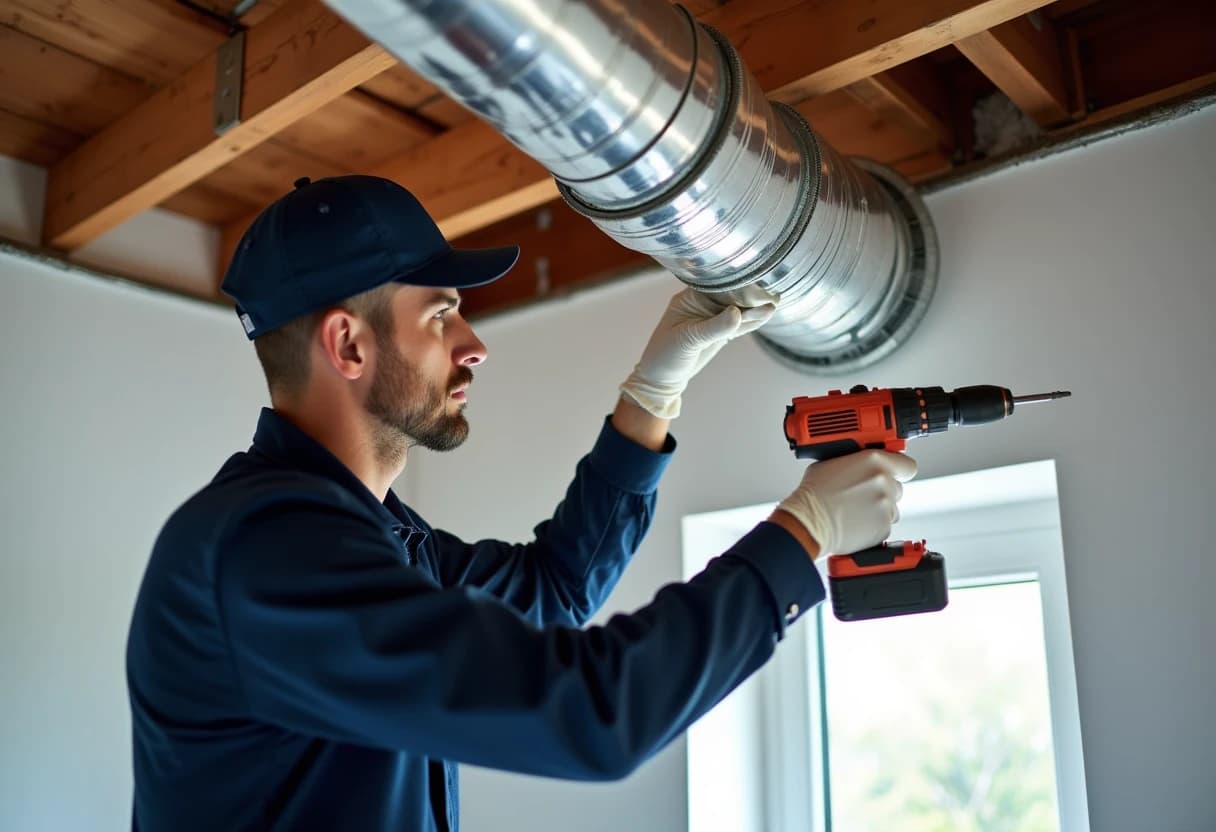
An overlong dryer vent is a permanent tax on every load of laundry. Each foot of duct and every elbow adds resistance; the code caps the total at 35 equivalent feet — with each 90-degree elbow typically counting as five feet — because beyond that, dryers simply cannot push lint and moisture to the outlet. Yet Greater Boston basements are full of runs half again that long, snaking around decades of renovations. Our rerouting service shortens them: we find the nearest legal path outdoors, often cutting a 40-foot wander to a 12-foot straight shot, and rebuild it in rigid metal. Drying times drop immediately, lint accumulation slows permanently, and the fire-risk math improves for good.
Why Dryer Vent Installation & Rerouting Matters for Lincoln Homes
Where the vent terminates shapes both the house and the maintenance schedule. Every option has an engineering trade: side-wall terminations are shortest and easiest to inspect, but must clear grade, snow line, and required distances from openings; rim-joist terminations serve basement laundries elegantly with minimal envelope disruption; roof terminations suit interior laundry rooms in condos and capes but load up faster — lint fights gravity the whole vertical run — and need durable, steep-weather-rated caps. What is never acceptable: terminating into an attic, crawlspace, garage, soffit vent or chimney, all of which we find regularly and all of which pump moisture and lint into the structure. The termination itself must have a backdraft damper that closes against winter wind and pests, and no screen — mesh mats over with lint in months, which is why the code forbids it. Our installations weigh the options against your home's layout and Massachusetts weather, cut clean penetrations through clapboard, shingle, brick or block, and flash and seal them so the envelope stays weather-tight for decades.
A large share of our Lincoln installation work is corrective: replacing what a previous decade improvised. Lincoln pairs 18th-century farmhouses and estate properties with one of the country's most significant concentrations of modernist homes, including the Gropius House and the mid-century enclaves inspired by it, all set on large conservation-minded lots. The modernist houses often use radiant slabs or unconventional duct layouts hidden in flat-roof assemblies, while the antique farmhouses carry delicate retrofit forced-air systems threaded through original timber frames. Behind those walls we find vinyl hose stapled to joists, flex duct wandering forty feet to a screened hood, vents dumping into crawlspaces — installations that fail the IRC's dryer exhaust rules on every line. With more than a third of the town preserved as conservation land and working farms like Drumlin Farm and Codman Community Farms, Lincoln's air carries a real seasonal load of pollen, field dust and farm particulates that settles in return ducts. The flat-roofed modernist homes here also hide compact duct runs that are easy to neglect and tricky to access without experience. We tear out the improvisation and build the system the code describes: 4-inch rigid metal on the shortest workable route, clamped and taped joints, a damper-equipped termination sealed to the envelope. Documented with photos, verified with the dryer running.
Our Dryer Vent Installation & Rerouting Process in Lincoln
1Site Assessment & Route Planning
The technician maps what exists and what is possible: where the dryer sits (or will sit), which walls are exterior, what the framing and foundation allow, and where obstacles — plumbing, wiring, ductwork, finished ceilings — constrain the path. Shortest is best: fewer feet and fewer elbows mean faster drying and slower lint accumulation for the life of the system.
2Demolition of Non-Compliant Venting
Where the old route will be reused, we strip it to sound structure; where it is abandoned, we seal the redundant penetrations properly — foam and blocking inside, patched and flashed outside — so the old path does not remain as an air leak or pest entry. Clean removal is part of the installation, not an extra.
3Cut & Flash the Exterior Penetration
Penetrations are where amateur installs leak — water into sheathing, air into cavities. Ours are built like window details: sized to the hood, flashed to shed water over the cladding, sealed with quality exterior sealant, and finished so the termination looks intentional on the facade. On masonry we drill and anchor; we never improvise attachment.
4Install Rigid Metal Duct on the Planned Route
The run goes in as 4-inch smooth-interior rigid metal duct — the material the IRC specifies — cut to fit, joined male-to-female in the direction of airflow, and assembled without a single screw protruding into the airstream: joints are clamped or externally fastened and sealed with UL-listed foil tape. Elbows are used sparingly and counted against the length budget.
5Mount the Termination Hood & Damper
Termination choice is matched to the route: low-profile wall hoods for clapboard and shingle, masonry-mounted hoods for brick, rim-joist hoods for basement exits, and dedicated dryer roof caps — never plumbing-style caps — for vertical runs. Each is chosen for damper quality, because the damper is the moving part that determines how the termination survives New England weather.
6Connect the Appliance & Seal the System
System sealing is completed end to end: every joint taped with UL-listed foil tape, the wall penetration sealed inside and out, and the transition clamped tight. A dryer vent is a pressure system; leaks anywhere cost airflow at the termination and push lint and moisture into places they do not belong. Sealed means sealed everywhere.
7Test, Verify & Document the Installation
Before we leave: work areas vacuumed with HEPA equipment, penetration debris removed, the dryer set and leveled, and a walkthrough of the finished system — where it runs, how the damper should look during a cycle, and when the first annual cleaning is due. A correctly built vent needs almost nothing from you; we make sure you know the little it does.
Benefits of Professional Dryer Vent Installation & Rerouting in Lincoln
A Laundry Located Where You Actually Want It
For renovations, early vent planning is leverage: consulted while walls are open, we can route a short, straight, fully concealed run that would be expensive or impossible after drywall. A ten-minute conversation at framing stage regularly saves homeowners hundreds of dollars and a compromised route.
Fire-Safe by Design, Not by Vigilance
Roughly 2,900 US home dryer fires a year trace overwhelmingly to lint, and lint traces to the installation faults a proper build eliminates: flex corrugations, overlong runs, obstructed airstreams. Replacing an improvised vent with an engineered one is the single largest permanent reduction in dryer fire risk available to a homeowner.
Permanently Lower Energy Costs
Sealed rigid duct also stops the hidden energy leaks of bad systems: conditioned air escaping through gapped joints, winter infiltration through failed dampers, and the heating-season cost of a laundry room with a permanent 4-inch draft. A tight system with a tight damper closes all of it.
Code Compliance That Closes Every Question
Insurers and condo associations increasingly ask about dryer venting after regional fire losses, and 'professionally installed to code, with photos' is the answer that ends the conversation. We provide certificates of insurance for association work and per-unit records for multi-family buildings as standard practice.
Decades of Service From a One-Day Job
Rigid metal duct, properly supported and sealed, is lifetime infrastructure: it does not kink, sag, melt or degrade, and it routinely outlasts several dryers. After installation day, the system's entire maintenance schedule is an annual cleaning and an occasional glance at the damper. Most homeowners never think about it again — which is the point.
Dramatically Faster Drying
Shortening a wandering 40-foot run to a direct 12-foot route transforms drying performance: full airflow means each cycle actually exhausts the gallon of moisture a load releases, so sensor dryers stop running overtime and heavy loads finish in one pass. Customers routinely describe post-installation performance as having bought a new machine.
Signs Your Lincoln Home Needs Dryer Vent Installation & Rerouting
Chronic Condensation the Route Guarantees
Watch the laundry itself: loads that come out damp-smelling, a duct that drips after cycles, rust tracks under joints. Chronic internal moisture is rotting the system from the inside while it feeds blockages. The permanent fix is a route engineered for New England winters, not another season of drip trays and patches.
Your Vent Is Flexible Plastic or Foil Duct
A quick self-check: press gently on the visible duct. Rigid metal does not give; flex crumples. If any concealed portion of your run is flex, assume the hidden sections are in worse shape than the visible ones — they always are — and price the replacement before the blockage schedule prices it for you.
The Run Is Overlong or Elbow-Heavy
Count the route: if your duct wanders more than roughly 25 linear feet, or turns more than three corners, it is likely past the code's 35-foot equivalent-length budget once elbows are deducted — typically five feet per 90-degree bend. Beyond the budget, the dryer physically cannot keep lint moving to the outlet, and chronic clogging is built in.
Blockages and Repairs Keep Recurring
If your vent needs cleaning twice a year, blocks anyway, and has accumulated a history of repairs, the route itself is the problem — too long, too bent, wrong materials, or condensation-prone by design. At some point serial maintenance costs more than the reroute that ends it. We will do that math with you honestly; often the crossover is closer than expected.
The Dryer Vents Indoors — Anywhere
Window inserts and condensation boxes marketed as 'indoor dryer vents' are not a solution for a standard vented dryer in a Massachusetts home; they are humidity machines. If one is in service in your laundry, a proper exterior route almost certainly exists — our assessment will find the shortest one and price it flat.
Inspection, Insurance or Association Requirements
Appliance warranties add quiet pressure: manufacturers condition coverage on adequate exhaust, and a warranty claim on a dryer connected to a non-compliant vent can be denied on that basis. If you are buying a premium machine, the few hundred dollars of proper venting is also warranty insurance.
Dryer Vent Installation & Rerouting Cost in Lincoln, MA
Multi-family and condo installation pricing carries a few specifics worth knowing up front. Roof terminations — common for interior condo laundries — sit toward the top of the range for the flashing and access work, typically $650 to $900 for the full installation. Association requirements add process rather than much cost: we provide written scopes for board approval and certificates of insurance at no charge, and our documentation is built to satisfy trustee and management-company review. The meaningful savings lever is coordination: when a triple-decker owner or association books multiple units in one mobilization, shared setup, staging and travel drop per-unit pricing by 20 to 30 percent, and the building ends up with one consistent, compliant system instead of three eras of improvisation. For laundry-relocation projects inside renovations, timing is the lever: venting roughed in while walls are open routinely costs $200 to $400 less than the identical route built after finishes, which is why we encourage a planning call at the framing stage — free advice that saves real money.
Want the full pricing picture? See our complete Boston-area cost guide or call (617) 390-7145 for an exact flat quote for your Lincoln home.
Local Knowledge: Lincoln, Middlesex County
Every town's ductwork tells the story of its housing. Lincoln pairs 18th-century farmhouses and estate properties with one of the country's most significant concentrations of modernist homes, including the Gropius House and the mid-century enclaves inspired by it, all set on large conservation-minded lots. The modernist houses often use radiant slabs or unconventional duct layouts hidden in flat-roof assemblies, while the antique farmhouses carry delicate retrofit forced-air systems threaded through original timber frames. With more than a third of the town preserved as conservation land and working farms like Drumlin Farm and Codman Community Farms, Lincoln's air carries a real seasonal load of pollen, field dust and farm particulates that settles in return ducts. The flat-roofed modernist homes here also hide compact duct runs that are easy to neglect and tricky to access without experience. We plan Lincoln jobs around those realities, from equipment selection to time on site, and it shows in the results. If you live near Gropius House or anywhere across Lincoln's 01773 area, we have almost certainly cleaned a system like yours before — and we can tell you exactly what to expect before we arrive.
The Best Time of Year in Lincoln
Renovation season drives our installation rhythm as much as weather does. Greater Boston remodels from spring through fall — basements finished, laundries moved upstairs, triple-deckers converted to condos — and every one of those projects needs dryer exhaust designed rather than improvised. The economics of timing are stark: venting planned at framing stage routes shorter, conceals cleaner and costs $200 to $400 less than the same run retrofitted after drywall. We take planning calls from homeowners and contractors all season, often walking a route in fifteen minutes that saves the project real money and the homeowner a decade of compromise. If your project touches the laundry — or could move it somewhere better — the cheapest vent you will ever build is the one designed before the walls close.
Why Choose Boston Air Duct Cleaners
Boston Air Duct Cleaners is a local, owner-operated company based at 1121 Washington St in West Newton — not a national franchise dispatching subcontractors. Every crew is our own: background-checked, factory-trained on commercial negative-pressure equipment, and fully insured. We quote flat prices before work begins, document every job with before-and-after photos, and follow NADCA-standard source-removal methods on every system we touch. That is why so much of our work comes from repeat customers, property managers and word-of-mouth referrals across Middlesex County.
Serving Lincoln and Surrounding Communities
We serve every community around Lincoln as well: Concord, Lexington, Weston, Waltham, Sudbury, Wayland all fall inside our regular service routes. If you have a second property, a rental, or family nearby, ask about multi-home scheduling — grouped appointments on the same route are our most requested discount.