
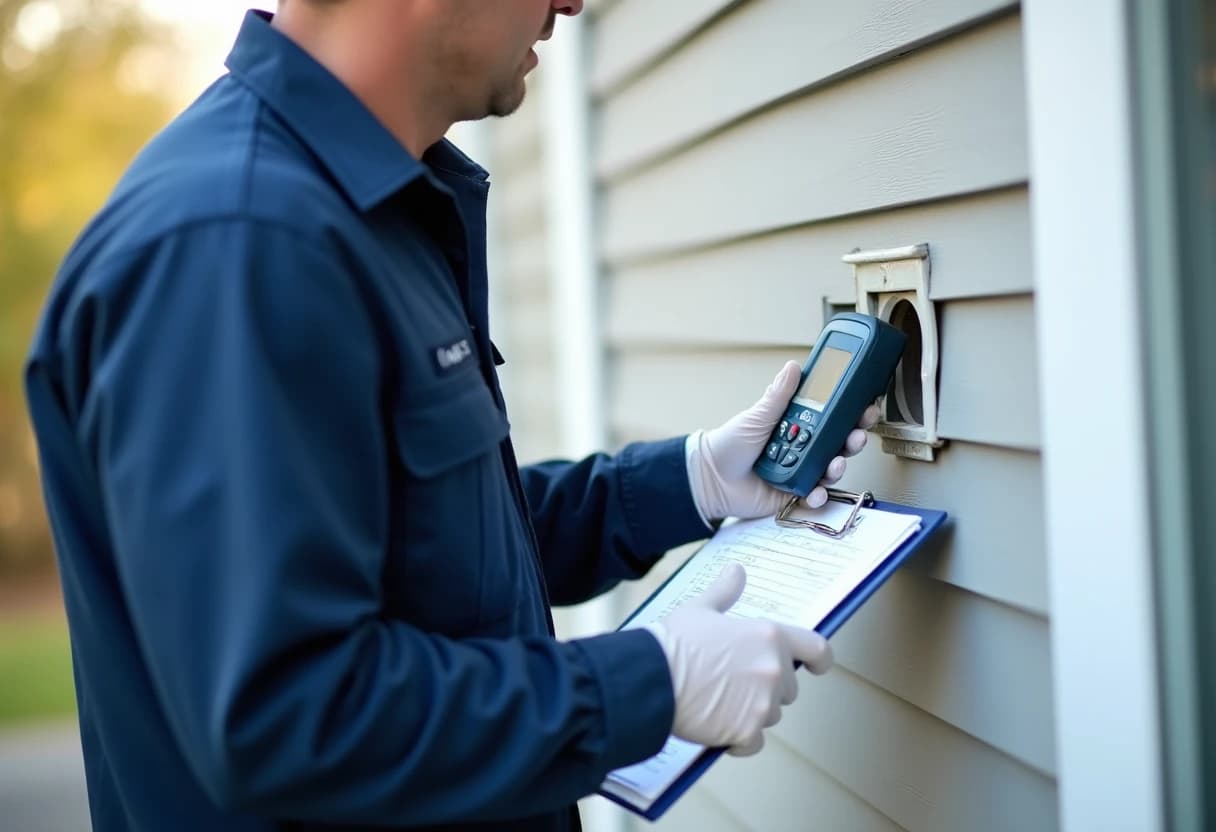
A dryer vent inspection is the fastest, cheapest way to answer a question every homeowner should be able to answer: is my dryer exhaust safe? Our Lowell technicians measure airflow at the termination with a calibrated anemometer, run an inspection camera the full length of the duct, examine the exterior hood and damper, assess the lint load inside the run, and check the installation against the residential code rules that govern dryer ducts. You leave with a written safety report — photos, measurements and a clear verdict — instead of a guess. If the vent is clean and compliant, we tell you so and you are done for the year. If it needs work, you will know exactly what and why before spending a dollar on cleaning or repairs.
Why Dryer Vent Inspection & Safety Check Matters for Lowell Homes
There are moments when a dryer vent inspection stops being optional. Buying a home: the general home inspector looks at the dryer connection but almost never cameras the duct or measures airflow, so the one appliance system most associated with house fires goes essentially unexamined at purchase. Selling a home: a documented, dated inspection removes a negotiation point and signals maintenance discipline. Insurance: a growing number of carriers ask about dryer vent maintenance after lint-fire claims, and a written report answers the question definitively. Condo and rental compliance: many Massachusetts associations and landlords now require periodic dryer vent verification, and our report format is written to satisfy them. New dryer installation: manufacturers void warranties for vent-related failures, and installers frequently connect brand-new machines to old, non-compliant ducts. In every one of these situations, the inspection costs a fraction of what it protects, and the paperwork is often the point.
Condo and multi-family living shapes dryer safety in Lowell more than most owners realize. Lowell's housing runs from grand Victorians in Belvidere to dense triple-deckers and workers' cottages in The Acre and Centralville, with the downtown canal district full of textile mills converted to lofts and condos. Mill conversions rely on long shared duct trunks and rooftop air handlers, while the triple-decker stock is a patchwork of retrofitted furnaces, ductless heads and decades-old sheet metal. In triple-deckers and converted buildings, dryer ducts often run long distances through shared walls and ceilings to reach an outside face, and the termination may be three stories up where nobody has looked at it in years. The mill-to-loft conversions along Lowell's canals recirculate air for dozens of units at a time, so a neglected trunk line affects entire floors, not just one apartment. Add a large stock of pre-1940 multifamilies with basement mechanicals near the Merrimack, and dust, humidity and lint problems compound quickly here. Association boards across Middlesex County increasingly require documented dryer vent verification for exactly this reason — one unit's neglected duct is every unit's fire risk. Our inspection reports are formatted for board and property-manager submission: photos, airflow numbers, code notes and a dated finding for each unit, delivered after a single visit.
Our Dryer Vent Inspection & Safety Check Process in Lowell
1Interview & Visual Assessment
We start by listening: how long do loads take, has anything changed, when was the vent last cleaned, any moisture or odor issues? Then the technician examines the laundry area — dryer position, transition duct type and condition, visible connections — because the interview and the first look often predict exactly what the instruments will find.
2Airflow Measurement at the Termination
The single most telling test takes two minutes: dryer on, anemometer at the hood. Exhaust volume tells us how much of the dryer's rated airflow actually survives the trip through the duct. We record the reading in your report so future inspections can track the trend — a slow year-over-year decline is the earliest possible warning of developing blockage.
3Full-Length Camera Inspection
This is the step no flashlight can replace: a camera pass of the complete exhaust run, wall cavities and ceiling sections included. You can watch live as it travels. Lint depth, joint condition, duct material transitions and any obstructions are recorded, and representative frames go into your written report as evidence for every finding.
4Termination Hood & Damper Check
We check the exit as carefully as the run. A damper that will not open steals airflow; one that will not close invites cold air, moisture and animals. We also flag code and safety issues here: mesh screens that catch lint, terminations too close to openings or grade, and hoods damaged by weather or renovation work.
5Lint-Load Assessment & Fire-Risk Scoring
Not all lint findings are equal. A light, even film is normal; wet, matted accumulation at a low point signals condensation problems; heavy packing at elbows signals a duct working beyond its geometry. We grade what the camera found against how your household uses the dryer, so the recommendation matches your actual risk.
6Code-Compliance Review
We review the installation against the residential mechanical code for dryer exhaust: smooth rigid metal duct (not foil or plastic flex in concealed runs), a maximum of 35 feet equivalent length with deductions for each elbow, no screws penetrating the airstream, proper termination with a backdraft damper and no screen. Violations are photographed and explained.
7Written Safety Report & Recommendations
Everything we measured and saw goes into a written safety report delivered the same day. Pass or fail, you have proof of the vent's condition — the document buyers ask for, insurers accept and associations require. If work is warranted, the report doubles as a precise scope, so any quote you gather is comparing the same job.
Benefits of Professional Dryer Vent Inspection & Safety Check in Lowell
A Written Report You Can Actually Use
Documentation has quiet value that compounds. After a kitchen fire two streets over, your insurer asks about dryer maintenance — you have a dated report. A buyer's inspector flags the vent — you produce this year's inspection and the issue evaporates. The paper trail costs nothing extra; it comes standard.
Fire Risk Caught Before It Matters
Lint fires do not announce themselves; they accumulate. An inspection converts that slow, invisible buildup into a number and a photograph you can act on. Homeowners who inspect annually essentially never experience a vent-related fire, because the fuel never gets the chance to reach a dangerous load.
No Unnecessary Cleanings
Fear sells a lot of dryer vent cleanings that ducts did not need. Our answer is evidence: your own duct on camera, your own airflow in numbers. When the data says clean, we quote it flat; when it says pass, you keep your money and gain a report. Either way you decide from facts.
Lower Drying Costs & Longer Appliance Life
The economics are simple: restricted airflow taxes every single load, and the tax grows as the restriction does. Measurement catches the problem when it is small. Customers consistently report faster drying and lower utility bills after acting on inspection findings — savings that repeat weekly, every laundry day.
Hidden Code Violations Exposed
Plastic flex duct in a wall, a 50-foot equivalent run, screws bristling into the airstream, a screened termination — these violations hide inside structures and cause chronic problems until someone cameras the run. Finding them converts a recurring symptom into a one-time fix.
Protection From Moisture & Carbon Monoxide
Gas dryer owners get an extra layer of safety from inspection: the same duct carrying lint and moisture carries combustion exhaust. Verified airflow and a tight, intact run mean carbon monoxide leaves the house completely — a check that takes minutes and covers a risk most homeowners never consider.
Signs Your Lowell Home Needs Dryer Vent Inspection & Safety Check
The Dryer or Laundry Room Feels Hot
Modern dryers protect themselves from restricted vents by cycling their high-limit switch — you experience this as a hot machine, lukewarm loads and mysteriously long cycles. The safety is working, but it was not designed for daily duty. An inspection identifies the restriction before the safety component fails.
Recent Renovation, New Dryer or New Home
Just bought the house? Your home inspector almost certainly did not camera the dryer duct or measure its airflow — general inspections do not include it. Given that lint fires are among the most common preventable house fires, a dedicated vent inspection belongs on every new-owner checklist.
No Visible Exhaust at the Outside Hood
The outdoor hood is the one part of the system you can check yourself, and a weak or absent exhaust stream there is diagnostic. But the hood cannot tell you where the problem lives — the duct, the damper or the dryer. The anemometer and camera answer that in one visit.
Burning or Musty Smells During Operation
Trust your nose. Scorched smells mean lint meeting heat; sour smells mean water pooling where it should not; animal odors mean something has moved into the duct or hood. Each has a distinct cause and a distinct fix, and a single camera inspection distinguishes among them definitively.
Clothes Take More Than One Cycle
Drying time is the vent's report card. Loads that once took 45 minutes now taking 80 means delivered airflow has fallen substantially — and every extra minute is money and heat stress. If your laundry routine has quietly stretched over the past year, the duct is asking for an inspection.
You Cannot Remember the Last Service
If the vent has no service history you can name, assume it has never been inspected — most have not. NFPA guidance is simple: dryer exhaust should be checked at least annually. The first inspection establishes your baseline; every year after tracks the trend.
Dryer Vent Inspection & Safety Check Cost in Lowell, MA
Budget-wise, the inspection is designed to be an easy annual yes: $79 to $149 depending on home layout, versus roughly $2,900 dryer fires nationally each year and average fire losses that run into five figures per incident. Price drivers are practical, not mysterious. Ranch homes and first-floor laundries with side-wall terminations book at $79–$99. Colonials and multi-story homes where the duct rises through the structure to a high or roof termination run $99–$129, reflecting ladder work and longer camera runs. Complicated situations — inaccessible dryers, runs exceeding 25 feet, multiple elbows requiring segment-by-segment documentation — reach $149. There are no add-on fees for the report, the photos or the code review; they are the service. Compare that with an appliance repair visit ($150+ before parts) that a simple airflow measurement might have prevented, and the inspection typically pays for itself the first time it changes a decision.
Want the full pricing picture? See our complete Boston-area cost guide or call (617) 390-7145 for an exact flat quote for your Lowell home.
Local Knowledge: Lowell, Middlesex County
Serving Lowell means knowing Lowell. Lowell's housing runs from grand Victorians in Belvidere to dense triple-deckers and workers' cottages in The Acre and Centralville, with the downtown canal district full of textile mills converted to lofts and condos. Mill conversions rely on long shared duct trunks and rooftop air handlers, while the triple-decker stock is a patchwork of retrofitted furnaces, ductless heads and decades-old sheet metal. The mill-to-loft conversions along Lowell's canals recirculate air for dozens of units at a time, so a neglected trunk line affects entire floors, not just one apartment. Add a large stock of pre-1940 multifamilies with basement mechanicals near the Merrimack, and dust, humidity and lint problems compound quickly here. Those conditions shape how we work here: which brush heads come off the truck, how we protect finishes in older interiors, and what we expect to find when the camera goes into a 01852 duct system. Our crews are in and around Lowell nearly every week — often for neighbors of past customers — so scheduling is fast and our arrival windows hold.
The Best Time of Year in Lowell
Humid Boston summers change what we find inside dryer ducts. Moisture-laden ambient air combines with exhaust condensation in long or cool runs — basement ducts especially — and lint that would stay loose and fluffy in dry conditions mats into dense, damp accumulations that restrict flow and occasionally host mold. Coastal and near-coastal homes add salt air to the equation, which corrodes hoods, hinge pins and damper springs measurably faster than inland exposure. A summer inspection catches both patterns, and it is also the easiest season to schedule: our calendar is lightest between June and August, which makes it the smart pick for annual-plan customers.
Why Choose Boston Air Duct Cleaners
Boston Air Duct Cleaners is a local, owner-operated company based at 1121 Washington St in West Newton — not a national franchise dispatching subcontractors. Every crew is our own: background-checked, factory-trained on commercial negative-pressure equipment, and fully insured. We quote flat prices before work begins, document every job with before-and-after photos, and follow NADCA-standard source-removal methods on every system we touch. That is why so much of our work comes from repeat customers, property managers and word-of-mouth referrals across Middlesex County.
Serving Lowell and Surrounding Communities
We serve every community around Lowell as well: Chelmsford, Dracut, Tewksbury, Billerica, Lawrence, Methuen all fall inside our regular service routes. If you have a second property, a rental, or family nearby, ask about multi-home scheduling — grouped appointments on the same route are our most requested discount.