
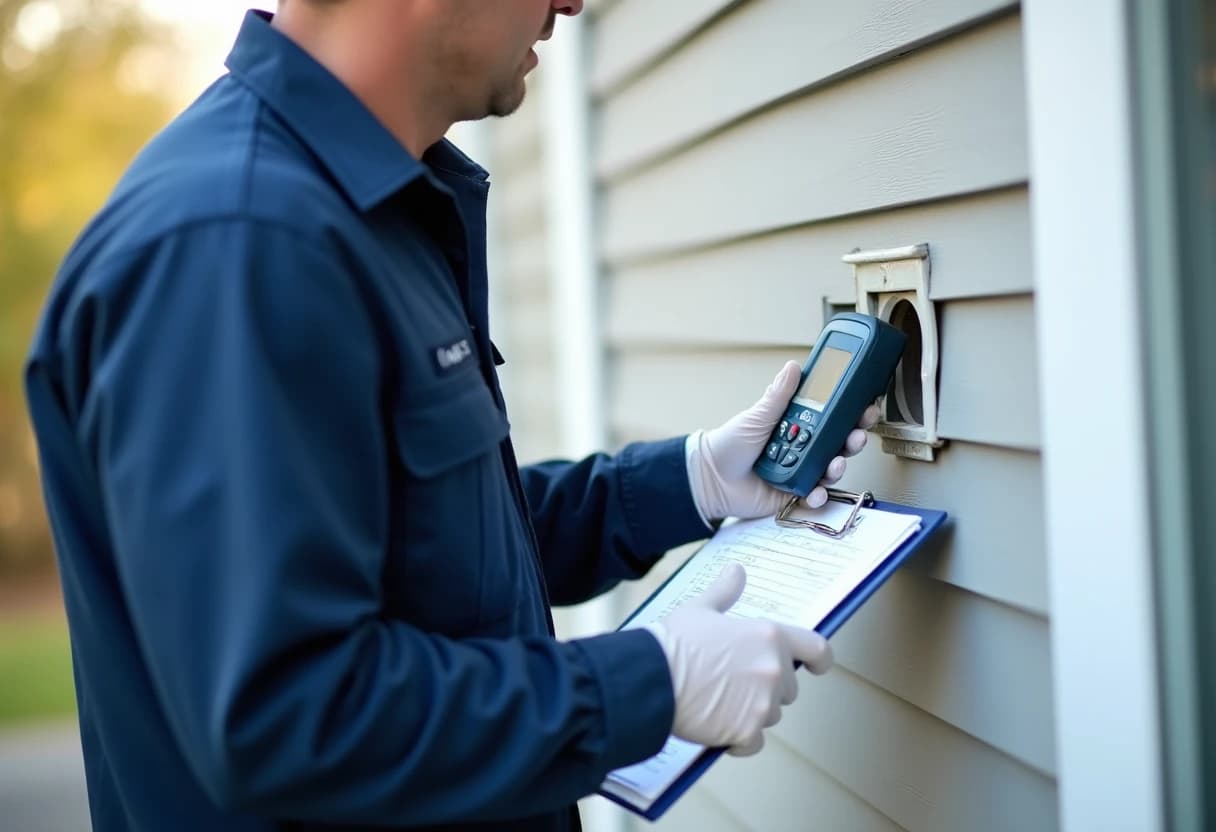
Not every dryer vent needs cleaning every year — but every dryer vent deserves inspecting every year, because the failure modes are silent and the worst-case outcome is a fire. Our Norwood inspection service exists for homeowners who want the truth about their vent without committing to a service they may not need. We measure exhaust airflow, camera the complete duct run, check the termination hood, verify the installation against code, and score the lint load. Roughly a third of the vents we inspect are fine, and we say so in writing. The rest get a documented finding and a flat-rate path to fixing it — your call, no pressure.
Why Dryer Vent Inspection & Safety Check Matters for Norwood Homes
The dryer vent is the only exhaust duct in your home that moves flammable material by design. Every load sheds lint; the trap catches most of it, and the rest travels the duct — where some fraction sticks at every elbow, joint, screw tip and rough surface along the way. Whether that accumulation is trivial or dangerous depends on the duct's length, geometry, material and history, which is exactly what an inspection evaluates. The residential code (IRC M1502) exists because these variables matter: it specifies smooth rigid metal duct, limits runs to 35 feet of equivalent length with deductions for every elbow, and prohibits screws that protrude into the airstream because each protruding tip becomes a lint anchor. Many Massachusetts homes — especially older ones retrofitted with laundry in basements or upper floors — violate one or more of these rules, often invisibly inside walls. A camera inspection is the only practical way to find out, and a written report is the only way to prove the vent's condition to an insurer, a buyer or a condo board.
The Norwood climate is quietly hard on dryer terminations. Norwood's compact prewar neighborhoods mean older duct retrofits with plenty of hidden joints, and homes near Route 1 and the Automile pick up a steady load of fine traffic particulate. We also service many of the town's two-families, where a single neglected basement dryer run can affect two households at once. Wind-driven rain, coastal air and freeze-thaw cycles corrode hoods and stiffen damper flaps, and by late winter we routinely find Norwood terminations that no longer open fully — or no longer close, inviting drafts and pests. Norwood was built out largely between 1900 and 1960, leaving a dense grid of American Foursquares, bungalows and capes around the Common, with two-families concentrated in South Norwood and later splits toward Westover. Most of the older homes started on steam or hot-water heat, so today's central-air and forced-air systems are retrofits packed into tight framing. A recent wave of apartment construction along Route 1 and near the commuter rail adds newer shared-system buildings to the mix. An annual inspection catches termination problems along with everything else: our checklist covers the hood, damper, exterior seal, duct interior, airflow volume, lint load and code compliance in one visit. Neighbors in Westwood and Walpole book us for the same annual check, which keeps our trucks in the area and appointment windows short.
Our Dryer Vent Inspection & Safety Check Process in Norwood
1Interview & Visual Assessment
Every inspection opens with a short conversation and a visual survey. Drying times, error codes, humidity in the laundry room and the age of the installation all steer the inspection. The technician checks the transition duct behind the dryer first — foil accordion duct and plastic flex are immediate findings, since both are recognized fire hazards.
2Airflow Measurement at the Termination
We quantify before we diagnose. An anemometer reading at the outside hood, taken while the dryer runs, measures delivered airflow against the benchmark a dryer needs to operate safely. Strong flow with a clean camera pass means a pass; weak flow tells us restriction exists and the camera's job is to find it.
3Full-Length Camera Inspection
An inspection camera travels the entire duct run from the dryer connection to the termination, recording as it goes. We are looking for lint accumulation and where it concentrates, separated or leaking joints, crushed or kinked sections, screws protruding into the airstream, moisture staining, and any nesting material — the full biography of a duct you cannot otherwise see.
4Termination Hood & Damper Check
We check the exit as carefully as the run. A damper that will not open steals airflow; one that will not close invites cold air, moisture and animals. We also flag code and safety issues here: mesh screens that catch lint, terminations too close to openings or grade, and hoods damaged by weather or renovation work.
5Lint-Load Assessment & Fire-Risk Scoring
We translate the inspection into a plain-English risk score. You will know approximately what percentage of the duct's cross-section remains open, where the worst accumulation sits, and how urgent intervention is. FEMA attributes roughly 2,900 dryer fires a year primarily to lint — the score tells you honestly where your vent stands relative to that risk.
6Code-Compliance Review
Many Massachusetts dryer runs predate modern code or were improvised during renovations, so this review frequently finds the root cause behind chronic lint problems: an over-length run, an accordion foil transition, a screened termination collecting lint like a filter. Identifying the violation matters because cleaning a non-compliant duct treats the symptom on a schedule; correcting it treats the cause once.
7Written Safety Report & Recommendations
Everything we measured and saw goes into a written safety report delivered the same day. Pass or fail, you have proof of the vent's condition — the document buyers ask for, insurers accept and associations require. If work is warranted, the report doubles as a precise scope, so any quote you gather is comparing the same job.
Benefits of Professional Dryer Vent Inspection & Safety Check in Norwood
Protection From Moisture & Carbon Monoxide
Gas dryer owners get an extra layer of safety from inspection: the same duct carrying lint and moisture carries combustion exhaust. Verified airflow and a tight, intact run mean carbon monoxide leaves the house completely — a check that takes minutes and covers a risk most homeowners never consider.
No Unnecessary Cleanings
The $79 inspection frequently saves the $200 cleaning. When airflow measures strong and the camera shows light accumulation, we say so in writing and leave. Customers who used to buy blind annual cleanings routinely discover their actual interval is longer — and their total maintenance spend drops accordingly.
Hidden Code Violations Exposed
Plastic flex duct in a wall, a 50-foot equivalent run, screws bristling into the airstream, a screened termination — these violations hide inside structures and cause chronic problems until someone cameras the run. Finding them converts a recurring symptom into a one-time fix.
Real-Estate & Insurance Documentation
Condo associations and landlords in Massachusetts are steadily adding dryer vent verification to their maintenance requirements after well-publicized multi-family lint fires. Our per-unit reports satisfy property managers and boards in one visit, with scheduling built for buildings — multiple units, one appointment block, individual documentation.
Fire Risk Caught Before It Matters
The roughly 2,900 dryer fires U.S. homes suffer each year share a common history: a restriction that built silently for years. Annual inspection breaks that pattern by catching declining airflow and accumulating lint at the measurement stage — years before the ignition stage. It is the cheapest intervention in fire prevention.
Lower Drying Costs & Longer Appliance Life
The economics are simple: restricted airflow taxes every single load, and the tax grows as the restriction does. Measurement catches the problem when it is small. Customers consistently report faster drying and lower utility bills after acting on inspection findings — savings that repeat weekly, every laundry day.
Signs Your Norwood Home Needs Dryer Vent Inspection & Safety Check
The Dryer or Laundry Room Feels Hot
Excess heat and humidity around a running dryer indicate the exhaust system is failing at its one job. Moist air leaking from joints fogs windows and dampens walls; heat backing up trips thermal safeties. Both symptoms show up clearly on an inspection — and both are early warnings worth heeding.
Recent Renovation, New Dryer or New Home
Just bought the house? Your home inspector almost certainly did not camera the dryer duct or measure its airflow — general inspections do not include it. Given that lint fires are among the most common preventable house fires, a dedicated vent inspection belongs on every new-owner checklist.
Insurance, Condo or Sale Requirements
If your carrier, condo board or property manager has asked for proof of dryer vent maintenance, that is the sign — the requirement itself. Our written report is built to satisfy exactly these requests: dated, photographed, measured and signed, delivered after a single visit.
Burning or Musty Smells During Operation
Musty smells on 'clean' laundry point to moisture lingering in the duct — often a low spot where condensation pools and lint mats into a damp plug. Beyond the odor, wet lint accumulations restrict flow badly and hide mold. The camera finds the low spot; the fix follows from there.
No Visible Exhaust at the Outside Hood
Lint visibly beard-ing around the exterior hood, a damper wedged with debris, or a termination that was painted or caulked over during exterior work — all common findings, all easily missed from ground level, and all fully documented during the exterior portion of our inspection.
Clothes Take More Than One Cycle
Drying time is the vent's report card. Loads that once took 45 minutes now taking 80 means delivered airflow has fallen substantially — and every extra minute is money and heat stress. If your laundry routine has quietly stretched over the past year, the duct is asking for an inspection.
Dryer Vent Inspection & Safety Check Cost in Norwood, MA
A standalone dryer vent inspection in Greater Boston runs $79 to $149, with most single-family homes landing near the middle. The variables are access and complexity: a first-floor laundry with a short run to a reachable exterior hood sits at the low end, while roof terminations, multi-story runs, stacked or hard-to-move appliances, and long concealed ducts requiring extended camera work move the price up. Multi-unit buildings are quoted per unit with volume discounts for associations and property managers booking a full building. What the fee always includes: anemometer airflow measurement, full-length camera inspection, exterior hood and damper evaluation, lint-load scoring, code-compliance review, and the written photographic report. What it never includes: pressure to buy anything. If cleaning or repair is warranted, you receive a flat-rate quote alongside the findings — and if we perform the cleaning during the same visit, the inspection fee is credited toward it, which is how most customers who need work choose to proceed.
Want the full pricing picture? See our complete Boston-area cost guide or call (617) 390-7145 for an exact flat quote for your Norwood home.
Local Knowledge: Norwood, Norfolk County
Every town's ductwork tells the story of its housing. Norwood was built out largely between 1900 and 1960, leaving a dense grid of American Foursquares, bungalows and capes around the Common, with two-families concentrated in South Norwood and later splits toward Westover. Most of the older homes started on steam or hot-water heat, so today's central-air and forced-air systems are retrofits packed into tight framing. A recent wave of apartment construction along Route 1 and near the commuter rail adds newer shared-system buildings to the mix. Norwood's compact prewar neighborhoods mean older duct retrofits with plenty of hidden joints, and homes near Route 1 and the Automile pick up a steady load of fine traffic particulate. We also service many of the town's two-families, where a single neglected basement dryer run can affect two households at once. We plan Norwood jobs around those realities, from equipment selection to time on site, and it shows in the results. If you live near Norwood Memorial Municipal Building or anywhere across Norwood's 02062 area, we have almost certainly cleaned a system like yours before — and we can tell you exactly what to expect before we arrive.
The Best Time of Year in Norwood
Massachusetts winters stress the exhaust side of a dryer in ways most owners never see. Warm, moist exhaust meeting sub-freezing duct sections condenses, and that condensation turns dry lint into wet mats that cling and clog. Terminations ice up; damper flaps freeze shut overnight and get forced by the morning's first load; snow drifts bury low wall hoods entirely. A mid-winter inspection is often the year's most revealing one — we routinely find seasonal blockages that did not exist in September. If drying times slow every January in your house, that pattern itself is a finding worth investigating.
Why Choose Boston Air Duct Cleaners
As a West Newton-based company, we treat Norwood like the neighborhood it is — because for us, it is. Our reputation lives or dies on local referrals, so every job gets the full process: complete system cleaning under negative pressure, mechanical agitation of every run, blower compartment service, and a documented walkthrough before we leave. We are licensed and insured, our estimates are free and flat, and our schedule holds same-day slots for urgent calls. One visit and you will understand why neighbors keep our magnet on the fridge.
Serving Norwood and Surrounding Communities
Beyond Norwood, our crews cover the surrounding communities daily — including Westwood, Walpole, Dedham, Canton, Sharon, Medfield. Because routes cluster geographically, booking alongside a neighboring appointment often unlocks same-day service and combined-visit savings. Wherever you are in Norfolk County, the same flat-rate pricing, insured technicians and photo-documented process applies.