
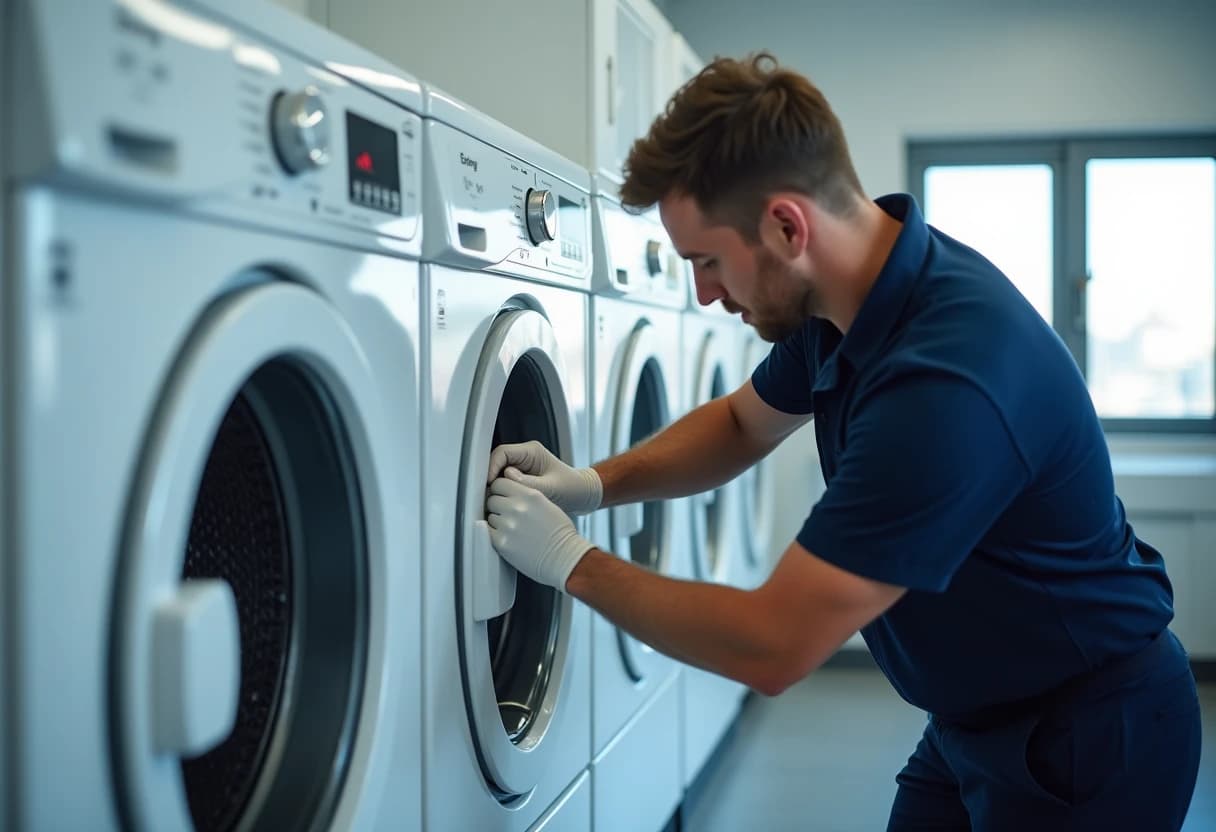
The call we never want to get from Roslindale is the one after the fire. Dryer fires are overwhelmingly preventable — lint-clogged venting is the leading cause, per FEMA and NFPA — and in multi-family buildings a single unit's blocked vent endangers every neighbor sharing the structure. That is why insurers, and increasingly master-policy underwriters, ask associations for documented vent maintenance. Our program gives Roslindale buildings the complete answer: scheduled whole-building cleanings with resident coordination handled by us, mechanical end-to-end cleaning of every vent and shared riser, immediate flagging of hazards like foil accordion transition ducts and crushed runs, and a unit-by-unit report formatted for board minutes and insurance files. Most buildings are completed in one to three days.
Why Commercial & Multi-Unit Dryer Vent Cleaning Matters for Roslindale Homes
Laundromats and high-duty commercial laundry face the same physics at industrial intensity. A commercial dryer cycling ten hours a day produces more lint in a week than a household machine does in a year, and that lint loads into manifolded duct systems that were often sized optimistically to begin with. The operational symptoms arrive before the fire risk peaks: dry times stretch, customers complain and leave, gas consumption climbs, high-limit switches trip, and machines cook their own components in the trapped heat. NFPA 211 and equipment manufacturers alike call for regular exhaust cleaning at commercial duty cycles — quarterly or better in busy stores, not the annual rhythm of a home. Our commercial program matches the interval to your throughput: full mechanical cleaning of each machine's run and every common trunk, termination and damper service, booster fan cleaning where installed, and airflow verification numbers before and after so you can see the recovery. Most operators find the service pays for itself in gas savings and machine uptime before the fire-safety benefit is even counted.
Multi-unit housing defines Roslindale, and its dryer venting shows the accumulated improvisation of decades. Roslindale grew as a streetcar suburb, and its hilly streets carry a friendly mix of 1900s-1920s triple-deckers, Colonial Revivals, bungalows and two-families, many still owned by the families who have held them for generations. First-time buyers priced out of JP have driven a wave of gut renovations that add central air and new ductwork to houses that spent a century on radiators. Basements here are often partially finished, hiding duct trunks behind paneling installed decades ago. In buildings like these, vents were often added long after construction — routed through basements, snaked to whatever wall was nearest, extended during renovations — and many have never been professionally cleaned since installation. Roslindale's renovation wave means we regularly clean brand-new duct systems that were contaminated during the construction that installed them - drywall dust in a never-used system is one of our most common findings here. The neighborhood's older two-families around the Village also produce classic long-run dryer vent problems, with basement dryers pushing lint uphill to grade-level terminations. Our crews work Roslindale buildings regularly and carry what its stock demands: rotary systems for long improvised runs, ladder and roof access for upper-floor terminations, and the patience for buildings where every unit's vent tells a different story. Boards get one proposal, one project, one per-unit report.
Our Commercial & Multi-Unit Dryer Vent Cleaning Process in Roslindale
1Building Walkthrough & Per-Unit Proposal
Every building project starts with a walkthrough: we identify how each unit vents — individual wall runs, shared vertical risers, common trunk lines — locate terminations on walls and roofs, note access requirements, and inspect representative runs. The proposal that follows prices the building flat, per unit, with riser and common-duct service itemized, so boards approve a known number.
2Resident Coordination & Scheduling
We treat resident experience as part of the deliverable: clear advance notices, tight arrival windows, uniformed technicians who protect floors and finish each unit in roughly 20 to 40 minutes, and a same-day completion log to management. Units we cannot access are documented — not silently skipped — and a make-up window is scheduled so the building report ends with every unit accounted for.
3Dryer-Side Service: Transition Duct & Connection
The first feet of the vent path fail most often: crushed transition hoses behind the dryer, lint packed at the wall connection, and prohibited foil accordion duct that sags into lint-collecting bellies. We service this section in every unit — machine pulled, area vacuumed, transition cleaned or replacement offered, connection remade properly — because a clean wall duct fed through a clogged transition solves nothing.
4Mechanical Cleaning of the Full Vent Run
Compressed-air whips and rotary brushes work the duct from the unit connection toward the termination, mechanically stripping the lint mat that blowers and leaf-blower shortcuts merely compact. Every elbow — each one worth 5 feet of equivalent length under code math, and each one a lint trap in practice — gets deliberate attention. Extracted lint is bagged per unit, which residents find quietly persuasive.
5Shared Risers, Common Trunks & Booster Fans
Common-element ducts get common-element treatment: documented condition before and after, cleaning with equipment sized for vertical and long-trunk work, and function checks on the mechanical components — booster fans, backdraft dampers, rooftop exhaust terminations — that keep a shared system moving air. For associations, this is the portion of the project that most clearly discharges the board's maintenance duty, and we document it accordingly.
6Termination Service & Exterior Verification
Exterior work is where multi-unit projects earn their price: terminations three stories up that no resident has ever seen, roof caps buried under winter ice damage, wall hoods behind shrubs. Each one is cleared of lint and debris, checked for damper function so it seals when idle and opens fully under flow, and photographed for the report. Damaged or non-compliant caps are flagged with replacement pricing.
7Airflow Verification & Building Compliance Report
Each cleaned run gets a functional verification — airflow at the termination with the dryer running, or anemometer readings where equipment access allows — so the report records outcomes, not just activity. The building deliverable lists every unit: cleaned and verified, no-access, or exception, with photos of hazards and itemized repair recommendations. Boards file it; insurers accept it; renewals cite it.
Benefits of Professional Commercial & Multi-Unit Dryer Vent Cleaning in Roslindale
Directly Reduced Fire Risk, Building-Wide
Fire prevention in shared-wall housing is collective by nature: one blocked vent endangers the neighbors, and no resident can clean the common risers. A coordinated cleaning is the only mechanism that actually resets the whole building's risk — every run, every riser, every termination verified clear on the same dated report.
Volume Pricing That Beats Unit-by-Unit Service
Coordinated projects are simply more efficient: one mobilization, sequenced access, crews completing multiple units per hour, shared risers cleaned once for everyone above them. We pass that efficiency through as per-unit volume pricing scaled to building size, which is why an annual program typically costs an association less per door than one emergency service call.
Shorter Dry Times & Lower Utility Costs
A lint-restricted vent forces dryers to run longer per load — frequently twice as long — and in buildings with common laundry or owner-paid utilities, that waste lands directly on the operating budget. Restored airflow returns machines to single-cycle drying, and laundromats often see the gas savings alone repay the cleaning within months.
Insurance & Liability Documentation That Holds Up
Master-policy renewals increasingly ask when dryer vents were last professionally cleaned, and after any fire, maintenance records become the story. Our per-unit compliance report — cleaned, verified, exceptions documented, hazards flagged in writing — is formatted for exactly those readers: underwriters at renewal, adjusters after a claim, and counsel if it ever comes to that.
Longer Dryer Life & Fewer Appliance Failures
Thermal fuse failures, the classic 'dryer runs but no heat' complaint, are overwhelmingly a venting symptom — the fuse did its job against trapped heat. Buildings on an annual cleaning program see this entire complaint category shrink, which residents experience as reliable machines and managers experience as a quieter work-order queue.
A Program, Not a Project
The real deliverable is the recurring cycle: annual (or duty-matched) cleanings calendared in advance, consistent per-unit pricing locked for program clients, the same report format every year so building condition trends are visible, and reminders that arrive before renewal questionnaires do. Boards approve it once; it protects the building indefinitely.
Signs Your Roslindale Home Needs Commercial & Multi-Unit Dryer Vent Cleaning
Burning Smells, Hot Laundry Areas or Tripped Thermal Fuses
Thermal fuses and high-limit switches exist to interrupt exactly this failure, and their tripping is diagnostic: heat had nowhere to go. Repeated no-heat service calls on building machines are the venting system burning through safety margins. Clean the exhaust paths before the next component in that chain is the lint itself.
No One Can Say When Vents Were Last Cleaned
New management contracts and board turnovers routinely surface this gap: dryer vents appear in no budget, no vendor list and no maintenance log. It is among the first items worth correcting, because it combines genuine fire risk with an insurer-facing documentation hole — and because the first cleaning doubles as a building-wide inspection.
Insurance Questionnaires or Post-Incident Requirements
When the master-policy renewal asks 'When were dryer vents last professionally cleaned?', the underwriting message is explicit: this risk is on their radar, and undocumented buildings price accordingly. A completed building-wide cleaning with per-unit reporting answers the question directly — and answering it before renewal season is markedly cheaper than answering it after a nonrenewal notice.
High-Duty Operations: Laundromats & Common Laundry Rooms
Commercial duty cycles compress the maintenance calendar: a laundromat dryer produces in weeks the lint a household machine makes in a year, loading manifolded ducts continuously. If your store has never set a cleaning interval matched to throughput, the venting is overdue by definition — quarterly service is typical for busy operations.
Dryers Taking Two or More Cycles Per Load
The test is simple: a healthy dryer with clear venting dries a standard load in one cycle. Track your building's work orders — clusters of slow-dry, no-heat and thermal-fuse tickets are the venting system asking for service, and each ticket represents a unit running its dryer at elevated temperature against a restricted duct.
Lint Visible at Terminations or on the Building Exterior
Lint beards on wall caps, gray fuzz on the siding below terminations, or lint scatter on the roof around stack outlets mean the ducts are so loaded they are extruding their contents. What escapes outside is the overflow; the accumulation inside the run is worse, and the affected units are drying against serious restriction.
Commercial & Multi-Unit Dryer Vent Cleaning Cost in Roslindale, MA
Annual program pricing is where the economics get genuinely favorable. Buildings on our recurring schedule receive locked per-unit rates, priority booking in the spring and fall rush, and lighter-touch renewal cleanings — because a vent cleaned twelve months ago needs maintenance, not excavation, and we price the difference honestly. Most associations find the steady-state annual cost per door runs 20–30% below their first catch-up cleaning, which had years of accumulation to remove. Laundromats and common laundry rooms price by machine count and duty cycle rather than by unit: figure roughly $30–$60 per machine per visit at quarterly intervals for busy stores, with common manifolds and booster fans included in scope. Operators should weigh that against the other side of the ledger — gas waste from restricted exhaust, machine downtime, and element and fuse replacements — which for high-throughput stores routinely exceeds the cleaning cost on its own.
Want the full pricing picture? See our complete Boston-area cost guide or call (617) 390-7145 for an exact flat quote for your Roslindale home.
Local Knowledge: Roslindale, Suffolk County
Serving Roslindale means knowing Roslindale. Roslindale grew as a streetcar suburb, and its hilly streets carry a friendly mix of 1900s-1920s triple-deckers, Colonial Revivals, bungalows and two-families, many still owned by the families who have held them for generations. First-time buyers priced out of JP have driven a wave of gut renovations that add central air and new ductwork to houses that spent a century on radiators. Basements here are often partially finished, hiding duct trunks behind paneling installed decades ago. Roslindale's renovation wave means we regularly clean brand-new duct systems that were contaminated during the construction that installed them - drywall dust in a never-used system is one of our most common findings here. The neighborhood's older two-families around the Village also produce classic long-run dryer vent problems, with basement dryers pushing lint uphill to grade-level terminations. Those conditions shape how we work here: which brush heads come off the truck, how we protect finishes in older interiors, and what we expect to find when the camera goes into a 02131 duct system. Our crews are in and around Roslindale nearly every week — often for neighbors of past customers — so scheduling is fast and our arrival windows hold.
The Best Time of Year in Roslindale
Winter is dryer-fire season in New England, and the mechanics are seasonal in every direction. Cold months mean heavier laundry — flannels, fleeces, blankets — that sheds more lint per load; closed-up buildings mean any exhaust leak or interior-terminating vent dumps moisture where it condenses; and frozen or lint-jammed termination flaps restrict airflow exactly when dryers work hardest. Fire departments nationally see dryer-fire incidence peak in winter, and Massachusetts buildings fit the pattern. Fall is therefore the smart season for building-wide cleaning: every run cleared and every damper verified before the heavy-laundry months, and the project completed while roof and ladder access is still comfortable. Associations that anchor their annual cycle to September and October get the protection when it matters most — and beat the scheduling rush.
Why Choose Boston Air Duct Cleaners
Homeowners across Suffolk County choose Boston Air Duct Cleaners for three reasons. First, honesty: our inspection camera tells you whether your system actually needs cleaning — and sometimes the answer is no. Second, capability: truck-grade negative-air machines, rotary brush systems and HEPA filtration handle everything from antique gravity-furnace conversions to brand-new high-velocity systems. Third, accountability: flat quoted pricing, before-and-after photos, insured technicians, and a real local office you can call at (617) 390-7145. That combination is rarer in this industry than it should be.
Serving Roslindale and Surrounding Communities
Roslindale sits in the heart of our service area, and neighboring West Roxbury, Jamaica Plain, Dedham, Milton, Roxbury, Dorchester appointments share the same routes. That density is why our response times in this part of Suffolk County are among our fastest — and why you will see our trucks in the area week after week.