
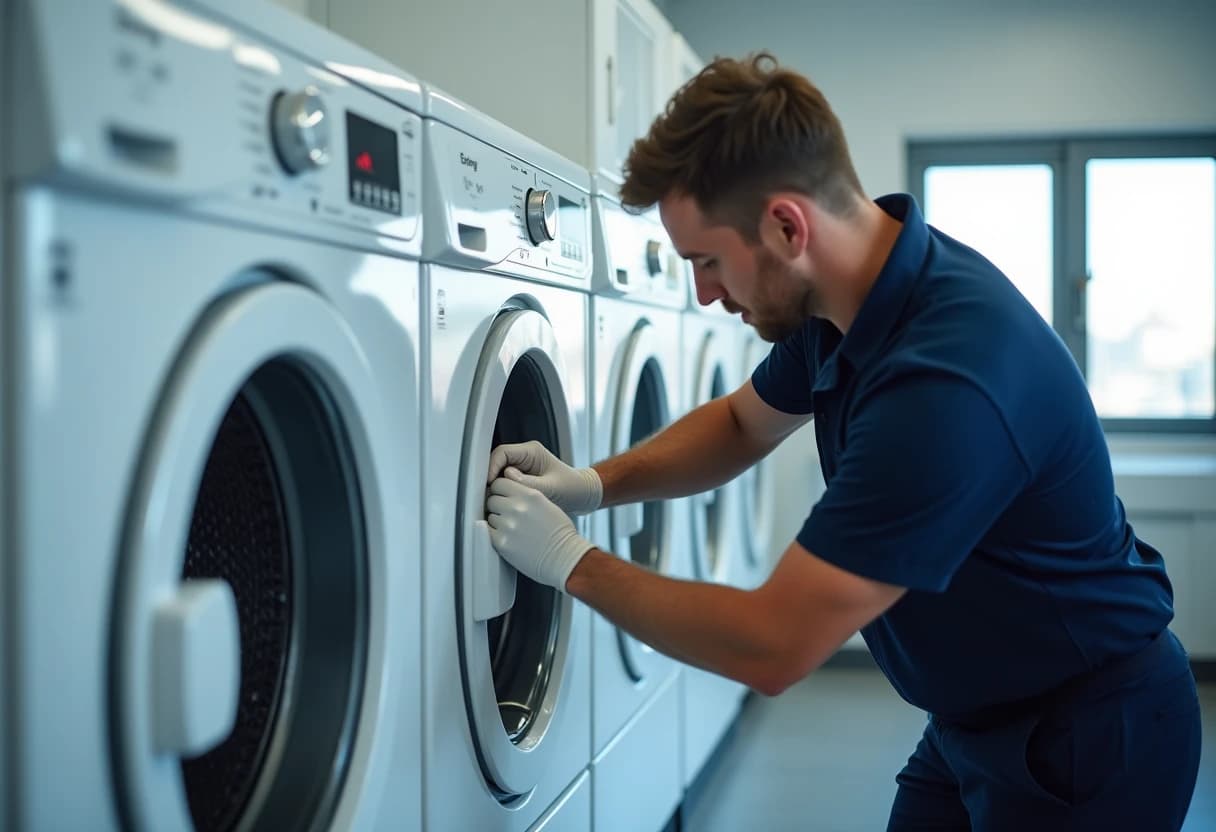
Every dryer in your building is a small fire waiting on maintenance. FEMA attributes roughly 2,900 clothes dryer fires a year in US homes to exactly the failure this service prevents — lint accumulation in vents and ducts, the leading ignition factor. For condo associations, HOAs, apartment owners and property managers in Whitman, that risk multiplies by the unit count: dozens of dryers, dozens of vent runs, and in many buildings shared risers where one resident's lint becomes everyone's hazard. Our multi-unit dryer vent cleaning program handles the whole building in one coordinated visit — every unit's vent mechanically cleaned end to end, airflow verified, exceptions documented — and closes with a per-unit compliance report your board, manager and insurance carrier can file.
Why Commercial & Multi-Unit Dryer Vent Cleaning Matters for Whitman Homes
Multi-family buildings accumulate venting problems single homes never see. Stacked units in mid-rise and high-rise construction often share vertical risers — one common duct serving multiple dryers — where lint from every household compounds and where no individual resident can clean even if they try. Long horizontal runs snake through ceiling plenums to reach an outside wall, exceeding the code intent of the IRC's 35-foot equivalent-length limit once elbows are deducted. Renovations leave behind crushed flex duct, illegal screw-joined sections that snag lint, and foil accordion transitions that both the code and every dryer manufacturer warn against. Terminations get painted shut, screened over (another code violation — screens trap lint), or blocked by bird nests three stories up where nobody looks. Our crews see all of it weekly, and the whole-building service is designed for it: equipment for vertical risers and roof terminations, unit-by-unit condition documentation, and honest flagging of the hazards that cleaning alone cannot fix, priced separately for board approval. You cannot manage what has never been inspected — and most buildings have never been inspected.
Ask any fire official who works near Whitman Town Hall: dryer fires in multi-family buildings are among the most preventable calls they run. Whitman grew up around its shoe factories, and the streets near the center still hold the Victorians and workers' cottages of that era, ringed by postwar capes and ranches and a scattering of newer colonials. Many of the factory-era homes have been converted from oil boilers to forced-air systems over the years, often reusing narrow chases never meant for ductwork. Older multi-unit stock compounds the risk — long vent runs to reach exterior walls, shared chases, foil accordion transitions installed decades ago that code and manufacturers now prohibit. Whitman - famous as the birthplace of the Toll House chocolate chip cookie - is a classic commuter-rail town where older homes change hands quickly, and new owners often discover their duct system was last cleaned decades ago, if ever. The compact lots and full basements typical here also mean dryer vents frequently run long distances to reach an outside wall, a classic lint-fire risk profile. Our whole-building service is built for exactly this: every Whitman unit's vent mechanically cleaned end to end, hazardous configurations photographed and flagged in writing, terminations cleared and damper function verified, and a compliance report your association's insurer will actually accept.
Our Commercial & Multi-Unit Dryer Vent Cleaning Process in Whitman
1Building Walkthrough & Per-Unit Proposal
First we learn your building's venting anatomy, because no two multi-unit buildings vent alike. Stacked risers, basement manifolds, improvised renovation-era runs and individual wall vents each demand different equipment and time. The walkthrough maps it, a camera check of representative runs establishes condition honestly, and your written proposal reflects the actual building — not a per-vent teaser that grows on site.
2Resident Coordination & Scheduling
We treat resident experience as part of the deliverable: clear advance notices, tight arrival windows, uniformed technicians who protect floors and finish each unit in roughly 20 to 40 minutes, and a same-day completion log to management. Units we cannot access are documented — not silently skipped — and a make-up window is scheduled so the building report ends with every unit accounted for.
3Dryer-Side Service: Transition Duct & Connection
The first feet of the vent path fail most often: crushed transition hoses behind the dryer, lint packed at the wall connection, and prohibited foil accordion duct that sags into lint-collecting bellies. We service this section in every unit — machine pulled, area vacuumed, transition cleaned or replacement offered, connection remade properly — because a clean wall duct fed through a clogged transition solves nothing.
4Mechanical Cleaning of the Full Vent Run
We clean mechanically, not just pneumatically: a spinning brush head sized to the duct scrubs the full circumference along the entire run while vacuum extraction carries lint out of the building. Runs that exceed sensible lengths, hidden crush points and disconnections announce themselves during this pass, and anything cleaning cannot fix is documented with location and photos for the building's repair planning.
5Shared Risers, Common Trunks & Booster Fans
High-rise and mid-rise venting is a system, not a bundle of individual runs. Our crews clean shared risers top-down from roof terminations with weighted rotary lines, verify each unit's takeoff where it joins the common duct, and confirm draft through the full stack afterward. Central exhaust fans and pressure-relief dampers serving laundry stacks are cleaned and checked in the same mobilization.
6Termination Service & Exterior Verification
Every vent ends at a termination, and terminations fail constantly: flaps stuck open to pests or frozen shut with lint, screens added by well-meaning painters (code prohibits them — they trap lint), caps crushed or painted over, bird and rodent nests in the hood. We clear and verify every termination, on walls or roofs, with ladder and roof access included in the project scope.
7Airflow Verification & Building Compliance Report
Verification is what separates a maintenance program from a receipt. We confirm restored airflow run by run, re-photograph representative ducts against their before images, and compile the compliance report: every unit's status, every exception explained, every hazard located and pictured, every recommendation priced separately for board action. Associations on our annual program receive the same format each cycle, so year-over-year condition is genuinely comparable.
Benefits of Professional Commercial & Multi-Unit Dryer Vent Cleaning in Whitman
Volume Pricing That Beats Unit-by-Unit Service
A single-home dryer vent cleaning in Greater Boston runs $150–$250; on a coordinated building project, per-unit pricing drops steeply — often to a fraction of retail — because mobilization, travel and setup are shared across dozens of units. The building gets professional service in every unit for less than residents could ever arrange individually.
Insurance & Liability Documentation That Holds Up
Master-policy renewals increasingly ask when dryer vents were last professionally cleaned, and after any fire, maintenance records become the story. Our per-unit compliance report — cleaned, verified, exceptions documented, hazards flagged in writing — is formatted for exactly those readers: underwriters at renewal, adjusters after a claim, and counsel if it ever comes to that.
Shorter Dry Times & Lower Utility Costs
Every minute of extra runtime is heat pushed against a clogged duct: wasted energy, elevated temperatures, and accelerated wear. Post-cleaning, residents notice loads finishing in one cycle again — the most tangible everyday benefit of the program and the one that quiets the steady trickle of 'my dryer is broken' maintenance tickets.
Hazard Discovery Before It Costs You
Every exception we flag is a future incident pre-empted: the crushed run behind a renovated wall, the riser takeoff installed backwards, the termination flap frozen shut that made one unit's dryer exhaust into the building. Boards receive these findings prioritized and priced, converting unknown risks into a manageable repair list.
Directly Reduced Fire Risk, Building-Wide
The comparison that matters is cost per risk retired. For a modest per-door price, an association eliminates its most preventable fire hazard for the year — one whose national loss statistics, per NFPA and FEMA, are driven precisely by the maintenance being skipped. Few line items in a reserve study buy comparable protection per dollar.
A Program, Not a Project
The real deliverable is the recurring cycle: annual (or duty-matched) cleanings calendared in advance, consistent per-unit pricing locked for program clients, the same report format every year so building condition trends are visible, and reminders that arrive before renewal questionnaires do. Boards approve it once; it protects the building indefinitely.
Signs Your Whitman Home Needs Commercial & Multi-Unit Dryer Vent Cleaning
Foil Accordion Ducts or Improvised Vent Runs in Units
Improvised venting accumulates in multi-unit buildings with every renovation and appliance swap: plastic flex hose, screw-joined sections snagging lint in the airstream (a specific code prohibition), runs far beyond the 35-foot equivalent-length intent once elbows are counted. A building-wide cleaning doubles as the survey that finally catalogs these conditions.
No One Can Say When Vents Were Last Cleaned
Buildings inherit their venting history blind: previous owners' renovations, decades of resident turnover, and zero records. FEMA's dryer-fire data — about 2,900 a year, led by failure to clean — describes exactly this population of never-serviced vents. A documented first cleaning moves your building out of that statistic's denominator.
High-Duty Operations: Laundromats & Common Laundry Rooms
Shared laundry rooms in apartment and condo buildings combine commercial duty with residential oversight — machines run all day, but no one owns the maintenance. Booster fans cake with lint and stall, common trunks load up, and the room runs hot. If your building's laundry room fits that description, it is the building's single most overdue vent.
Lint Visible at Terminations or on the Building Exterior
Terminations that never fully close — propped open by lint mats — do double damage: they confirm heavy internal accumulation, and they hold an open door for pests, drafts and winter freeze-up. Any visible lint at an exterior outlet justifies putting a camera and a brush through that run promptly.
Burning Smells, Hot Laundry Areas or Tripped Thermal Fuses
A hot, linty smell during dryer operation is the machine overheating against restricted exhaust — the exact precondition of a lint fire. Treat it as urgent in any building: the affected unit's run needs immediate inspection, and one unit's condition in a shared-riser building is a reasonable proxy for its neighbors'.
Dryers Taking Two or More Cycles Per Load
Residents report it as an appliance problem — 'the dryer is getting old' — but two-cycle drying is a venting symptom far more often than a machine failure. Before replacing dryers or fielding another season of complaints, verify the exhaust path; in multi-unit buildings a pattern of slow-dry complaints maps reliably onto clogged runs and risers.
Commercial & Multi-Unit Dryer Vent Cleaning Cost in Whitman, MA
Why volume pricing works in the association's favor: the expensive parts of vent cleaning are mobilization and setup, and a building project pays for them once across dozens of units. Crews sequenced through an access schedule complete multiple units per hour, so a 24-unit building might complete in a day at a per-door price no resident could obtain individually. Complexity moves the number: buildings where every unit vents a short run to its own wall cap sit at the low end near $40–$60 per unit; mid-rises with stacked risers, roof terminations and long ceiling runs price toward $70–$90 plus itemized riser service; and buildings needing hazard remediation — foil transition replacements (typically $45–$85 per unit installed), termination cap replacements, disconnected-run repairs — receive those items priced separately for board approval, never folded silently into the cleaning invoice.
Want the full pricing picture? See our complete Boston-area cost guide or call (617) 390-7145 for an exact flat quote for your Whitman home.
Local Knowledge: Whitman, Plymouth County
Every town's ductwork tells the story of its housing. Whitman grew up around its shoe factories, and the streets near the center still hold the Victorians and workers' cottages of that era, ringed by postwar capes and ranches and a scattering of newer colonials. Many of the factory-era homes have been converted from oil boilers to forced-air systems over the years, often reusing narrow chases never meant for ductwork. Whitman - famous as the birthplace of the Toll House chocolate chip cookie - is a classic commuter-rail town where older homes change hands quickly, and new owners often discover their duct system was last cleaned decades ago, if ever. The compact lots and full basements typical here also mean dryer vents frequently run long distances to reach an outside wall, a classic lint-fire risk profile. We plan Whitman jobs around those realities, from equipment selection to time on site, and it shows in the results. If you live near Toll House cookie birthplace site or anywhere across Whitman's 02382 area, we have almost certainly cleaned a system like yours before — and we can tell you exactly what to expect before we arrive.
The Best Time of Year in Whitman
Budget season is the other calendar that matters. Condo boards and HOAs typically set budgets in fall for January fiscal years, and management companies batch portfolio maintenance into spring and fall windows — so the associations that get the best scheduling are the ones whose proposals are in hand before the budget meeting, not after the insurance renewal letter. Our walkthroughs and written building proposals are free and typically delivered within a week, which makes September the ideal month to price a program for board approval, October through November the prime execution window, and spring the natural slot for portfolio managers batching multiple properties. Insurance renewal dates deserve the same planning: a completed compliance report dated before the questionnaire arrives reads as a program; one dated after reads as a scramble. We calendar program buildings so the report always predates the renewal.
Why Choose Boston Air Duct Cleaners
We built this company around the jobs other duct cleaners do badly: the 130-year-old Victorian with panned-joist returns, the Whitman condo with a 60-foot dryer run to the roof, the post-renovation house full of drywall dust. Our crews see Greater Boston's hardest systems every week, and the experience shows in the details — floor protection on the way in, sealed registers during the work, HEPA-vacuumed work areas on the way out, and imagery that proves the ducts are actually clean. Call (617) 390-7145 and judge the difference from the first conversation.
Serving Whitman and Surrounding Communities
Beyond Whitman, our crews cover the surrounding communities daily — including Abington, Brockton, Hanson, East Bridgewater, Rockland, Holbrook. Because routes cluster geographically, booking alongside a neighboring appointment often unlocks same-day service and combined-visit savings. Wherever you are in Plymouth County, the same flat-rate pricing, insured technicians and photo-documented process applies.