
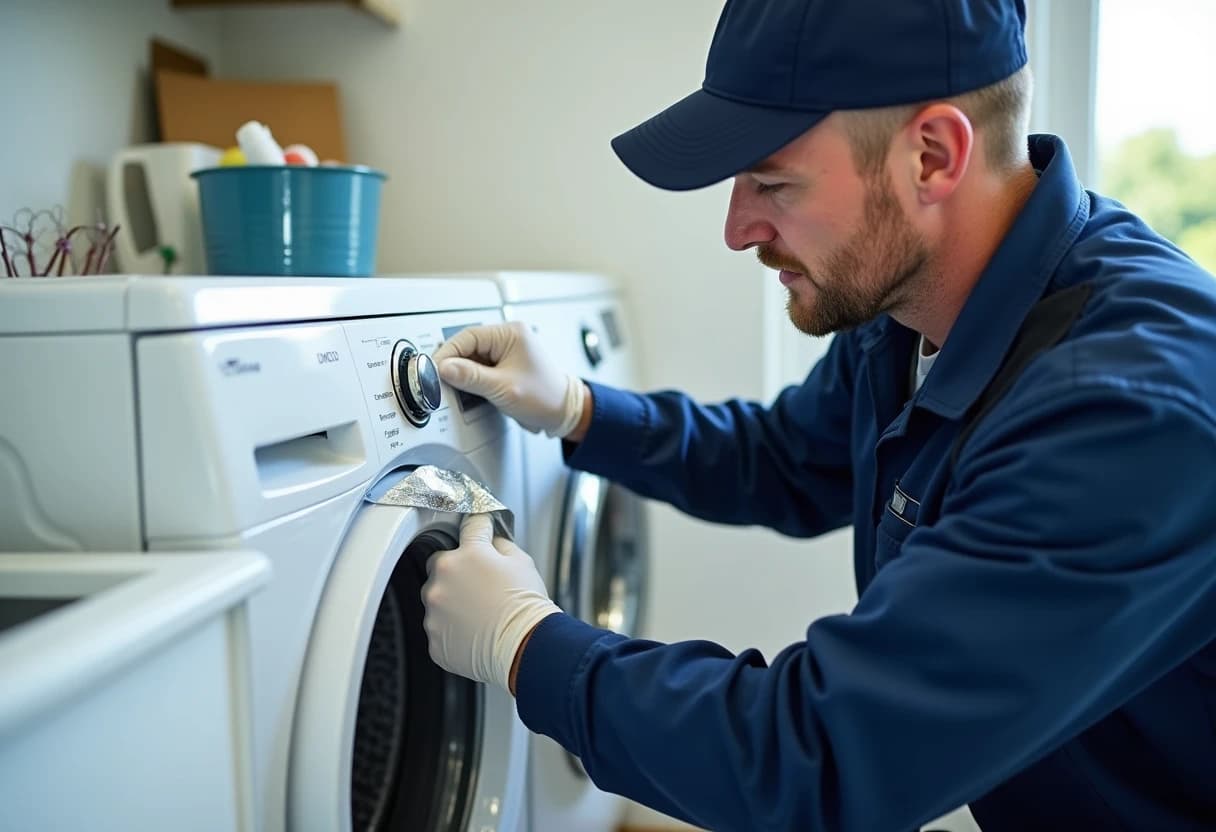
That flattened foil hose behind your dryer is doing more damage than it looks. Crushed transition ducts are the most common dryer vent failure we find in Winthrop homes — the machine gets pushed back against the wall, the accordion hose collapses to a fraction of its diameter, and the dryer spends years straining against a pinched exhaust while lint packs the kink. We replace these hazards with semi-rigid aluminum connectors and repair everything downstream too: separated joints, sagging runs, holes rusted through duct walls, and exterior hoods that no longer close against weather and pests. Done right, with the materials the code requires, a repaired vent runs trouble-free for decades.
Why Dryer Vent Repair Matters for Winthrop Homes
Condensation problems deserve their own diagnosis, because they mimic other failures and defeat simple cleaning. The physics: dryer exhaust leaves the drum warm and nearly saturated with moisture. If the duct passes through a cold basement, garage, crawlspace or attic — as most retrofitted Massachusetts laundry runs do — the exhaust cools below its dew point and water condenses inside the duct. The consequences cascade: condensate soaks passing lint into heavy mats that block the line; pooled water corrodes galvanized duct from the inside until pinholes leak onto ceilings; water drains backward through joints and drips behind the dryer; and in the worst winter cases, condensate freezes at the termination and seals the vent entirely. The repairs are specific and effective: restore continuous slope so water drains outward, seal the joints it has been escaping through, insulate the cold duct sections, shorten or reroute runs where the design is hopeless, and replace corroded segments. Guessing at it wastes money; our inspection identifies which combination your vent actually needs.
Dryer vent damage in Winthrop is largely a story about the buildings. Winthrop packs Victorian-era seaside cottages, gambrel two-families and early-1900s multifamilies onto a dense peninsula where nearly every home is within a half mile of open ocean. Heating is historically boiler-based, so the forced-air and heat-pump systems now common here are almost all retrofits worked into compact framing with short, twisting duct runs. Laundry hookups in homes like these were added long after construction, so vents thread through old framing, hug cold foundation walls and rely on joints assembled in cramped, concealed spaces — precisely the conditions that produce separations, crush points and condensation. Salt air is the defining factor in Winthrop - exterior dryer vent hoods, flappers and duct terminations corrode and seize faster on this peninsula than anywhere else we service, and ocean humidity keeps interior duct surfaces damp enough to hold odors. Wind-driven sand and salt spray off Winthrop Beach also work into exterior intakes on the water-facing sides of homes. Our repair crews work in Winthrop weekly and arrive equipped for its housing stock: rigid metal duct and fittings in the sizes older runs need, insulation for cold-space sections, and the patience concealed ductwork demands.
Our Dryer Vent Repair Process in Winthrop
1Diagnose the Full Exhaust Path
Repair starts with finding every failure, not just the obvious one. We trace the duct from the dryer's outlet to the exterior termination, inspecting each accessible section and joint, and test airflow at both ends with the dryer running. Weak exterior flow with strong drum heat means the exhaust is escaping en route — and we find where.
2Protect the Area & Open Access
Before repair work, we protect floors and finishes along the work path, move the dryer out carefully on sliders, and set up at the failure points. Where a concealed joint requires access, we discuss options first — many repairs can be made from existing openings, and when cutting is unavoidable we keep openings minimal and tell you exactly what restoration will involve.
3Reconnect & Properly Fasten Separated Joints
We do not just push a failed joint back together; we rebuild it so it cannot fail the same way. That means cleaning mating surfaces, correcting the misalignment or unsupported weight that pulled the joint apart, adding hangers or strapping where the run lacked support, and sealing the finished connection against both air and moisture leakage.
4Replace Crushed, Corroded or Non-Compliant Sections
Vinyl and foil accordion duct found anywhere in the run is removed on sight and replaced: rigid metal for the concealed run, a short UL-listed semi-rigid aluminum connector at the appliance. The smooth interior of proper duct resists lint accumulation dramatically better than corrugations — the repair also makes every future cleaning faster and more effective.
5Cure Condensation: Slope, Seal & Insulate
Condensation repairs follow the water. We restore continuous slope toward the termination so condensate drains out instead of pooling; seal the joints it has been leaking through with foil tape rated for the duty; and insulate duct sections crossing unheated basements, garages, attics and exterior wall bays so exhaust stays above its dew point until it exits.
6Repair or Replace the Exterior Hood & Damper
The new hood is sealed to the wall correctly: fastened to siding or masonry, flashed and caulked so wind-driven rain stays out of the wall assembly, with the duct connection sealed inside. On brick and stone, we drill and anchor rather than improvise; on clapboard, we integrate with the siding plane. The termination should outlast the roof.
7Replace the Transition Duct & Reset the Dryer
The appliance connection is rebuilt to spec: a UL-listed semi-rigid aluminum transition duct, as short and straight as the layout allows, secured with clamps at both ends. We position the dryer so the connector keeps its full diameter — not crushed against the wall — and mark the safe distance so future pushes do not recreate the old kink.
8Verify Airflow & Document the Repair
Finally we log the service and recommend a cleaning schedule for the repaired system — typically annual. A repaired vent with smooth rigid duct and a proper termination accumulates lint far more slowly than the failed system it replaced, and the documentation we leave shows exactly what is now behind your walls.
Benefits of Professional Dryer Vent Repair in Winthrop
Moisture Out of Your Walls and Ceilings
In New England's freeze-thaw climate, moisture in building assemblies does compounding damage each winter. Sealing a leaking dryer vent removes one of the few moisture sources that operates year-round, indoors, by the gallon. Building scientists put exhaust integrity high on the envelope checklist for exactly this reason.
Restored Drying Performance
Because the leak or crush also lets conditioned air escape or exhaust recirculate, repairs frequently improve more than laundry: cold-air infiltration through a stuck-open damper ends, and the laundry room stops swinging between sauna and icebox with the seasons.
Lower Energy and Repair Bills
A failed exterior damper is a hole in your heated envelope all winter — a 4-inch duct delivering January directly to your laundry room. Replacing it with a tight-closing hood pays for itself in heating savings and comfort, entirely apart from what it does for the dryer.
Pest Entry Points Closed
We remove existing nesting material as part of termination repair and clean the affected duct section, because a nest is both a blockage and a sanitation issue in an airstream that passes your clothing. The new hood's pest protection is chosen to exclude animals without the lint-trapping mesh that code prohibits.
Code Compliance & Inspection-Ready Documentation
Dryer venting is a standard flag on Massachusetts home inspections: vinyl flex, taped joints, screened hoods and overlong runs all appear in reports and complicate sales. Our repairs bring the system to current code — rigid metal, compliant joints, proper termination — with photo documentation that answers inspector and buyer questions before they are asked.
A Serious Fire Hazard, Eliminated
A breached or restricted dryer vent combines the two ingredients of the roughly 2,900 annual US dryer fires: accumulating lint and rising exhaust temperatures. Repair removes both — the escape points that seed wall cavities with fuel, and the crush points and blockages that overheat the system. It is fire prevention with a wrench, and it lasts for decades.
Signs Your Winthrop Home Needs Dryer Vent Repair
Musty or Mildew Smell in the Laundry Area
A persistent damp smell around the laundry — or in one adjacent wall or ceiling — often means exhaust moisture has been feeding hidden mildew via a leak or chronic condensation. The odor is the nose's report on a moisture problem the eyes cannot see. A vent-path inspection locates the escape point, and repair dries up its food supply.
Lint Appearing Where It Shouldn't
Lint around the exterior hood is normal in small amounts; lint anywhere else along the run is not. Interior lint accumulation is doubly serious because it is fuel collecting where no cleaning schedule can reach it — the escape point must be sealed, and the accessible accumulation removed.
Exterior Damper Broken, Stuck or Missing
Cold drafts in the laundry room trace to the damper more often than to windows: a flap that no longer closes turns the duct into a 4-inch outside-air inlet. If the laundry area runs noticeably colder in winter than adjacent rooms, put the hood on your inspection list — the heating-season savings from a tight new damper are immediate.
A Home Inspection or Appliance Tech Flagged the Vent
Condo associations increasingly require documented vent compliance after regional dryer fire losses. If your building has sent a notice, we handle the full cycle: inspection, written scope for board approval, code-compliant repair, and completion records with photos. One visit, and your unit's file is closed.
Slow Drying That Cleaning Didn't Fix
The symptom pattern is diagnostic: strong heat in the drum with weak or absent airflow at the exterior hood means exhaust is going somewhere else. That somewhere is the failure point. It is a fifteen-minute find for a technician with airflow instruments and knowledge of how these runs are routed in local housing.
Water Stains, Drips or Peeling Paint Near the Vent Path
A ceiling stain below a second-floor laundry, paint bubbling behind the dryer, or drips from a basement duct joint all point to exhaust moisture escaping or condensing in the run. Each load adds another gallon of vapor to the problem. Repair — sealing, sloping, insulating or replacing the affected section — stops the source; cosmetic fixes without it just repaint the symptom.
Dryer Vent Repair Cost in Winthrop, MA
Dryer vent repair in Greater Boston typically runs $150 to $450, and the spread is about what failed and where. At the low end: transition hose replacement with a compliant semi-rigid connector, exterior hood and damper replacement, or reconnecting an accessible separated joint — each roughly $150 to $250 including parts. Mid-range, $250 to $350, covers replacing damaged duct sections with rigid metal, curing condensation with re-sloping, sealing and insulation, or repairs involving moderate access work. The top of the range, $350 to $450, reflects concealed-joint repairs requiring access openings, multi-failure jobs combining several fixes, corroded runs needing substantial replacement, or difficult terminations on upper walls and roofs. Every quote is flat and follows a diagnosis you can see — photos of the actual failure — so you know what you are paying to fix. If damage is extensive enough that full replacement or rerouting makes better sense than repair, we say so and quote that option separately rather than selling repairs onto a duct that has reached its end.
Want the full pricing picture? See our complete Boston-area cost guide or call (617) 390-7145 for an exact flat quote for your Winthrop home.
Local Knowledge: Winthrop, Suffolk County
Every town's ductwork tells the story of its housing. Winthrop packs Victorian-era seaside cottages, gambrel two-families and early-1900s multifamilies onto a dense peninsula where nearly every home is within a half mile of open ocean. Heating is historically boiler-based, so the forced-air and heat-pump systems now common here are almost all retrofits worked into compact framing with short, twisting duct runs. Salt air is the defining factor in Winthrop - exterior dryer vent hoods, flappers and duct terminations corrode and seize faster on this peninsula than anywhere else we service, and ocean humidity keeps interior duct surfaces damp enough to hold odors. Wind-driven sand and salt spray off Winthrop Beach also work into exterior intakes on the water-facing sides of homes. We plan Winthrop jobs around those realities, from equipment selection to time on site, and it shows in the results. If you live near Yirrell Beach or anywhere across Winthrop's 02152 area, we have almost certainly cleaned a system like yours before — and we can tell you exactly what to expect before we arrive.
The Best Time of Year in Winthrop
The freeze-thaw cycle is uniquely hard on the exterior components of New England dryer vents. Damper hinges and springs work loose as metal expands and contracts; caulk joints between hood and siding crack open, letting wind-driven rain into the wall; and ice forming in the hood from condensing exhaust bends flaps out of true a little more each season. Coastal and near-coastal homes add salt corrosion, which seizes hinges and eats galvanized steel years ahead of schedule. This is why we treat termination inspection as part of every service call: the hood fails gradually, then suddenly, and replacing it during a routine visit costs a fraction of the cascade — drafts, pests, blockage — that a failed one begins.
Why Choose Boston Air Duct Cleaners
What separates us from the coupon crowd is simple: we do the whole job, we prove it, and we charge what we quoted. Our technicians clean supplies, returns, trunks and blower compartments on every visit — never a cosmetic vent wipe. Photo documentation comes standard, pricing is flat and confirmed up front, and our trucks carry true commercial vacuum equipment, not rented shop-vacs. Based in West Newton and serving Winthrop year-round, we answer our own phone at (617) 390-7145 and stand behind every cleaning with a satisfaction guarantee.
Serving Winthrop and Surrounding Communities
We serve every community around Winthrop as well: East Boston, Revere, Chelsea, Boston, Everett, Lynn all fall inside our regular service routes. If you have a second property, a rental, or family nearby, ask about multi-home scheduling — grouped appointments on the same route are our most requested discount.