
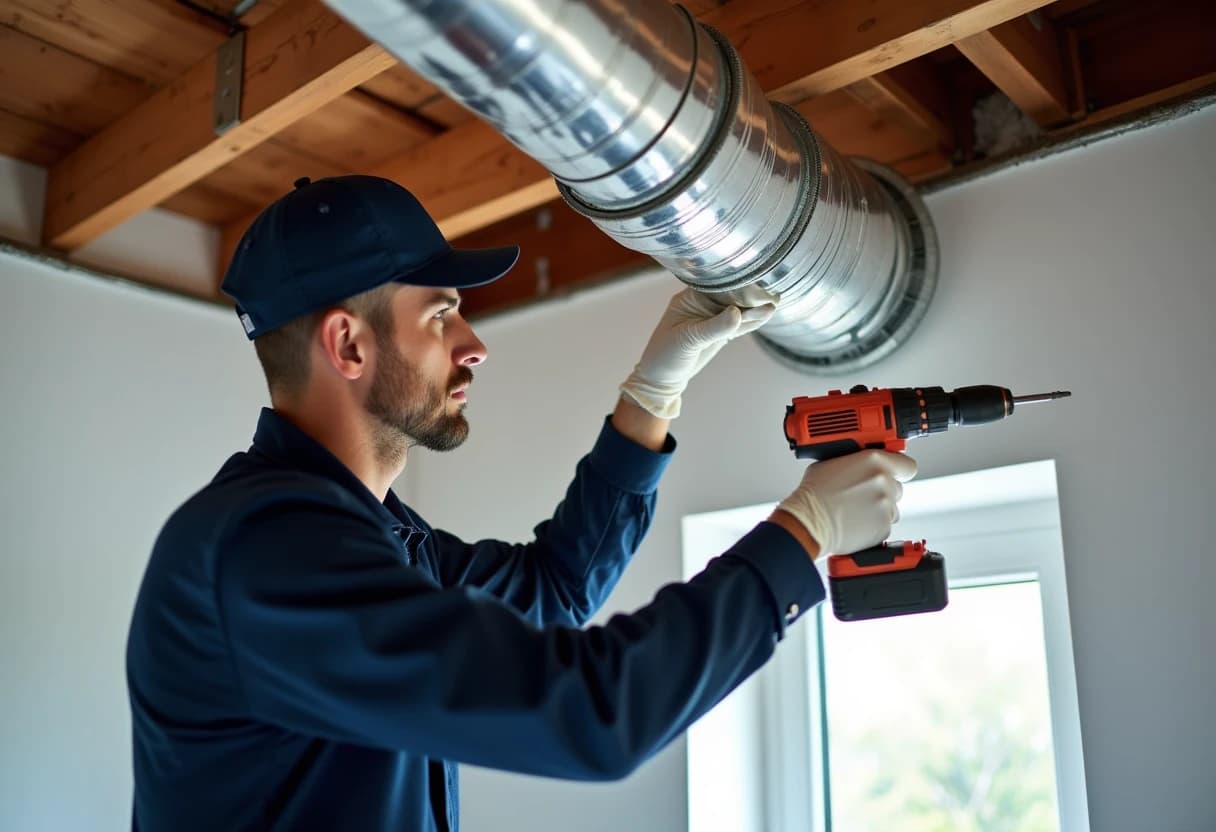
Moving your laundry to a better spot? Finishing a basement? Buying a home whose inspection flagged the venting? Those are the moments to get the dryer exhaust right permanently. We install and reroute dryer vents throughout Andover: planning the shortest code-legal path from the appliance to outdoors, cutting clean penetrations through clapboard, brick or rim joist, hanging rigid metal duct with proper support and slope, and finishing with a quality hood whose damper seals against New England weather. A correctly built vent needs nothing but an annual cleaning for decades — and it dries clothes the way the appliance manual promised.
Why Dryer Vent Installation & Rerouting Matters for Andover Homes
Where the vent terminates shapes both the house and the maintenance schedule. Every option has an engineering trade: side-wall terminations are shortest and easiest to inspect, but must clear grade, snow line, and required distances from openings; rim-joist terminations serve basement laundries elegantly with minimal envelope disruption; roof terminations suit interior laundry rooms in condos and capes but load up faster — lint fights gravity the whole vertical run — and need durable, steep-weather-rated caps. What is never acceptable: terminating into an attic, crawlspace, garage, soffit vent or chimney, all of which we find regularly and all of which pump moisture and lint into the structure. The termination itself must have a backdraft damper that closes against winter wind and pests, and no screen — mesh mats over with lint in months, which is why the code forbids it. Our installations weigh the options against your home's layout and Massachusetts weather, cut clean penetrations through clapboard, shingle, brick or block, and flash and seal them so the envelope stays weather-tight for decades.
Condo and multi-family installation around Harold Parker State Forest is its own discipline, and Andover associations know the stakes: one bad vent in a shared structure is everyone's fire risk. Andover pairs stately 18th- and 19th-century colonials around the academy and town center with the planned 1920s brick-and-stucco homes of Shawsheen Village and large executive colonials from the 1980s and 90s along the I-93 corridor. The older homes often carry retrofit duct systems squeezed into original framing, while the newer ones have sprawling multi-zone layouts with long attic runs. We manage the full process — written scopes for board approval, certificates of insurance, penetrations planned with the building envelope and neighboring units in mind, and per-unit documentation on completion. Andover's big multi-zone colonials often run two or three separate air handlers, and the attic-mounted systems take a beating from summer condensation and winter temperature swings that loosen duct joints over time. In Ballardvale and other spots near the Shawsheen River, spring damp adds a musty edge that shows up first in basement returns. For triple-deckers and small associations we can rough in venting for multiple units in one mobilization, which cuts per-unit cost substantially and gives the building one consistent, compliant system.
Our Dryer Vent Installation & Rerouting Process in Andover
1Site Assessment & Route Planning
The technician maps what exists and what is possible: where the dryer sits (or will sit), which walls are exterior, what the framing and foundation allow, and where obstacles — plumbing, wiring, ductwork, finished ceilings — constrain the path. Shortest is best: fewer feet and fewer elbows mean faster drying and slower lint accumulation for the life of the system.
2Demolition of Non-Compliant Venting
Old venting comes out carefully, not destructively: we protect finishes, keep openings minimal, and document conditions as we find them. What we uncover often explains years of symptoms — a crushed flex section behind a wall, a joint that separated a decade ago, a cavity lined with escaped lint. Photos go in your record.
3Cut & Flash the Exterior Penetration
Penetrations are where amateur installs leak — water into sheathing, air into cavities. Ours are built like window details: sized to the hood, flashed to shed water over the cladding, sealed with quality exterior sealant, and finished so the termination looks intentional on the facade. On masonry we drill and anchor; we never improvise attachment.
4Install Rigid Metal Duct on the Planned Route
Where the route crosses unheated space — a cold basement, garage bay, attic run — we insulate the duct so exhaust stays above its dew point until it exits, which is the difference between a dry duct and a condensation problem in a Massachusetts winter. Concealed sections are completed and verified before any finishes close them in.
5Mount the Termination Hood & Damper
Termination choice is matched to the route: low-profile wall hoods for clapboard and shingle, masonry-mounted hoods for brick, rim-joist hoods for basement exits, and dedicated dryer roof caps — never plumbing-style caps — for vertical runs. Each is chosen for damper quality, because the damper is the moving part that determines how the termination survives New England weather.
6Connect the Appliance & Seal the System
Gas dryers are handled with the care the fuel demands: the flexible gas connector unstrained, the machine leveled and positioned, and the connection checked before operation. Electric units get cords routed clear of the duct. The appliance end is where good systems get ruined by casual reconnection, so we finish it to the same standard as the concealed run.
7Test, Verify & Document the Installation
You receive complete documentation: photos of the route (including concealed sections before they closed), the materials used, the equivalent-length math, and the finished termination. For permitted work, condo approvals or home sales, this record answers every question an inspector, board or buyer will ask about what is behind the walls.
Benefits of Professional Dryer Vent Installation & Rerouting in Andover
Moisture Managed, Structure Protected
For basement laundries — the Massachusetts default — proper installation is the difference between a dry basement and a damp one. Vents that dump into crawlspaces, leak at joints or condense in cold runs feed exactly the humidity and mold problems New England basements already fight; a correct rim-joist installation removes the dryer from that fight entirely.
Dramatically Faster Drying
Every elbow removed and every foot shortened is resistance the dryer no longer fights on every load, forever. The performance gain is not subtle on bad systems — 30 to 50 percent cycle-time reductions are common when we replace overlong flex runs — and unlike an appliance upgrade, it benefits every dryer the laundry will ever have.
Permanently Lower Energy Costs
The efficiency also shows up in maintenance economics: smooth, short, sealed runs need only quick annual cleanings, while flex mazes generate blockage-level service calls and appliance repairs. Over ten years, the well-installed vent is the cheaper vent by a wide margin, before counting a single kilowatt-hour.
A Laundry Located Where You Actually Want It
Relocation also fixes inherited mistakes: many Andover-area laundries sit where a previous owner could most easily improvise a vent, not where the household actually wants to do laundry. Once the exhaust is treated as a designed system, the laundry can finally move to where life happens.
Fire-Safe by Design, Not by Vigilance
A code-compliant installation attacks fire risk structurally: smooth rigid metal that lint slides across instead of catching on, a run short enough that exhaust velocity carries fibers all the way out, joints without screw tips to snag them, and a termination that cannot mat over. The system accumulates fuel slowly by design — safety that does not depend on anyone remembering anything.
Decades of Service From a One-Day Job
Because we also clean and repair dryer vents across Greater Boston, we install with the next twenty years of maintenance in mind — routes our own brushes can traverse, access preserved where it matters, baselines recorded for future verification. We build systems we expect to service ourselves, and it shows in the choices.
Signs Your Andover Home Needs Dryer Vent Installation & Rerouting
The Dryer Vents Indoors — Anywhere
A vent that ends in an attic, crawlspace, garage, ceiling cavity or bucket-style indoor 'lint trap' is an urgent installation call. Every load pumps a gallon of moisture and a charge of fine lint into the structure or living space — feeding mold, soaking insulation, and accumulating fuel where no one will ever clean it. This setup should not run another season.
Chronic Condensation the Route Guarantees
Watch the laundry itself: loads that come out damp-smelling, a duct that drips after cycles, rust tracks under joints. Chronic internal moisture is rotting the system from the inside while it feeds blockages. The permanent fix is a route engineered for New England winters, not another season of drip trays and patches.
A New Laundry Location Needs Its First Vent
Moving laundry upstairs, finishing a basement, building an in-law suite or converting a condo all create the same requirement: a new exhaust route, designed before the walls close if at all possible. Vent routing decided at the framing stage is shorter, cheaper and cleaner than the same route retrofitted through finished surfaces months later.
The Run Is Overlong or Elbow-Heavy
The symptom pattern of an overlong run: drying times that were never good, cleanings that help briefly and fade fast, and lint accumulating mid-run rather than at the ends. No maintenance schedule fixes a route that exceeds the appliance's reach; rerouting to a shorter path is the only durable answer.
Your Vent Is Flexible Plastic or Foil Duct
Flex duct concealed in walls and cavities is the worst case: it cannot be effectively brushed, so no cleaning ever truly clears it, and it accumulates lint until it blocks. If a cleaning service has ever told you your run 'can't really be cleaned,' this is what they meant — and rigid replacement is the answer.
Inspection, Insurance or Association Requirements
Massachusetts home inspections flag improvised dryer venting constantly — flex runs, screened hoods, indoor terminations, overlong routes — and the flag follows the transaction: buyers demand fixes, sellers concede credits. A documented compliant installation clears the item permanently, whether you are listing this spring or just retiring a known liability.
Dryer Vent Installation & Rerouting Cost in Andover, MA
Multi-family and condo installation pricing carries a few specifics worth knowing up front. Roof terminations — common for interior condo laundries — sit toward the top of the range for the flashing and access work, typically $650 to $900 for the full installation. Association requirements add process rather than much cost: we provide written scopes for board approval and certificates of insurance at no charge, and our documentation is built to satisfy trustee and management-company review. The meaningful savings lever is coordination: when a triple-decker owner or association books multiple units in one mobilization, shared setup, staging and travel drop per-unit pricing by 20 to 30 percent, and the building ends up with one consistent, compliant system instead of three eras of improvisation. For laundry-relocation projects inside renovations, timing is the lever: venting roughed in while walls are open routinely costs $200 to $400 less than the identical route built after finishes, which is why we encourage a planning call at the framing stage — free advice that saves real money.
Want the full pricing picture? See our complete Boston-area cost guide or call (617) 390-7145 for an exact flat quote for your Andover home.
Local Knowledge: Andover, Essex County
Serving Andover means knowing Andover. Andover pairs stately 18th- and 19th-century colonials around the academy and town center with the planned 1920s brick-and-stucco homes of Shawsheen Village and large executive colonials from the 1980s and 90s along the I-93 corridor. The older homes often carry retrofit duct systems squeezed into original framing, while the newer ones have sprawling multi-zone layouts with long attic runs. Andover's big multi-zone colonials often run two or three separate air handlers, and the attic-mounted systems take a beating from summer condensation and winter temperature swings that loosen duct joints over time. In Ballardvale and other spots near the Shawsheen River, spring damp adds a musty edge that shows up first in basement returns. Those conditions shape how we work here: which brush heads come off the truck, how we protect finishes in older interiors, and what we expect to find when the camera goes into a 01810 duct system. Our crews are in and around Andover nearly every week — often for neighbors of past customers — so scheduling is fast and our arrival windows hold.
The Best Time of Year in Andover
Winter is the season your vent's design gets examined, whether it passed inspection or not. Cold amplifies every routing flaw: exhaust crossing uninsulated basements and garages condenses hard, marginal slopes pool water into lint mats, and terminations without quality dampers ice open or shut. Meanwhile the laundry load peaks — sweaters, blankets, snow-soaked layers — pushing maximum moisture through the system at its coldest. Installations we design for New England build the winter case in from the start: insulated duct across unheated space, continuous outward slope, and dampers chosen to swing free at ten degrees in a nor'easter. If last winter exposed your current vent's design — drips, frost, February blockages — this year's install season is the time to retire it.
Why Choose Boston Air Duct Cleaners
Boston Air Duct Cleaners is a local, owner-operated company based at 1121 Washington St in West Newton — not a national franchise dispatching subcontractors. Every crew is our own: background-checked, factory-trained on commercial negative-pressure equipment, and fully insured. We quote flat prices before work begins, document every job with before-and-after photos, and follow NADCA-standard source-removal methods on every system we touch. That is why so much of our work comes from repeat customers, property managers and word-of-mouth referrals across Essex County.
Serving Andover and Surrounding Communities
Andover sits in the heart of our service area, and neighboring North Andover, Lawrence, Tewksbury, Wilmington, Methuen, Reading appointments share the same routes. That density is why our response times in this part of Essex County are among our fastest — and why you will see our trucks in the area week after week.