
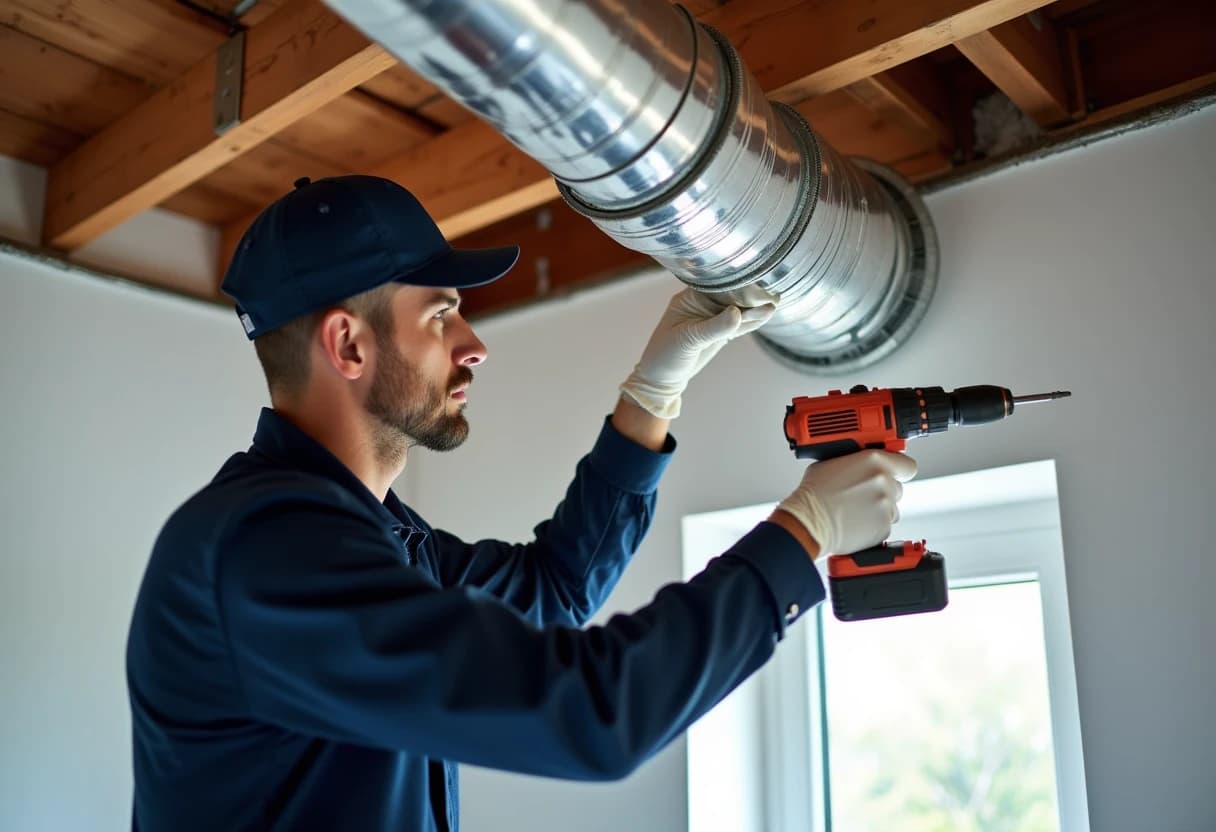
An overlong dryer vent is a permanent tax on every load of laundry. Each foot of duct and every elbow adds resistance; the code caps the total at 35 equivalent feet — with each 90-degree elbow typically counting as five feet — because beyond that, dryers simply cannot push lint and moisture to the outlet. Yet Greater Boston basements are full of runs half again that long, snaking around decades of renovations. Our rerouting service shortens them: we find the nearest legal path outdoors, often cutting a 40-foot wander to a 12-foot straight shot, and rebuild it in rigid metal. Drying times drop immediately, lint accumulation slows permanently, and the fire-risk math improves for good.
Why Dryer Vent Installation & Rerouting Matters for North Andover Homes
New England's housing stock makes professional installation more consequential here than almost anywhere. Triple-deckers and brownstone conversions put laundry deep in floor plans, far from legal termination points, demanding careful route planning against the length budget. Balloon-framed Victorians hide cavities that swallow flex duct into inaccessible, uncleanable runs. Stone and brick foundations require masonry penetrations done with the right tools and flashing. Retrofitted basement laundries sit below grade, where the only paths out are up through the rim joist or across to a window bay — and where cold foundation walls make uninsulated duct a condensation machine. Condo associations layer approval processes and insurance requirements on top. We work these constraints every week: our installers carry the drills, core bits, flashing and fittings the old construction demands, we insulate runs crossing unheated space as a standard practice, and we provide the certificates and documentation associations require. The result is a vent that fits the building it serves — not a catalog diagram forced into a house that predates the catalog by a century.
Basement laundries dominate North Andover's housing stock, and they are where thoughtful venting matters most. North Andover ranges from the antique homes ringing the Old Center common and the mill-worker housing of Machine Shop Village to sprawling 1990s and 2000s Colonials in the hills near Lake Cochichewick. The converted mill buildings downtown now hold condos with shared mechanical systems, while the newer estates run multiple forced-air zones with long attic and basement duct runs. Older village homes often hide retrofit ductwork behind original plaster. A below-grade dryer must exhaust up and out — through the rim joist above the foundation, most often — and every foot of that run crosses cold space where moist exhaust wants to condense. North Andover's mill-to-condo conversions come with decades-old shared duct chases that few owners have ever seen inside, and we regularly find original construction debris still sitting in them. Out by Lake Cochichewick, wooded lots deliver heavy pollen seasons that load up returns and filters fast. Our basement installations handle both problems by design: the shortest legal route to a rim-joist or high-wall termination, continuous slope so any condensate drains outward, and insulation on duct crossing unheated space. The result is a basement laundry that stays dry, and a vent that stays clear between annual cleanings.
Our Dryer Vent Installation & Rerouting Process in North Andover
1Site Assessment & Route Planning
The technician maps what exists and what is possible: where the dryer sits (or will sit), which walls are exterior, what the framing and foundation allow, and where obstacles — plumbing, wiring, ductwork, finished ceilings — constrain the path. Shortest is best: fewer feet and fewer elbows mean faster drying and slower lint accumulation for the life of the system.
2Demolition of Non-Compliant Venting
Old venting comes out carefully, not destructively: we protect finishes, keep openings minimal, and document conditions as we find them. What we uncover often explains years of symptoms — a crushed flex section behind a wall, a joint that separated a decade ago, a cavity lined with escaped lint. Photos go in your record.
3Cut & Flash the Exterior Penetration
Penetrations are where amateur installs leak — water into sheathing, air into cavities. Ours are built like window details: sized to the hood, flashed to shed water over the cladding, sealed with quality exterior sealant, and finished so the termination looks intentional on the facade. On masonry we drill and anchor; we never improvise attachment.
4Install Rigid Metal Duct on the Planned Route
The run goes in as 4-inch smooth-interior rigid metal duct — the material the IRC specifies — cut to fit, joined male-to-female in the direction of airflow, and assembled without a single screw protruding into the airstream: joints are clamped or externally fastened and sealed with UL-listed foil tape. Elbows are used sparingly and counted against the length budget.
5Mount the Termination Hood & Damper
The termination is a quality metal hood matched to the 4-inch duct, with a backdraft damper that swings fully open under airflow and closes tight against weather, drafts and pests — and no screen, which the code prohibits on dryer terminations because mesh mats over with lint. It is fastened to the cladding, sealed at the perimeter, and tested by hand before the first cycle.
6Connect the Appliance & Seal the System
System sealing is completed end to end: every joint taped with UL-listed foil tape, the wall penetration sealed inside and out, and the transition clamped tight. A dryer vent is a pressure system; leaks anywhere cost airflow at the termination and push lint and moisture into places they do not belong. Sealed means sealed everywhere.
7Test, Verify & Document the Installation
You receive complete documentation: photos of the route (including concealed sections before they closed), the materials used, the equivalent-length math, and the finished termination. For permitted work, condo approvals or home sales, this record answers every question an inspector, board or buyer will ask about what is behind the walls.
Benefits of Professional Dryer Vent Installation & Rerouting in North Andover
A Laundry Located Where You Actually Want It
Proper vent design frees the floor plan: a second-floor laundry, a kitchen-adjacent closet, a finished-basement corner all become viable when the exhaust route is engineered rather than improvised. We tell you honestly which locations work within the length budget — and often find compliant routes that make the layout you wanted possible.
Permanently Lower Energy Costs
A dryer that finishes in one cycle instead of two uses half the energy per load — a difference worth $10 to $20 a month to a busy household, recurring for the life of the system. Few building improvements have a payback mechanism this direct: the installation cost is fixed once, and the savings arrive with every laundry day after.
Fire-Safe by Design, Not by Vigilance
A code-compliant installation attacks fire risk structurally: smooth rigid metal that lint slides across instead of catching on, a run short enough that exhaust velocity carries fibers all the way out, joints without screw tips to snag them, and a termination that cannot mat over. The system accumulates fuel slowly by design — safety that does not depend on anyone remembering anything.
Decades of Service From a One-Day Job
Because we also clean and repair dryer vents across Greater Boston, we install with the next twenty years of maintenance in mind — routes our own brushes can traverse, access preserved where it matters, baselines recorded for future verification. We build systems we expect to service ourselves, and it shows in the choices.
Dramatically Faster Drying
Shortening a wandering 40-foot run to a direct 12-foot route transforms drying performance: full airflow means each cycle actually exhausts the gallon of moisture a load releases, so sensor dryers stop running overtime and heavy loads finish in one pass. Customers routinely describe post-installation performance as having bought a new machine.
Code Compliance That Closes Every Question
The finished system meets the IRC's dryer exhaust provisions line by line: 4-inch smooth rigid metal, equivalent length within the 35-foot budget, no fasteners in the airstream, damper-equipped unscreened termination. For home sales, that removes a standard inspection flag; for permits and condo approvals, our documentation answers the questions before they are asked.
Signs Your North Andover Home Needs Dryer Vent Installation & Rerouting
Inspection, Insurance or Association Requirements
Appliance warranties add quiet pressure: manufacturers condition coverage on adequate exhaust, and a warranty claim on a dryer connected to a non-compliant vent can be denied on that basis. If you are buying a premium machine, the few hundred dollars of proper venting is also warranty insurance.
Blockages and Repairs Keep Recurring
If your vent needs cleaning twice a year, blocks anyway, and has accumulated a history of repairs, the route itself is the problem — too long, too bent, wrong materials, or condensation-prone by design. At some point serial maintenance costs more than the reroute that ends it. We will do that math with you honestly; often the crossover is closer than expected.
The Run Is Overlong or Elbow-Heavy
Basement laundries venting to a far wall are the classic offenders — installed where the first hole was easiest, not where the route was shortest. Our assessment often finds a rim-joist or near-wall exit that cuts the run by half or more. Ask for the measurement; the equivalent-length math takes ten minutes and settles the question.
A New Laundry Location Needs Its First Vent
Renovation is the moment of maximum leverage: we consult with homeowners and contractors while framing is open, position the laundry within the length budget, and rough in the run for pennies on the retrofit dollar. If your project touches the laundry's walls or ceiling, call before drywall — future you will be grateful.
Your Vent Is Flexible Plastic or Foil Duct
Flex duct concealed in walls and cavities is the worst case: it cannot be effectively brushed, so no cleaning ever truly clears it, and it accumulates lint until it blocks. If a cleaning service has ever told you your run 'can't really be cleaned,' this is what they meant — and rigid replacement is the answer.
Chronic Condensation the Route Guarantees
Winter tells the truth about marginal routes: dripping joints, frost at the termination, ice sealing the damper, damp lint clogs by February. If your vent has a cold-weather personality, its path crosses too much unheated space unprotected. We rebuild such runs with insulation and continuous outward slope — or shorten them past the problem entirely.
Dryer Vent Installation & Rerouting Cost in North Andover, MA
Multi-family and condo installation pricing carries a few specifics worth knowing up front. Roof terminations — common for interior condo laundries — sit toward the top of the range for the flashing and access work, typically $650 to $900 for the full installation. Association requirements add process rather than much cost: we provide written scopes for board approval and certificates of insurance at no charge, and our documentation is built to satisfy trustee and management-company review. The meaningful savings lever is coordination: when a triple-decker owner or association books multiple units in one mobilization, shared setup, staging and travel drop per-unit pricing by 20 to 30 percent, and the building ends up with one consistent, compliant system instead of three eras of improvisation. For laundry-relocation projects inside renovations, timing is the lever: venting roughed in while walls are open routinely costs $200 to $400 less than the identical route built after finishes, which is why we encourage a planning call at the framing stage — free advice that saves real money.
Want the full pricing picture? See our complete Boston-area cost guide or call (617) 390-7145 for an exact flat quote for your North Andover home.
Local Knowledge: North Andover, Essex County
Serving North Andover means knowing North Andover. North Andover ranges from the antique homes ringing the Old Center common and the mill-worker housing of Machine Shop Village to sprawling 1990s and 2000s Colonials in the hills near Lake Cochichewick. The converted mill buildings downtown now hold condos with shared mechanical systems, while the newer estates run multiple forced-air zones with long attic and basement duct runs. Older village homes often hide retrofit ductwork behind original plaster. North Andover's mill-to-condo conversions come with decades-old shared duct chases that few owners have ever seen inside, and we regularly find original construction debris still sitting in them. Out by Lake Cochichewick, wooded lots deliver heavy pollen seasons that load up returns and filters fast. Those conditions shape how we work here: which brush heads come off the truck, how we protect finishes in older interiors, and what we expect to find when the camera goes into a 01845 duct system. Our crews are in and around North Andover nearly every week — often for neighbors of past customers — so scheduling is fast and our arrival windows hold.
The Best Time of Year in North Andover
New England's building stock gives installation a seasonal maintenance logic too. Coastal and near-coastal homes lose termination hardware to salt corrosion years ahead of inland schedules, making hood quality and periodic inspection part of the design conversation. Freeze-thaw cycles work on every exterior penetration, which is why our flashing details are built to roofing standards rather than caulk-and-hope. And the region's centuries-old walls — balloon framing, stone foundations, triple wythe brick — reward installers who have opened them before and punish those improvising on the day. We schedule the weather-sensitive stages around the forecast, stock the fittings old construction demands, and build every system for the specific abuse a Massachusetts year delivers: forty inches of snow, ninety-degree dew-point weeks, and the two hundred laundry days in between.
Why Choose Boston Air Duct Cleaners
Homeowners across Essex County choose Boston Air Duct Cleaners for three reasons. First, honesty: our inspection camera tells you whether your system actually needs cleaning — and sometimes the answer is no. Second, capability: truck-grade negative-air machines, rotary brush systems and HEPA filtration handle everything from antique gravity-furnace conversions to brand-new high-velocity systems. Third, accountability: flat quoted pricing, before-and-after photos, insured technicians, and a real local office you can call at (617) 390-7145. That combination is rarer in this industry than it should be.
Serving North Andover and Surrounding Communities
Beyond North Andover, our crews cover the surrounding communities daily — including Andover, Lawrence, Methuen, Middleton, North Reading, Georgetown. Because routes cluster geographically, booking alongside a neighboring appointment often unlocks same-day service and combined-visit savings. Wherever you are in Essex County, the same flat-rate pricing, insured technicians and photo-documented process applies.