
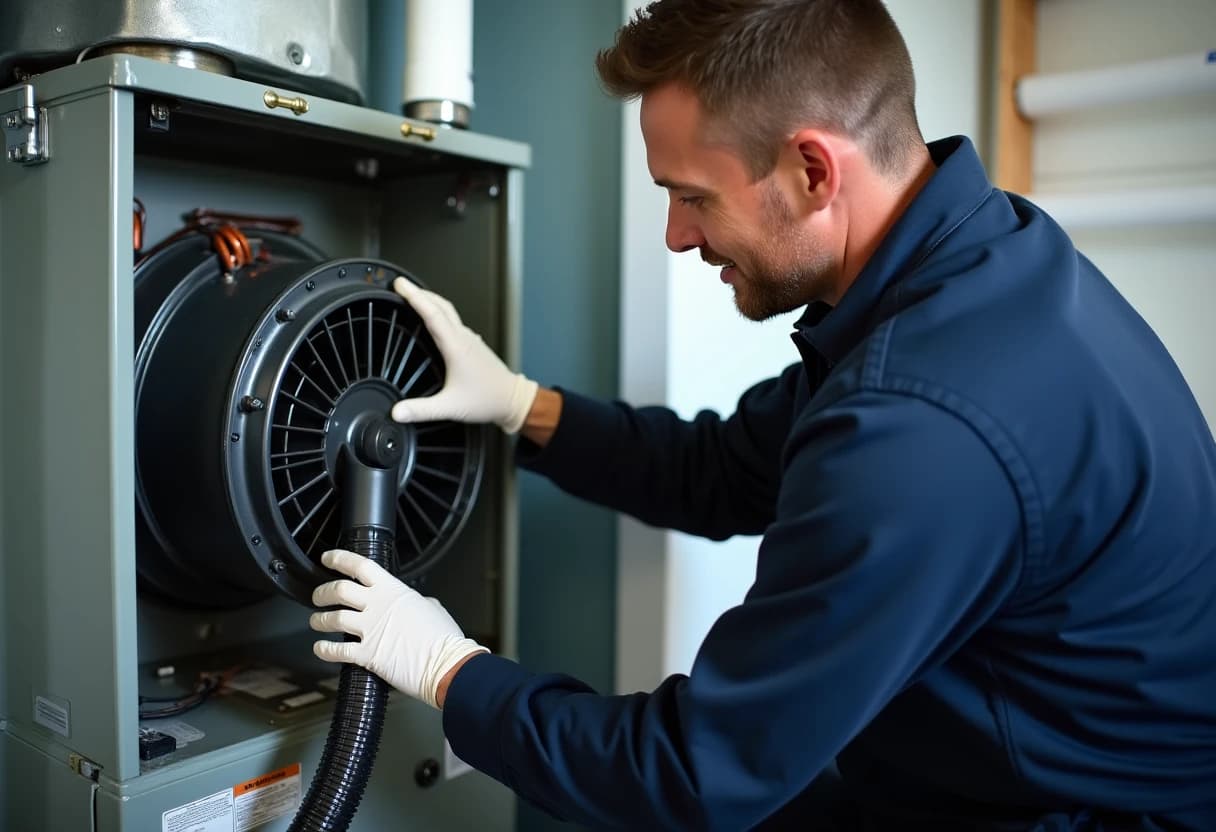
Think of HVAC system cleaning as a deep service interval for the largest appliance you own. Cars get more than oil changes; heating and cooling systems deserve more than filter swaps. In one visit we restore the entire air side: source-removal duct cleaning under negative pressure, blower wheel and motor compartment detailing, evaporator coil cleaning, drain pan and condensate service, plenum and cabinet cleanup, and a fresh filter to protect the work. Back Bay homeowners typically pair it with their annual furnace tune-up — the technician tuning combustion and the crew restoring airflow are complementary halves of the same maintenance logic — and the systems that get both run quieter, heat faster, cool harder and last visibly longer.
Why HVAC System Cleaning Matters for Back Bay Homes
Filters cannot do this job, and understanding why explains the service. A furnace filter sits at one point in the circuit, typically protecting only the equipment downstream of the return drop — everything upstream of it, meaning the entire return duct network, runs unfiltered by design, inhaling whatever the rooms produce. Standard filters also pass a large share of fine particulate even where they do sit, and every gap, bypass and late filter change compounds the leakage. The result is universal: open any air handler that has run a decade on filter changes alone and the blower wheel carries a felt of compacted dust, the coil face is gray, and the cabinet floor holds drifts. None of that is a filter failure exactly — it is the filter doing a limited job in a system that needs more. Periodic whole-system cleaning is the more: it removes the accumulation the filter was never positioned to prevent, resets the equipment to clean baseline, and — paired with a quality filter afterward — dramatically slows the rebuild.
Heating and cooling in Back Bay is a long-season, high-cost proposition. The high-velocity small-duct systems common in Back Bay brownstones clog faster than conventional ductwork because the two-inch flexible tubing has so little tolerance for buildup. Add in landmark-district window restrictions that limit natural ventilation and dryer vents that exit through rear alley walls after long horizontal runs, and Back Bay units benefit from cleaning more often than almost anywhere we serve. Back Bay is a nearly unbroken grid of Victorian brownstones built on filled land between the 1860s and 1890s, most long since divided into condos, alongside luxury towers near the Prudential and Copley Place. Original coal-and-radiator buildings have been retrofitted over and over - high-velocity mini-duct systems, ceiling-cassette air handlers, and full forced-air conversions threaded through plaster walls and marble-trimmed stairwells. Those retrofit runs are narrow, joint-heavy and notoriously dusty. With Massachusetts energy prices where they are, a system losing efficiency to a matted blower and fouled coil bleeds money for six months of heating and two of cooling every year. Our whole-system cleaning is the recovery: measured, documented, and typically reflected in the next utility bill. We schedule Back Bay jobs alongside the fall tune-up rush and the spring AC prep season — book ahead of either and the timing pays twice.
Our HVAC System Cleaning Process in Back Bay
1Full System Inspection & Airflow Baseline
We begin where the problems live: the air handler comes open first, because blower and coil condition determine half the scope. The technician documents the equipment, cameras representative duct runs, checks the condensate path, and walks you through findings with photos. The quote you approve reflects exactly what the inspection found — no mid-job discoveries priced from a flashlight.
2Protection, Sealing & Negative Pressure
The system becomes a closed circuit before anything gets agitated: sealed openings, depressurized trunks, HEPA-filtered collection. This setup is what separates source removal from dust redistribution, and it protects the equipment work too — debris loosened in the ducts flows to the vacuum rather than settling into the freshly opened blower compartment downstream.
3Complete Duct Network Cleaning
Returns get equal billing with supplies in our sequence, because they are the dirtier side — unfiltered by design, inhaling everything the rooms produce. We clean the full return network including the drop into the air handler, which is the last unfiltered stretch before your blower and the reason freshly serviced equipment refouls when duct-only cleanings skip it.
4Blower Wheel & Motor Compartment Detailing
While the compartment is open we clean everything air touches: wheel, housing scroll, motor exterior, mounting hardware, compartment floor and walls. We also note conditions worth your HVAC tech's attention — bearing noise, capacitor age, belt wear on older units — in your report. We clean equipment; we flag, rather than sell, mechanical repairs.
5Evaporator Coil Cleaning
Coil cleaning is precision work: fin surfaces are delicate, and the right approach depends on fouling depth — from HEPA vacuuming and soft brushing for surface dust to application of appropriate coil cleaners for bonded buildup. We work carefully, protect the surrounding cabinet and drain path, and photograph the coil face before and after so the recovery is visible fin by fin.
6Cabinet, Plenums & Condensate Service
This stage finishes the wet section: pan cleaned of the biofilm and sludge that clog drains and breed odor, trap flushed, line verified flowing, float switch checked where fitted. Cooling-season backups — water around the air handler, tripped switches, ceiling stains under attic units — trace here, and ten minutes of prevention now beats an August service call later.
7Fresh Filter, Reassembly & Verified Results
We close the system with a fresh filter — quality pleated media, or your preferred spec — reinstall every register, and run the system live. The walkthrough covers register-by-register airflow against the morning's baseline, the complete before-and-after photo set, and written notes on anything worth watching. You see the recovery, not just an invoice describing it.
Benefits of Professional HVAC System Cleaning in Back Bay
One Visit, Complete Documentation
Bundling ducts and equipment into one appointment beats the piecemeal alternative on every axis: one mobilization cost instead of two, one afternoon of access instead of several, and no gap period where the uncleaned half recontaminates the cleaned one. The flat system price runs well below the summed cost of duct cleaning, coil service and blower work booked separately.
Lower Energy Bills, Month After Month
Efficiency loss from fouling is a compounding leak: the blower draws more power to move less air, the compressor and burners run longer to deliver the same comfort, and every cycle costs more than design intended. Whole-system cleaning plugs the leak at every point at once — which is why it is the rare home service with a genuine payback period rather than just a benefit.
Cooling That Keeps Up in July
A blanketed evaporator coil cannot shed heat, so the AC runs longer, delivers less, and loses exactly when you need it most — the humid Massachusetts afternoons that now define our summers. Coil cleaning restores rated cooling capacity and, just as important here, dehumidification, so the house gets cool and dry instead of cool-ish and clammy.
Quieter Operation, Fewer Odors
An unbalanced, matted blower wheel hums, drones and vibrates its way through every cycle — noise most owners attribute to age. Cleaning rebalances the assembly and clears the restrictions that make air whistle through starved returns, and the system drops to the background again. Many customers say the new quiet is the benefit they notice most.
Airflow Restored to Design Capacity
The felt difference has a mechanical explanation: a fouled system fights elevated static pressure and degraded fan performance simultaneously, and the losses multiply. Removing both restores the delivered-air volume the ductwork was engineered around — which is why post-cleaning systems reach setpoint faster, cycle less, and finally push meaningful air to the far registers upstairs.
Years Added to Equipment Life
HVAC technicians will tell you which systems reach old age: the ones with clean airflow. Limit-switch trips, cracked exchangers and burned motors cluster in fouled systems because restriction stresses everything upstream and downstream of it. Periodic whole-system cleaning is how a homeowner buys into the long-lived cohort — and why tune-up techs are among our steadiest referral sources.
Signs Your Back Bay Home Needs HVAC System Cleaning
No Record of the System Ever Being Cleaned
New homeowners inherit the air side as-is, with no line item on any disclosure covering blower mats and coil blankets. If your purchase included a system of unknown cleaning history — which is to say, almost any purchase — a baseline whole-system cleaning tells you what you own, documents it, and starts the maintenance clock from a known-clean state.
AC Struggling, Icing, or Running Nonstop
Watch for the humidity tell: a struggling AC that leaves the house cool but clammy is failing at dehumidification, which a blanketed coil surrenders first. In a Massachusetts July, moisture removal is half the job. If the air feels damp at setpoint, the coil face deserves a look before the thermostat takes any more blame.
Visible Buildup on the Blower or Around the Air Handler
Pull the blower compartment door and look at the wheel with a flashlight: blades carrying a visible felt of compacted dust are stealing airflow every minute the system runs, and the wheel you can see is cleaner than the coil you cannot. Visible equipment buildup is definitive — no further diagnosis needed, the system is due.
Burnt-Dust Smell at Furnace Startup
Households plan around this smell — open windows for the October first-fire, guests warned, sensitive noses out of the house. That workaround treats a cleanable condition as a fact of life. A system cleaned end to end starts the heating season without announcement, because there is nothing on the exchanger or in the plenums left to burn off.
Uneven Rooms, Noisy Cycles, Dust Everywhere
Temperature spread between floors — sweltering upstairs in summer, cold bedrooms over the garage in winter — is often delivered-airflow starvation at the duct path's far end, not a zoning flaw. Before pricing dampers, mini-splits or a bigger system, restore the airflow you already own; the far rooms are where cleaning shows its work first and most.
Weak Airflow at Some or All Registers
The upstairs-never-cools, back-bedroom-never-warms pattern is a delivered-airflow problem before it is anything else: the rooms farthest down the duct path feel restriction first and worst. Owners live with it for years assuming the system is undersized; more often it is suffocating. Cleaning restores the margin, and the far rooms are where the recovery shows first.
HVAC System Cleaning Cost in Back Bay, MA
Timing and bundling move the price meaningfully. Pairing whole-system cleaning with your annual furnace tune-up is the highest-value configuration — the services are complementary, not redundant: the tune-up tech handles combustion, controls and mechanical health; we handle the air side the tune-up scope skips. Booked in the same season, each service makes the other's results better and longer-lasting, and cleaning first means your tech tunes a system breathing properly. Shoulder seasons price best: late spring and late summer bookings avoid the October tune-up crush and the July AC panic, and our calendars hold genuine availability. Bundle economics apply across our services too — adding dryer vent cleaning to a whole-system visit is our most popular pairing, priced well below the standalone sum, and sanitizing treatment adds $75 to $200 when equipment or odor conditions warrant it. Finally, maintenance cadence is the quiet discount: systems on a three-to-five-year cleaning cycle stay in light-buildup territory, where jobs run faster and quote lower — the cheapest whole-system cleaning is the one that never lets the system get truly dirty.
Want the full pricing picture? See our complete Boston-area cost guide or call (617) 390-7145 for an exact flat quote for your Back Bay home.
Local Knowledge: Back Bay, Suffolk County
Serving Back Bay means knowing Back Bay. Back Bay is a nearly unbroken grid of Victorian brownstones built on filled land between the 1860s and 1890s, most long since divided into condos, alongside luxury towers near the Prudential and Copley Place. Original coal-and-radiator buildings have been retrofitted over and over - high-velocity mini-duct systems, ceiling-cassette air handlers, and full forced-air conversions threaded through plaster walls and marble-trimmed stairwells. Those retrofit runs are narrow, joint-heavy and notoriously dusty. The high-velocity small-duct systems common in Back Bay brownstones clog faster than conventional ductwork because the two-inch flexible tubing has so little tolerance for buildup. Add in landmark-district window restrictions that limit natural ventilation and dryer vents that exit through rear alley walls after long horizontal runs, and Back Bay units benefit from cleaning more often than almost anywhere we serve. Those conditions shape how we work here: which brush heads come off the truck, how we protect finishes in older interiors, and what we expect to find when the camera goes into a 02116 duct system. Our crews are in and around Back Bay nearly every week — often for neighbors of past customers — so scheduling is fast and our arrival windows hold.
The Best Time of Year in Back Bay
New England's equipment stock adds a seasonal wrinkle worth naming: an enormous share of local systems are conversions and hybrids — forced-air retrofitted into homes built for radiators, hydro-air systems marrying boilers to air handlers, condo conversions threading flex duct through triple-decker framing. These systems run higher static pressure than clean-sheet designs, which means less margin for fouling: buildup that a generously ducted suburban system tolerates will noticeably choke a retrofit. The seasonal moisture cycle compounds it — humid summers make basement equipment buildup damp and sticky, long winters bake it hard — so accumulation here bonds faster and restricts sooner than national rules of thumb suggest. For conversion-era systems, we recommend the inspection interval owners of old houses already apply to everything else: regularly, and before the hard season rather than after it.
Why Choose Boston Air Duct Cleaners
Boston Air Duct Cleaners is a local, owner-operated company based at 1121 Washington St in West Newton — not a national franchise dispatching subcontractors. Every crew is our own: background-checked, factory-trained on commercial negative-pressure equipment, and fully insured. We quote flat prices before work begins, document every job with before-and-after photos, and follow NADCA-standard source-removal methods on every system we touch. That is why so much of our work comes from repeat customers, property managers and word-of-mouth referrals across Suffolk County.
Serving Back Bay and Surrounding Communities
Back Bay sits in the heart of our service area, and neighboring Beacon Hill, South End, Boston, Brookline, Seaport District, Allston appointments share the same routes. That density is why our response times in this part of Suffolk County are among our fastest — and why you will see our trucks in the area week after week.