
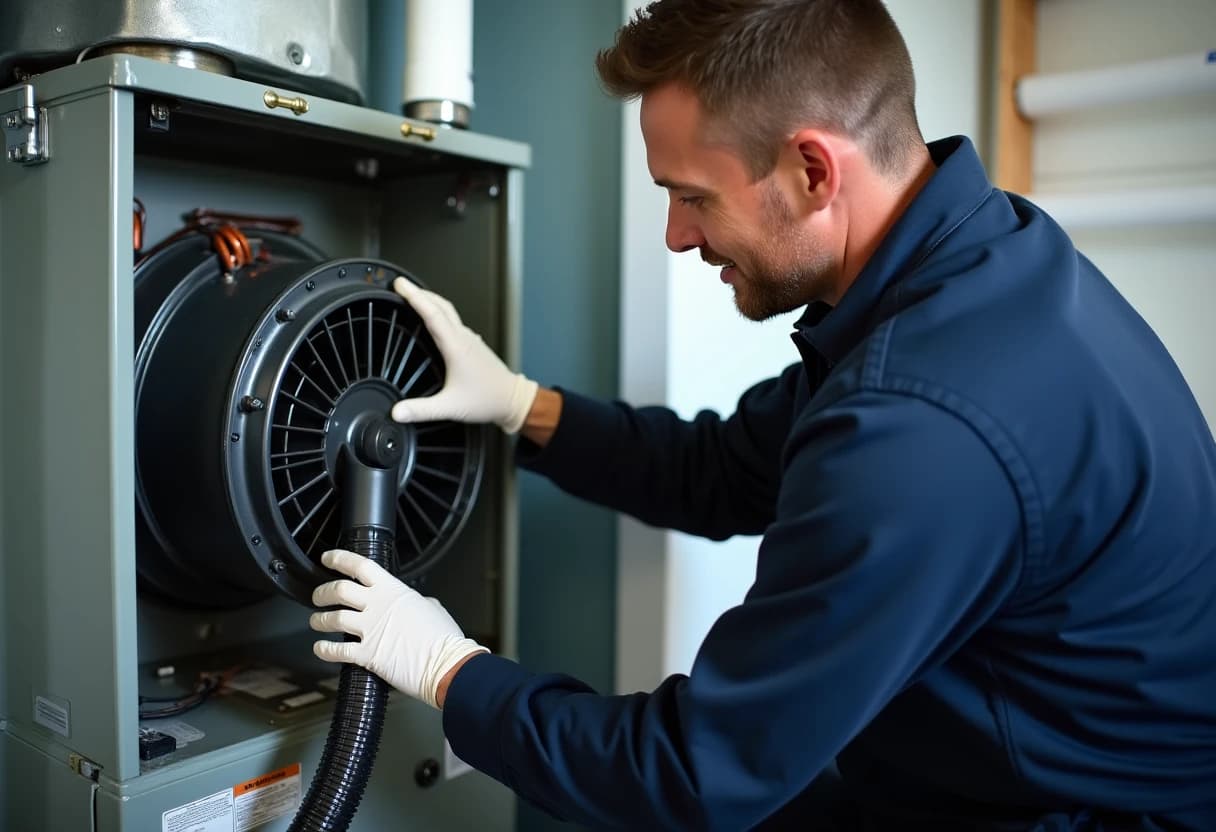
Think of HVAC system cleaning as a deep service interval for the largest appliance you own. Cars get more than oil changes; heating and cooling systems deserve more than filter swaps. In one visit we restore the entire air side: source-removal duct cleaning under negative pressure, blower wheel and motor compartment detailing, evaporator coil cleaning, drain pan and condensate service, plenum and cabinet cleanup, and a fresh filter to protect the work. South End homeowners typically pair it with their annual furnace tune-up — the technician tuning combustion and the crew restoring airflow are complementary halves of the same maintenance logic — and the systems that get both run quieter, heat faster, cool harder and last visibly longer.
Why HVAC System Cleaning Matters for South End Homes
Filters cannot do this job, and understanding why explains the service. A furnace filter sits at one point in the circuit, typically protecting only the equipment downstream of the return drop — everything upstream of it, meaning the entire return duct network, runs unfiltered by design, inhaling whatever the rooms produce. Standard filters also pass a large share of fine particulate even where they do sit, and every gap, bypass and late filter change compounds the leakage. The result is universal: open any air handler that has run a decade on filter changes alone and the blower wheel carries a felt of compacted dust, the coil face is gray, and the cabinet floor holds drifts. None of that is a filter failure exactly — it is the filter doing a limited job in a system that needs more. Periodic whole-system cleaning is the more: it removes the accumulation the filter was never positioned to prevent, resets the equipment to clean baseline, and — paired with a quality filter afterward — dramatically slows the rebuild.
Ask anyone maintaining an older home near SoWa Art + Design District: South End basements are hard on mechanical equipment. The South End holds the largest intact Victorian rowhouse district in the country - block after block of 1850s-1880s bowfront brick rowhouses ringed around leafy garden squares, nearly all divided into condos, plus SoWa's former factory buildings converted to lofts. Five-story rowhouses split into three or four units mean stacked HVAC systems sharing tight rear chases, with condensers crowded onto roofs and decks. High-velocity mini-duct retrofits are everywhere here, threaded through original plaster and pocket-door partitions. South End rowhouse condos share more than walls: dust, cooking odors and lint travel through the gaps and chases of buildings framed 150 years ago, so one unit's duct hygiene affects its neighbors. Landmark district rules push dryer vents and exhausts to rear alley elevations through long runs we're often asked to trace and clear. It's one of our busiest neighborhoods for brownstone duct work. Dust and humidity from below-grade spaces load the return side continuously, and the blower and coil absorb what the filter misses — year after unopened year. Our HVAC system cleaning addresses the whole circuit at once, and in South End housing stock the difference between duct-only and whole-system work is not subtle: the equipment is where the worst accumulation lives.
Our HVAC System Cleaning Process in South End
1Full System Inspection & Airflow Baseline
We begin where the problems live: the air handler comes open first, because blower and coil condition determine half the scope. The technician documents the equipment, cameras representative duct runs, checks the condensate path, and walks you through findings with photos. The quote you approve reflects exactly what the inspection found — no mid-job discoveries priced from a flashlight.
2Protection, Sealing & Negative Pressure
We treat your home as a finished space: drop cloths, boot covers, corner guards on tight stairways, careful hose routing. With every opening sealed and the negative-air machine holding the ductwork under vacuum, loosened contamination has exactly one exit — through our filtration. Most customers are surprised the house is cleaner after a whole-system job than before it.
3Complete Duct Network Cleaning
Under negative pressure, every run gets individually agitated: rotary brushes sized to each duct scrub the walls while compressed-air whips chase debris from the register end back toward the vacuum. Supplies, returns, vertical risers and both main trunks are cleaned in sequence — no run skipped, with repeat passes wherever camera checks show buildup remaining.
4Blower Wheel & Motor Compartment Detailing
The blower assembly gets restoration-grade attention: wheel removed where design allows or detailed in place, blades cleared of the compacted felt that steals airflow, motor housing vacuumed and wiped, and the compartment HEPA-cleaned to bare metal. A clean wheel moves dramatically more air — this single component is where most of the felt recovery lives.
5Evaporator Coil Cleaning
Coil cleaning is precision work: fin surfaces are delicate, and the right approach depends on fouling depth — from HEPA vacuuming and soft brushing for surface dust to application of appropriate coil cleaners for bonded buildup. We work carefully, protect the surrounding cabinet and drain path, and photograph the coil face before and after so the recovery is visible fin by fin.
6Cabinet, Plenums & Condensate Service
Plenums collect the heaviest drifts in many systems — every airstream in the house passes through them — and they are routinely skipped by duct-only services because access takes cabinet work. We clean both, plus the cabinet interior, the filter rack and its sealing surfaces, and the condensate path, so the equipment core matches the freshly cleaned network around it.
7Fresh Filter, Reassembly & Verified Results
We close the system with a fresh filter — quality pleated media, or your preferred spec — reinstall every register, and run the system live. The walkthrough covers register-by-register airflow against the morning's baseline, the complete before-and-after photo set, and written notes on anything worth watching. You see the recovery, not just an invoice describing it.
Benefits of Professional HVAC System Cleaning in South End
Quieter Operation, Fewer Odors
Noise and odor are the system's two honest condition reports, and both improve immediately after whole-system work: airflow stops whistling through restrictions, the blower stops droning against imbalance, startup smells vanish because there is nothing left to cook off. A quiet, odorless system is not a luxury spec — it is what clean equipment simply sounds and smells like.
Cleaner Air From a Cleaner Machine
Whole-system cleaning is the complete version of the air-quality upgrade: the duct reservoir removed and the equipment surfaces — wet coil, biofilmed pan, shedding blower — cleaned behind it. Air crossing clean components picks up nothing on its way to your rooms, which is why households report less dust, neutral-smelling airflow and easier breathing within days.
Years Added to Equipment Life
HVAC technicians will tell you which systems reach old age: the ones with clean airflow. Limit-switch trips, cracked exchangers and burned motors cluster in fouled systems because restriction stresses everything upstream and downstream of it. Periodic whole-system cleaning is how a homeowner buys into the long-lived cohort — and why tune-up techs are among our steadiest referral sources.
Airflow Restored to Design Capacity
Airflow is the product your HVAC system exists to deliver, and dust taxes it at every stage — matted blower blades, blanketed coil fins, narrowed duct runs. Whole-system cleaning refunds the tax in full. The most common customer report after our visits: rooms that had not heated or cooled properly in years suddenly behave, with no equipment replaced and nothing adjusted but cleanliness.
Cooling That Keeps Up in July
Icing is the dramatic version: a starved coil runs too cold, condensation freezes, airflow collapses entirely and the system shuts down mid-heat-wave. The root cause is almost always airflow restriction — dirty coil, matted blower, choked returns. Cleaning the circuit end to end is both the cure and the prevention, and July is when the prevention proves its price.
One Visit, Complete Documentation
For condo associations, landlords and buyers, the documentation is the deliverable: proof the full air side was professionally cleaned to NADCA method, dated, photographed and itemized. It answers inspector questions before they are asked, satisfies board maintenance requirements in one submission, and reads — accurately — as the record of a well-kept mechanical plant.
Signs Your South End Home Needs HVAC System Cleaning
No Record of the System Ever Being Cleaned
The test costs nothing: open the blower door and look. NADCA guidance suggests inspection every couple of years; systems with no history reliably fail the eyeball test on the first try. In Greater Boston's older housing stock, where systems run long seasons and hard duty, 'never cleaned' and 'needs cleaning' are functionally the same finding.
Energy Bills Creeping Up Year Over Year
Compare this January's usage to the same month three years back, weather-adjusted even roughly. Steady growth without a rate change means the system works harder for the same heat — the signature of accumulating restriction. Cleaning recovers what buildup took; if the bills do not respond, the inspection will have flagged the mechanical issue that is actually responsible.
Weak Airflow at Some or All Registers
Weak flow paired with a system that sounds like it is working hard — motor droning, air whistling at returns — is restriction announcing itself twice. The fan is fighting elevated static pressure and losing. Filters get checked first, and should be; when a fresh filter does not restore the registers, the buildup is deeper in the circuit and needs mechanical removal.
Burnt-Dust Smell at Furnace Startup
Take the smell seriously as information: it means the airstream crosses surfaces loaded enough to volatilize, and what you smell burning in October you are breathing unburnt the rest of the year. Persistent or acrid versions merit prompt inspection anyway, to rule out the electrical and overheating causes that share the odor profile.
Visible Buildup on the Blower or Around the Air Handler
Pull the blower compartment door and look at the wheel with a flashlight: blades carrying a visible felt of compacted dust are stealing airflow every minute the system runs, and the wheel you can see is cleaner than the coil you cannot. Visible equipment buildup is definitive — no further diagnosis needed, the system is due.
AC Struggling, Icing, or Running Nonstop
An air conditioner that runs all afternoon without reaching setpoint on hot days is usually starved, not undersized: a fouled coil cannot shed heat and a matted blower cannot feed it enough air. If your AC 'got old' over a few seasons rather than gradually across decades, buildup is the likelier culprit — and cleaning is the cheaper test than replacement.
HVAC System Cleaning Cost in South End, MA
Whole-system HVAC cleaning in Greater Boston typically runs $450 to $900 — the ductwork cleaning plus blower detailing, evaporator coil cleaning, plenum and cabinet work, and condensate service in one visit. The comparison worth making: booked piecemeal, duct cleaning ($350–$700), coil cleaning ($150–$350) and blower service ($100–$250) sum well past the bundled price, because mobilization, system sealing and negative-pressure setup — the expensive parts of any visit — get paid once instead of three times. Within our range, price tracks system size (vent and return count, zone count), equipment configuration (coil accessibility varies enormously between furnace-with-A-coil setups and air handlers; some coils require panel work to reach), buildup severity (heavily fouled blowers and bonded coil blankets take repeat passes), and access (finished basements, attic air handlers, rooftop condos). Multi-system homes are quoted per system with multi-system discounts. Every quote is flat, confirmed after inspection, and inclusive — no per-main surcharges, no fuel fees, no on-site renegotiation.
Want the full pricing picture? See our complete Boston-area cost guide or call (617) 390-7145 for an exact flat quote for your South End home.
Local Knowledge: South End, Suffolk County
What makes South End different? The South End holds the largest intact Victorian rowhouse district in the country - block after block of 1850s-1880s bowfront brick rowhouses ringed around leafy garden squares, nearly all divided into condos, plus SoWa's former factory buildings converted to lofts. Five-story rowhouses split into three or four units mean stacked HVAC systems sharing tight rear chases, with condensers crowded onto roofs and decks. High-velocity mini-duct retrofits are everywhere here, threaded through original plaster and pocket-door partitions. South End rowhouse condos share more than walls: dust, cooking odors and lint travel through the gaps and chases of buildings framed 150 years ago, so one unit's duct hygiene affects its neighbors. Landmark district rules push dryer vents and exhausts to rear alley elevations through long runs we're often asked to trace and clear. It's one of our busiest neighborhoods for brownstone duct work. For duct and dryer vent systems, those local factors translate into specific, predictable problems — and predictable problems are the ones we solve fastest. Call (617) 390-7145, tell us your street and home style, and we will quote the job accurately the first time, usually in under five minutes.
The Best Time of Year in South End
The first furnace start of fall is New England's annual system inspection, whether owners want one or not: accumulation on the heat exchanger and in the plenums cooks off at first fire, and the burnt-dust smell reports exactly how much the system carries. Homes that treat the smell as an October tradition are breathing that accumulation unburnt the rest of the year. Pairing whole-system cleaning with the fall tune-up — cleaning first, tune-up after — has become our most-recommended sequence: the tech tunes combustion on a system breathing at design airflow, limit-trip and short-cycle risks drop for the winter, and the heating season opens quiet, odorless and at full delivery. Fall books heavily; September appointments get the sequence done before the tune-up rush.
Why Choose Boston Air Duct Cleaners
Homeowners across Suffolk County choose Boston Air Duct Cleaners for three reasons. First, honesty: our inspection camera tells you whether your system actually needs cleaning — and sometimes the answer is no. Second, capability: truck-grade negative-air machines, rotary brush systems and HEPA filtration handle everything from antique gravity-furnace conversions to brand-new high-velocity systems. Third, accountability: flat quoted pricing, before-and-after photos, insured technicians, and a real local office you can call at (617) 390-7145. That combination is rarer in this industry than it should be.
Serving South End and Surrounding Communities
We serve every community around South End as well: Back Bay, Roxbury, Boston, South Boston, Beacon Hill, Jamaica Plain all fall inside our regular service routes. If you have a second property, a rental, or family nearby, ask about multi-home scheduling — grouped appointments on the same route are our most requested discount.