
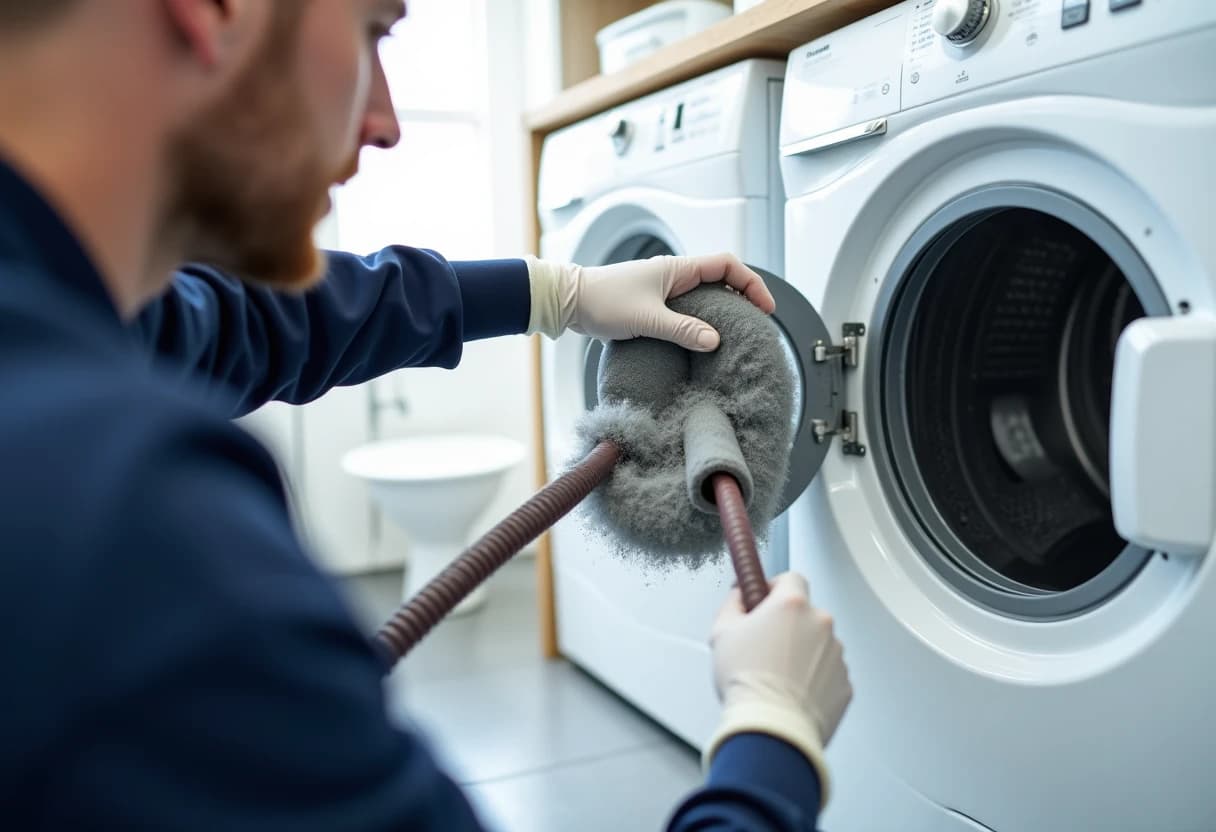
Homeowners in South End typically call us for dryer vent cleaning after one of three moments: a load that will not dry, a burning odor from the laundry area, or a repair technician who condemned the vent while servicing the dryer. All three trace to the same lint accumulation that builds silently for years. Our service removes it completely — rotary brush agitation through the full duct length, HEPA vacuum extraction, exterior hood cleaning, and a check of the transition duct behind the dryer where crushing and kinks hide. We are local, insured, and we quote flat pricing that covers the entire run, roof terminations included.
Why Dryer Vent Cleaning Matters for South End Homes
A restricted dryer vent quietly becomes one of the most expensive small problems in the house. When exhaust airflow drops, drying times stretch — a 45-minute load becomes 90 minutes, then two full cycles. Every extra minute burns electricity or gas, and a dryer running double cycles can add $10 to $20 a month to utility bills while wearing out its own components. Heating elements cycle harder against high-limit switches, thermal fuses blow, drum bearings and belts log twice the hours, and moisture-laden exhaust backs up into the machine and the laundry room. Appliance technicians will tell you a large share of 'broken dryer' service calls are actually blocked vents — and many charge you the visit fee to tell you so. Annual professional cleaning keeps airflow at design capacity, which means shorter cycles, lower bills, longer appliance life and clothes that suffer less heat damage. It is maintenance that shows a measurable return on the very next load of laundry.
From the multi-family blocks near Union Park to the single-families out toward SoWa Art + Design District, South End laundry setups share a common risk profile: dryers pushed far from exterior walls, vents extended during renovations, and terminations no one has looked at in years. The South End holds the largest intact Victorian rowhouse district in the country - block after block of 1850s-1880s bowfront brick rowhouses ringed around leafy garden squares, nearly all divided into condos, plus SoWa's former factory buildings converted to lofts. Five-story rowhouses split into three or four units mean stacked HVAC systems sharing tight rear chases, with condensers crowded onto roofs and decks. High-velocity mini-duct retrofits are everywhere here, threaded through original plaster and pocket-door partitions. That combination is how lint blockages build unnoticed. South End rowhouse condos share more than walls: dust, cooking odors and lint travel through the gaps and chases of buildings framed 150 years ago, so one unit's duct hygiene affects its neighbors. Landmark district rules push dryer vents and exhausts to rear alley elevations through long runs we're often asked to trace and clear. It's one of our busiest neighborhoods for brownstone duct work. Because our shop is in West Newton, about 10 miles away, we can usually offer South End same-week appointments — and because we clean from both the appliance side and the exterior hood, blockages at either end of the run are fully removed, not pushed deeper.
Our Dryer Vent Cleaning Process in South End
1Inspect the Dryer, Transition Duct & Vent Path
We start behind the dryer: pulling the machine, examining the transition duct for crushing, kinks or foil accordion material, and tracing the vent's full path from connection to exterior termination. Mapping the run tells us its length, elbow count and materials — and lets us confirm your flat price before any cleaning begins.
2Protect the Laundry Area & Disconnect the Dryer
The dryer comes away from the wall and off the duct so we can clean the whole line, not just what a stub brush reaches. This is also when hidden problems surface: lint packed behind the machine, transition hoses crushed flat by the dryer being pushed back too far, and disconnected joints quietly venting into the wall.
3Rotary Brush the Full Length of the Duct
Our core cleaning tool is a motor-driven rotary brush on flexible rods, fed through the entire duct run. The spinning brush head scrubs lint off the duct walls through every elbow and vertical section, in runs up to 35 feet and beyond. Unlike hand brushes, it maintains full scrubbing force at the far end of the line — where the worst accumulation usually hides.
4Capture Everything With HEPA Vacuum Extraction
Extraction runs continuously during brushing so debris moves in one controlled direction. On long or heavily blocked runs we alternate: brush a section, extract, advance. This staged approach clears even fully plugged ducts — the ones where the exterior damper has not opened in years — without compacting the blockage deeper.
5Clean From the Exterior Termination Inward
The exterior hood gets hands-on service: damper flap cleaned and checked for free movement, cage or screen cleared (or removal recommended — screens on dryer terminations trap lint and violate most codes), and the visible duct section brushed. A damper that cannot close invites drafts and pests; one that cannot open blocks the entire system.
6Service the Transition Duct & Reconnect
The short duct connecting dryer to wall does more harm than its length suggests — crushed, kinked or made of plastic, it can choke an otherwise clean system. We clean it, or if it is damaged or made of hazardous foil or vinyl accordion material, we recommend replacement with a semi-rigid aluminum connector, usually installed on the spot for a small parts charge.
7Verify Airflow & Walk You Through the Results
We run the dryer and inspect the termination together — you should see the damper flap standing open under confident airflow, something many homeowners have literally never observed on their own vent. Your technician reviews photos, flags any code or condition issues for future attention, and records your service date for an annual reminder.
Benefits of Professional Dryer Vent Cleaning in South End
Faster Drying Times
Airflow is what dries clothes; heat just helps. Restore full exhaust capacity and loads that limped through two cycles finish in one, towels stop coming out damp at the seams, and the dryer's moisture sensors — which many modern machines rely on — start reading accurately again. Most customers notice the difference on the first load after our visit.
Safer Operation for Gas Dryers
For gas dryers, vent cleaning is combustion safety, not just lint management. Backdrafting exhaust is odorless and invisible; the protection is a clear duct and a working CO detector. We verify complete, strong exhaust at the exterior termination on every gas dryer job — the confirmation that byproducts are leaving the house.
Longer Dryer Lifespan & Fewer Repairs
New dryers deserve clean vents from day one — manufacturers require adequate exhaust airflow for warranty coverage, and delivery crews almost never clean the existing duct. If you have recently replaced your dryer and skipped the vent, you have connected a new engine to a clogged tailpipe.
Documentation for Insurance, Condos & Peace of Mind
For landlords and multi-family owners, documented dryer vent service is due-diligence gold: it demonstrates fire-safety maintenance across units in a single record. We service whole buildings in one visit with per-unit documentation, which is why property managers across Greater Boston keep us on an annual rotation.
Less Moisture, Mildew & Musty Odor
Each load exhausts about a gallon of water as vapor. When the vent is blocked, that moisture backs into the laundry room and the duct itself — condensing on walls, peeling paint, and feeding mildew. A clear vent sends the humidity outside, drying out the laundry area and eliminating the damp, musty smell that clings to blocked systems.
Dramatically Reduced Fire Risk
After cleaning, your dryer's exhaust runs cool and free, its high-temperature safety switches stop cycling, and the duct holds no fuel load waiting for a spark. For households that run daily laundry — big families, home businesses, multi-generational homes — that risk reduction compounds with every load.
Signs Your South End Home Needs Dryer Vent Cleaning
Burning Smell During a Cycle
That 'hot lint' smell is exactly what it seems: fibers reaching their scorching point somewhere in the airflow path. Sometimes it is a sock against the element; usually it is accumulation. Either way, the difference between a smell and a fire can be one overloaded cycle. We prioritize these calls for same-week service.
Clothes Take More Than One Cycle to Dry
Modern sensor-dry machines mask the problem by simply running longer, so watch total time rather than dampness. A sensor cycle that used to finish in 45 minutes and now runs 75 is reporting a restricted vent the only way it can. Believe it before the thermal fuse makes the point more expensively.
Lint Building Up Behind or Inside the Dryer
Lint accumulating behind the machine, around the transition hose or under the dryer means the exhaust path is leaking or backing up — lint should travel out, not settle in. It is both a symptom of restriction and a hazard in itself, since this lint sits nearest the heat source. A cleaning addresses the cause and clears the accumulation.
Dryer or Clothes Are Hot to the Touch
A dryer cabinet too hot to rest a hand on, or clothes that come out scorching, means exhaust heat is not leaving the machine. That heat is being absorbed by the dryer's components — and by the lint in the duct. This is the pre-ignition condition fire investigators describe; treat it as urgent, not cosmetic.
Laundry Room Gets Hot and Humid
Watch for secondary evidence: peeling paint near the dryer, mildew spots on the ceiling above it, a musty smell that lingers after laundry day, rust on shelf brackets. All are condensation footprints from exhaust escaping into the room through a restricted or leaking duct rather than exiting the house.
The Exterior Vent Flap Barely Opens
Step outside during a drying cycle and look at the termination hood. The damper should stand fully open with a strong, warm airstream you can feel from a foot away. A flap that flutters weakly, opens halfway or stays shut is showing you the blockage directly — the cheapest diagnostic in home maintenance.
Dryer Vent Cleaning Cost in South End, MA
It helps to weigh the price against the alternatives. A $149 to $299 annual cleaning stands against: $10 to $20 a month in energy waste from a restricted vent; $150 to $400 appliance repair visits for blown thermal fuses and burned elements that blocked vents cause; $800 to $1,200 for the dryer replacement that chronic overheating hastens; and the uncapped cost of a lint fire, which averages five figures in property damage even when contained quickly. Insurance data and FEMA's fire statistics make dryer vent cleaning one of the highest-return maintenance dollars in the home. We keep the pricing flat and published because the service only works as prevention if people actually book it annually — surprise invoices are how homeowners talk themselves into skipping years, and skipped years are how blockages happen.
Want the full pricing picture? See our complete Boston-area cost guide or call (617) 390-7145 for an exact flat quote for your South End home.
Local Knowledge: South End, Suffolk County
What makes South End different? The South End holds the largest intact Victorian rowhouse district in the country - block after block of 1850s-1880s bowfront brick rowhouses ringed around leafy garden squares, nearly all divided into condos, plus SoWa's former factory buildings converted to lofts. Five-story rowhouses split into three or four units mean stacked HVAC systems sharing tight rear chases, with condensers crowded onto roofs and decks. High-velocity mini-duct retrofits are everywhere here, threaded through original plaster and pocket-door partitions. South End rowhouse condos share more than walls: dust, cooking odors and lint travel through the gaps and chases of buildings framed 150 years ago, so one unit's duct hygiene affects its neighbors. Landmark district rules push dryer vents and exhausts to rear alley elevations through long runs we're often asked to trace and clear. It's one of our busiest neighborhoods for brownstone duct work. For duct and dryer vent systems, those local factors translate into specific, predictable problems — and predictable problems are the ones we solve fastest. Call (617) 390-7145, tell us your street and home style, and we will quote the job accurately the first time, usually in under five minutes.
The Best Time of Year in South End
Think of the laundry calendar itself: spring brings pollen-heavy loads and washed winter bedding; summer adds beach towels and daily shirt changes through humid stretches; fall means sweaters, blankets and back-to-school volume; winter piles on the heaviest fabrics of the year while the vent works at its coldest. A Massachusetts dryer rarely gets an off-season — which is why the annual cleaning interval is a floor, not a ceiling, for busy households here. Families running daily loads, multi-family buildings with shared laundry patterns, and anyone drying pet bedding through shedding seasons should consider a six-to-nine-month schedule. We track your interval and remind you, so the vent stays ahead of the laundry rather than behind it.
Why Choose Boston Air Duct Cleaners
We built this company around the jobs other duct cleaners do badly: the 130-year-old Victorian with panned-joist returns, the South End condo with a 60-foot dryer run to the roof, the post-renovation house full of drywall dust. Our crews see Greater Boston's hardest systems every week, and the experience shows in the details — floor protection on the way in, sealed registers during the work, HEPA-vacuumed work areas on the way out, and imagery that proves the ducts are actually clean. Call (617) 390-7145 and judge the difference from the first conversation.
Serving South End and Surrounding Communities
We serve every community around South End as well: Back Bay, Roxbury, Boston, South Boston, Beacon Hill, Jamaica Plain all fall inside our regular service routes. If you have a second property, a rental, or family nearby, ask about multi-home scheduling — grouped appointments on the same route are our most requested discount.