
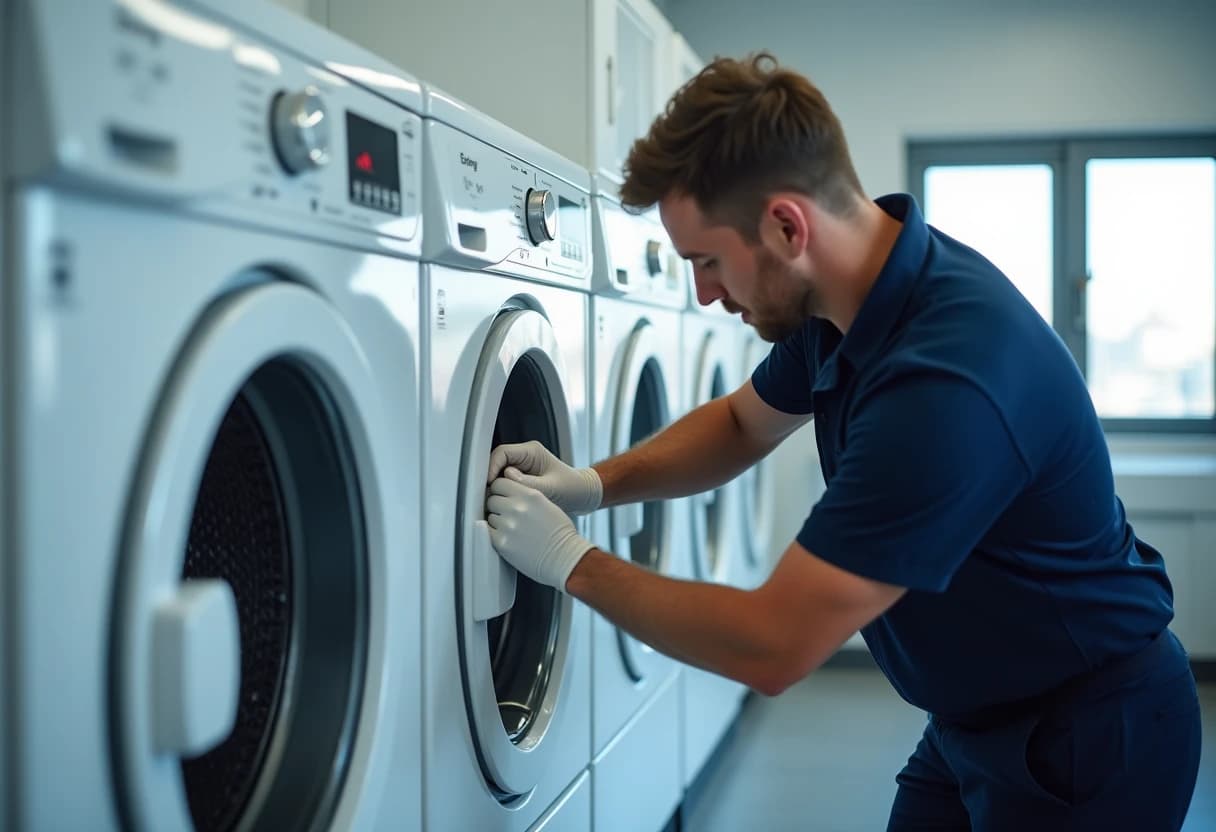
Every dryer in your building is a small fire waiting on maintenance. FEMA attributes roughly 2,900 clothes dryer fires a year in US homes to exactly the failure this service prevents — lint accumulation in vents and ducts, the leading ignition factor. For condo associations, HOAs, apartment owners and property managers in Canton, that risk multiplies by the unit count: dozens of dryers, dozens of vent runs, and in many buildings shared risers where one resident's lint becomes everyone's hazard. Our multi-unit dryer vent cleaning program handles the whole building in one coordinated visit — every unit's vent mechanically cleaned end to end, airflow verified, exceptions documented — and closes with a per-unit compliance report your board, manager and insurance carrier can file.
Why Commercial & Multi-Unit Dryer Vent Cleaning Matters for Canton Homes
Insurance is increasingly the driver that gets this work scheduled. Master-policy underwriters for condominium associations and apartment owners have tightened attention on dryer venting because the loss data justifies it: lint fires are frequent, preventable and well-documented. Renewal questionnaires now routinely ask when vents were last professionally cleaned; some carriers request the report itself, and after a claim, the absence of maintenance records becomes part of the story an adjuster writes. Massachusetts associations have an added legal dimension — boards carry a duty to maintain common elements, and in many governing documents the vent duct beyond the unit's wall is exactly that. A documented cleaning program is inexpensive armor: dated per-unit reports, condition exceptions logged and disclosed to owners, hazards like prohibited transition ducts flagged in writing, and a recurring schedule that demonstrates ongoing diligence rather than a one-time response. We format our reporting for precisely these audiences — boards, managers, carriers and counsel — because in multi-unit work the paperwork is not an accessory to the service. It is half the service.
Whether it is a triple-decker near Ponkapoag Pond, a mid-rise condominium off Canton Viaduct, or garden apartments elsewhere in Canton, the venting problems rhyme: lint-loaded runs, blocked or screened terminations, transition ducts that should have been replaced years ago. Canton mixes Victorian and early-1900s homes near Canton Center with large tracts of 1960s-1980s colonials and split-levels, plus a wave of newer townhouse and apartment construction around Canton Junction and the Route 138 corridor. The commuter-rail neighborhoods have seen heavy renovation, and many mid-century homes here run long basement trunk ducts that collect decades of debris. Homes bordering the Blue Hills Reservation and Ponkapoag Pond deal with heavy seasonal pollen and damp, wooded lots that keep basements humid - a combination that feeds mold in unlined ductwork. Canton's corporate parks off Royall Street also give us regular commercial duct and rooftop-unit work. As a local company based 16 miles away in West Newton, we have cleaned building-wide across Norfolk County for associations, HOAs and management portfolios — with volume pricing per unit, crews that respect residents' homes, and reporting standardized so multi-building managers can compare properties at a glance.
Our Commercial & Multi-Unit Dryer Vent Cleaning Process in Canton
1Building Walkthrough & Per-Unit Proposal
We scope before we quote: unit count and layout, vent configurations and lengths, termination locations and access (ladder, lift or roof), laundry room and common-area equipment, and any known problem units. Associations receive a fixed proposal with volume per-unit pricing, a project schedule with resident notice templates, and the reporting format agreed in advance so the board knows exactly what deliverable closes the project.
2Resident Coordination & Scheduling
Access is the hard part of multi-unit work, and we manage it for you. Our coordinator provides notice templates for management to distribute, builds a unit-by-unit schedule in efficient sequences, confirms time windows, and tracks completions and no-access units in real time. Buildings typically complete in one to three days, and residents are in their homes for minutes, not hours.
3Dryer-Side Service: Transition Duct & Connection
Each unit visit starts at the machine: lint screen housing vacuumed, dryer pulled and the fire-load of lint behind it removed, transition duct inspected against IRC M1502 requirements — smooth interior, proper material, no screws projecting into the airstream, no excessive length or crushing. Deficiencies are photographed for the unit's report line, and simple corrections are completed during the same visit with owner approval.
4Mechanical Cleaning of the Full Vent Run
The in-wall duct is cleaned end to end with rotary brush systems driven through the full run while a high-powered vacuum captures dislodged lint — the same agitation-plus-extraction principle as NADCA duct cleaning, sized for 4-inch dryer duct. Long runs and multiple elbows get repeat passes; the pass is complete when the brush returns clean and airflow verifies.
5Shared Risers, Common Trunks & Booster Fans
Common-element ducts get common-element treatment: documented condition before and after, cleaning with equipment sized for vertical and long-trunk work, and function checks on the mechanical components — booster fans, backdraft dampers, rooftop exhaust terminations — that keep a shared system moving air. For associations, this is the portion of the project that most clearly discharges the board's maintenance duty, and we document it accordingly.
6Termination Service & Exterior Verification
Exterior work is where multi-unit projects earn their price: terminations three stories up that no resident has ever seen, roof caps buried under winter ice damage, wall hoods behind shrubs. Each one is cleared of lint and debris, checked for damper function so it seals when idle and opens fully under flow, and photographed for the report. Damaged or non-compliant caps are flagged with replacement pricing.
7Airflow Verification & Building Compliance Report
Verification is what separates a maintenance program from a receipt. We confirm restored airflow run by run, re-photograph representative ducts against their before images, and compile the compliance report: every unit's status, every exception explained, every hazard located and pictured, every recommendation priced separately for board action. Associations on our annual program receive the same format each cycle, so year-over-year condition is genuinely comparable.
Benefits of Professional Commercial & Multi-Unit Dryer Vent Cleaning in Canton
Volume Pricing That Beats Unit-by-Unit Service
A single-home dryer vent cleaning in Greater Boston runs $150–$250; on a coordinated building project, per-unit pricing drops steeply — often to a fraction of retail — because mobilization, travel and setup are shared across dozens of units. The building gets professional service in every unit for less than residents could ever arrange individually.
Directly Reduced Fire Risk, Building-Wide
Fire prevention in shared-wall housing is collective by nature: one blocked vent endangers the neighbors, and no resident can clean the common risers. A coordinated cleaning is the only mechanism that actually resets the whole building's risk — every run, every riser, every termination verified clear on the same dated report.
Hazard Discovery Before It Costs You
Cleaning puts trained eyes and cameras into duct paths nobody has seen in years, and the discoveries matter: prohibited foil accordion transitions, disconnected runs dumping humid lint-laden air into wall cavities, vents terminating in attics or soffits, screens trapping lint at caps. Each is photographed, located and priced for correction — found on your schedule instead of an incident report's.
Longer Dryer Life & Fewer Appliance Failures
Thermal fuse failures, the classic 'dryer runs but no heat' complaint, are overwhelmingly a venting symptom — the fuse did its job against trapped heat. Buildings on an annual cleaning program see this entire complaint category shrink, which residents experience as reliable machines and managers experience as a quieter work-order queue.
Insurance & Liability Documentation That Holds Up
Documentation converts maintenance into protection. The same cleaning, undocumented, protects the building physically but leaves the association exposed on paper. Our reports close that gap: scope, method, dates, per-unit outcomes and photographic evidence, delivered in a format managers file once and retrieve in minutes when the renewal questionnaire arrives.
A Program, Not a Project
The real deliverable is the recurring cycle: annual (or duty-matched) cleanings calendared in advance, consistent per-unit pricing locked for program clients, the same report format every year so building condition trends are visible, and reminders that arrive before renewal questionnaires do. Boards approve it once; it protects the building indefinitely.
Signs Your Canton Home Needs Commercial & Multi-Unit Dryer Vent Cleaning
Burning Smells, Hot Laundry Areas or Tripped Thermal Fuses
Laundry rooms that run noticeably hot and humid indicate exhaust air staying in the building — restricted ducts, failed boosters or leaking joints. Beyond discomfort, that moisture feeds mold in shared spaces and the heat stresses every machine in the room. Both symptoms resolve when the common venting actually moves its design airflow.
Foil Accordion Ducts or Improvised Vent Runs in Units
If your association has never inspected what connects residents' dryers to the walls, assume nonconformance: transition duct is resident-installed, unregulated in practice, and frequently the worst link in the chain. Our unit visits document and correct these connections — the cheap fix that removes the most flammable segment of the entire vent path.
Lint Visible at Terminations or on the Building Exterior
Walk the building perimeter and look at every vent hood: visible lint at the flap, caps that no longer close, vegetation fuzzy with fibers below the outlet. These external tells are free inspection data, and they reliably indicate runs overdue for mechanical cleaning — plus terminations that need damper service while the crew is there.
High-Duty Operations: Laundromats & Common Laundry Rooms
Commercial duty cycles compress the maintenance calendar: a laundromat dryer produces in weeks the lint a household machine makes in a year, loading manifolded ducts continuously. If your store has never set a cleaning interval matched to throughput, the venting is overdue by definition — quarterly service is typical for busy operations.
Insurance Questionnaires or Post-Incident Requirements
Post-incident requirements are the hard version of the sign: a fire or near-miss anywhere in the building, an adjuster's inquiry, or a fire-department visit that noted lint at terminations. At that point documentation is being demanded rather than recommended. The same program that would have prevented the scrutiny now becomes its resolution — start it either way.
No One Can Say When Vents Were Last Cleaned
Buildings inherit their venting history blind: previous owners' renovations, decades of resident turnover, and zero records. FEMA's dryer-fire data — about 2,900 a year, led by failure to clean — describes exactly this population of never-serviced vents. A documented first cleaning moves your building out of that statistic's denominator.
Commercial & Multi-Unit Dryer Vent Cleaning Cost in Canton, MA
Why volume pricing works in the association's favor: the expensive parts of vent cleaning are mobilization and setup, and a building project pays for them once across dozens of units. Crews sequenced through an access schedule complete multiple units per hour, so a 24-unit building might complete in a day at a per-door price no resident could obtain individually. Complexity moves the number: buildings where every unit vents a short run to its own wall cap sit at the low end near $40–$60 per unit; mid-rises with stacked risers, roof terminations and long ceiling runs price toward $70–$90 plus itemized riser service; and buildings needing hazard remediation — foil transition replacements (typically $45–$85 per unit installed), termination cap replacements, disconnected-run repairs — receive those items priced separately for board approval, never folded silently into the cleaning invoice.
Want the full pricing picture? See our complete Boston-area cost guide or call (617) 390-7145 for an exact flat quote for your Canton home.
Local Knowledge: Canton, Norfolk County
What makes Canton different? Canton mixes Victorian and early-1900s homes near Canton Center with large tracts of 1960s-1980s colonials and split-levels, plus a wave of newer townhouse and apartment construction around Canton Junction and the Route 138 corridor. The commuter-rail neighborhoods have seen heavy renovation, and many mid-century homes here run long basement trunk ducts that collect decades of debris. Homes bordering the Blue Hills Reservation and Ponkapoag Pond deal with heavy seasonal pollen and damp, wooded lots that keep basements humid - a combination that feeds mold in unlined ductwork. Canton's corporate parks off Royall Street also give us regular commercial duct and rooftop-unit work. For duct and dryer vent systems, those local factors translate into specific, predictable problems — and predictable problems are the ones we solve fastest. Call (617) 390-7145, tell us your street and home style, and we will quote the job accurately the first time, usually in under five minutes.
The Best Time of Year in Canton
Winter is dryer-fire season in New England, and the mechanics are seasonal in every direction. Cold months mean heavier laundry — flannels, fleeces, blankets — that sheds more lint per load; closed-up buildings mean any exhaust leak or interior-terminating vent dumps moisture where it condenses; and frozen or lint-jammed termination flaps restrict airflow exactly when dryers work hardest. Fire departments nationally see dryer-fire incidence peak in winter, and Massachusetts buildings fit the pattern. Fall is therefore the smart season for building-wide cleaning: every run cleared and every damper verified before the heavy-laundry months, and the project completed while roof and ladder access is still comfortable. Associations that anchor their annual cycle to September and October get the protection when it matters most — and beat the scheduling rush.
Why Choose Boston Air Duct Cleaners
Homeowners across Norfolk County choose Boston Air Duct Cleaners for three reasons. First, honesty: our inspection camera tells you whether your system actually needs cleaning — and sometimes the answer is no. Second, capability: truck-grade negative-air machines, rotary brush systems and HEPA filtration handle everything from antique gravity-furnace conversions to brand-new high-velocity systems. Third, accountability: flat quoted pricing, before-and-after photos, insured technicians, and a real local office you can call at (617) 390-7145. That combination is rarer in this industry than it should be.
Serving Canton and Surrounding Communities
Beyond Canton, our crews cover the surrounding communities daily — including Stoughton, Sharon, Norwood, Westwood, Milton, Randolph. Because routes cluster geographically, booking alongside a neighboring appointment often unlocks same-day service and combined-visit savings. Wherever you are in Norfolk County, the same flat-rate pricing, insured technicians and photo-documented process applies.